Are TenPoint Crossbows Worth It for Deer Hunting Today?
TenPoint crossbows are worth it for hunters who will use the safety features, quiet cocking systems, and ready-to-hunt packages. If you only want the cheapest effective crossbow, the premium usually is not recovered. Buying the wrong bow costs more than cash: it can mean slower setups, more missed shots, and a carry package you outgrow fast. This guide breaks down who should buy TenPoint, where the value lands, and where cheaper models make better sense.
Verdict
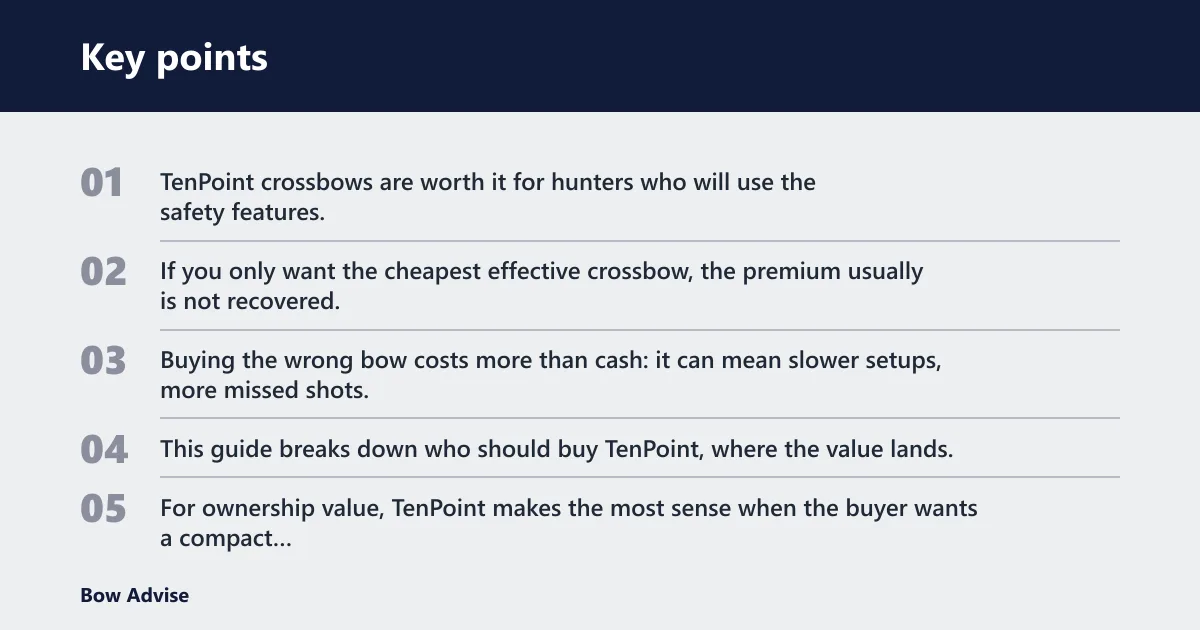

For ownership value, TenPoint makes the most sense when the buyer wants a compact hunting rig with less fuss at full draw, a better trigger, and fewer add-on purchases later. The premium is easier to justify on reverse-draw and de-cock models than on a basic front-end package. For budget-first buyers, Wicked Ridge usually delivers the better return.
📊 TenPoint crossbows are described as having ‘over 30 years of innovation.’. Source: Tenpoint Crossbows & Accessories.
Specs at a glance
| Category | TenPoint | Wicked Ridge |
|---|---|---|
| Brand position | Premium TenPoint family | Value-oriented TenPoint family |
| Speed range | Speeds up to 440 FPS | 400 FPS-class models |
| Platform style | Compact and full-size, including reverse-draw | More price-focused hunting packages |
| Cocking options | ACUdraw, ACUdraw Silent on select models | Rope cocking or crank on select models |
| De-cocking | Available on select models | Available on select models |
| Optics | Pro-View 400, RangeMaster Pro, some laser rangefinding scopes | Package optics vary by model |
| Typical use case | Blind, tree stand, premium ready-to-hunt setup | Lower-cost hunting setup with fewer extras |
Who it is for
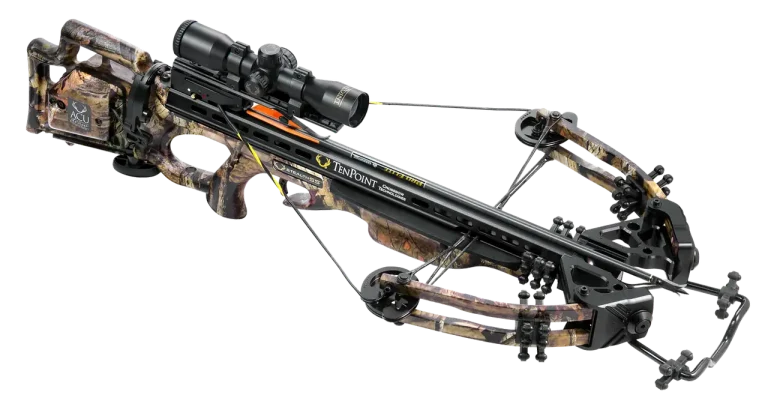
TenPoint is for hunters who value convenience as much as speed. It fits buyers who want a compact platform, a safer unloading method, and a package that needs fewer immediate upgrades after purchase. That is where the higher price starts to make sense.
It also fits hunters who shoot from tree stands or blinds, where a shorter front end and easier handling matter more than raw velocity. A model with ACUdraw Silent or de-cock capability can save time and reduce stress during setup and exit.
Suppose a hunter carries a crossbow through thick timber and hunts from a small blind with limited room to draw. A compact reverse-draw frame and crank cocking can matter more than a bargain sticker price. In that use case, the premium buys convenience and confidence, not just speed.
Buyer-fit matrix: TenPoint vs Wicked Ridge
| Buyer type | Model family | Setup complexity | Cocking method | Likely add-on costs | Premium justified? |
|---|---|---|---|---|---|
| Beginner hunter | Wicked Ridge entry model | Lower | Rope cocking or basic crank on select models | Bolt pack, lighted scope if not included | Usually no |
| Beginner who wants less strain | TenPoint Titan X De-Cock | Moderate | ACUdraw De-Cock | Extra bolts, range time, possible sling | Yes, if de-cock matters |
| Tree-stand hunter | TenPoint Turbo X or Venom X | Moderate | ACUdraw on select packages | Bolts, quiver, maybe upgraded scope | Often yes |
| Blind hunter in tight space | TenPoint reverse-draw platform | Moderate to higher | ACUdraw Silent on select models | Bolts and accessory tuning | Yes for compact handling |
| Budget buyer | Wicked Ridge value model | Lower | Rope cocking most likely | More likely to add cocking aid later | No |
| Feature-first buyer | TenPoint TRX Ultra / TX Ultra | Higher | Crank-based premium system | Higher-priced package, rangefinding optic on some trims | Only for buyers who will use everything |
What works about TenPoint crossbows?
The strongest TenPoint value is the package quality. The brand is positioned around over 30 years of innovation, speeds up to 440 FPS, and effective hunting ranges of 40-60 yards. That matters less as a brag line and more as a sign that these bows are built for a narrow hunting window with fewer compromises.
TenPoint also leans into features that reduce friction in the field. Twin-Riser Technology, ZERO-Trac Barrel, and the TriggerTech trigger are aimed at control and repeatability. For many hunters, the real gain is not a tiny speed bump; it is a better trigger break, cleaner rail interaction, and easier handling in a stand or blind.
Compact reverse-draw handling
Reverse-draw crossbows are one of the strongest reasons to buy up the TenPoint line. The platform keeps the frame compact while still chasing higher speed, which helps in blinds, in cluttered stands, and in spots where a long front end becomes annoying fast.
That compactness has a value argument. A bow that is easier to aim and move in confined spaces may reduce lost opportunities, especially when a deer stops quartering away and the window is brief. The premium lands on ergonomics, not just the advertised velocity.
Better cocking and de-cocking options
ACUdraw changes ownership more than many buyers expect. TenPoint says the system can reduce cocking effort to 5 pounds on select models, and ACUdraw Silent adds a quieter option on premium hunting rigs. That convenience matters for hunters who want repeatable draw tension without wrestling a rope every time.
De-cocking matters too. Being able to unload a crossbow without firing a bolt is a practical safety benefit and a real resale-value plus, because more buyers prefer a package that is easier to manage at the end of the hunt.
Scopes and package value
TenPoint packages often include optics that are part of the ownership math, not extras to ignore. Pro-View 400 and RangeMaster Pro scopes are aimed at hunting distances that match the brand’s typical 40-60 yard positioning. Some flagship packages also add a laser rangefinding scope option, which pushes cost up but reduces the number of separate purchases.
That package approach is where TenPoint can feel expensive at the register yet cheaper over time. If a buyer would otherwise add a crank, a better scope, and more bolts to a cheaper bow, the gap narrows quickly.
What does not work for every buyer?
The biggest drawback is price. TenPoint’s premium tier can be a hard sell if the buyer only wants a functional deer crossbow and does not care about advanced cocking systems or compact premium construction. The money spent on features can outpace the benefit for occasional hunters.
Complexity is the second drawback. Crank systems, de-cocking systems, and high-end optics can help a lot, but they also add more steps to learn and more parts to maintain. A hunter who wants a simple, low-cost setup may be better served by a less complicated package.
Say a hunter buys a flagship model, then still has to add bolts, a case, a sling, and a better sighting plan. The total bill climbs fast. At that point, a Wicked Ridge package or a lower TenPoint model may have been the cleaner buy.
Alternatives
TenPoint is not the only answer. The right alternative depends on whether the buyer wants lower cost, simpler ownership, or a feature set that still keeps the package under control. The most important comparison is not brand prestige; it is how much performance and convenience are actually needed.
TenPoint Titan X De-Cock is the most obvious value-leaning TenPoint choice for many hunters. At $799.99, it sits well below the flagship crowd while still pairing a lighted Pro-View 400 scope with ACUdraw De-Cock. The drawback is that it is still a premium package, so buyers who only want the lowest entry price may pay for features they will not use.

Barnett Wildcat Ultralite DC is a budget-minded alternative at $399.99. The lower price is the attraction, and the de-cock trigger plus included sight package make it easy to understand. The tradeoff is that it is not a TenPoint-family premium build, so buyers who care about advanced cocking systems and higher-end package finish may find the step down too large.

RAVIN R10 Pro XK7 is the middle ground for buyers who want a more premium feel without moving into TenPoint’s top tier. At $1,599.99, it sits between TenPoint’s entry and flagship pricing. The drawback is that package value depends heavily on whether the buyer wants Ravin’s setup style more than TenPoint’s de-cock and cocking convenience.
Should you buy TenPoint or stop at Wicked Ridge?
Buy TenPoint if you want a premium package, care about safer unloading, and expect to use a crank or silent-cocking system often. Stop at Wicked Ridge if you want a lower-cost hunting bow and do not need premium optics, de-cocking, or reverse-draw handling. That split is where the ownership value line usually falls.
For most beginners, Wicked Ridge is the better first stop unless the buyer is specifically worried about cocking effort or wants a de-cock system from day one. For experienced hunters, TenPoint becomes easier to justify once the package replaces several separate purchases and the compact frame fits a blind or stand better than a cheaper, longer build.
Choose TenPoint if…
- The buyer wants a compact hunting bow for tight stands or blinds.
- Crank cocking, silent cocking, or de-cocking will be used often.
- The package needs to feel ready out of the box, not after upgrades.
- The budget can absorb a premium price tier without stress.
Choose Wicked Ridge if…
- The main goal is a functional crossbow at a lower purchase price.
- The buyer is fine with rope cocking or a simpler crank setup.
- Feature load matters less than total cost.
- The hunter is newer and still learning what features matter most.
How much do the flagship models cost?
TenPoint’s flagship pricing is not subtle. Wyvern lists the TRX Ultra Crossbow with Laser Rangefinding Scope starting at $3,899.99, the TRX Ultra Crossbow starting at $3,199.99, the TX Ultra 26.5 Crossbow at $1,849.99 without the rangefinding scope, and the TX Ultra 29.5 Crossbow starting at $2,299.99.
That spread shows how much the scope and package tier can change ownership cost. The buyer is not only paying for speed or a premium name. The buyer is also paying for convenience, optics, and the kind of package that is meant to stay in the safe and go straight to the woods.
Which mid-tier models make sense?
TenPoint’s mid-tier and entry models are where more buyers should look first. Wyvern lists the Flatline 460R Crossbow Package at $1,674.95, the Stealth 450R at $1,374.95, the Turbo X Crossbow Package at $1,299.99, the Venom X Crossbow Package at $999.99, the Phantom De-Cock Crossbow Package at $999.99, and the Titan X De-Cock Crossbow Package at $799.99.
The practical read is simple. Turbo X, Venom X, Titan X, and Phantom De-Cock are the models where premium ownership can still make sense without jumping all the way to flagship money. They are also the trims where the buyer should pay close attention to what comes in the box, because package differences change value fast.
Are TenPoint crossbows worth the money?
TenPoint crossbows are worth the money for hunters who will use the premium features in real hunting conditions. The value case improves when a buyer wants safer cocking, easier unloading, better package optics, and a compact frame for blinds or tree stands. If those needs are absent, cheaper brands can make more sense.
The best way to judge value is to count the extras that would otherwise be added later. Bolts, a scope upgrade, a cocking aid, and a sling can narrow the gap quickly. When those items are already bundled, the premium starts to look more rational.
Are TenPoint crossbows good?
TenPoint crossbows are good for buyers who want a hunting-focused package with better handling and more built-in convenience than bare-bones alternatives. The brand’s speed claims, compact reverse-draw options, and trigger and rail features point to a design philosophy aimed at practical hunting use rather than sticker-price competition.
The caution is that good does not mean right for everyone. A hunter who does not need ACUdraw, de-cocking, or a premium optic will not get full value from the line, even if the bow itself is strong.
Who makes TenPoint crossbows?
TenPoint crossbows are made by TenPoint, an American crossbow brand described as having over 30 years of innovation. Archery Warehouse says TenPoint products are designed, built, and tested in the USA. That positioning matters because many buyers associate the brand with premium construction and hunting-specific feature sets.
The important part is not the slogan alone. It is how the company uses that position to price its packages, from value-leaning models to flagship reverse-draw bows with expensive optic options.
Which TenPoint crossbow is best for the money?
The best TenPoint crossbow for the money is usually the one that solves the buyer’s biggest pain point without overbuying. For many hunters, the Titan X De-Cock or Turbo X sits in the sweet spot, because the package includes meaningful convenience without jumping to flagship pricing.
Buyers who want more speed and a lighter carry setup may prefer the reverse-draw family, but the money question still comes down to use case. If the bow will be shot from a blind and stored carefully, lower-priced TenPoint packages often deliver the better return.
What makes TenPoint crossbows different from cheaper brands?
TenPoint is different mainly in the way it bundles features into a hunting package. ACUdraw, ACUdraw Silent, de-cocking systems, TriggerTech triggers, and higher-end optics can turn the bow into a more complete tool out of the box. Cheaper brands often ask the buyer to build that package piece by piece.
The tradeoff is obvious: more convenience, higher price. That is why Wicked Ridge exists inside the same family. It gives cost-sensitive buyers a lower entry point while keeping the broader TenPoint approach to hunting-oriented design.
How much do TenPoint crossbows cost?
TenPoint pricing runs from sub-$1,000 packages to flagship models that push well above $3,000. Wyvern lists the Titan X De-Cock Crossbow Package at $799.99, the Venom X and Phantom De-Cock at $999.99, the Turbo X at $1,299.99, the Stealth 450R at $1,374.95, the Flatline 460R at $1,674.95, and the TRX Ultra line above $3,000.
The real total can be higher once bolts, cases, and any extra accessories are added. That is why total ownership cost matters more than the base tag alone.
Do TenPoint crossbows come with cocking systems?
Many TenPoint crossbows come with cocking systems, but not every model uses the same one. ACUdraw appears on select models, ACUdraw Silent is used on select reverse-draw hunting bows, and de-cocking systems are available on select TenPoint and Wicked Ridge models. The buyer should check the exact package, not just the family name.
This matters because cocking convenience changes how often the bow gets used and how pleasant it is to handle. A bow that is easier to cock gets shot more often and is less likely to be left in the case.
Which TenPoint model is best for a beginner hunter?
For a beginner hunter, the safest TenPoint choice is usually a lower-priced, de-cock capable model like the Titan X De-Cock. It gives the new buyer a simpler way to unload, a package scope, and a manageable price compared with flagship reverse-draw options. That lowers the cost of mistakes.
If the beginner’s budget is tight and the goal is to learn basics first, Wicked Ridge may be the better fit. New hunters do not always need premium features on day one.