What A Archery Competition Yerds: Ultimate, Best Answers
Archery competition distances, often searched as “yerds,” vary by event. For Olympic recurve, the standard is 70 meters (76.6 yards). Indoor competitions are typically 18 meters (20 yards). Field and 3D archery use a wide range of marked and unmarked distances, from 10 to 80 yards, depending on the target and archer’s class.
Have you ever watched archery and wondered, “How far are they shooting?” It’s a great question! Knowing the distance, or yardage, is key to understanding the sport. Many newcomers search for “what a archery competition yerds,” and if that’s you, you’re in the right place. It can seem confusing at first, with so many different numbers mentioned.
But don’t worry, it’s much simpler than it looks. Whether you’re watching the Olympics or thinking about trying a local tournament, I’m here to break it all down for you. We’ll walk through the most common distances in different types of archery, step-by-step. By the end, you’ll understand exactly how far archers shoot and why.
First, Let’s Talk About “Yerds” vs. “Yards”

Before we dive in, let’s clear up a small detail. You might see or type “yerds” when looking for information, which is a common typo. The correct term is “yards.” It’s an easy mistake to make, and the important thing is that you’re asking the right questions to learn more about this amazing sport! Throughout this guide, we will use the term “yards” to keep things clear.
Why Do Archery Competition Distances Vary So Much?
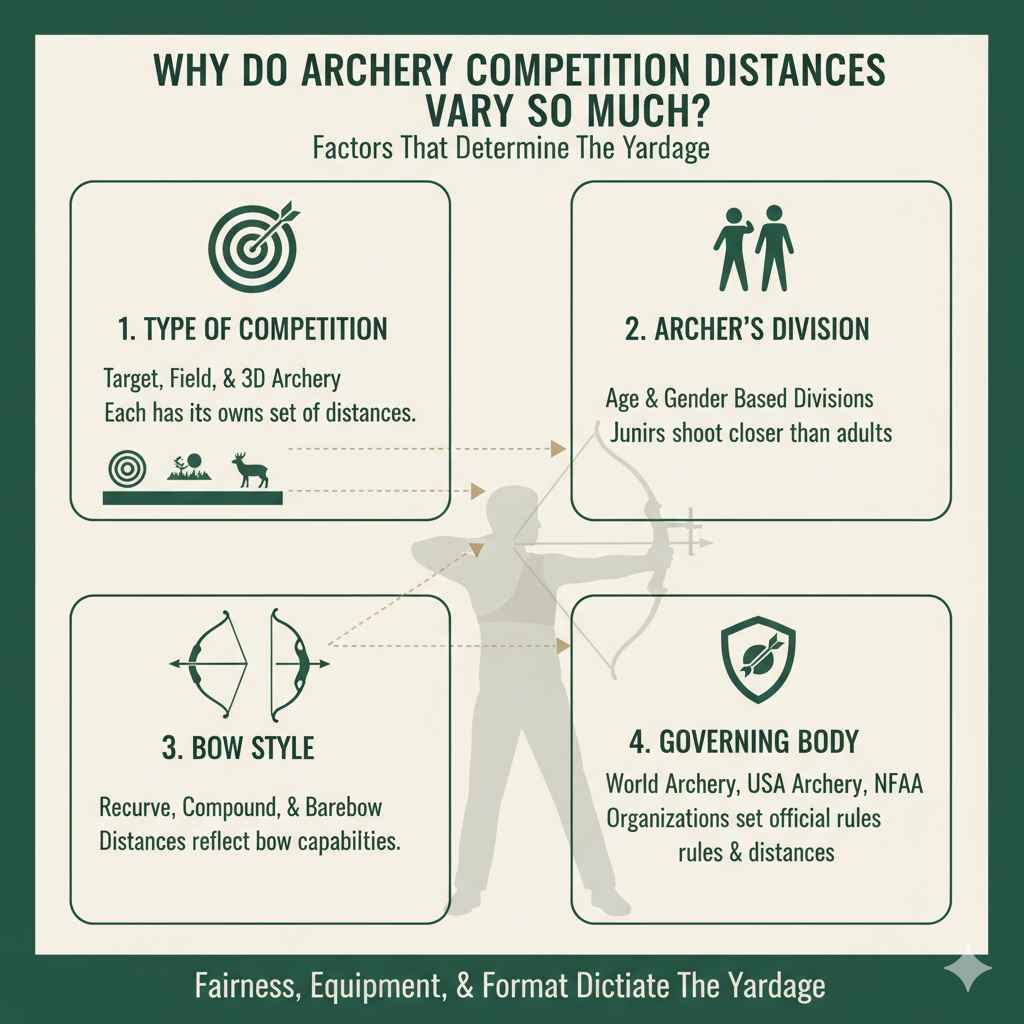
One of the first things you’ll notice is that there isn’t just one single distance for all archery. The yardage an archer shoots from depends on several key factors. Understanding these helps make sense of it all.
- Type of Competition: A quiet indoor range has different rules than a rugged outdoor course. The main types are Target, Field, and 3D archery, and each has its own set of distances.
- Archer’s Division: Competitions are broken down into divisions based on age and gender to keep things fair. A junior archer will shoot from a closer distance than an adult competitor.
- Bow Style: The type of bow you use also plays a big role. An Olympic recurve bow, a modern compound bow, and a traditional barebow all have different capabilities, and the distances reflect that.
- Governing Body: Organizations like World Archery, USA Archery, or the National Field Archery Association (NFAA) set the official rules and distances for their events.
A Deep Dive into Target Archery Distances
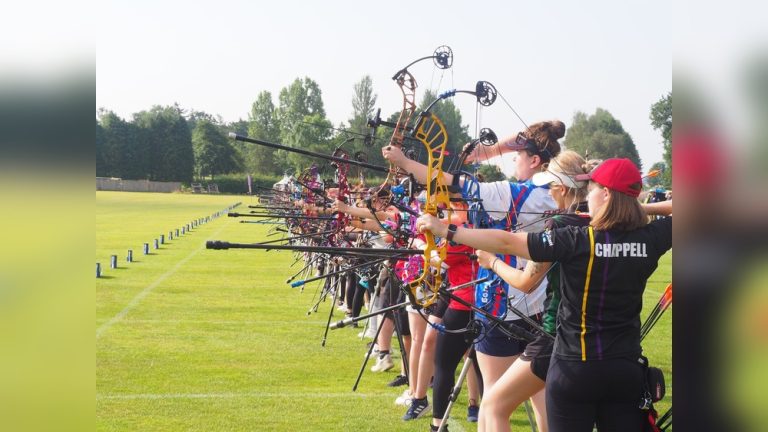
Target archery is likely what you picture when you think of archery competitions. Archers stand in a straight line and shoot at the familiar round, multi-colored targets. This discipline is all about precision and consistency. The distances are always known and are strictly regulated.
Olympic Recurve: The Gold Standard
The most famous archery event in the world is the Olympic Games. In Olympic archery, all competitors, both men and women, shoot from a single, challenging distance.
- Distance: 70 meters (which is about 76.6 yards).
- Target Size: The target face is 122 centimeters (about 48 inches) in diameter.
Shooting accurately from over 76 yards is an incredible display of skill. The 10-ring, the tiny circle in the very center, is only 12.2 centimeters (4.8 inches) wide—about the size of a CD! This is the ultimate test for recurve archers and a distance many archers aspire to master.
Indoor Target Archery Distances
When the weather turns cold, archery moves indoors. Indoor archery is a great way for beginners to start because the environment is controlled, with no wind or rain to worry about. The distances are much shorter, allowing archers to focus purely on their form.
- Most Common Distance: 18 meters (about 20 yards). This is the standard for most official indoor competitions worldwide.
- Other Common Distance: 25 meters (about 27 yards).
Because the distance is shorter, the target faces are also smaller to keep it challenging. At 18 meters, archers often shoot at a “3-spot” target, which has three small target faces on one sheet. This prevents them from damaging their arrows by hitting them too close together.
Outdoor Target Archery (World Archery Rounds)
Outside of the Olympics, outdoor target archery competitions involve shooting from multiple distances. These events, often called “rounds,” test an archer’s ability to adjust their aim for different yardages. The specific distances vary depending on the round and the archer’s division.
Here is a table showing some common distances you might see in a World Archery outdoor event. Note that distances are often set in meters and converted to yards for reference.
| Division | Bow Type | Distances Shot (Meters) | Distances Shot (Yards, Approx.) |
|---|---|---|---|
| Senior Men | Recurve | 90, 70, 50, 30 | 98, 77, 55, 33 |
| Senior Women | Recurve | 70, 60, 50, 30 | 77, 66, 55, 33 |
| Senior Men | Compound | 50 (on an 80cm face) | 55 |
| Senior Women | Compound | 50 (on an 80cm face) | 55 |
As you can see, it changes quite a bit! This variety is what makes outdoor target archery so engaging.
Exploring Field Archery: The Hiker’s Competition
If you love being outdoors and enjoy a good walk, field archery might be for you. Think of it as a mix between hiking and archery. Instead of standing on a flat field, you walk a course through woods or hills, shooting at targets from different stations.
The beauty of field archery is that it challenges you with uphill, downhill, and sidehill shots. The distances also vary from target to target, testing your versatility.
Marked vs. Unmarked Distances
Field archery has two main formats:
- Marked Rounds: At each shooting station, a post or marker tells you the exact distance to the target. Your job is to set your sight correctly and make a good shot.
- Unmarked Rounds: This is the real challenge! The distance to the target is unknown. You must use your experience to estimate the yardage before you shoot. This skill, called “range estimation,” is a huge part of the game.
Typical Field Archery Distances
Distances in field archery can range anywhere from 10 yards all the way up to 80 yards. The National Field Archery Association (NFAA) in the US has a system where different colored stakes mark the shooting spots for different divisions.
- Adults: Might shoot from the white stake, with distances up to 80 yards.
- Youth and Bowhunter Classes: Might shoot from the red stake, with shorter maximum distances.
- Cubs (young children): Shoot from even closer stakes.
This format ensures everyone can participate and be challenged at an appropriate level.
The Thrill of 3D Archery: Simulating the Hunt
3D archery is one of the fastest-growing forms of the sport. Instead of paper targets, archers shoot at life-sized foam models of animals. The courses are laid out in natural settings, similar to field archery, to simulate a hunting scenario.
How 3D Archery Distances Work
Almost all 3D archery competitions use unmarked distances. When you walk up to a shooting peg, you’ll see a foam deer or bear in the distance, but you won’t be told how far away it is. You have to judge the distance yourself, which is a major part of the fun and challenge.
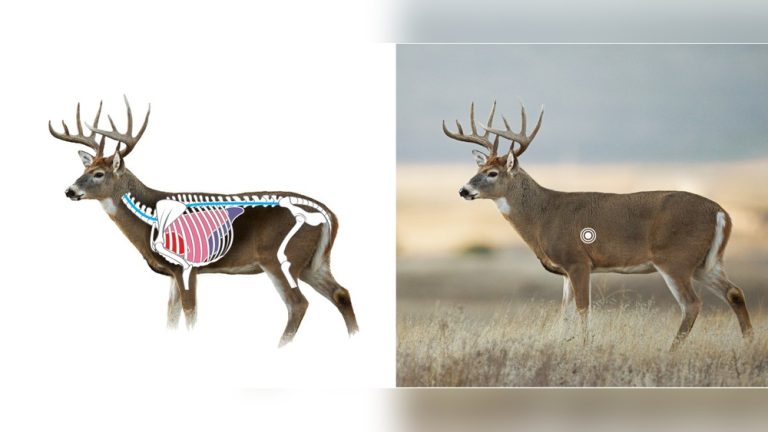
Scoring is also different. Instead of rings, the foam animals have scoring areas marked on them that mimic an animal’s vital organs. A shot in the “heart/lung” area scores the highest.
Common 3D Archery Yardages by Class
The maximum shooting distance in 3D archery is determined by your class or division. This is based on your equipment and skill level. A professional archer with a high-tech compound bow will have a longer maximum distance than someone shooting a simple traditional bow.
Here’s a table with some example maximum distances from organizations like the Archery Shooters Association (ASA).
| Competition Class (Example) | Typical Maximum Distance | Who It’s For |
|---|---|---|
| Pro/Known Pro | 50 yards | Professional archers |
| Open Classes | 40-50 yards | Advanced amateur archers with high-end gear |
| Hunter Class | 30-40 yards | Archers with more basic hunting-style equipment |
| Youth/Beginner | 20-30 yards | Younger archers and newcomers |
| Traditional/Barebow | 25-30 yards | Archers shooting without sights |
These distances ensure that every shot is a reasonable challenge for the equipment being used.
How to Prepare for Competition Distances: A Beginner’s Plan
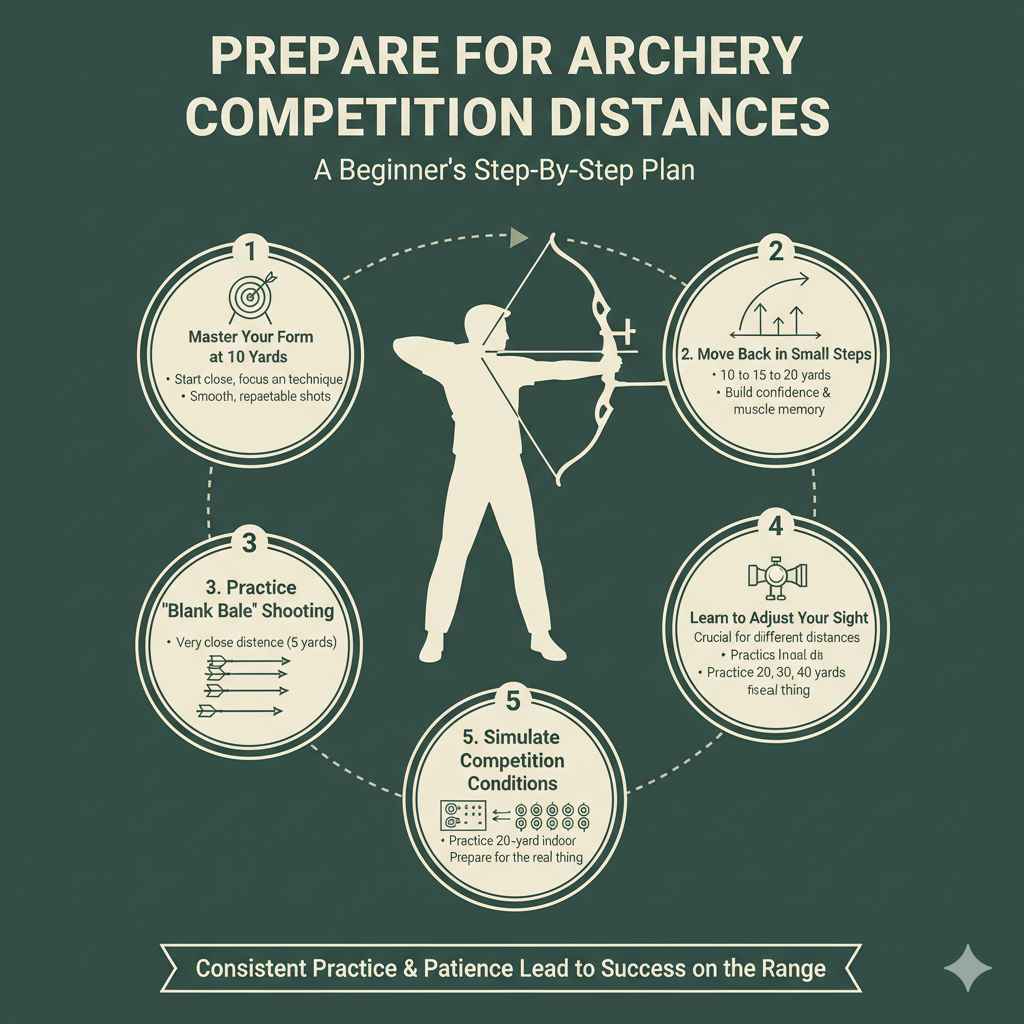
Feeling inspired to try a competition? That’s fantastic! But you don’t need to start at 70 meters. The key to success in archery is building a strong foundation. Here’s a simple plan to help you work your way up to longer distances.
- Master Your Form at 10 Yards: Start close. At 10 yards, you can focus entirely on your shooting technique without worrying about missing the target. Your only goal is to make every shot feel smooth and repeatable.
- Move Back in Small Steps: Once you can consistently group your arrows in the center at 10 yards, move back to 15 yards. When you’re comfortable there, try 20 yards. This slow and steady progression builds confidence and muscle memory.
- Practice “Blank Bale” Shooting: This means shooting at a target with no face on it from a very close distance (maybe 5 yards). The goal isn’t to aim, but to feel your form. It’s one of the best ways to build a consistent shot process.
- Learn to Adjust Your Sight: If you use a sight, learning how to adjust it for different distances is crucial. Practice “sighting in” at various yardages (20, 30, 40 yards) so you know exactly where to set it.
- Simulate Competition Conditions: Once you feel ready, try shooting a practice round. Set up a target at the official distance for a beginner indoor competition (20 yards) and see how you score. It’s a great way to prepare for the real thing.
Frequently Asked Questions (FAQ)
What is the standard archery distance?
There isn’t one single standard. For Olympic recurve archery, it’s 70 meters (76.6 yards). For indoor competitions, the most common standard is 18 meters (20 yards). Other disciplines like field and 3D archery have a wide variety of distances.
How far do beginners shoot in archery?
Most beginners start shooting at very close distances, typically between 5 and 10 yards. This helps them learn proper form and safety without worrying about accuracy. A great starting distance for your first competition is 18 meters (20 yards) in an indoor event.
What is the farthest an arrow can be shot?
This is called “flight archery,” a special discipline focused on pure distance. Using specialized bows and arrows, flight archers can shoot an arrow over 1,200 yards—that’s more than half a mile! However, this is very different from target archery, where accuracy is the goal.
Do kids shoot the same distance as adults?
No, children and youth archers shoot from much shorter distances. Competition organizers set specific, shorter yardages for different age groups to ensure the sport is safe, fun, and fair for them.
How do you measure distance in archery without a rangefinder?
In unmarked 3D and field archery, this is called “range estimation.” Archers learn to judge distance by comparing the size of the target to things they know, like the size of their sight pin or a gap between their fingers at arm’s length. It’s a skill that takes a lot of practice!
Is 30 yards a good distance for archery?
Yes, 30 yards is a very respectable distance for both beginners and experienced archers. It’s a common distance in many competitions and is a great goal for new archers working on extending their range. Being accurate at 30 yards shows you have a solid foundation.
Why is Olympic archery always 70 meters?
The 70-meter distance was standardized to create a significant challenge that truly tests the world’s best archers. At this range, factors like wind and tiny variations in form have a huge impact on the arrow’s flight, separating the good archers from the great ones.
Your Next Steps on the Archery Journey
As you can see, the world of archery competition “yerds,” or yards, is diverse and exciting! From the intense precision of 70-meter Olympic shooting to the adventurous challenge of an unmarked 3D course, there is a discipline and distance for everyone.
The most important thing to remember is not to be intimidated by the long distances. Every expert archer started at the beginning, standing just a few yards from the target. Focus on building good habits, practice consistently, and most importantly, have fun with it.
If you’re interested in competing, I highly recommend visiting a local archery club. You’ll find experienced coaches and friendly archers who can help you get started on the right foot. Now that you understand the distances, you’re one step closer to hitting your own archery goals. Happy shooting!