Olympic Archery Distance: How Far Is the Target? (70m)
Olympic archery targets sit at a standard 70 meters (about 76.6 yards) from the archer — recurve is the only bow style used at the Olympics, so this distance never changes across events. Miss the depth perception at that range and even a small aiming error costs the gold ring entirely. This guide breaks down the exact distance, target size, and why it is set where it is.
The Official Olympic Archery Distance: A Closer Look
When you tune into the Olympic Games and see the archery competition, the archers aren’t just aiming at any old distance. There’s a specific, carefully chosen measurement that forms the heart of the sport. This single, standardized distance is what separates the casual hobbyist from the elite Olympian, demanding a level of focus and technical mastery that is truly awe-inspiring. So, let’s get straight to the point.
The Magic Number: 70 Meters
The official distance for Olympic archery is consistently 70 meters. This is the standard for both the individual and team Olympic archery events. If you’re thinking in yards, that’s about 76.6 yards. This distance has been the standard for quite some time, ensuring a level playing field for all competitors regardless of where the Games are held.
Why 70 meters? It’s a distance that strikes a balance. It’s far enough to demand significant skill in compensating for gravity and wind, but not so far that the sport becomes purely about guesswork or luck. It allows for the precision of the shot to be the deciding factor, rather than just raw power or extreme trajectory adjustments. This distance emphasizes consistent form, mental fortitude, and the ability to adapt to varying conditions on the day.
A Brief History of the Olympic Distance
The distance has evolved over the history of the sport. In the early Olympics, archery distances varied quite a bit. For instance, in the 1972 Munich Olympics, the distance was 70 meters. Before that, it was different. However, the 70-meter standard was firmly established and has remained ever since, recognized by the World Archery Federation (more on them later!) as the official competition distance for major events like the Olympics and World Championships.
This standardization is crucial. It means that archers train for years, honing their skills to perform at this exact distance. They learn precisely how their arrows will fly, how much they’ll drop due to gravity, and how wind will affect their shot at 70 meters. It creates a consistent benchmark for excellence.

Understanding the Target Face
So, we know the distance is 70 meters, but what are they actually aiming at? The target face itself is a fascinating part of Olympic archery. It’s a circular target with scoring zones, and the size of the target face also plays a role in the challenge.
Target Size at 70 Meters
At the official Olympic distance of 70 meters, the target face has a diameter of 122 centimeters. This is often referred to as a “122 target face.”
To give you some perspective, 122 centimeters is just under 4 feet in diameter. That might sound quite large, but remember, the archer is standing 70 meters away! To put that into relatable terms, imagine trying to hit a dinner plate from the length of a football field. It’s a significant challenge!
Scoring Zones on the Target
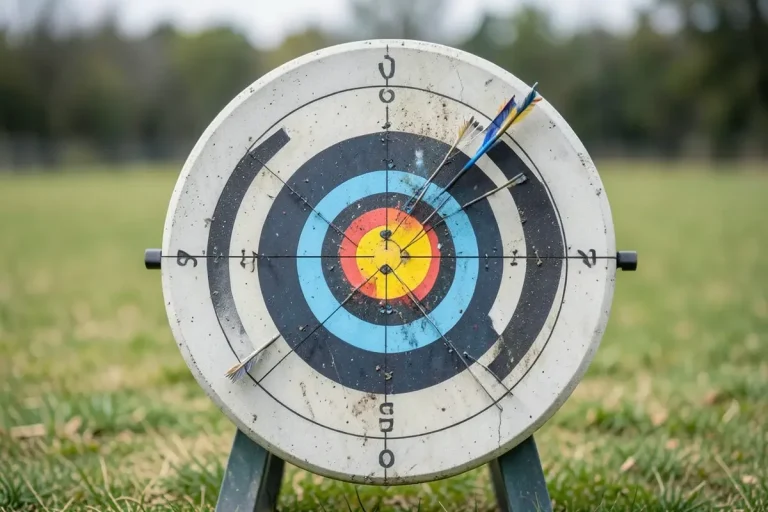
The 122 cm target face is divided into ten concentric rings, representing different scores. The center ring, the bullseye, is worth 10 points. As you move outwards, the scores decrease. Here’s a quick breakdown:
- Innermost ring (X): 10 points (also used as a tie-breaker, nearest the absolute center)
- Next ring: 10 points
- Next ring: 9 points
- Next ring: 8 points
- And so on, down to the outermost ring: 1 point
The most valuable scoring rings are quite small when viewed from 70 meters. The 10-point ring, for example, is only 12.2 centimeters (about 4.8 inches) in diameter. This is where the archer’s precision really needs to shine.
Why This Distance? The Science and Skill Involved
The choice of 70 meters isn’t arbitrary. It’s a carefully calculated distance that highlights specific aspects of archery skill and requires archers to master several key elements of shooting.
Gravity and Trajectory
At 70 meters, gravity has a noticeable effect on the arrow’s flight path. An archer cannot simply aim straight at the target. They must aim slightly above the target to account for the arrow “dropping” as it travels through the air. This is called the arrow’s trajectory or its “drop.”
The amount of drop depends on several factors:
- Arrow Speed: Faster arrows drop less than slower arrows.
- Arrow Weight: Lighter arrows might fly flatter initially but can be more affected by wind.
- Bow Draw Weight: A higher draw weight generally results in a faster arrow speed.
- Archer’s Release: A clean release ensures the arrow flies true without erratic movement.
Olympic archers spend countless hours practicing to understand and compensate for this drop with their specific equipment. They achieve this by adjusting their “sight picture” – where they aim their sight’s pin on the target. This adjustment is subtle and precise, often measured in millimeters at the archer’s eye level.
Wind: The Unpredictable Factor
Wind is perhaps the biggest challenge in outdoor archery. Even a slight breeze can push an arrow off course, especially over a distance of 70 meters. Archers must learn to read the wind, feel its direction and strength, and make micro-adjustments to their aim not just vertically, but also horizontally (left or right).
This is where experience and intuition come into play. An archer might stand on the shooting line and feel the wind. They’ll then look at the flags (if present) and observe how the wind affects leaves on trees or dust on the ground. They also pay close attention to how the arrow flies from their bow – does it tend to drift left or right?
The World Archery Federation provides specific rules and guidelines for competition, including how wind aids are handled. For instance, you can’t get help from wind machines, but you can use wind flags placed along the field to gauge conditions. You can learn more about their rules and regulations on the official World Archery website.
Equipment and Consistency
At 70 meters, even tiny inconsistencies in equipment or technique can lead to missed points. This is why Olympic archers use highly specialized, incredibly precise equipment. Their bows are tuned to perfection, their arrows are matched for weight and stiffness, and their sights feature micro-adjustable pins.
Consistency is the name of the game. An archer needs to be able to draw their bow, aim, and release the arrow in exactly the same way, shot after shot, even under immense pressure.
Olympic Archery Formats and Distances
While 70 meters is the iconic distance, it’s good to know that archery competitions can sometimes feature other distances or formats. However, for the main Olympic events, 70 meters is the standard.
Olympic Recurve vs. Compound
At the Olympics, the primary archery discipline is Olympic Recurve. This is the style you’ll see in the main medal matches. It’s characterized by the traditional recurve bow (without magnifying sights or arrow rests that are mechanically attached to the bow). The 70-meter distance applies to Olympic Recurve competitions.
There is also Compound Archery, which uses bows with cams or wheels. These bows are faster and shoot arrows with a flatter trajectory, making them inherently easier to shoot accurately at longer distances than recurve bows. However, Compound Archery is not currently an Olympic medal sport, though it is featured in other major international events like the World Archery Championships and the World Games.
Other Archery Distances
Beyond the Olympics, archery competitions can feature a range of distances. For example, in outdoor target archery, you might see distances ranging from 30 meters all the way up to 90 meters for men and 70 meters for women in some championship events, and even longer for specialist disciplines. However, for beginners and those focused on the Olympic dream, mastering the challenges of 70 meters is the ultimate goal.
A Table of Distances for Context
To help visualize how the 70-meter Olympic distance fits into the broader world of archery, here’s a table showing common distances used in different archery disciplines. This can give you a feel for the scope of the sport and where Olympic archery sits.
| Discipline | Common Competition Distance(s) | Notes |
|---|---|---|
| Olympic Recurve (Outdoor) | 70 meters (for major championships like the Olympics and World Championships) | This is the standard Olympic distance. Archery rounds often include shorter distances as well (e.g., 50m, 30m) for different phases of competition or for younger divisions. |
| Compound (Outdoor) | 50 meters (for major championships like the World Archery Championships) | Compound bows are more forgiving at longer distances, so 50m is challenging but manageable for top-level competition. |
| Field Archery | Ranges from 10 to 80 yards (approx. 9 to 73 meters) | Archers shoot at targets often placed on uneven terrain, varying distances, and in natural environments. Distances can vary per target. |
| 3D Archery | Varies widely, often up to 70 yards (approx. 64 meters or more) | Archers shoot at life-sized animal targets made of foam. Distances are often marked but can sometimes be judged. |
| Indoor Archery | 18 meters (common for World Archery indoor championships) and 25 meters | Shorter distances due to space limitations, often used in winter months. Target faces are typically smaller than outdoor targets. |
Tips for Beginners: Understanding Distance and Practice
As a beginner, the idea of 70 meters might feel overwhelming. That’s perfectly normal! The key is to start closer and build up gradually. Here’s how to approach it:
Start Close, Build Confidence
When you first pick up a bow, don’t worry about 70 meters. Begin at a much shorter distance.
- 10-15 meters (approx. 11-16 yards): This is a great range to learn the fundamentals of your stance, grip, aim, and release without the added frustration of a long distance. You can focus on making every shot feel the same.
- 20-30 meters (approx. 22-33 yards): Once you’re consistently hitting the target at closer ranges, start extending your distance. This is where you’ll begin to feel the arrow’s trajectory and the slight challenge of wind if you’re shooting outdoors.
- 40-50 meters (approx. 44-55 yards): As your accuracy improves, you can gradually increase the distance. At this range, you’ll really start to notice the drop and how small aiming adjustments can make a big difference.
Focus on Form, Not Just Distance
It’s more important to shoot accurately at a shorter distance with good form than to be wildly inaccurate at a longer distance. Your goal should be to develop a repeatable shot process. This means:
- Maintaining a stable stance.
- Consistent draw length and anchor point.
- A clean, surprise release.
- Follow-through after the shot.
These fundamentals are the bedrock of accuracy, no matter the distance. You can find excellent resources for beginner archery techniques through organizations like the USA Archery website, which offers training programs and safety advice.
Best Beginner Recurve Sight Pick
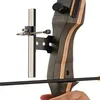
TOPARCHERY Recurve Bow Sight, Single Pin
A simple single-pin metal sight matching this guide’s own advice: a basic recurve bow with an adjustable sight is perfect for beginners.
- Best for: new archers learning to compensate for arrow drop at longer distances
- Why we picked it: simple single-pin design, no complexity to slow down learning fundamentals
- Main drawback: single pin means re-adjusting for every distance change
Compare more recurve sight options
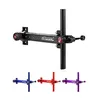 Option 1 SOOHUPET 6-Inch Recurve Bow Sight
|  Option 2 Single Pin Aluminum T-Shaped Recurve Bow Sight
|  Option 3 Recurve Bow Scope Sight with Fiber Optic Pin
|
As an Amazon Associate we earn from qualifying purchases.
Equipment Considerations
For beginners, a simpler setup is usually best. A basic recurve bow with an adjustable sight is perfect. As you progress, you might consider finer adjustments to your equipment, but don’t get caught up in having the most expensive gear right away. Your skill development is far more important.
Remember, the journey to shooting like an Olympian is a marathon, not a sprint. Enjoy the process, celebrate small victories, and trust your practice!

Frequently Asked Questions (FAQ) About Olympic Archery Distance
Q1: What is the standard distance for Olympic archery?
The standard distance for Olympic archery events (specifically, the individual and team recurve disciplines) is 70 meters. For those who prefer imperial measurements, this is approximately 76.6 yards.
Q2: How big is an Olympic archery target at 70 meters?
At 70 meters, the target face has a diameter of 122 centimeters (approximately 48 inches or just under 4 feet). The scoring rings are concentric, with the innermost gold ring (10 and X) being much smaller and significantly harder to hit.
Q3: Why is 70 meters the chosen distance for the Olympics?
The 70-meter distance is chosen because it provides a significant challenge that tests an archer’s precision, consistency, and ability to compensate for factors like gravity and wind, without being so extreme that it becomes dominated by luck rather than skill.
Q4: Do archers shoot at different distances during an Olympic competition?
While 70 meters is the primary competition distance for the main elimination rounds and medal matches of Olympic Recurve, the qualification round, known as the Ranking Round, also takes place at 70 meters. However, other archery disciplines or training often involve a wider range of distances.
Q5: Is the distance the same for men and women in the Olympics?
Yes, the 70-meter distance is the standard for both male and female archers competing in the Olympic Recurve events. This ensures a uniform challenge for all athletes.
Q6: How do archers aim at such a long distance?
Olympic archers use specialized recurve bows equipped with sights. These sights have adjustable pins, allowing archers to finely tune their aim point. They compensate for arrow drop by aiming slightly higher than the target and for wind by aiming left or right of the target. This requires extensive practice to calibrate their sight settings based on their equipment and environmental conditions.
Q7: Can beginners start practicing at 70 meters?
It’s not recommended for absolute beginners to start at 70 meters. It’s best to begin at much shorter distances, like 10-20 meters, to learn proper form, stance, and release. As your skills develop and your accuracy improves, you can gradually increase the distance, eventually working your way up to 70 meters if that’s your goal.
Conclusion: The Heart of the Challenge
So, there you have it! The definitive answer is that the Olympic archery target stands a challenging 70 meters (approximately 76.6 yards) away from the archer. This distance is not just a number; it’s the heart of the Olympic archery challenge. It’s a distance that demands exceptional skill, unwavering focus, and an almost intimate understanding of physics – how gravity pulls an arrow down and how the wind can steer it astray.
For those new to archery, it’s a fantastic benchmark to understand when you watch the Games. For those looking to pick up a bow, remember to start close, build your technique brick by brick, and enjoy the journey. The path to mastering archery, whether at 70 meters or a comfortable backyard distance, is paved with practice, patience, and a whole lot of fun. Keep shooting, keep learning, and you’ll be amazed at what you can achieve!