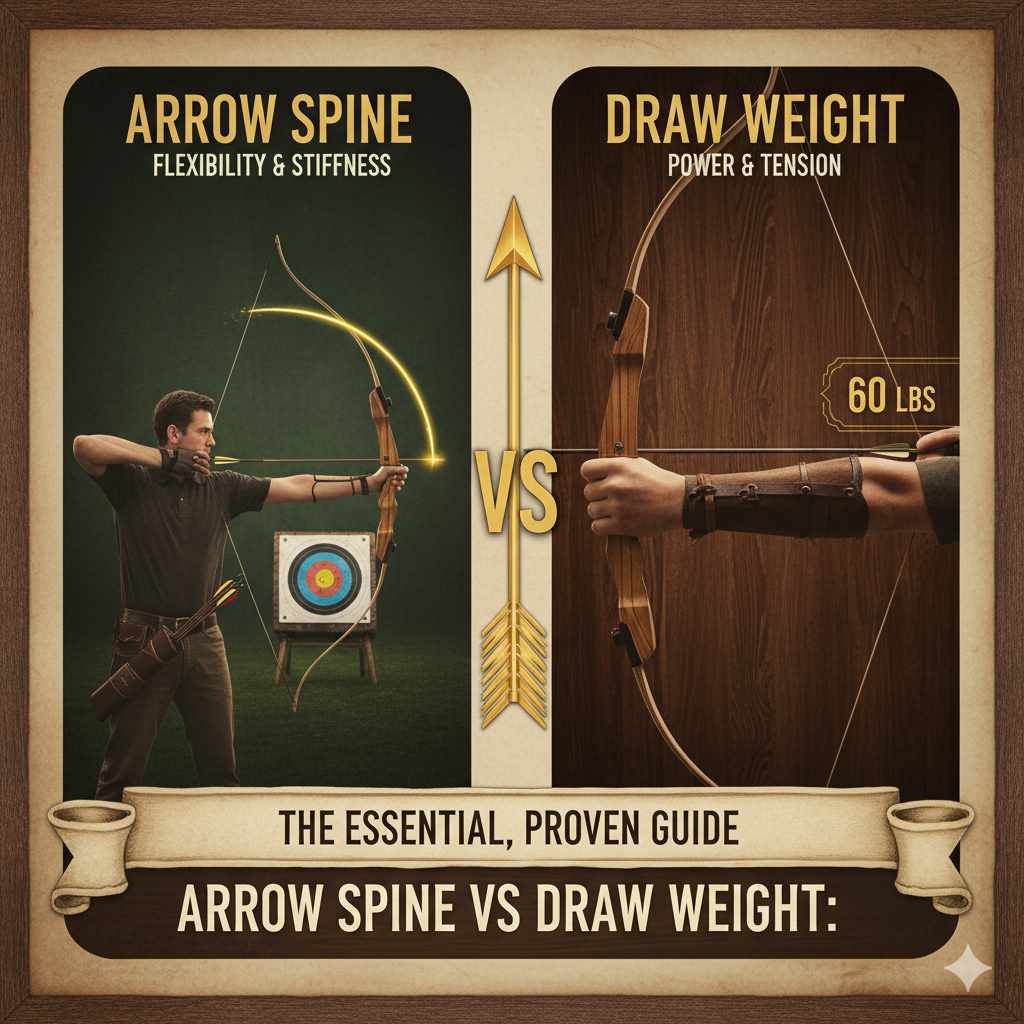
Arrow spine must match your bow’s draw weight for safe, accurate shooting. A higher draw weight requires a stiffer arrow (a lower spine number, like 340), while a lower draw weight needs a more flexible arrow (a higher spine number, like 500). Mismatching them leads to poor arrow flight and potential danger.
Welcome to the range! I’m Salman Arfeen, and today we’re tackling one of the most important topics in archery: matching your arrow to your bow. Getting this right is the secret to hitting your target consistently and safely. It can feel confusing at first, with all the numbers and terms. But don’t worry. I’m here to break it down into simple, easy steps.
Many new archers grab any arrow that looks good, only to wonder why their shots are all over the place. The problem often isn’t your aim—it’s your equipment. Understanding the relationship between your bow’s power and your arrow’s flexibility is a game-changer. In this guide, we’ll walk through exactly what arrow spine and draw weight are, why they must work together, and how you can choose the perfect arrow every time. Let’s get you shooting with confidence!
First Things First: What is Draw Weight?
Before we can talk about arrows, we need to understand the engine that powers them: your bow. The draw weight is the foundation of your entire archery setup.
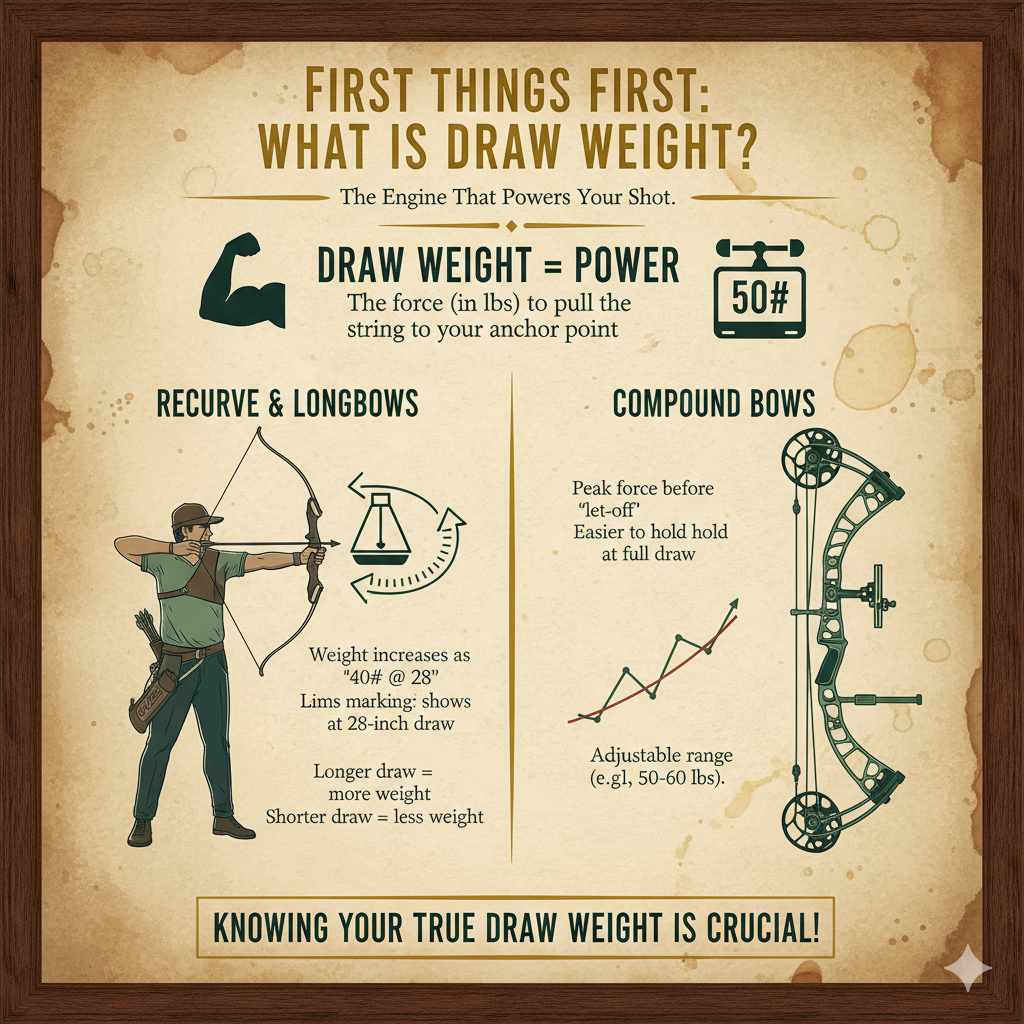
In the simplest terms, draw weight is the amount of force, measured in pounds (#), required to pull the bowstring back to your anchor point. When you hear an archer say they shoot a “50-pound bow,” they are talking about their draw weight.
- For Recurve and Longbows: The draw weight increases the further you pull the string back. The number written on the bow’s limbs (e.g., 40# @ 28″) tells you the weight at a standard 28-inch draw length. If your draw length is longer, your actual draw weight will be higher. If it’s shorter, it will be lower.
- For Compound Bows: The draw weight is the peak force you pull before the “let-off” kicks in, making it easier to hold at full draw. Compound bows usually have an adjustable draw weight range, like 50-60 pounds.
Knowing your true draw weight is the first critical piece of the puzzle. It determines how much energy is transferred to the arrow upon release. Think of it as the power level of your bow. Now, let’s find an arrow that can handle that power.
Understanding Arrow Spine: The Arrow’s Stiffness
Now for the other half of the equation. Arrow spine is one of the most misunderstood concepts for beginners, but it’s actually very simple once you get the hang of it.
Arrow spine is simply a measure of an arrow’s stiffness—how much it resists bending. It is NOT about the “backbone” of the arrow in a literal sense. It’s about its flexibility under pressure.
When you release the bowstring, a massive amount of energy is thrust into the back of the arrow. This forces the arrow to flex and bend before straightening out as it flies toward the target. This flexing action is called the “Archer’s Paradox,” and it’s essential for the arrow to clear the bow’s riser without hitting it.
- An arrow that is too weak (too flexible) for your draw weight will bend too much. It will fly erratically and can even shatter upon release, which is extremely dangerous.
- An arrow that is too stiff for your draw weight won’t bend enough. It will push off the riser and consistently fly off to the side of your target (to the left for a right-handed shooter).
How Spine is Measured: The Confusing Numbers Game
Here’s the part that trips people up: the spine number on the arrow shaft (like 340, 400, 500) works in reverse.
A lower spine number means a stiffer arrow. A higher spine number means a more flexible (weaker) arrow.
So, a 340 spine arrow is much stiffer than a 500 spine arrow. This number comes from a standardized test where a weight is hung from the center of the arrow shaft, and the amount it bends is measured. The less it bends, the stiffer it is, and the lower its spine number.
The Golden Rule: Matching Spine to Draw Weight
So, how do these two forces work together? The relationship is direct and non-negotiable for good shooting.
The higher your bow’s draw weight, the stiffer your arrow needs to be.
Why? A powerful bow (high draw weight) unleashes a huge amount of energy. A flexible, high-spine-number arrow can’t handle that force. It will over-flex, wobble like a fish out of water, and fly unpredictably. It needs a stiff, low-spine-number arrow that can manage that energy and flex just the right amount to achieve stable flight.
Conversely, a low-power bow (low draw weight) doesn’t have enough energy to properly flex a very stiff arrow. The arrow won’t bend around the riser correctly and will be pushed offline.
Quick-Reference Spine Chart
Every arrow manufacturer has its own detailed charts, which you should always use for a final decision. However, this simplified table gives you a great starting point for understanding the relationship with common compound bow setups.
| Draw Weight Range (in pounds) | Recommended Arrow Spine (Starting Point) | Arrow Stiffness |
|---|---|---|
| 25-40# | 600 – 500 | Most Flexible |
| 40-55# | 500 – 400 | Medium Flexibility |
| 55-70# | 400 – 340 | Stiff |
| 70-85# | 340 – 300 | Very Stiff |
Disclaimer: This is a general guide. Always consult the manufacturer’s specific spine chart and consider the other factors listed below.
It’s Not Just About Draw Weight: Other Key Factors
While draw weight is the biggest factor, a few other variables can change which arrow spine you need. Think of draw weight as your starting point, and these as the fine-tuning adjustments.
1. Arrow Length
The length of your arrow has a significant impact on its stiffness. A longer arrow is easier to bend than a shorter one, even if they are made from the same material.
- Longer Arrow = Weaker Spine: If your draw length is long, you’ll need a longer arrow. This makes the arrow act weaker, so you may need to choose a stiffer spine (lower number) to compensate.
- Shorter Arrow = Stiffer Spine: If you cut an arrow shorter, you are effectively making it stiffer.
This is why spine charts always have you cross-reference your draw weight with your arrow length (or draw length).
2. Point Weight
The weight of the tip of your arrow (whether it’s a field point for practice or a broadhead for hunting) also influences how the spine reacts.
- Heavier Point = Weaker Spine: Adding more weight to the front of the arrow causes the shaft to flex more on the shot. This makes the arrow behave as if it has a weaker, more flexible spine.
- Lighter Point = Stiffer Spine: A lighter point will cause the arrow to flex less, making it act stiffer.
If you’re on the edge between two spine sizes, sometimes switching from a 125-grain point to a 100-grain point is all you need to make your arrow fly perfectly.
3. Bow Type (Compound vs. Recurve)
The design of your bow changes how energy is delivered to the arrow. Modern compound bows with aggressive “hard” cams are incredibly efficient and transfer energy very quickly. Recurve and longbows deliver it more smoothly.
Because of this, an arrow shot from a 60# compound bow experiences much more force than the same arrow shot from a 60# longbow. As a result, you will often need a stiffer arrow for a fast, modern compound bow than you would for a traditional bow of the exact same draw weight.
How to Choose the Right Arrow Spine: A Step-by-Step Guide
Feeling ready to pick your arrows? Follow these simple steps to get it right.
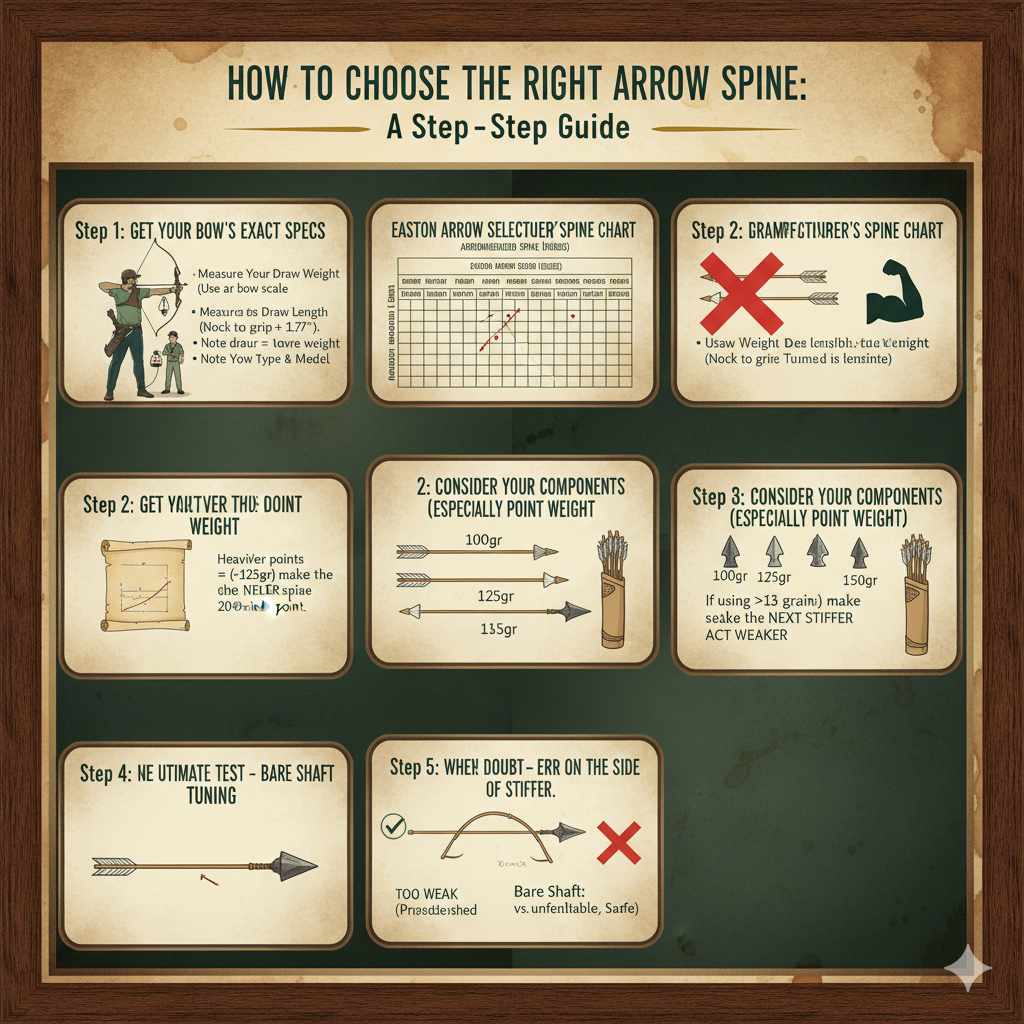
Step 1: Get Your Bow’s Exact Specs
You can’t guess here. You need precise numbers. If you don’t know them, visit a local archery pro shop. They can help you in minutes.
- Measure Your Draw Weight: Use a bow scale to find out the exact peak weight you are pulling. Don’t just go by the number on the limbs.
- Measure Your Draw Length: This is the distance from the nock point on the string to the throat of the grip, plus 1.75 inches, when you are at full draw. An expert at a shop can measure this for you accurately.
- Note Your Bow Type: Are you shooting a compound, recurve, or longbow? Note the make and model if you can.
Step 2: Consult a Manufacturer’s Spine Chart
Now that you have your numbers, it’s time to use a professional spine selection chart. Do not rely on generic charts for your final purchase. Go directly to the website of the arrow brand you want to buy (Easton, Gold Tip, Carbon Express, etc.).
These charts are easy to use. You’ll typically find your draw weight along one axis and your arrow length along the other. Find where those two points intersect on the chart, and it will give you a recommended spine group.
For a great example, check out the famous Easton Arrow Selector Tool. It walks you through the process clearly and is trusted by archers worldwide.
Step 3: Consider Your Components (Especially Point Weight)
Most spine charts are based on a standard point weight, usually around 100 or 125 grains. If you plan to use a much heavier or lighter point, the chart will often have instructions for how to adjust. For example, it might say, “If using points over 125 grains, select the next stiffer spine group.” Pay close attention to these details.
Step 4: When in Doubt, Err on the Side of Stiffer
This is a critical piece of advice for both safety and performance. If you land on the line between two spine sizes on a chart, it is almost always better to choose the stiffer option (the lower spine number).
A slightly-too-stiff arrow is forgiving and can often be tuned to fly well. A too-weak arrow, however, is unpredictable, inaccurate, and can be a serious safety hazard. Never risk shooting an underspined arrow.
Step 5: The Ultimate Test – Bare Shaft Tuning
Once you have your arrows, the best way to confirm your choice is a simple process called “bare shaft tuning.” This involves shooting one arrow without any fletchings (feathers or vanes) at a close distance (around 15-20 yards) alongside your regular fletched arrows.
The fletchings are like the rudder on a boat; they correct wobbly flight. By removing them, you get to see what the arrow really wants to do right out of the bow. Its flight is purely a result of its spine match.
Interpreting Bare Shaft Results (for a Right-Handed Archer)
| If the Bare Shaft Hits… | This Indicates Your Spine Is… | A Simple Potential Fix |
|---|---|---|
| LEFT of your fletched arrows | Too Weak (Too Flexible) | Decrease point weight, or you need a stiffer arrow (lower spine number). |
| RIGHT of your fletched arrows | Too Stiff | Increase point weight, or you need a weaker arrow (higher spine number). |
| IN THE SAME GROUP as your fletched arrows | Perfect! | Congratulations! You have a great match. |
Note: For left-handed archers, the results are reversed (right impact = too weak, left impact = too stiff).
Frequently Asked Questions (FAQ)
What happens if my arrow spine is too weak?
A severely weak (underspined) arrow will flex excessively when shot. This leads to extremely poor accuracy, a “fishtailing” flight path, and a high risk of the arrow breaking or shattering from the force. This is a major safety concern. Never shoot an arrow you suspect is too weak for your bow.
What happens if my arrow spine is too stiff?
A too-stiff (overspined) arrow will not flex enough to clear the bow’s riser cleanly. For a right-handed archer, this will typically cause the arrow to consistently impact to the left of the target. While less dangerous than a weak spine, it will still prevent you from achieving tight, accurate groups.
Do spine numbers like ‘400’ mean the same thing for all brands?
Mostly, yes. The numbering system is based on a standardized industry measurement. A 400 spine arrow from Easton should have a very similar stiffness to a 400 spine arrow from Gold Tip. However, slight variations in materials and manufacturing can exist. It is always best practice to use the specific spine chart for the brand of arrows you are purchasing.
I just increased my bow’s draw weight. Do I need new arrows?
If the increase is significant (more than 5 pounds), then yes, you absolutely need to re-evaluate your arrow spine. That increase in power may now require a stiffer arrow for safe and accurate flight. Take your bow back to a pro shop, confirm your new peak draw weight, and consult a spine chart again.
Can I make my arrows stiffer by cutting them shorter?
Yes. Shortening an arrow shaft makes it more resistant to bending, which effectively increases its stiffness (it behaves like a lower-numbered spine). This is a common tuning technique used by experienced archers. However, as a beginner, you should first select the correct spine from a chart and only use this method for fine-tuning under expert guidance.
Wait, a 340 spine is stiffer than a 500 spine? Why?
It’s confusing, but yes! The number represents the amount of deflection, or bend, in thousandths of an inch. A “340 spine” arrow bends 0.340 inches in the test, while a “500 spine” arrow bends 0.500 inches. Since the 500-spine arrow bends more, it is more flexible (weaker).
Conclusion: Your Path to Perfect Arrow Flight
You’ve done it! You now understand the critical partnership between arrow spine and draw weight. It’s not just technical jargon; it’s the bedrock of archery accuracy and safety. Remember the golden rule: more power from your bow requires a stiffer arrow that can handle it.
Always start by knowing your exact draw weight and draw length. Use those numbers on the arrow manufacturer’s specific chart to find your starting point. And don’t forget that little adjustments to point weight or arrow length can help you fine-tune your setup to perfection.
This may seem like a lot of information at first, but it quickly becomes second nature. Taking the time to match your equipment properly is the single best thing you can do to build confidence and see real results. Now, you can step up to the shooting line knowing your gear is working with you, not against you. Happy shooting, and always be safe!