Is a Bowfishing Light Kit Worth It?
A bowfishing light kit is worth it only if it improves target clarity, run time, and shot consistency enough to justify the full cost. For many boats, that payoff shows up only when you fish low-light nights often. A poor setup wastes money, drains batteries fast, and can make fish harder to judge before the shot. This guide compares total setup cost, battery/runtime tradeoffs, and real shot-quality gains so you can decide whether the upgrade fits your boat or bow.
When a light kit earns its cost


A bowfishing light kit is worth it when it gives you more usable shot time, better fish definition, and fewer setup headaches than a borrowed or improvised light. It is usually not worth it for occasional trips, shallow clear water in short windows, or bank setups where a simple handheld light already covers the lane.
What you gain beyond a basic light
The real gain is not raw brightness alone. A dedicated bowfishing light kit can place light where the arrow actually travels, cut shadows on the water, and keep your hands free for drawing and shooting. That matters when fish move fast under glare or when the boat drifts into patchy cover.
For bow-mounted systems, the stabilizer-bushing mount keeps the light tied to the bow, so the beam follows the shot line. For boat-mounted systems, the gain is broader coverage and less aiming fuss, especially when two or more shooters work the same water.
When the upgrade does not pay off
The upgrade often falls flat if you fish only a few nights a year, run shallow clear water with short stalks, or already have a strong borrowed light source. It can also disappoint if the kit needs extra batteries, a charger, wiring, or a generator that pushes total ownership cost beyond the light itself.
A common first-timer mistake is buying a bright light without checking mount compatibility. A 600-lumen bow light that fits poorly and wiggles on the riser can lose more shot control than it gains in output.
The main buying factors that matter
Judge a kit by total cost, runtime, mounting method, beam control, and water resistance. Brightness matters, but so do the power source and how fast the setup gets you from dark deck to first shot. For muddy water, broader output and color tuning matter more than a narrow hotspot.
Suppose a shooter runs a small jon boat and wants quick setup. A compact bow-mounted kit with rechargeable power may make more sense than a deck system that needs wiring, switches, and extra hardware. If the boat already carries a deep cycle battery and multiple shooters, the math shifts toward deck lights.
Bowfishing light kit costs
Total cost includes more than the lamp. A usable setup may need a light, battery, charger, mount, switch, wiring, and sometimes a generator. That difference can double the real spend compared with the sticker price on the box, so compare complete setups, not only the light head.
What a basic handheld setup really costs
A basic handheld setup is the cheapest entry point because it can rely on gear you already own or borrow. The tradeoff is lower shot speed, less consistent beam placement, and more hand fatigue. It works best for short sessions, bank shooting, or a tight budget.
Its hidden cost is usually time. A shooter must hold the beam, manage the bow, and track fish at once. That slows the shot window when fish turn in glare or move through brush edges.
What an entry-level bow-mounted kit adds
An entry-level bow-mounted kit adds the mount, switch, and often a dedicated rechargeable battery. The October Mountain Products Splashlight Bowfishing Riser Light Kit is rated at 600 lumens, includes a rechargeable battery, charger, and AC and DC adapters, and its light threads directly into a stabilizer bushing.
That package matters because it cuts the number of parts a beginner has to source separately. The added cost buys easier aiming and a cleaner setup than a loose handheld light, but it does not give wide boat coverage.
What a full boat/deck kit adds
A full boat/deck kit adds broader area lighting, remote control, and more adjustment. The FOXPRO Mudcutter 4 Boat LED Light Kit has adjustable color from 2000K to 6000K, includes wireless remote control and a hard-wired rheostat, and is IP68 waterproof. That kind of setup costs more because it covers more water and more hardware.
For large boats and multi-shooter crews, the value comes from coverage and control. For a small craft that shoots one lane at a time, the extra cost may not buy enough practical speed.
Bow-mounted light or boat light?
A bow-mounted light is usually better for one shooter who wants the beam to move with the bow. A boat light is better when the crew needs broader coverage, easier brightness control, and less aiming strain. The better choice depends on where the shots come from and how much water you need to light at once.
Bow-mounted light setup and mounting limits
Bow-mounted lights fit shooters who want a compact setup and faster hand-to-target movement. The key limits are mount stability, weight, and the amount of beam spread you get from the bow position. The FOXPRO BowFire weighs 1.9 lbs and offers three light settings: Cool White, Middle White, and Warm White.
That kind of setup can help one shooter stay oriented, but it does not light the whole deck. If the beam is too narrow, fish outside the cone disappear. If the mount is loose, the beam wanders when the bow moves.
Boat/deck light coverage and control
Boat lights cover more water and let the crew tune output while moving. The Mudcutter kit’s wireless remote and hard-wired rheostat make brightness changes easier, and the 2000K to 6000K range helps match light color to water conditions. That flexibility matters more in mixed or muddy water.
Boat kits also demand more installation effort. Wiring, mounting points, and power planning matter. If those steps are rushed, the light may shake, short, or become awkward to use during a shot sequence.
Which setup improves shot speed more?
For a single shooter, a stable bow-mounted light often improves shot speed more because the beam follows the shot line. For two or more shooters, a boat/deck kit usually wins because it keeps more fish visible and cuts the time spent re-aiming the light for each shot.
Say your boat drifts through a muddy creek with two shooters on opposite sides. A deck light can keep both lanes visible, while a bow light may force one shooter to chase the beam and lose the shot window.
How many lumens do you need?
There is no single lumen number that fits every bowfishing setup. Clear water usually needs less total output than muddy water, but beam shape and control matter as much as raw brightness. A focused beam can help on distance, while a flood pattern often helps close-in fish visibility.
Lumens for clear water
In clear water, lower to moderate output can be enough if the beam is controlled and glare is limited. Too much light can wash out detail on the water surface and make fish harder to judge. In that setting, color choice and beam spread often matter more than pushing lumen count upward.
Lumens for muddy water
Muddy water needs more output and usually more beam coverage. Outrigger Outdoors says the Swamp Eye HD can reach up to 12,000 lumens, and that higher-output class is aimed at tough visibility. Even then, muddy water still benefits from color tuning and wide beam use, not just sheer intensity.
HID lights can still help in mixed water because they throw strong output, but they work best when the power setup can support them. If the beam is too tight, the fish may appear only at the edge of the light cone, which shortens the decision window.
Beam pattern, flood, and spot tradeoffs
Flood beams cover more of the surface and help track fish movement near the boat. Spot beams reach farther and can help locate fish at distance, but they may create harsher glare and hide movement outside the cone. Many boat setups work best with a controlled flood, not a narrow spotlight.
LED lights are easier to tune this way because they can use cool white and warm white options, plus flood or spot control in a durable aluminum housing. That makes them easier to match to water clarity than a fixed-output setup.
Light kit feature comparison
The best feature set depends on power, water resistance, and how much control the shooter wants. LED systems are usually easier to run from batteries. HID systems can be very bright, but they often make more sense when a generator or heavy power supply is already part of the plan.
LED versus HID performance
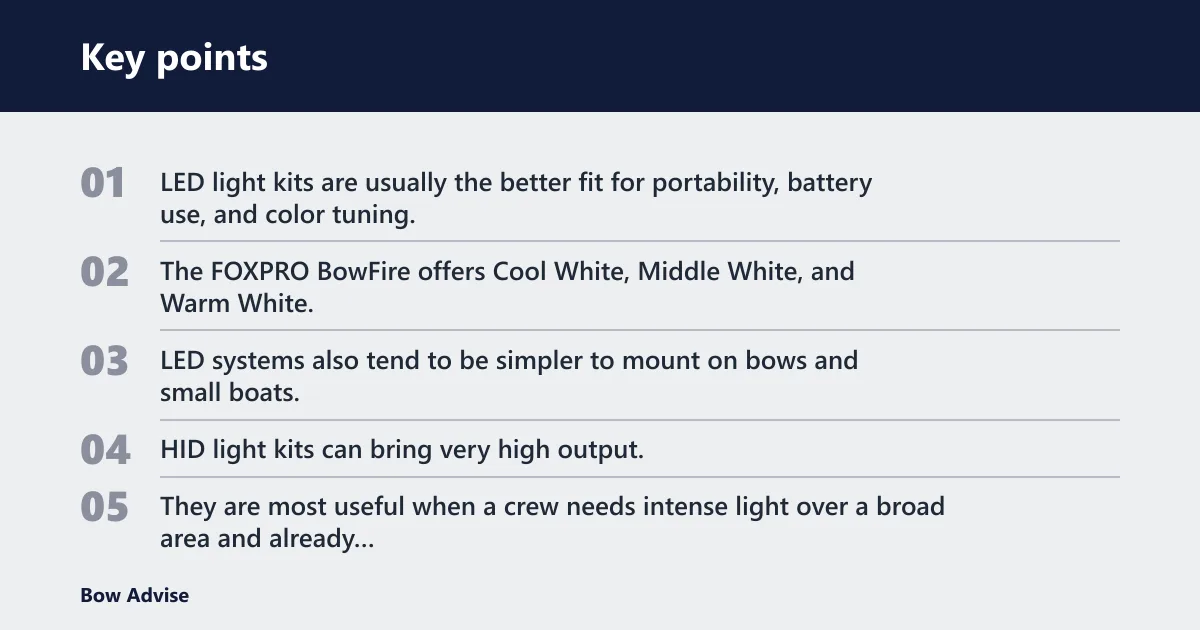
LED light kits are usually the better fit for portability, battery use, and color tuning. The FOXPRO BowFire offers Cool White, Middle White, and Warm White, and its 3-year LED replacement warranty is useful for buyers who want a longer service window. LED systems also tend to be simpler to mount on bows and small boats.
HID light kits can bring very high output, and they often do well when paired with generator power. They are most useful when a crew needs intense light over a broad area and already accepts the extra power gear and setup bulk.
Battery runtime versus generator power
Rechargeable batteries make bow-mounted kits portable, but runtime is the limiting factor. BonfireBob says the Fin-Finder Splashlight gives up to four hours before recharge, while Outrigger Outdoors says the Swamp Eye HD runs about 10 hours on a typical deep cycle battery. Those numbers show why runtime should be checked before buying.
Do you need a generator for bowfishing lights? Not always. A generator makes sense for high-output HID systems or long nights on a larger boat, but many LED bow lights run well from rechargeable packs or deep cycle batteries. If the battery cannot cover the whole session, the generator becomes part of the total cost.
IP rating, beam control, and mounting compatibility
Water resistance should match the amount of spray and splash your setup sees. IP67 and IP68 are common water-resistance standards to check; IP68 is generally the more water-resistant of the two for water exposure. The Mudcutter kit is IP68 waterproof, which is a better fit for deck use where spray and rinse-downs are common.
Mounting compatibility matters just as much. A stabilizer-bushing mount works well on a bow, while a boat kit may need dedicated brackets and wiring. If the mount and power source do not match the craft, even a bright light becomes awkward to use.
Decision table
| Setup | Upfront cost | Installation effort | Runtime | Brightness control | Visibility in muddy water | Shot-speed impact | Who should buy it |
|---|---|---|---|---|---|---|---|
| Basic handheld light | Lowest | Very low | Depends on existing battery or flashlight | Usually limited | Poor to fair unless the beam is strong and steady | Slowest; one hand stays busy | Beginners, bank shooters, occasional trips |
| Entry-level bow-mounted kit | Moderate | Low to moderate | Good if the rechargeable pack is sized well | Usually basic to moderate | Fair in clear to mixed water | Faster for solo shooters | Single shooters who want a cleaner bow setup |
| Full boat/deck lighting kit | Highest | Moderate to high | Best with deep cycle battery or generator support | Best; remote and rheostat are common | Best for broad muddy-water coverage | Fastest for crews | Boats with multiple shooters, long nights, rough water |
Frequently asked questions
Is a bowfishing light kit worth it?
It is worth it when you fish often enough to benefit from better shot timing, better beam placement, and less hand fatigue. For short or rare outings, a basic handheld light may make more sense because the extra cost of mounts, batteries, and chargers can outweigh the gains.
Can you use any bow for bowfishing?
Not every bow is a good fit. A bowfishing setup needs enough mounting room, reasonable balance, and a setup that tolerates water exposure. Many shooters prefer bows that accept a stabilizer-bushing mount and can handle a practical light without making the front end too heavy.
What bowfishing light is best for muddy water?
For muddy water, look for more output, broader beam coverage, and color adjustment. High-output LED or HID systems help most.
How many lumens do you need for bowfishing?
It depends on water clarity and beam shape. Clear water can work with modest output if the beam is controlled, while muddy water benefits from much higher output. The Swamp Eye HD reaching up to 12,000 lumens shows the scale needed for difficult conditions, but beam control still matters.
Do you need a generator for bowfishing lights?
Not always. Rechargeable batteries are enough for many LED bow lights, and some setups are built around a rechargeable pack and charger. A generator becomes more useful for large boat kits, long nights, or power-hungry HID systems that need steady output beyond a battery’s practical runtime.
What features matter most in a bowfishing light kit?
Start with mounting compatibility, runtime, and beam control. Then check water resistance, brightness settings, and whether the power source fits your boat or bow. For boat use, remote control and brightness adjustment matter more. For bow use, weight and a stable stabilizer-bushing mount matter more.