Back Tension Release vs Trigger Release for Hunting
For most bowhunters, Trigger Release is the better hunting choice because it is quicker to set, easier to run under pressure, and simpler with cold hands, while Tension Release is usually better for training and target shooting. Pick the wrong one and you can miss a short shot window, punch the trigger, or send a poor shot when adrenaline spikes. This guide compares accuracy, simplicity, glove use, shot timing, and the situations where each release makes sense.
| Factor | Tension Release | Trigger Release | Winner |
|---|---|---|---|
| Field speed | Requires a controlled pull and rotation to fire. | Fires with a direct index-finger press. | Trigger Release |
| Shot cleanliness | Can reduce punching because the shot breaks from back tension. | Can be very clean, but only if the finger pressure stays light and surprise-based. | Tension Release |
| Cold-weather handling | Handheld versions can be awkward to use with gloves and cold fingers. | Wrist-strap styles are often easier to keep attached and ready. | Trigger Release |
| Learning curve | Usually harder to trust and time well. | Usually easier for most hunters to learn fast. | Trigger Release |
| Target panic risk | Often used to manage punching and anticipation. | Can feed punching if the shooter snatches at the shot. | Tension Release |
Tension vs trigger mechanics under hunting stress
The core trade-off is simple: Tension Release can deliver cleaner execution, while Trigger Release is easier to run when a live animal appears and the shot window is short. In hunting, that matters more than perfect bench groups. A release that looks great on a target bale can still fail when the bow is at full draw, the animal moves, and the hunter’s hands are cold.
What each release does at full draw
A Tension Release uses back tension and rotation to fire, usually through a hinge-style or resistance-style mechanism. The shot happens when the archer keeps engaging the back and the release rotates through its travel. A Trigger Release uses an index finger to move a sear or caliper mechanism, which makes the shot more direct and usually faster to command.
Why hunting stress changes the answer
Stress changes how a release feels in the hand and how quickly the shooter acts. Under adrenaline, many hunters rush the shot, grip harder, or freeze at anchor. That is where a trigger can be both helpful and dangerous: easy to fire, but also easier to punch. A tension release can keep the shot cleaner, yet it asks more from concentration and timing.
Tension release decision matrix
Tension Release is the better fit for hunters who value shot execution over speed, especially if target panic or trigger punching is already part of the picture. Trigger Release is the better fit for hunters who need fast, repeatable field handling and a shorter learning curve. The right pick depends on stress tolerance, not just target-group size.
| Decision factor | Tension Release | Trigger Release | Best fit |
|---|---|---|---|
| Hunting stress | Can stay cleaner if the shooter can keep pulling through the shot. | Can be easier to execute fast, but more likely to be punched under pressure. | Tension Release |
| Learning curve | Harder at first because the shot break feels less direct. | Easier for most hunters to understand and repeat quickly. | Trigger Release |
| Cold-weather use | Handheld designs can be less friendly with gloves. | Wrist-strap versions stay attached and are easier to grab in cold weather. | Trigger Release |
| Shot-break consistency | Can be very consistent when anchor and back-wall pressure stay the same. | Can also be consistent, but finger pressure must stay disciplined. | Tension Release |
| Target panic risk | Often helps reduce anticipation and trigger snatching. | Can worsen punching if the hunter keeps anticipating the shot. | Tension Release |
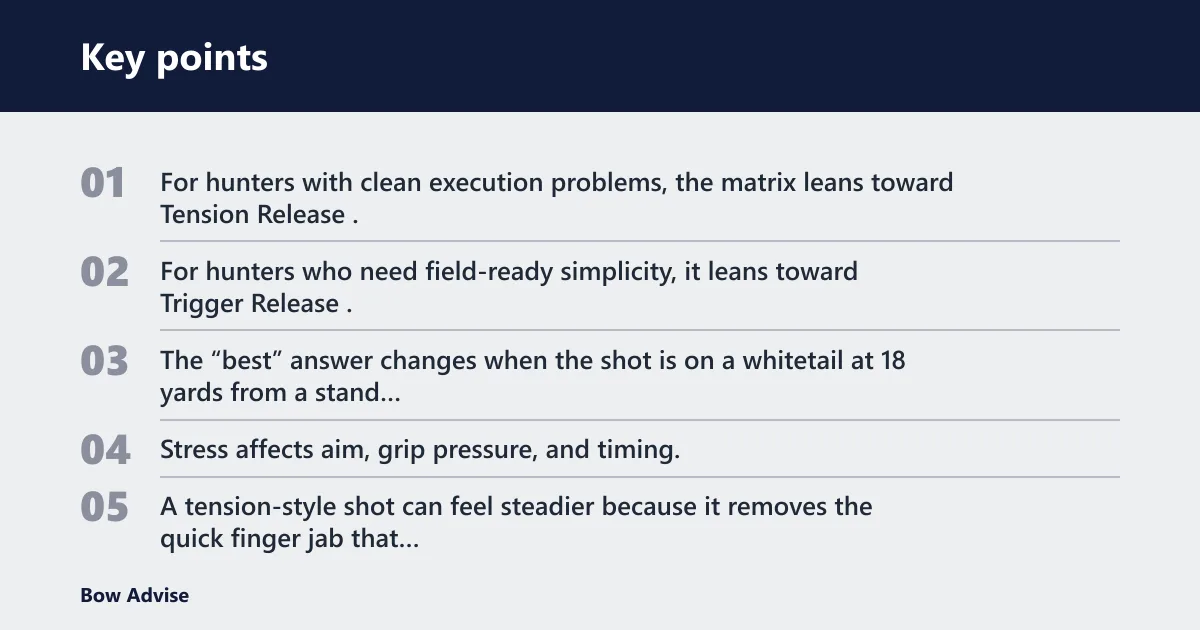
For hunters with clean execution problems, the matrix leans toward Tension Release. For hunters who need field-ready simplicity, it leans toward Trigger Release. The “best” answer changes when the shot is on a whitetail at 18 yards from a stand compared with a calm shot into a target bag.
Hunting stress
Stress affects aim, grip pressure, and timing. A tension-style shot can feel steadier because it removes the quick finger jab that causes many misses, but it can also feel harder to manage when an animal is moving. A trigger release wins this row because it is easier to command when time is short.
Learning curve
Most bowhunters learn a trigger release faster because the motion is familiar: anchor, aim, press. A tension release takes more trust because the shot should break as back tension builds, not because the archer decides to “make it go.” That difference matters most for beginners and for hunters changing from one style to the other.
Cold-weather use
Gloves and cold fingers change everything. Wrist-strap trigger releases are usually easier to keep on the hand, clip to a D-loop, and fire without fumbling. A handheld tension release can still work, but cold dexterity makes secure handling and anchor setup harder.
Shot-break consistency
Consistency depends on a repeatable anchor, solid back-wall feel, and the same release motion every shot. A compound bow with a solid back wall gives more confidence to either release, but it matters more for handheld tools because the archer feels more of the wall through the hand. A mushy wall can invite creeping or uncertainty.
Target panic risk
Target panic often shows up as trigger anticipation, flinching, or an urge to snatch the shot before the pin settles. A tension release can help because it removes the “now” moment from the finger. It does not erase the problem, though; the archer still has to learn steady anchor, steady aim, and back engagement.
How each release works on a compound bow
A compound bow changes the whole conversation because let-off lets the archer hold at full draw, and the back wall shapes how stable that hold feels. Release choice should match that wall, the anchor point, and the way the bow settles at full draw. Hunting bows commonly sit in the 60-80 lb draw-weight range, so control at anchor matters.
Tension release, hinge-style activation, and rotation-based execution
A tension release usually fires when the archer increases back tension and allows the head to rotate through its travel. That can be an advantage for a shooter who wants a surprise break. It also means the archer must stay committed to the shot through the whole aiming process, which is harder when the animal is moving or the lane is tight.
Trigger release, index-finger activation, and common wrist-strap forms
A trigger release is usually index-finger activated and often sold in wrist-strap form for hunting. Some handheld trigger-style aids exist too, but the wrist-strap version is the common field choice because it is harder to drop, easier to clip to a D-loop, and more natural for fast shots from awkward positions. The downside is obvious: a hard finger punch can move the bow.
Why the back wall and anchor matter
A solid back wall helps the archer stop at the same point every time. That matters for both release types, but especially for handheld designs, where anchor inconsistency shows up fast in left-right misses. If the bow feels mushy at full draw, the shooter may float, creep, or rush the shot.
Which release is easier under pressure?
Trigger Release is easier under pressure for most hunters because it is faster to set, easier to understand, and simpler to fire when the shot window is short. Tension Release can be smoother, but it asks more patience at full draw, which is exactly what pressure tends to steal. That difference shows up most when the animal is close and moving.
Heart rate and short shot windows
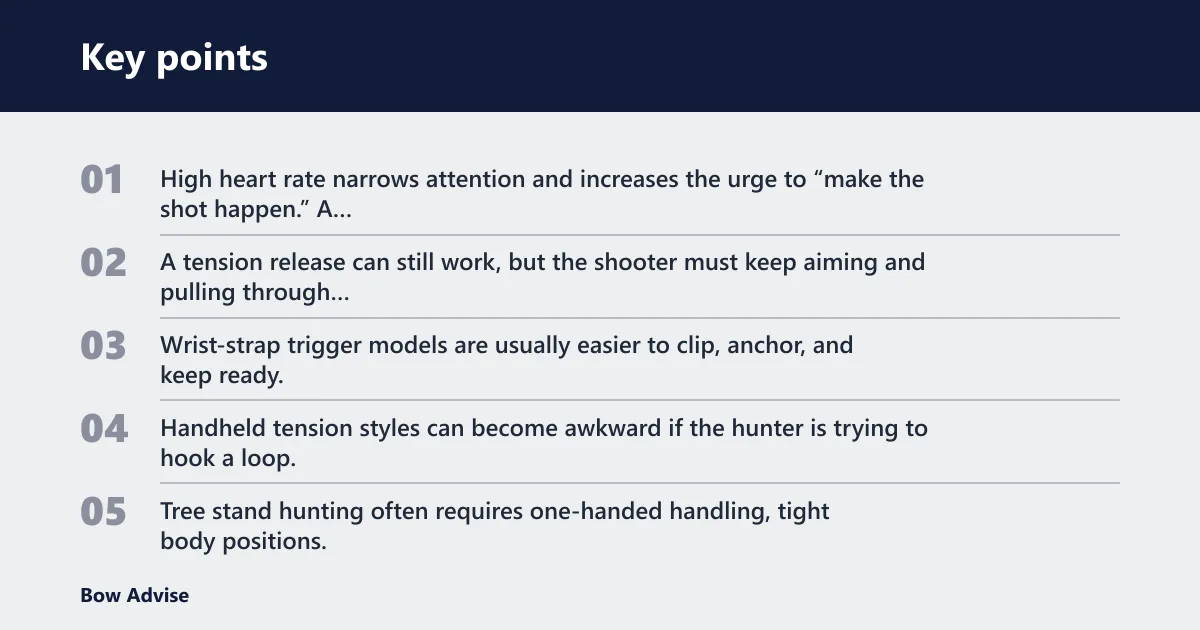
High heart rate narrows attention and increases the urge to “make the shot happen.” A trigger release fits that reality better because the finger press is direct and familiar. A tension release can still work, but the shooter must keep aiming and pulling through the shot without rushing the release cycle.
Gloves, cold hands, and clipping the D-loop
Cold hands reduce fine motor control. Gloves make that worse. Wrist-strap trigger models are usually easier to clip, anchor, and keep ready. Handheld tension styles can become awkward if the hunter is trying to hook a loop, settle the wrist, and maintain safe control in one motion.
One-handed setup in a tree stand
Tree stand hunting often requires one-handed handling, tight body positions, and fast adjustment after the bow is raised. That puts a premium on retention and simplicity. Trigger releases, especially wrist-strap versions, usually win here because they stay attached and are easier to get into position without extra fumbling.
Picture a hunter in a 16-foot stand with thin gloves and a buck quartering away at 22 yards. A handheld tension release can work, but only if the bowhand, anchor, and release hand all settle quickly. If the shooter fumbles for two extra seconds, the lane may be gone.
Does back tension help target panic?
Tension Release often helps with target panic because it reduces trigger anticipation and makes the shot break less predictable. That said, it does not cure panic by itself. If the archer still collapses at anchor, snatches at aim, or changes facial reference every shot, the same problem can return in a different form.
How trigger anticipation creates punch errors
Trigger anticipation makes the shooter wait for the pin to settle and then fire abruptly. That punch can send shots low, left, or right depending on handedness and bow setup. A trigger release makes that mistake easy to repeat because the shot is under the index finger.
Why some hunters freeze with a trigger
Some hunters freeze because they know the shot is coming and do not trust their finger discipline. That hesitation can be worse than the original flinch. A tension release can remove some of that mental lock-up by shifting the job from “press now” to “keep pulling until it breaks.”
What still has to be fixed in practice
Target panic management still depends on practice. Anchor must be consistent. The bow arm must stay steady. The archer must learn how the release breaks and how the back wall feels at full draw. Without that work, the release style alone will not solve the issue.
Suppose a bowhunter changes from a crisp wrist-strap trigger to a hinge and keeps the same rushed aim. The new release may feel cleaner for a week, but if the anchor point drifts even half an inch, the shot still breaks at the wrong time. The release changed; the habit did not.
Hunting situations that change the choice
Trigger Release is usually the better field tool for tree stands and many blind setups because it is simpler to handle with gloves and awkward angles. Tension Release can make sense where the archer has more time to settle, especially in spot-and-stalk situations. The hunting setup should drive the choice.
Tree stand hunting
Tree stand hunting often means cold fingers, bulky clothing, and a shot lane that opens and closes fast. That pushes the decision toward a trigger release, especially a wrist-strap model. A back tension release can work in a stand, but only if the hunter is comfortable clipping, anchoring, and holding at full draw without rushing.
Ground blind use
Ground blinds can be easier than tree stands for body position, but they still favor fast, quiet handling. If the blind is cramped or visibility is narrow, a trigger release is usually more practical. If the hunter has room to draw, settle, and wait, a tension release becomes more realistic.
Spot-and-stalk hunting
Spot-and-stalk gives more movement windows and often more time to build a clean shot cycle. That extra time can help a tension release perform well because the archer can settle, aim, and let the shot break through back tension. Even then, the system only works if the hunter can remain steady after the draw.
Choose Tension Release if… / Choose Trigger Release if…
Tension Release is the better pick if the hunter has target panic, wants a cleaner surprise break, shoots from a stable rest or open lane, and is willing to practice a slower, more deliberate shot process. Trigger Release is the better pick if the hunter needs speed, wears gloves often, hunts from a stand, or wants the simplest option for live-animal pressure.
Choose tension release if…
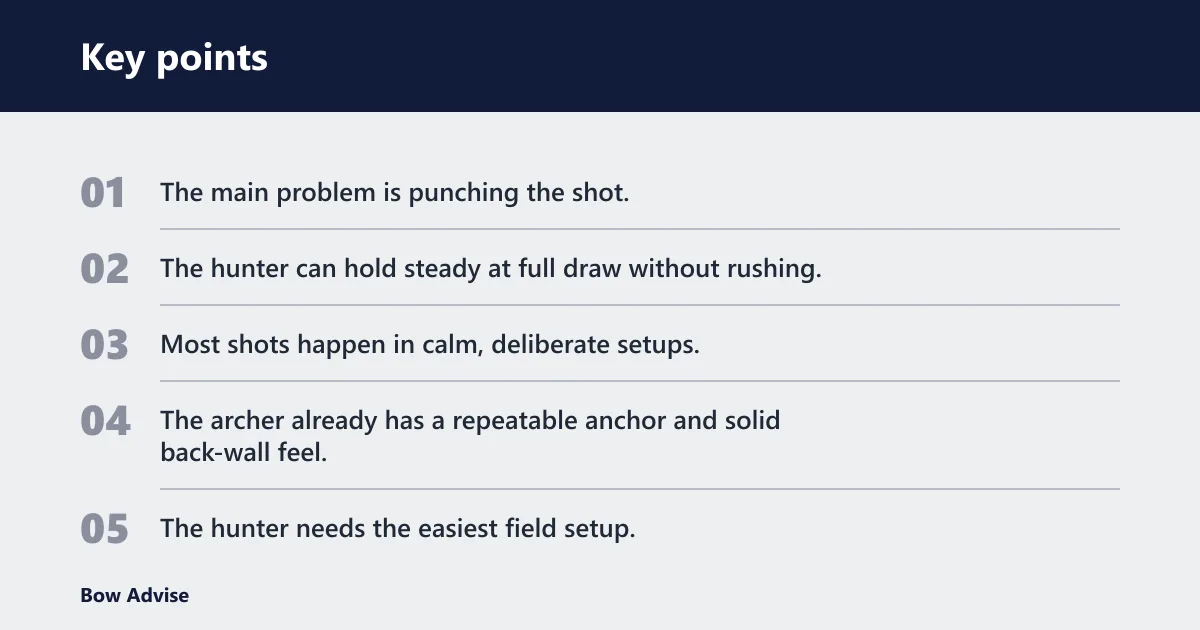
- The main problem is punching the shot.
- The hunter can hold steady at full draw without rushing.
- Most shots happen in calm, deliberate setups.
- The archer already has a repeatable anchor and solid back-wall feel.
Choose trigger release if…
- The hunter needs the easiest field setup.
- Cold weather and gloves are common.
- Most shots come from a tree stand, blind, or other tight setup.
- The priority is fast, dependable hunting use rather than training a surprise break.
Best choice by hunter type
Beginner hunters usually do better with Trigger Release because it is simpler to learn and use in the field. Panic-prone shooters often benefit from Tension Release, but only if they are willing to practice properly. Experienced bowhunters may keep both styles in the toolbox: trigger for hunting, tension for form work or specific situations.


Frequently asked questions
Is a back tension release more accurate than a trigger release for hunting?
Not always. Tension Release can be more accurate when a hunter has solid anchor, clean back-wall pressure, and good follow-through because it reduces punching. Trigger Release can match that accuracy if the shooter keeps finger pressure light and controlled. In hunting, field handling often matters as much as raw accuracy.
Are back tension releases legal for hunting?
Usually yes, but the rule depends on the state, province, or country and sometimes on the exact release design. Hunters should check local regulations before season. Some places care about mechanical aid type, hunting method, or legal equipment definitions, so the answer is not universal.
Which release is easier to use on a live animal under pressure?
Trigger Release is usually easier because it is faster, more familiar, and simpler to activate when the shot window is short. A wrist-strap version is especially practical in the field. Tension Release can be excellent, but it asks for more patience exactly when adrenaline is highest.
Can you hunt with a back tension release in a tree stand?
Yes, but it is less forgiving than a trigger release in many stand situations. Gloves, cold hands, and one-handed movement can make setup harder. If the hunter can anchor cleanly and stay calm at full draw, it can work. If not, a trigger release is usually the safer practical choice.
What are the biggest mistakes hunters make with trigger releases?
The biggest mistakes are punching the trigger, collapsing at the shot, changing anchor, and squeezing the release too hard. Hunters also sometimes chase pin float instead of accepting it. Those habits can move the bow at the exact moment the arrow leaves the string.
Do back tension releases help cure target panic for bowhunters?
They often help reduce target panic symptoms, especially trigger anticipation and shot punching, but they do not cure the problem by themselves. The archer still has to fix anchor, aim, and draw-cycle discipline in practice. Without that work, the same panic can reappear during hunting pressure.
Which release is better for beginner hunters?
Trigger Release is usually better for beginners because it is easier to understand, easier to clip onto a D-loop, and easier to run in the field. A beginner can learn better shot habits with it if finger pressure stays light. A tension release is useful later, especially for shooters working on punch control.
How does release choice affect accuracy at short hunting distances?
At short distances, release choice affects the shot more through execution than through arrow flight. A trigger release may be easier to fire fast, but it can also create a rushed punch. A tension release may produce a cleaner break, but only if the hunter can hold steady long enough to let it fire naturally.