Mechanical Release vs Thumb Release for Bowhunting
Choose a Mechanical Release if you want a simple, index-finger shot with little hand movement; choose a Thumb Release if you anchor hard, want more control, and can keep a repeatable shot process. Pick the wrong one and your anchor, aim, and back tension can break down under hunting stress. This guide compares both release types by draw style, anchor habits, glove use, and field shot execution.
| Decision factor | Mechanical Release | Thumb Release | Winner |
|---|---|---|---|
| Anchor consistency | Easy to keep the same wrist position and draw stop feel | Strong anchor reference when the handle is indexed the same way each draw | Mechanical Release |
| Glove compatibility | Works better with thicker gloves and limited finger dexterity | Thumb button feel can get muted by gloves | Mechanical Release |
| One-hand use and tree stand readiness | Wrist strap and tethered setups are quick to get on and stay quiet | Handheld use takes more grip control and more care in a stand | Mechanical Release |
| Trigger control and back-tension potential | Trigger-style activation is simple, but can invite punch-and-hold habits | Better fit for surprise shot execution and pull-through practice | Thumb Release |
| Cold-weather feel, target panic risk, and learning curve | Better in cold conditions and usually easier to learn | Can reduce target panic for some shooters, but takes more discipline | Tie |
Which release type fits glove use and tree stand work?
The comparison is direct: Mechanical Release favors speed, glove use, and a simple hunting setup, while Thumb Release favors a hard anchor, cleaner pull-through, and tighter control over shot execution. Neither wins on reputation alone. The better fit is the one that keeps your draw style, anchor point, and release motion steady under hunting pressure.
Anchor consistency score
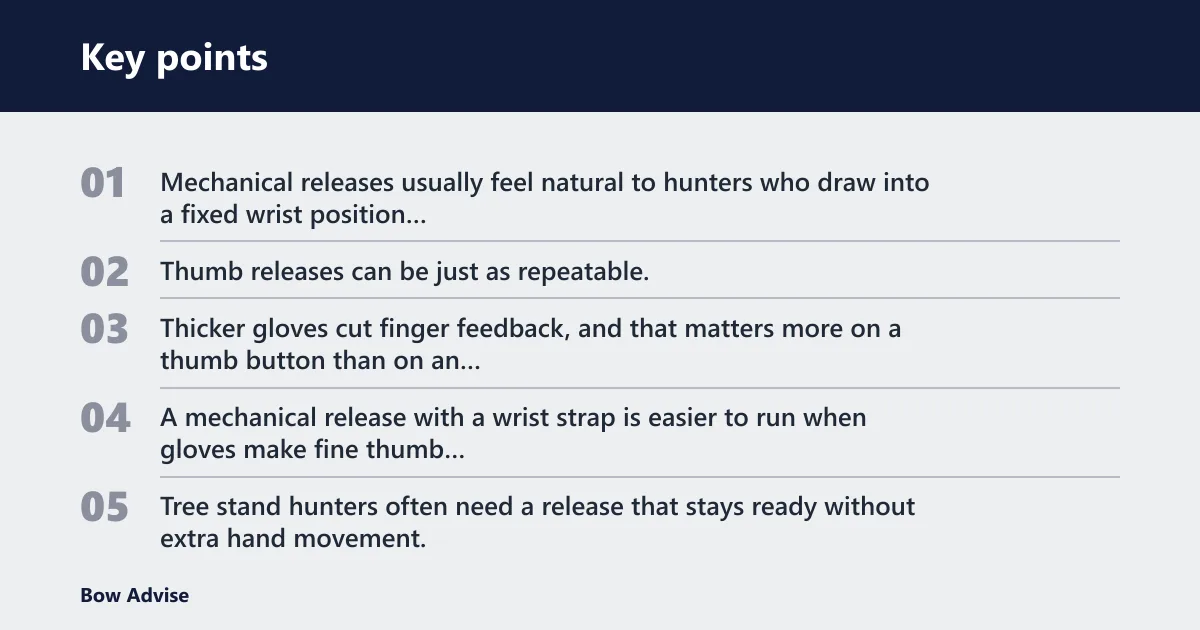
Mechanical releases usually feel natural to hunters who draw into a fixed wrist position and want the aid to fade into the shot process. Thumb releases can be just as repeatable, but only if the handle lands in the same spot each time and the grip stays indexed the same way.
Glove compatibility score
Thicker gloves cut finger feedback, and that matters more on a thumb button than on an index-style trigger. A mechanical release with a wrist strap is easier to run when gloves make fine thumb pressure less exact.
One-hand use and tree stand score
Tree stand hunters often need a release that stays ready without extra hand movement. Mechanical releases, especially wrist-strap models, usually do that better because they are easier to keep positioned, quiet, and ready when a shot appears at close range.
Trigger control and back-tension score
Thumb releases have the edge for shooters who want a cleaner surprise shot and a more deliberate pull-through. Mechanical releases can be very accurate, but their trigger-style shot is easier to punch, which can raise anticipation if the hunter does not manage trigger weight and sear travel well.
Cold-weather feel, target panic risk, and learning curve
Cold hands reduce dexterity and make a thumb button feel less exact. Mechanical releases are usually easier to learn and better for hunters who need simple activation in cold, bulky conditions, while thumb releases can help some shooters manage target panic if they already understand controlled back tension.
Release decision matrix
This matrix rates each release on a simple 1-to-5 scale for hunt-critical factors. Higher is better, except where the factor is about risk or difficulty, where a higher score means less problem in the field. The point is not to crown a universal winner. It is to match the release to the hunter’s actual draw style and field setup.
| Factor | Mechanical Release | Thumb Release | What the score means |
|---|---|---|---|
| Anchor consistency | 4 | 4 | Both can be repeatable when the anchor point is disciplined |
| Glove compatibility | 5 | 2 | Thumb pressure is harder to feel through thicker gloves |
| One-hand use | 5 | 3 | Wrist straps and tethered mechanical releases are easier to stage |
| Trigger control | 3 | 4 | Thumb releases support cleaner surprise activation for trained shooters |
| Back-tension potential | 2 | 5 | Thumb handles are better for pull-through execution |
| Cold-weather feel | 5 | 2 | Cold, stiff fingers usually handle an index trigger better |
| Target panic risk | 2 | 4 | Trigger punching is more common with mechanical releases |
| Learning curve | 5 | 3 | Mechanical releases are usually simpler for newer hunters |
Which fits your draw style?
The better release is the one that fits how you draw, where you anchor, and how you actually execute a hunting shot. Hunters who draw with a wrist-strap habit and a fixed hand path usually adapt faster to a mechanical release. Hunters who already keep a hard anchor and use a more target-style hand position often find a thumb release more natural.
Wrist-strap habit and anchor repeatability
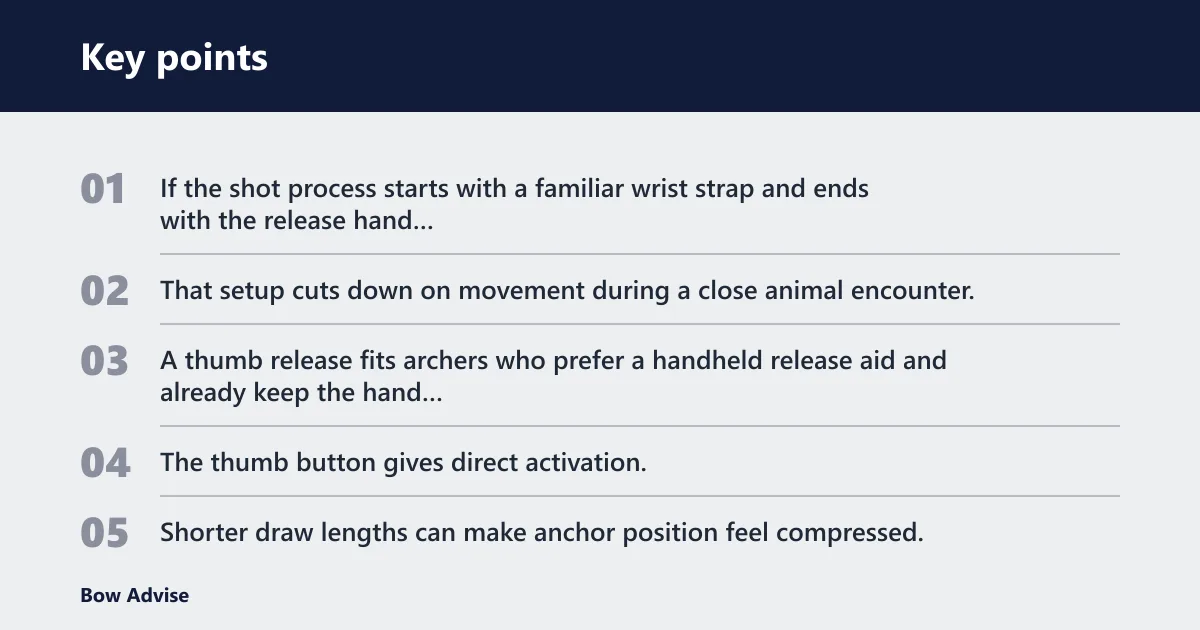
If the shot process starts with a familiar wrist strap and ends with the release hand landing in the same spot under the jaw or at the corner of the mouth, a mechanical release often feels cleaner. That setup cuts down on movement during a close animal encounter.
Target-style hand position and thumb control
A thumb release fits archers who prefer a handheld release aid and already keep the hand settled in a consistent index position. The thumb button gives direct activation, but it also demands a steadier grip and more control than a wrist-strap trigger.
Short draw, long draw, and anchor pressure
Shorter draw lengths can make anchor position feel compressed, which may favor the simplest shot cycle. Longer draw lengths often give more room for a secure anchor, and that can favor thumb shooters who want to build back tension through the elbow and shoulder instead of through the finger.
How release choice changes shot execution
Mechanical releases usually encourage a quicker, more direct trigger sequence. Thumb releases slow the shot down enough to make pressure management more obvious, which can help bowhunters who need cleaner execution at 20 to 40 yards.
Suppose a hunter draws a 60-pound compound from a tree stand with a bulky glove on the bow hand and a thin liner on the release hand. A mechanical release is easier to stage, because the trigger is simpler to find and operate without changing the anchor.
A common first-timer mistake is switching to a thumb release and changing anchor point at full draw. That small shift can move the peep out of line and force the archer to chase the sight picture instead of settling into it.
How do hunting conditions change the choice?
Cold weather, tree stands, and tight hunting windows change release fit fast. A release that feels fine on a range can become awkward when gloves, a harness, or limited movement get added. The right choice is the one that stays quiet, stays ready, and does not force a new hand position when the shot opportunity appears.
Cold-weather gloves and finger dexterity
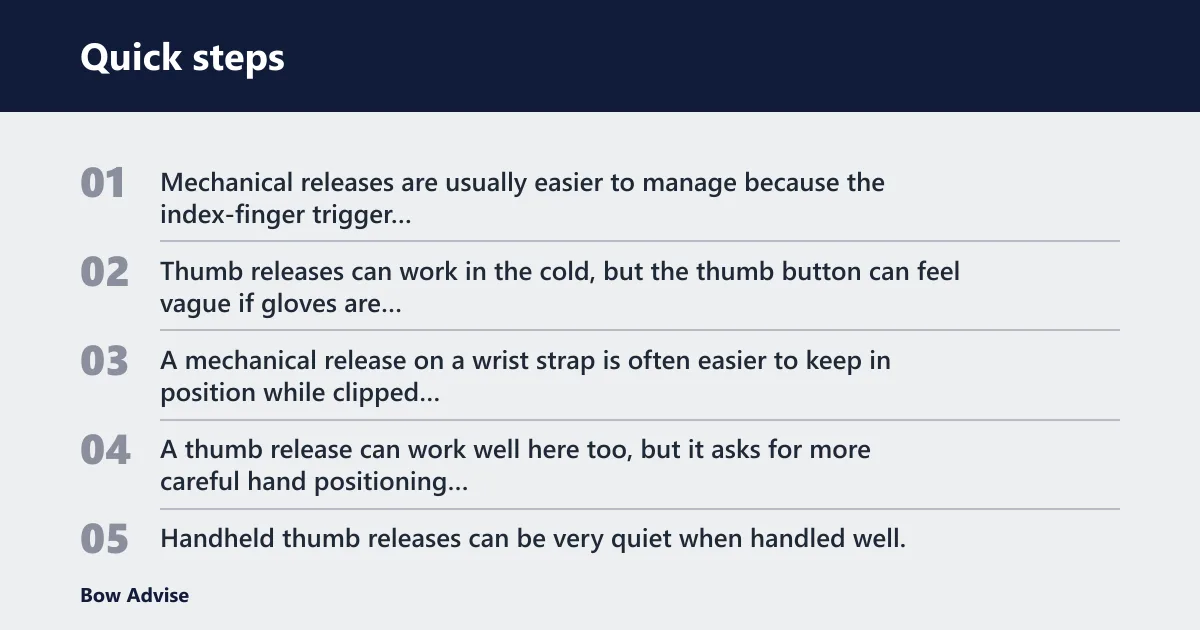
Glove thickness is a real factor. Mechanical releases are usually easier to manage because the index-finger trigger remains familiar even when hand feel drops. Thumb releases can work in the cold, but the thumb button can feel vague if gloves are thick or stiff.
Tree stand hunting and limited movement
Tree stand hunting rewards simple motion. A mechanical release on a wrist strap is often easier to keep in position while clipped in, watching lanes, and waiting on a shot. A thumb release can work well here too, but it asks for more careful hand positioning and steadier manipulation.
Quiet handling and shot readiness
Noise matters at close range. Handheld thumb releases can be very quiet when handled well, but they leave more room for fidgeting if the shooter is trying to settle grip and trigger control at the same time. Mechanical releases are less demanding when the shot has to happen fast.
D-loop setup and peep alignment
Both release types work well with a D-loop on a compound bow, but the release choice changes how the anchor settles against the face. If the anchor shifts, peep alignment shifts with it. That is why the same release can feel excellent on one bow and awkward on another when draw length or anchor geometry changes.
Trigger feel, travel, and control
Mechanical releases use trigger-style activation, usually with the index finger. Some models offer adjustable travel or tension, which changes how much movement happens before the release fires. Thumb releases use thumb button or hook activation, and many hunters choose them because the shot can feel more controlled and less abrupt.
Mechanical release trigger weight and travel
On some mechanical models, trigger weight and sear travel can be adjusted. Less travel can make the shot feel fast, but it can also raise the chance of an accidental discharge if the hunter is heavy-handed or surprised by the wall.
Thumb release tension, sear feel, and surprise shot
Thumb releases often let the shooter build pressure into the handle and fire with a surprise shot. That is why they can help archers who are working through target panic or trying to move away from punch-and-hold habits.
Accidental discharge risk and safe activation
Safety is about how the release is handled, not only what type it is. A very light mechanical trigger can go off too easily in a tense tree stand. A thumb release can also fire early if the thumb is placed on the button too soon or if grip pressure changes during aim.
Adjustability on hunting models
Many hunting releases offer some amount of travel or tension adjustment, but the useful range varies by model. The practical goal is not maximum sensitivity. It is a clean shot that matches the hunter’s release hand, anchor point, and ability to stay calm at full draw.
Do thumb releases work for bowhunting?
Yes, thumb releases can work very well for bowhunting when the hunter keeps the same anchor, controls the handle, and understands how the shot is supposed to break. They are especially useful for shooters who want back-tension potential and a cleaner pull-through. They are less forgiving when gloves, cold hands, or rushed movement break that process.
Back-tension potential in the field
Thumb releases are the stronger choice for back-tension shooting because they support a controlled surprise release. That does not mean every hunter must shoot that way. It means the release makes that style possible in the field if the archer is already trained to use it.
When a thumb release helps shot execution
Thumb releases help when the hunter draws with a firm anchor, settles the sight pin, and wants to keep pressure moving through the back instead of snapping at the trigger. They can also help archers who dislike the twitchy feel of a trigger release.
When a thumb release creates problems
A thumb release creates problems when the hunter changes grip pressure at anchor, searches for the button, or cannot feel the handle consistently in cold weather. It also becomes awkward if the archer is used to a wrist-strap trigger and has not built a repeatable handheld shot process.
Hunting distances and repeatability
At common bowhunting distances, repeatability matters more than theoretical precision. A release that keeps the peep aligned, the anchor steady, and the shot process unchanged will usually serve better than a “better” style that forces the hunter to think too much at full draw.
Choose Mechanical Release if… / Choose Thumb Release if…
Choose Mechanical Release if you are a beginner hunter, wear gloves often, hunt from a tree stand, or need one-hand readiness with the least amount of hand movement. It is also the safer fit for archers who want a straightforward trigger feel and do not want to rebuild their shot process.
Choose Thumb Release if you already anchor hard, prefer a handheld release aid, want more back-tension potential, or are moving away from trigger punching. It also fits hunters who can keep their thumb pressure consistent and do not mind a slower learning curve.
- Match the release to your anchor point first.
- Check how well it works with your hunting gloves.
- Practice one-handed staging if you hunt from a stand.
- Confirm peep alignment at full draw with your actual setup.
- Pick the release that keeps your shot process unchanged under pressure.


Frequently asked questions
Mechanical release vs thumb release: which is better for bowhunting?
Neither is always better. Mechanical releases fit hunters who want simple index-finger activation, strong glove compatibility, and easy one-hand readiness. Thumb releases fit hunters who anchor consistently and want more control over shot execution. The better choice is the one that matches draw style and field conditions.
Is a thumb release good for hunting from a tree stand?
Yes, but only if the hunter can keep the handle staged quietly and maintain a repeatable anchor from a seated position. In a tree stand, a mechanical wrist-strap release is often simpler. A thumb release works best when the shooter already handles it naturally under pressure.
Do mechanical releases improve accuracy for bowhunters?
They can improve practical accuracy for hunters who shoot them consistently, because the trigger is easy to learn and hard to overthink. That said, accuracy comes from repeatable anchor, peep alignment, and clean execution. A mechanical release does not fix poor form by itself.
Which release is better for cold weather gloves: thumb or wrist strap?
A wrist-strap mechanical release is usually better with cold-weather gloves. Thick gloves reduce thumb feel and make fine button pressure less reliable. If glove use is common in the hunt, the simpler trigger and strap setup usually wins.
What draw style works best with a thumb release?
A draw style with a hard, repeatable anchor and a handheld, target-style release hand position fits thumb releases best. The key is that the handle must land the same way every time. Hunters who draw differently on every shot usually struggle more with a thumb release.
Should a beginner hunter start with a thumb release or a wrist release?
Most beginner hunters should start with a mechanical wrist release. It is easier to stage, easier to feel through gloves, and less demanding on anchor discipline. A thumb release can come later, after the hunter has a stable anchor and understands controlled shot execution.