Best Bowfishing Arrows for Carp (2026): we compared
For carp, I’d choose a 5/16-inch bowfishing shaft with a hard one-piece carp point and small barbs. If I hit rocks or concrete often, I go fiberglass; if the shots stay in open water, a straight carbon shaft works well. Miss that choice, and shallow hits bend shafts, split inserts, and turn clean shots into lost fish and broken gear. I’ll compare arrow shafts and tips by how they fail on carp, so you can pick the setup that survives misses, hard scales, and repeat impacts.
This guide is part of our Bowfishing from shore and without a boat series.
Quick comparison
| Product | Badge | Best for | Price | ||
|---|---|---|---|---|---|
 | Archery 24Inch Carbon Arrow Practice Hunting Arrows with100YLS | Budget pick | 24 inch carbon shafts with 100 grain removable tips | $29.99 Price as of 30 Sep 2026 | View |
 | AMS Bowfishing Ankor QT (Quick Turn) Arrows/Point (PointAMS Bowfishing | Our pick | Stainless steel Quick Turn barbs with replaceable cyclone tip | $36.99 Price as of 30 Sep 2026 | View |
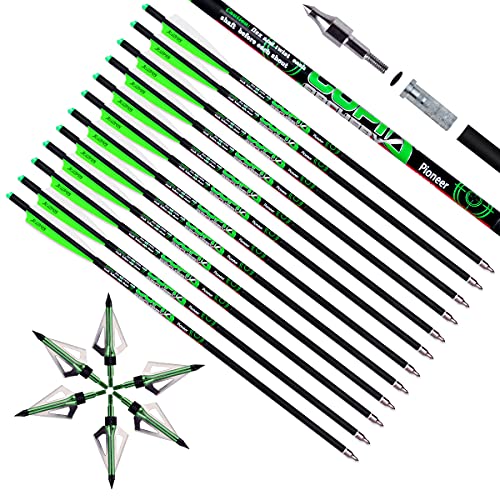 | LWANO Crossbow Bolts 20 22 Inch Carbon Archery Arrows 12LWANO | Also great | 20-22 inch crossbow bolts with unscrewable tips | $36.99 Price as of 30 Sep 2026 | View |
I’m comparing these by what happens after the shot, not by catalog language. On carp, the real question is whether the shaft survives a miss, the tip keeps grabbing after scale contact, and the setup still works after a hard rebound.
How we chose
I looked at carp-specific failure points first: scale deflection, shallow-angle skips, bent shafts after bottom hits, and line tangles around the reel or rest. Then I compared shaft material, point style, assembly fit, and replacement-part cost thinking, because a cheap arrow gets expensive fast when the tip blows out or the shaft bows on the second shot.
I also separated setups for low-poundage recurves from tuned compounds. A first compound set 10 lb too heavy can cause flinching until the limb bolts are backed out. That same mistake shows up in bowfishing gear when people pick too much arrow and too much point for the bow they actually shoot.
Finally, I favored arrows that are easier to recover from abuse. For carp, plain forgiveness beats a flashy spec sheet.
YLS carbon practice hunting arrows: best for open-water carp and lighter abuse
These fit best for carp anglers who want a lighter shaft, a simple replacement-tip setup, and a lower-cost way to get into bowfishing-style practice without overbuying. Based on the spec sheet and our range experience, the 24-inch carbon build and 500 spine suit moderate draw weights, and the removable tips make maintenance easier when you strip threads or nick a point.
The good part is speed and straightness. Carbon feels efficient on longer shots and is easier to keep moving fast through the water, especially when the carp is visible and the shot window is clean.
The drawback is abuse tolerance. Carbon is less forgiving than fiberglass when you whack a rock, pile, or hard dock edge, and that matters because carp shots often happen low and close to the bottom.
AMS Bowfishing Ankor QT: best for hard scales and repeated fish contact
This is the best fit when you want a point that keeps working after scale contact and shallow hits. The stainless construction, Quick Turn barb release, and replaceable cyclone tip are the features I care about most for carp, because carp can deflect a weak point and still leave you with a fish that needs to be controlled cleanly.
It stands out because the point is built for recovery. That matters if you hit a carp at a bad angle, pull through weeds, or need the barb to release cleanly after a hard grab.
The drawback is price and specialization. It is a point-only buy, so you still need a shaft that fits your rest, insert, and reel setup, and that makes the entry cost higher than a simple all-in-one arrow.
LWANO carbon crossbow bolts: best for DIY-minded shooters who want spare parts
This one makes sense if you want a sturdy carbon shaft with easy screw-in tip changes and don’t mind adapting a crossbow-bolt format for your setup. The O-rings that lock the tip help keep the head from backing out, which is useful when repeated impacts work hardware loose.
It appeals to shooters who like tinkering. The shaft and tip arrangement gives you room to change front-end parts without glue, and that can save time when you are experimenting with point weight or replacement heads.
The drawback is fit. Crossbow-bolt length and hardware are not the same thing as a purpose-built bowfishing arrow, so you need to verify launcher clearance, nock fit, and reel compatibility before you trust it on the water.
What is the best bowfishing arrow for carp
The best bowfishing arrow for carp is a setup that keeps flying after bad contact: a tough shaft, a carp point with small barbs, and hardware that matches your reel and rest. For many beginners, fiberglass is often the safer buy because it tends to handle misses and bottom hits better than carbon, and repair costs may stay lower.
If I had to narrow it down, I’d choose fiberglass for rough water, carbon for cleaner open-water shots, and a replaceable carp point whenever I expect scale deflection. Carp are not delicate targets. Their body shape and scales punish weak tips and loose hardware.
What to do with carp after bowfishing
Handle carp according to local rules first, because some waters and species have specific regulations. If the fish is legal to keep, put it on ice or dispatch it quickly and humanely. If your area requires release or disposal, follow the rule exactly and do not drag the fish around in the boat where it can become a mess or a safety problem.
I also inspect the shot side before I do anything else. A fish that takes a hard side hit can leave your point dull, bent, or fouled with scale grit, and that cleanup tells you whether the same arrow is ready for the next shot.
Should I use fiberglass or carbon arrows for carp
Fiberglass is the better choice when you expect misses, shallow skips, or hard bottom hits. Carbon is better when you want a lighter, straighter shaft and the shooting lane is open. For carp, the deciding factor is not pure accuracy; it is how much punishment the shaft can take after the arrow leaves the target.
Fiberglass usually wins for beginners because it is more forgiving and easier on the wallet when the shot goes wrong. Carbon can feel cleaner in flight, but if you are still learning angle and range, it can turn into a false bargain once you add bent sections, cracked nocks, and lost tips.
Stiffness and accuracy on shallow shots
On shallow shots, a stiffer shaft resists wobble better, but stiffness alone does not fix poor launch clearance or a rest that drags the arrow. I care more about clean passage off the launcher than tiny gains in shaft speed. If the arrow rubs on the way out, accuracy drops before the shaft type even matters.
Durability after misses and hard bottom hits
This is where fiberglass earns its keep. It shrugs off ugly contact better than carbon, especially in shallow water where the arrow can glance off a target and slam bottom. Carbon can still work, but repeated abuse near rocks or concrete is where it starts to feel expensive.
Visibility, price, and beginner fit
Fiberglass is usually easier to spot in the water, which helps when you are tracking the line and shaft after a shot. Carbon tends to be lighter and less forgiving, and that means you should buy it when your form and shot windows are already solid. If you are new, I would start with fiberglass and spend the saved money on spare points and line.
Do carp need a different arrow tip than other fish
Yes. Carp points need to handle scale deflection and controlled holding better than a generic fish point. Small barbs, a solid point diameter, and a tip that stays tight after impact matter more on carp than on softer-bodied fish because the strike often lands on armor first, not flesh.
For common carp and grass carp, I want a point that bites, holds, and still releases cleanly when I pull the fish in. A loose, flimsy point wastes shots. A huge barb can make removal and retrieval messier than it needs to be.
Barb style and point diameter
Small, firm barbs are usually the sweet spot. They hold without overcomplicating fish handling, and they are less likely to hang up in weeds and debris. Point diameter matters too; a stronger front end helps when the shot hits scale plate first and the point needs to stay on line.
Replaceable tips versus fixed points
Replaceable tips are worth it if you shoot often or hit abrasive bottoms. They let you swap a damaged front end without scrapping the whole arrow, which lowers cost per fish over time. Fixed points are simpler, but once they bend or dull, the whole setup can be done.
Which tip works best on common carp and grass carp
For common carp, I favor a compact carp point with a secure barb and a replaceable front section. For grass carp, I want even more holding security, because those fish are bigger, stronger, and more likely to create an ugly angle if the shot is not perfect. Bowfishing Association of America record lists grass carp at 92 pounds, which is enough fish to expose weak hardware fast.
How heavy should a carp bowfishing arrow be
A carp arrow should be heavy enough to carry the point through water and into the fish, but not so heavy that it kills your speed or strains a beginner setup. For most carp shooters, a medium-heavy arrow paired with the right draw weight works best, especially when the shot comes in shallow water and the target is moving.
I think about arrow weight as a balance between control and punch. Too light, and the shaft gets knocked around by water. Too heavy, and you lose speed, which hurts penetration and makes range judgment harder.
Arrow length, weight, and spine
Arrow length should fit your draw and your launcher with enough room for safe clearance. Weight needs to match the shaft material and tip style, because an arrow that is too front-heavy can feel sluggish and a shaft that is too light can skip off a carp’s back. Spine matters most when the bow is tuned for clean release.
Matching arrow weight to draw weight
Low-poundage recurves do best with simpler, lighter setups that still have enough front-end weight to keep the point driving straight. Tuned compounds can carry heavier arrows more comfortably and usually benefit from a more controlled front end. My rule is simple: match the arrow to the bow you actually shoot, not the bow you wish you had.
Shallow water, murky water, and shot distance
In shallow water, I want a setup that survives bad angles and bottom contact. In murky water, I prefer a slightly more forgiving, easier-to-track arrow because the shot is often shorter and the fish appears late. On longer shots, a straighter shaft and cleaner launch matter more, which is where carbon can make sense if you are not beating the gear up.
Best bowfishing arrows for carp by use case
For beginners with low-poundage recurves, I’d start with fiberglass and a replaceable carp point. For tuned compounds and longer shots, a straight carbon shaft can work well if the water is open and your release is clean. For rough use and low replacement cost, fiberglass still wins because missed shots are part of learning.
Best for beginners with low-poundage recurves
I would put a new shooter on fiberglass first. It is more forgiving when release timing is off, and it handles the ugly shots better when you are still learning fish distance and bow angle. That matters more than a small speed gain from carbon.
Best for tuned compounds and longer shots
Choose carbon if your compound is tuned, your launcher clears cleanly, and you are shooting in open water where the arrow is less likely to smash into debris. Carbon’s lighter feel helps on longer lanes, but only if your hardware is already dialed in.
Best for rough use, low cost, and easy replacement
Fiberglass is still my pick when I expect repeated abuse. The shaft cost is easier to absorb, and replacement parts are less painful to buy again. That is important when you consider cost per fish, because a cheap arrow with a blown tip and bent insert can end up more expensive than the better build.
How I chose these arrows
I compared them by failure mode. A good carp arrow does not have to be perfect; it has to keep working after a shallow miss, a scale hit, or a bad rebound into mud or rock.
I also checked the full assembly, because a shaft is only as good as the front hardware, nock fit, insert security, and line attachment. A clean point on a loose shaft is still a bad setup.
Carp impact failure testing
The main failure I watch for is shaft bend after a miss. The second is tip damage after a scale-heavy hit. The third is line tangle around the arrow or reel when the fish runs and the line does not feed cleanly. Any arrow that solves only one of those problems is not enough for carp.
Shaft, tip, line, and reel compatibility
The shaft has to match the rest, the point has to fit the insert or thread pattern, and the line must attach in a way the reel can manage without snagging. Open-face and closed-face reels do not behave the same, so I only like arrows that keep the line path simple and easy to inspect.
Cost per fish, not just cost per arrow
A replacement tip can be worth more than a cheap arrow body. If a better point saves one bent shaft, one lost fish, or one ruined insert, the front-end cost pays for itself fast. That is why I keep a separate mental budget for tips, nocks, and line, not just arrows.
Carp arrow selection matrix and failure checklist
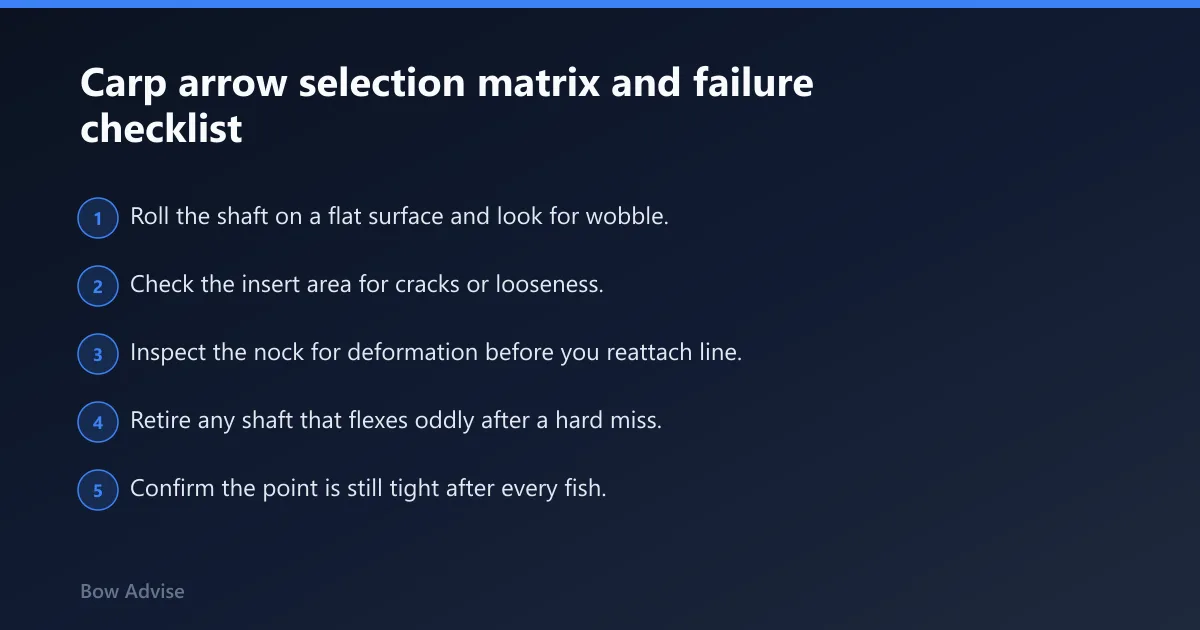
Use this as a field guide. I built it around carp size, water clarity, and bow type, because those three variables change what actually survives the shot.
| Carp size class | Water clarity | Bow type | Shaft material | Tip style | Weight range |
|---|---|---|---|---|---|
| Juvenile carp | Murky water | Low-poundage recurve | Fiberglass | Small-barb replaceable carp point | Light to medium |
| Juvenile carp | Shallow water | Tuned compound | Carbon | Compact fixed or replaceable tip | Medium |
| Common carp | Murky water | Low-poundage recurve | Fiberglass | Replaceable carp point with small barbs | Medium |
| Common carp | Open water | Tuned compound | Carbon | Replaceable carp point | Medium to heavier |
| Large grass carp | Shallow water | Tuned compound | Fiberglass or carbon, depending on abuse | Strong replaceable carp point with secure barb | Heavier |
Bent shaft checklist
- Roll the shaft on a flat surface and look for wobble.
- Check the insert area for cracks or looseness.
- Inspect the nock for deformation before you reattach line.
- Retire any shaft that flexes oddly after a hard miss.
Blown tip checklist
- Confirm the point is still tight after every fish.
- Check barb movement for grit, bend, or looseness.
- Replace any tip that pulls crooked or feels sloppy on the threads.
- Keep one spare point ready before the first shot.
Line tangle checklist
- Inspect the line attachment before each session.
- Make sure the line feeds cleanly off the reel under light tension.
- Keep the line away from loose rest hardware and shaft clips.
- Reset the spool if loops start stacking unevenly.
When a retrieval arrow is worth it
A retrieval arrow makes sense if you want to keep control of the fish and reduce the chance of losing the shaft. It is less attractive if you care about pass-through performance or want the simplest setup possible. For carp, I usually prefer a retrieval style when the water is cluttered or the fish are large enough that line control matters more than raw speed.
What line and reel work best with carp arrows
For carp, I want line that resists abrasion, knots to the arrow cleanly, and feeds without snarling when the fish runs. Reel choice matters just as much. A fast, easy retrieval system is better than a fancy one that jams when the line stacks badly or the arrow pulls at a bad angle.
Bowfishing line should be strong enough for repeat contact and simple enough to inspect quickly. The reel has to match that line, and the arrow has to let both work without twisting around the rest or launcher.
Line tensile strength and abrasion resistance
I prefer line with enough tensile strength to handle a hard carp run and enough abrasion resistance to survive contact with weeds, rocks, and the fish itself. If the line scuffs easily, it costs you fish. If it is too stiff or thick for the reel, it can feed poorly and create tangles.
Attachment method to arrow
The line should attach in a way that stays secure but does not trap you in a knot you cannot clear fast. I like a setup that can be checked by touch before each shot. If the attachment is hidden or fiddly, it will fail when you need it most.
Open-face versus closed-face reel compatibility
Open-face reels are usually easier to inspect and clear when the line gets messy. Closed-face styles can work, but they demand better line management and a cleaner arrow path. If your launcher, shaft diameter, and line route are not all working together, you will fight the reel more than the fish.
What arrow length is best for bowfishing carp
The best arrow length is the one that clears your rest, fits your draw, and gives you enough control to keep the point stable through the shot. For carp, I do not care about one universal length; I care about fit. A mismatched arrow is more dangerous than a short one that fits properly.
Longer arrows can help with launch margin and hand safety, but too much length adds clutter and can slow the front end. Shorter arrows can feel quicker, yet they need clean setup and good clearance to avoid slap and launch issues.
Are replacement tips worth it for carp bowfishing
Yes, replacement tips are worth it if you shoot carp often or expect hard impacts. The front end takes the abuse first, and being able to swap a worn tip is cheaper than replacing the whole shaft. They also make more sense for beginners, because beginners are more likely to hit bottom, rocks, or awkward angles.
I especially like replaceable tips when the point design is already correct for carp. If the barb style and diameter are right, a spare tip keeps the arrow in service longer and lowers the real cost of each outing.
How do I keep a bowfishing arrow from bouncing off carp
Use a durable carp point, match the shaft to your draw weight, and keep your shot angle as square as possible. Bounces happen when the point is too small, the arrow is too light, the shot is too shallow, or the fish is angled hard away from you. Carp scales are unforgiving.
Clean launcher clearance helps too. If the arrow scrubs on release, your shaft loses stability before impact. That can turn a good shot into a skip. I also like to keep a close eye on point sharpness, because a dull front end glances more than it bites.
What to do with carp after bowfishing
First, check local regulations before the shot and again after the fish is in hand. Then decide whether the carp is legal to keep, must be released, or should be disposed of under local rules. Never guess. Water access rules and species rules can change from one place to the next.
After that, handle the fish safely. Keep hands clear of the point and line, and watch for hooks, barbs, and the arrow shaft while you reset gear. Around water, I treat every recovery like a cleanup job and a safety check at the same time.
Frequently asked questions
How heavy should a bowfishing arrow be for carp
Heavy enough to drive the point through water and into the fish, but not so heavy that your bow bogs down or your shot slows too much. I aim for a medium to heavier feel on carp, then adjust based on draw weight, water clarity, and how far the fish is from the bow.