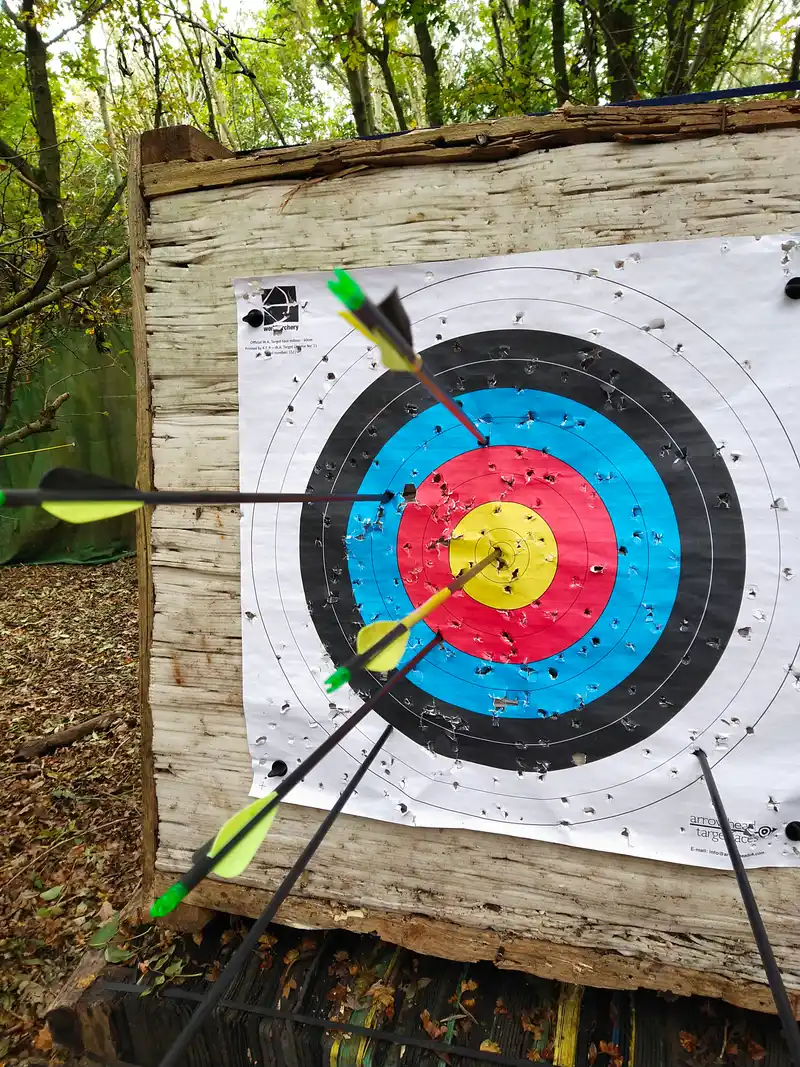
Carbon Arrows vs Aluminum Arrows for Hunting: Key Differences
Carbon arrows are usually the better hunting choice for most bowhunters because they are lighter, stiffer for their weight, and usually hold up better after hard impacts. Aluminum can still win for short-range, heavy-front setups and exact spine matching. Wrong shaft choice can mean poor broadhead flight, broken arrows, and higher total replacement cost after a bent or splintered shaft. This guide compares tuning tolerance, durability, penetration, and when aluminum still makes sense for deer and similar game.
This guide is part of our Hunting gear comparisons for archers series.
Carbon arrows vs aluminum arrows for hunting: the core hunting trade-off
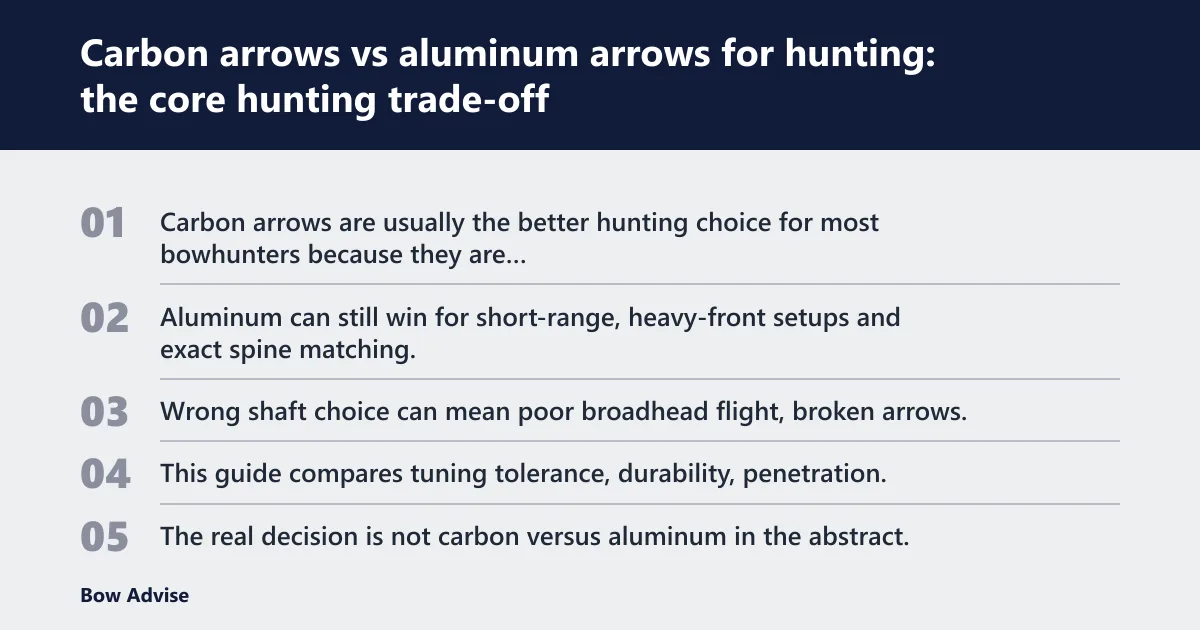


The real decision is not carbon versus aluminum in the abstract. It is how the shaft behaves in a hunting setup with your draw weight, arrow length, broadhead type, and transport habits. Carbon arrows are made from carbon fiber and are lighter than aluminum, while aluminum shafts are metal alloy construction and heavier than equal-spine carbon. Those differences change launch speed, broadhead forgiveness, and the way damage shows up after impact.
Carbon is the dominant choice for many modern bowhunters, and for good reason. But aluminum still has a place. A heavier shaft can carry good momentum, can be easier to match in a compact hunting setup, and can be the cleaner answer for some traditional and recurve bows where exact tune and a heavier finished arrow matter more than raw speed.
| Decision factor | Carbon arrows | Aluminum arrows for hunting: key differences | Winner |
|---|---|---|---|
| Weight and speed | Lighter shaft mass, often faster launch speed | Heavier at equal spine, usually slower but with more mass | Carbon arrows |
| Damage mode | Can crack or splinter, sometimes with hidden damage | Can bend or dent, sometimes can be straightened | Tie |
| Tuning forgiveness with broadheads | Often better with hunting-focused designs and good spine match | Very consistent, can work well with heavier front ends | Carbon arrows |
| Inspection burden | Needs crack checks before shooting and hunting | Needs bend checks, but damage is often visible | Aluminum arrows for hunting: key differences |
| Budget and replacement risk | Often higher purchase price, lower loss if durable and inspected | Often lower entry cost, but bend risk can shorten usable life | Tie |
Weight and launch speed
Carbon wins this row because it is lighter than aluminum for the same spine. That usually means faster arrow speed, and often a flatter trajectory at hunting distance. Aluminum gives up speed, but the added mass can help momentum and can quiet some setups, especially when the bow is already tuned for a heavier arrow.
Damage mode
This is often a close call because both materials can fail in ways that matter to hunters. Carbon can crack or splinter, including hidden damage after a hard hit, while aluminum can bend or dent. The practical difference is that bent aluminum is often easier to spot, while carbon often needs a careful flex, roll, and visual inspection.
Tuning forgiveness with broadheads
Carbon gets the edge because hunting-focused carbon shafts are often built around broadhead stability. That matters most with fixed blades, where poor dynamic spine can cause planing. Aluminum can also tune well, especially when the arrow is built heavier up front, but carbon’s lighter mass and modern hunting shaft designs usually make it the easier path for broadhead flight.
Inspection burden
Aluminum wins this row because bent shafts are usually easier to catch before shooting. Carbon shafts need crack checks for safety, and hidden damage is the problem. A shaft that looks fine can still fail under launch stress if it has a crack from an unseen impact, so carbon may need more careful inspection.
Budget and replacement risk
This one is a tie once you include lifespan, loss rate, and replacement risk. Aluminum often costs less up front, but a bent shaft may be done for hunting even if it still flies. Carbon often costs more initially, yet it can stay in service longer if it survives impact and passes inspection. Total cost depends on how often arrows get lost, hit hard, or need replacement.
📊 Mid-range carbon arrows are often within 0.003 to 0.004 inches straightness tolerance. Source: 10 Best Carbon Arrows for Hunting (2026 Reviews) • Advanced….
How do carbon and aluminum arrows compare side by side?

Carbon arrows are lighter, often faster, and usually the better all-around hunting choice when broadhead flight matters. Aluminum arrows are heavier, often more consistent in manufacturing, and can be a smart pick when a hunter wants a heavier shaft and a simpler tune path. The best choice depends on the bow, the broadhead, and how rough the setup will be in the field.
Weight and launch speed
Aluminum arrows are heavier than carbon arrows with equal spine. That extra mass can reduce launch speed, but it can also help arrow momentum on impact. Carbon’s lighter weight is useful when trajectory and speed matter, especially for hunters stretching yardage inside a bow’s ethical limit.
Spine options and shaft diameter
Spine rating is the shaft stiffness measurement that helps match an arrow to draw weight, arrow length, and point weight. Carbon and aluminum may need different diameters for similar spine, so the same “spine” number does not always mean the same build. A bow that tunes well with one material may need a different shaft size in the other.
Straightness tolerance and consistency
Carbon hunting shafts are sold with straightness tolerances as tight as ±.001 inches. Mid-range carbon arrows are often within 0.003 to 0.004 inches, and standard carbon arrows are often listed at 0.005 to 0.006 inches. Aluminum is known for consistent manufacturing tolerances, which is one reason it still appeals to hunters who want predictable arrow behavior without chasing premium carbon bins.
Price, lifespan, and replacement risk
Aluminum often wins at the checkout counter, but price alone is not the full story. A bent shaft may be cheaper to buy at first and still end up needing replacement sooner. Carbon can cost more initially, yet a tougher shaft with a good inspection habit may last longer in a hunting quiver, especially if the hunter avoids repeated hard impacts.
Which material tunes better with broadheads?
Carbon usually has the advantage with broadheads because hunting carbon shafts are designed around stable arrow flight and strong dynamic spine control. Fixed blades are unforgiving, so a shaft that recovers from the paradox well and resists planing can save a setup that looks good on paper but flies poorly in the field.
Fixed-blade broadheads and planing risk
Fixed blades create more steering effect than field points. If the shaft is under-spined, over-spined, too long, or matched with the wrong point weight, the broadhead can plane. Carbon hunting designs may use stiff ends or weight-forward construction to help control that, while aluminum often benefits from simple, predictable geometry and a well-matched spine.
Mechanical broadheads and forgiveness needs
Mechanical heads are usually easier to tune because the blades stay closed in flight. That does not make shaft choice irrelevant, but it does make the broadhead less sensitive to small tune errors. Carbon still tends to be the stronger default because it gives more speed for the same finished hunting arrow weight.
Dynamic spine, nock fit, and point weight effects
Dynamic spine is the in-flight flex behavior that changes with arrow length, insert weight, point weight, and shaft construction. Nock fit matters too, because a poor fit can introduce small inconsistencies that show up at broadhead distance. A shaft that paper-tunes okay can still group poorly if dynamic spine and nock fit do not match the rest of the setup.
Say your fixed-blade setup starts hitting left at 30 yards after a point-weight change. The shaft may be reacting to a spine change, not just the broadhead itself. In that case, shortening the arrow, reducing front weight, or moving to a different spine class may solve the problem faster than swapping heads again.
What damage looks like in real use
Carbon needs crack checks; aluminum needs bend checks. Both are safety-critical before practice and before a hunt. A damaged shaft can fly unpredictably, lose accuracy, or fail at release, so inspection is part of the hunting setup, not an optional habit.
Carbon crack checks and hidden damage
Carbon damage can be subtle. Look for splintering, white lines in the finish, soft spots, or a shaft that sounds different when flexed compared with the others. If a shaft has taken a hard hit, especially into a target face, a bone-like object, or a hard edge, treat it as suspect even if the outside looks normal.
Aluminum bends, dents, and when a shaft can be straightened
Aluminum often gives a clearer signal because bends and dents are easier to see. Some minor bends can sometimes be straightened, but a shaft with a visible crease, deep dent, or wobble is probably not one to trust for hunting. Straightening is not a free pass to keep shooting a shaft that is already compromised.
Inspection rules before practice and before a hunt
- Roll each shaft on a flat surface and watch for wobble.
- Inspect the full length under bright light for cracks, dents, or splinters.
- Check nock fit and insert alignment before broadhead shooting.
- Retire any shaft that took a hard impact and now looks or feels different.
- Do a final inspection before every hunt, not just after setup.
A common first-timer mistake is to keep shooting a carbon arrow that passed a quick glance after a target pass-through. That is exactly the kind of hidden damage that can turn into a field failure later. The safer move is simple: if there is doubt, remove the shaft from hunting duty.
Hunter decision matrix: which shaft wins in each scenario?
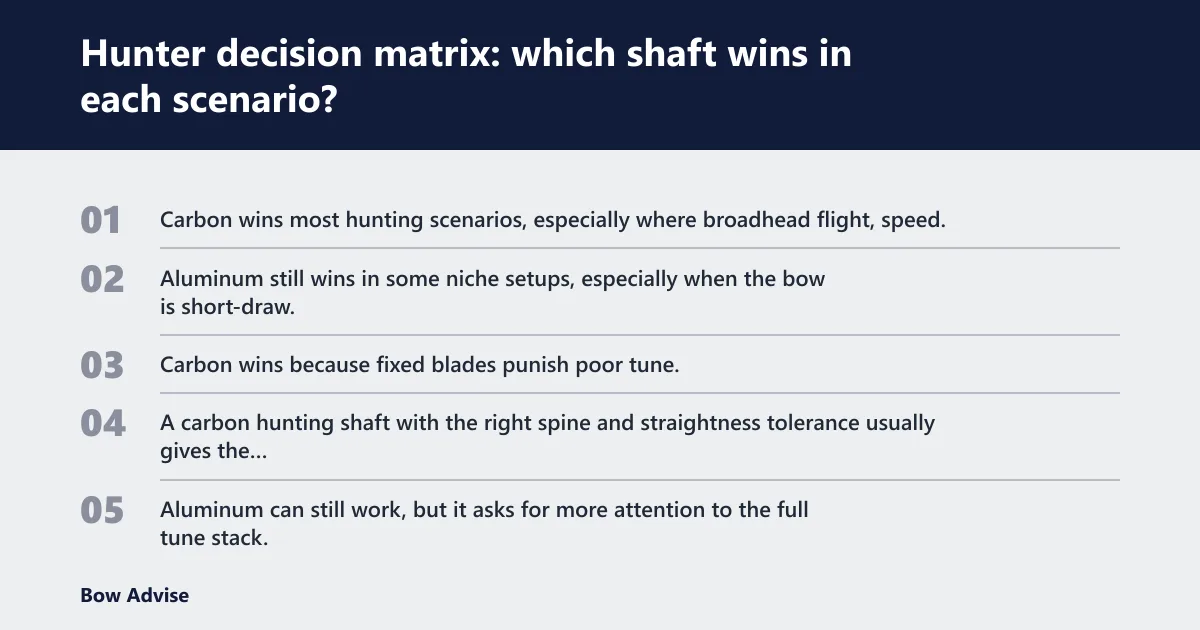
Carbon wins most hunting scenarios, especially where broadhead flight, speed, and impact resistance matter. Aluminum still wins in some niche setups, especially when the bow is short-draw, the arrow needs a heavier finished mass, or the hunter wants a simple, consistent shaft with visible damage when something goes wrong.
| Scenario | Carbon arrows | Aluminum arrows for hunting: key differences | Winner |
|---|---|---|---|
| Fixed-blade broadheads | Often better broadhead flight when spine is matched well | Can tune well, but may take more effort to control planing | Carbon arrows |
| Mechanical broadheads | Fast, forgiving hunting choice | Works fine if the setup is tuned and heavy enough | Carbon arrows |
| Short-draw bows | Helpful because speed loss is less of a penalty | Heavier shaft may help if the bow likes more mass | Tie |
| High-poundage compounds | Strong option for speed and penetration potential | Can work, but heavier arrows reduce launch speed | Carbon arrows |
| Beginner setups | Good, but hidden-crack inspection matters | Often simpler to understand and spot damage | Aluminum arrows for hunting: key differences |
| Budget builds | Better if loss risk is low and durability matters more than entry price | Often lower upfront cost | Aluminum arrows for hunting: key differences |
| Cold-weather hunts | Performs well if inspected carefully | Also works well; cold does not add hidden crack risk the same way | Tie |
| Rough transport conditions | Can survive well, but hidden damage must be checked | Bends can happen, but damage is often visible sooner | Aluminum arrows for hunting: key differences |
Fixed-blade broadheads
Carbon wins because fixed blades punish poor tune. A carbon hunting shaft with the right spine and straightness tolerance usually gives the easier path to stable arrow flight. Aluminum can still work, but it asks for more attention to the full tune stack, including point weight and arrow length.
Mechanical broadheads
Carbon remains the better default because speed and broadhead forgiveness both matter. Mechanical heads reduce steering sensitivity, so the arrow shaft’s main job becomes sending the head accurately and consistently. Carbon does that well without giving up too much momentum in a hunt-legal build.
Short-draw bows and high-poundage compounds
This row splits. Short-draw bows may benefit from a heavier aluminum shaft if the setup needs more finished mass and the bow tunes that way. High-poundage compounds usually lean carbon because speed, penetration potential, and shaft selection flexibility are better aligned with modern hunting goals.
Beginner setups, budget builds, cold-weather hunts, and rough transport
Beginners often do better with aluminum when the goal is simple tuning feedback and visible damage. Budget builds also favor aluminum at the checkout counter. For cold weather, either material can work. For rough transport, aluminum’s visible bend or dent can be easier to catch before the hunt than a carbon crack that hides under the finish.
Choose carbon arrows if… / Choose aluminum arrows for hunting: key differences if…
Carbon arrows are the better choice when the setup depends on faster launch speed, broadhead stability, and better impact resistance after normal hunting use. Aluminum arrows are the better choice when the hunter wants a heavier shaft, lower entry cost, and easier visual detection of damage. The right answer depends on the bow and the hunt, not on brand loyalty.
Choose carbon arrows if…
- You shoot fixed-blade broadheads and want less planing risk.
- Your compound bow benefits from a lighter shaft and faster launch speed.
- You want a hunting shaft with common straightness bins such as ±.001, ±.002, or ±.003.
- You are willing to inspect for hidden cracks before every hunt.
Choose aluminum arrows for hunting: key differences if…
- You want a heavier shaft for momentum or a traditional-style hunting setup.
- You prefer visible damage cues over hidden-crack risk.
- You are building on a tighter budget and can accept a shorter usable lifespan from bending.
- Your bow tunes cleanly with a heavier shaft and a simple, repeatable build.
Heavier aluminum can still be the better hunting shaft when quietness, momentum, and exact spine behavior matter more than speed. That is especially true in some recurve and traditional setups, and in compound builds where a heavier arrow helps the bow tune cleanly with a broadhead. Carbon wins more often, but aluminum is not outdated.
What spine should I choose for carbon vs aluminum hunting arrows?
Choose spine based on draw weight, arrow length, point weight, and the full setup, not just the material. Carbon and aluminum may require different shaft diameters for similar spine, so the same spine label does not guarantee the same tune. The correct spine is the one that lets the arrow recover cleanly and fly straight with your hunting head.
Matching spine to draw weight and arrow length
A longer arrow behaves weaker, and a heavier point weakens dynamic spine further. Higher draw weight usually needs a stiffer shaft. If the bow is marginal on spine, broadhead flight often gets worse before field-point groups tell the story, which is why hunting tuning should include the actual broadhead you plan to use.
Why straightness tolerance matters more for some setups
Straightness tolerance is the common hunting arrow spec listed in inches such as ±.001, ±.002, ±.003, or ±.006. Tighter tolerance usually costs more and often gives more consistent broadhead flight, especially on precise fixed-blade builds. For shorter ranges or less demanding setups, a looser bin may be acceptable if the shaft is otherwise a good match.
How grains per inch changes speed and momentum
Grains per inch is the shaft weight spec that helps compare arrow mass by model and spine. More grains per inch means a heavier shaft, which usually reduces speed but increases momentum. Less mass gives more speed, but the hunting trade-off is that a very light build may be less forgiving if the bow is not tuned well.
Frequently asked questions
Are carbon arrows better than aluminum arrows for hunting?
For most bowhunters, yes. Carbon arrows are usually better because they are lighter, often faster, and tend to hold up better after hard impacts when inspected properly. Aluminum still has a place when a heavier shaft, lower entry cost, or a simpler tune path matters more than speed.
Which is more accurate for bowhunting, carbon or aluminum arrows?
Neither material is automatically more accurate. Accuracy depends on spine match, straightness tolerance, broadhead choice, and how cleanly the arrow leaves the bow. A well-matched aluminum shaft can group extremely well, and a well-matched carbon shaft can do the same.
Do carbon arrows hit harder than aluminum arrows?
Not by themselves. Carbon is lighter, so it often moves faster, but aluminum is heavier and can carry more momentum at the same bow setup. “Hit harder” depends on total arrow build, not just shaft material, so finished weight matters more than the label on the shaft.
Are aluminum arrows safer or more durable than carbon arrows?
Aluminum is often easier to inspect because bends and dents are visible, while carbon can hide cracks after impact. That makes aluminum feel safer to some hunters. Durability depends on the type of abuse: carbon resists some impact conditions better, but hidden damage is the risk to respect.
What spine should I choose for carbon vs aluminum hunting arrows?
Choose the spine that matches your draw weight, arrow length, insert weight, and point weight. Carbon and aluminum may need different diameters to reach similar spine behavior, so do not assume the same label means the same tune. Start with the bow maker’s spine chart, then confirm with broadhead tuning.
Can I use aluminum arrows for deer hunting with a compound bow?
Yes. Aluminum arrows can be used for deer hunting with a compound bow as long as the shaft is correctly spined, straight, and matched to the broadhead setup. Many hunters prefer carbon, but aluminum still works well for deer when the finished arrow build is tuned correctly.
Do carbon arrows crack easily compared with aluminum arrows bend?
Carbon can crack or splinter, and those cracks may be hard to see. Aluminum usually bends or dents instead, which often makes damage more obvious. Neither failure mode should be ignored, because a damaged hunting shaft can be unsafe and inaccurate even if it still looks usable at a glance.
Which arrow material is better for beginners hunting with a bow?
Beginners often do well with aluminum because it is usually cheaper, easier to understand, and easier to inspect for visible damage. Carbon is also fine for beginners if they are ready to check for cracks carefully. The better choice is the one that matches the bow and the hunter’s inspection habits.