Recurve Bow vs Compound Bow for Bowfishing: Which Wins?
For bowfishing, I choose a recurve for beginners and tight boat or bank setups, and a compound only if you already own one that can be set to low draw weight and quick reloading matters less than aiming help. Pick the wrong setup and you waste shots, tangle lines, and fight the bow instead of the fish. I’ll compare control, reload speed, forgiveness, cost, and when an existing hunting bow makes sense.
This guide is part of our Bowfishing from shore and without a boat series.
Recurve bow vs compound bow for bowfishing: the real trade-off
| Decision factor | Recurve Bow | Compound Bow for Bowfishing | Winner |
|---|---|---|---|
| Boat use and cramped space | Short, simple, easier to move around rails and net handles | Can work well, but cams, cables, and add-ons can snag | Recurve Bow |
| First-shot speed and reload speed | Fast to bring up and reset with fewer steps | Fast shot once drawn, but more gear to manage between shots | Recurve Bow |
| Wet-hand control and accessory clutter | Better when hands are wet because there is less hardware | More to grip, set, and keep dry | Recurve Bow |
| Aiming help and hold comfort | Depends heavily on shooter skill and instinctive shooting | Let-off and a release aid make holding and aiming steadier | Compound Bow for Bowfishing |
| Beginner forgiveness | Forgives simple setup mistakes, but not weak form | Forgives the hold, but punishes bad setup and wrong draw length | Tie |
Boat use and cramped space
A recurve wins here because it stays simple in a tight boat. Fewer cams, cables, and accessories mean fewer things to bump against a gunwale, cooler, or partner’s net. In my own boat sessions, that matters more than raw arrow speed.
First-shot speed and reload speed
For quick follow-up shots, a recurve often feels faster in real use. I can bring it up, shoot, and reset with less fumble, which helps when a fish changes angle at the last second. A compound can be quick too, but only after you manage the extra moving parts.
Wet-hand control and accessory clutter
Wet hands change everything. A recurve’s plain build gives you fewer slippery spots and fewer line snags, while a compound bowfishing setup often adds more to hold, avoid, and maintain. That is why I like recurves for beginners on damp decks.
Aiming help and hold comfort
Here the compound has the edge. Compound bows use cams and cables, and let-off cuts the holding weight at full draw, which makes the aim steadier. If you struggle to hold on a fish that keeps moving, that help is real.
Beginner forgiveness
This row is a tie because each bow forgives a different mistake. Recurves are simple, but accuracy depends heavily on shooter skill and instinctive shooting. Compounds are easier to hold, but a wrong setup can punish you hard, especially if the draw length is off or the bow is too heavy.
📊 Even an entry-level compound can shoot 225 feet per second. Source: Fieldandstream.
Which bow is easier to shoot for bowfishing?
For most beginners, a compound is easier to shoot well because let-off reduces holding weight and a mechanical release steadies the shot. I still lean recurve for a first bowfishing setup in tight spaces, because bowfishing rewards fast handling and clean movement more than target-style aiming. Ease depends on the kind of mistake you make.
Recurve: simpler, but more shooter skill
A recurve has a plain build with no cams or cables, and it is commonly shot with fingers using instinctive shooting. That feels natural once you practice, but it asks a lot from your form. If your anchor point shifts or your release gets sloppy, fish will punish you fast.
Compound: steadier hold, more setup demands
Compound bows use cams and cables, and let-off makes them easier to hold at full draw. That helps when a fish moves and you need a longer aiming window. But the bow must fit you, the release must fit your hand, and the line-through setup must stay clean.
How beginner forgiveness changes on moving fish
Moving-water shots expose bad timing. I have seen new bowfishers jump at the fish instead of waiting for the line angle to settle, and that mistake shows up more with a rushed recurve shot. A compound helps hold the pin or point steadier, but if the shooter cannot read fish movement, the gear will not save the shot.

Side-by-side bowfishing comparison table
| Factor | Recurve Bow | Compound Bow for Bowfishing | Winner |
|---|---|---|---|
| How it works | Traditional bow with a single string between two limbs | Cams, cables, and a riser/limb structure with let-off | Tie |
| Shot style | Usually shot with fingers and no sight | Usually shot with a mechanical release | Tie |
| Holding comfort at full draw | Heavier to hold as you draw closer to full draw | Reduced holding weight at full draw | Compound Bow for Bowfishing |
| Arrow speed | Varies by design and draw weight | Generally faster and more efficient | Compound Bow for Bowfishing |
| Boat handling | Less clutter, easier in tight spaces | More parts to manage around rails and gear | Recurve Bow |
How it works
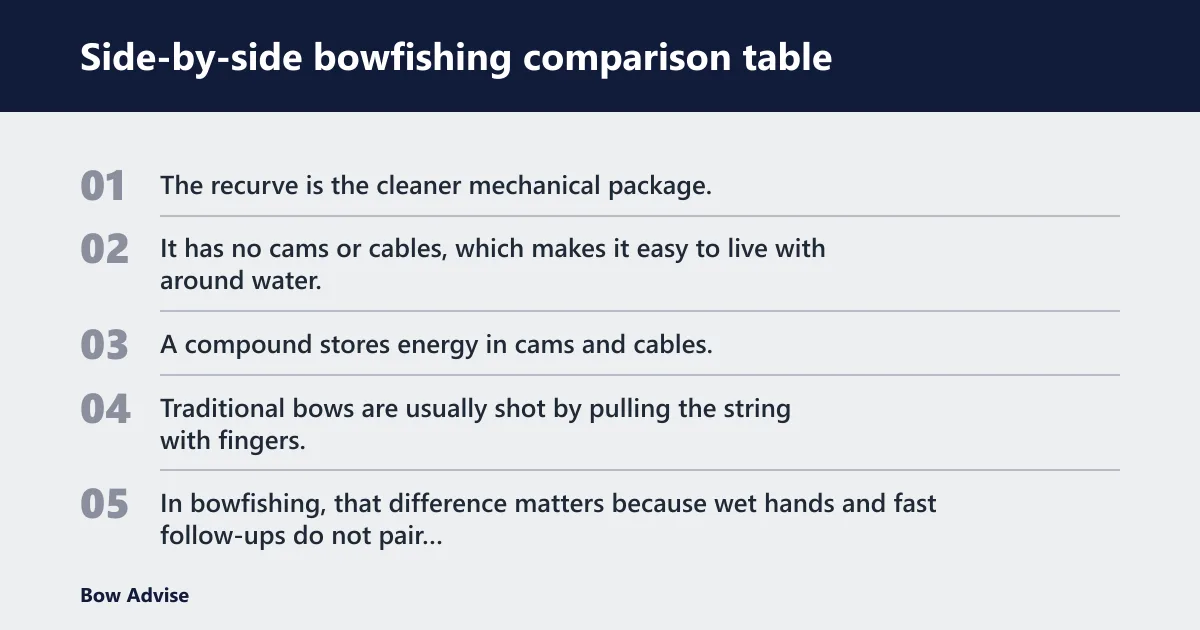
The recurve is the cleaner mechanical package. It has no cams or cables, which makes it easy to live with around water. A compound stores energy in cams and cables, and that extra machinery is why it shoots faster, but it also brings more to tune and protect.
Shot style
Traditional bows are usually shot by pulling the string with fingers, while compounds are typically used with a mechanical release. In bowfishing, that difference matters because wet hands and fast follow-ups do not pair well with extra finger slip or line tangles. I like the recurve’s direct feel, but I admit the release helps a compound stay calmer at anchor.
Holding comfort at full draw
Let-off is the compound’s biggest bowfishing advantage. A 70-pound compound may hold only 15 pounds at full draw, which makes it much easier to stay on a fish for the last half second before you release. A recurve keeps building weight as you draw, so tired arms show up sooner.
Arrow speed
Compound bows are generally faster than recurves, and even an entry-level compound can shoot 225 feet per second. That speed can help in some fishing angles, but it does not matter much if your setup is clumsy or your shot comes from a bad boat stance. Speed helps, but only after control is solved.
Boat handling
In a boat, simplicity beats bulk. A recurve’s fewer parts are easier to swing around a partner, anchor rope, or livewell lid. A compound can still work, but the extra hardware gives you more chance to catch a sleeve, line, or deck edge when the shot window opens and closes fast.
Why a recurve can make sense on the water
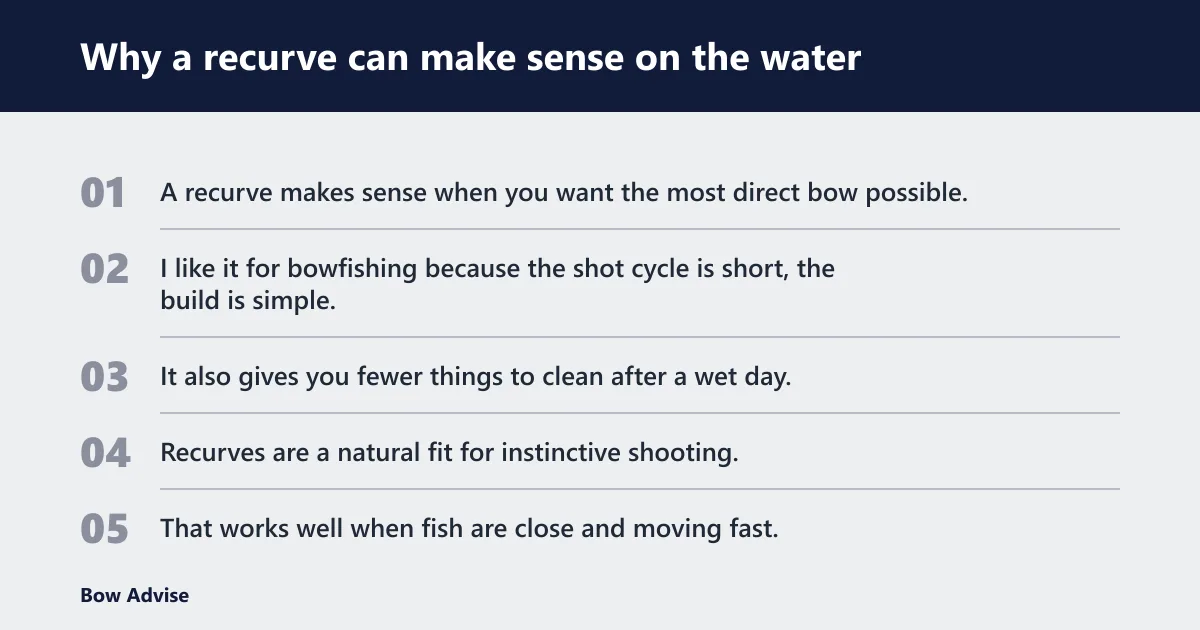
A recurve makes sense when you want the most direct bow possible. I like it for bowfishing because the shot cycle is short, the build is simple, and finger shooting keeps the setup familiar if you already shoot traditional bows. It also gives you fewer things to clean after a wet day.
Finger shooting and instinctive aiming
Recurves are a natural fit for instinctive shooting, where you judge the shot without relying on sights. That works well when fish are close and moving fast, because you are reading body position and water angle more than aiming dots. The trade-off is that your form has to be honest.
What the simple build does well around water
A recurve has a plain build with no machinery or hardware. Around water, that means less to corrode, fewer parts to rinse, and less clutter when you lift the bow in a narrow space. I value that on cold mornings when wet gloves make every grip feel clumsy.
Where recurves punish weak form or rushed shooting
A recurve requires more practice because the shooter carries more of the aiming burden. A rushed anchor, string pinch, or sloppy draw shows up fast. My first compound was set 10 lb too heavy, and I flinched for a month before I backed the limb bolts out; that taught me how quickly poor fit ruins confidence, no matter the bow type.
Why a compound can make sense on the water
A compound makes sense when you want help holding on target. Let-off gives you a steadier aiming window, and a mechanical release removes some of the finger-related wobble that comes with traditional shooting. If you already own a hunting bow, it can be a practical bowfishing starting point.
Let-off and steadier aiming window
Let-off is the compound-bow advantage that matters most on fish. It lowers the holding weight at full draw, so you can stay aimed while the fish turns or the boat drifts. That extra second often feels bigger than the speed gap between bow types.
Mechanical release use in bowfishing
Compounds are typically used with a mechanical release, and that is common on bowfishing setups too. The release clips onto the string and lets you draw and shoot without pinching fingers around the serving. I like it when I need steadier control, but it is one more item to keep dry and close at hand.
Where cams, cables, and setup weight can get in the way
Compounds use cams, cables, and a riser/limb structure, so they ask more from the shooter before the shot even starts. Compounds also have a specific maximum draw length that must be set, and that becomes a real issue if you borrow gear or buy used. A tuned compound can still be a poor bowfishing pick if it is awkward on your boat or too complicated for quick resets.
What matters most in bowfishing conditions?
Boat and bank shooting change the answer more than raw speed does. Bowfishing is short-range work on moving fish, often with wet hands, odd angles, and no time to settle into a perfect stance. That is why I judge a bow by control, reload speed, and how easy it is to live with when things get messy.
Boat versus bank shooting
From a boat, a shorter and simpler bow usually feels better because you can swing it without fighting the deck. From shore, a compound’s aiming help can matter more if you have room to brace and wait for the shot. The setting changes the score.
Short-range shots at moving fish
At bowfishing distances, fast fish movement matters more than field-point precision. A shooter who can read the fish’s line of travel and release cleanly will beat a better bow in the wrong hands. That is why I never pick by arrow speed alone.
Wet hands, brush, and tight decks
Wet hands make grip texture and clutter matter. On a packed deck, a recurve’s minimal build is easier to control, while a compound’s extra parts can catch on clothing or gear. I care about how the bow feels when my hands are cold and the deck is slick.
Draw weight and overdraw risk
Bowfishing often starts with shots taken quickly, so draw weight must stay comfortable enough for repeated reps. A recurve gets harder to pull the closer you get to full draw, while a compound’s holding weight stays lower because of let-off. If a bow feels wrong on the first few draws, it will feel worse after twenty.
Shorter bow length for boat maneuvering
Is a shorter bow better from a boat? Usually yes. Shorter bows are easier to rotate without hitting the rail, especially when another person is netting fish beside you. That is one reason I favor compact recurves for crowded boats, even when a compound would aim more steadily.
Bowfishing decision matrix: recurve vs compound
Here is the scoring matrix I actually use when someone asks me what to buy first. I score the recurve on simplicity and control, and the compound on hold comfort and aiming help. The better bow is the one that fits the way you fish, not the one with the flashier spec sheet.
| Scenario or factor | Recurve Bow | Compound Bow for Bowfishing | Winner |
|---|---|---|---|
| Boat use | 9/10 for maneuvering and cleanup | 6/10 because of bulk and hardware | Recurve Bow |
| Shore use | 7/10 if you already shoot traditional gear | 8/10 if you want aiming help from a stable stance | Compound Bow for Bowfishing |
| First-shot speed | 9/10 for quick handling | 7/10 because of setup steps | Recurve Bow |
| Reload speed | 8/10 | 6/10 | Recurve Bow |
| Wet-hand control | 9/10 | 6/10 | Recurve Bow |
| Accessory complexity | 9/10 | 5/10 | Recurve Bow |
| Beginner forgiveness | 7/10 | 7/10 | Tie |
Clear recommendation by scenario
If you fish from a boat, want fast resets, and hate clutter, I would start with a recurve. If you already own a compound, can set it up correctly, and want help holding on target, the compound earns its place. If your hands shake when a fish turns, the compound helps more; if your deck is crowded, the recurve does.
Choose recurve if… / Choose compound if…
Choose a recurve if you want the simplest setup, shoot fingers well, fish from a cramped boat, or care more about quick handling than aiming support. Choose a compound if you already own one, can set the draw length correctly, want let-off, or plan to use a mechanical release for steadier shots.
Choose recurve if…
- You are new to bowfishing and want fewer moving parts.
- You shoot instinctively and already like traditional bows.
- Your boat space is tight and gear tends to snag.
- You want fast reloads and simple cleanup after a wet trip.
Choose compound if…
- You already own a hunting bow that can be set up safely for fishing.
- You want let-off to steady the aim window on moving fish.
- You prefer a mechanical release over fingers.
- You will spend more time from shore or in a stable boat layout.
Frequently asked questions
recurve vs compound bow for bowfishing
For bowfishing, I usually put the recurve ahead for tight boats, fast reloads, and wet-hand control. I put the compound ahead when the shooter wants let-off and steadier aiming on moving fish. The right answer depends on how cramped the setup is and how comfortable you are with fingers or a release.
can any compound bow be used for bowfishing
Not every compound bow is a good bowfishing bow. A compound can work if it fits you, can be set to a comfortable and safe draw length, and can run the line-through setup cleanly. A hunting bow that is too long, too heavy, or awkward on a deck can still be a bad fishing choice.
do I need a release aid for bowfishing with a compound
A mechanical release is the common choice on compound bowfishing setups because it clips onto the string and helps you draw and shoot cleanly. You can shoot a compound other ways in some setups, but a release usually gives better control with wet hands and a line attached. I prefer it for consistency.
is a shorter bow better for bowfishing from a boat
Usually yes. A shorter bow is easier to swing around rails, seats, nets, and other people on the deck. That matters more than small differences in speed when the fish is close and the shot window is short. In a boat, maneuverability beats looking impressive.
what draw weight should I use for bowfishing
Use a draw weight you can pull smoothly, hold briefly, and repeat without flinching. If the bow feels heavy on the first few draws, it is too much for bowfishing because you shoot fast and often from awkward angles. I would rather have a lower, comfortable setup than a bow that wears me out.
what are the pros and cons of recurve and compound bows for bowfishing
The recurve’s pros are simplicity, quick handling, and better control in cramped or wet conditions. Its con is that it asks more from your form. The compound’s pros are let-off, steadier aiming, and faster arrow speed; its con is added setup complexity, more hardware, and more ways to make the bow feel wrong on the water.