AMO Bow Sight vs No Sight for Bowfishing: Which Wins?
For bowfishing, a no-sight setup is fastest for close, moving shots, a pin sight helps most in low light or at longer range, and a laser sight mainly helps beginners learn point of aim fast. Pick the wrong setup, and you lose fish to wasted motion, slow target pickup, or poor visibility on dark water. This guide compares AMO Bow Sight vs No Sight for Bowfishing by distance, water clarity, light, and shooter skill.
AMO bow sight vs no sight for bowfishing: the core trade-off
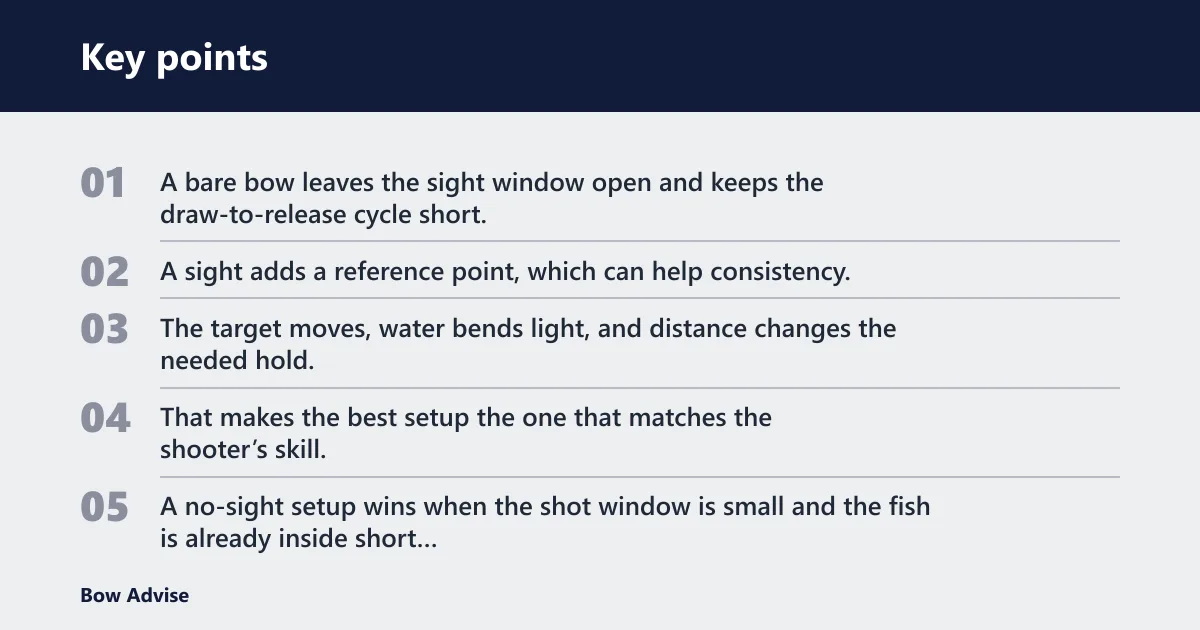


The trade-off is speed versus visibility. A bare bow leaves the sight window open and keeps the draw-to-release cycle short, which matters when fish move fast and the shot is close. A sight adds a reference point, which can help consistency, but it can also block part of the view and slow a rushed shot.
Bowfishing is not fine-precision work. The target moves, water bends light, and distance changes the needed hold. That makes the best setup the one that matches the shooter’s skill, boat or shore position, and the water conditions in front of them.
| Decision factor | AMO Bow Sight | No Sight for Bowfishing | Winner |
|---|---|---|---|
| Shot speed | Slower than barebow because the eye has to find the reference point | Fastest for snap shooting and quick target pickup | No Sight for Bowfishing |
| Sight-window visibility | Can obstruct the window, especially with a housing or multiple pins | Unobstructed line of sight to the fish | No Sight for Bowfishing |
| Learning curve | Lower once sighted in, but it still needs practice and setup | Higher at first because hold-over must be learned by feel | AMO Bow Sight |
| Close-range accuracy | Useful, but the added aiming step can be unnecessary at very short range | Strong for close shots when the shooter can aim instinctively | No Sight for Bowfishing |
| Setup cost | Higher, since it adds hardware and often sight-in time | Lower, with fewer parts to buy and maintain | No Sight for Bowfishing |
| Beginner forgiveness | Usually better, because it gives a clearer aiming reference | Less forgiving until the shooter learns refraction and depth | AMO Bow Sight |
Shot speed
A no-sight setup wins when the shot window is small and the fish is already inside short range. Barebow shooting is especially useful for quick shots, which is why many bowfishing shooters like it for sudden chances. A sight adds a step, and that extra step can cost the fish.
Sight-window visibility
Visibility matters because the shooter has to see both the fish and where the arrow will enter the water. The sight window is a major concern, especially from a boat where angles change fast and the target can vanish behind rails, poles, or movement. A bare bow keeps the view clean.
Learning curve
A sight gives a reference point, so it can shorten the guessing phase for a beginner. Pyramyd AIR defines a bow sight as a precision aiming tool, and fixed pin sights may have 3-7 pins. For bowfishing, that precision matters less than repeatable point-of-aim under time pressure.
Close-range accuracy
At very short range, instinctive aiming often works because the arrow has less time to drift and the correction is smaller. That said, fish appear in the wrong place because of refraction, so close range still needs a mental offset. When the shot gets longer, the advantage shifts toward a sighted setup.
Setup cost
No-sight setups are simpler and cheaper because there is less hardware to mount, tune, and replace. A sighted setup adds cost, and some options add batteries or specialty parts. A Trophy Ridge Sight Light listed at $30.71 shows how even a small accessory can add to the total.
Beginner forgiveness
Beginners often miss high because they aim at where they see the fish instead of where the arrow needs to land. A sighted setup can reduce that early error by giving a repeatable reference. That does not replace practice, but it can make the learning curve less punishing.
📊 Pyramyd AIR lists a Trophy Ridge Sight Light at $30.71. Source: Pyramydair.
How does a bowfishing shot change with water refraction?
Refraction bends light in water, so the fish can appear higher than it really is. That means the shooter must aim lower than the visible fish position, and the needed hold changes with depth and distance. Shallow water, deep water, and longer shots do not use the same point of aim.
Why fish appear higher than they are
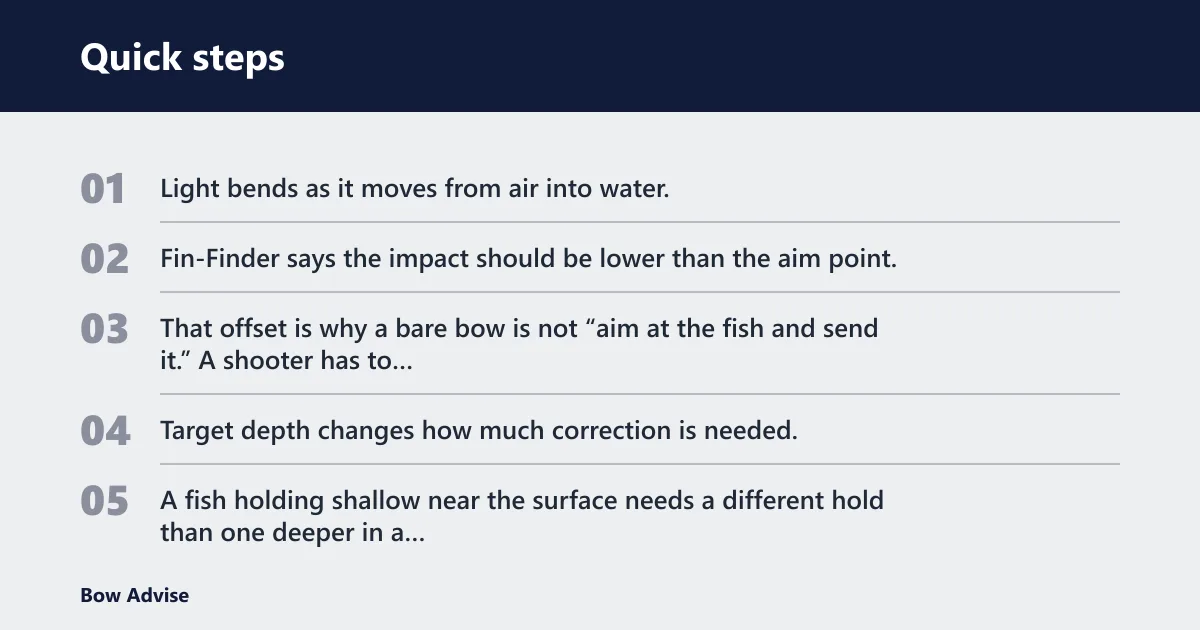
Light bends as it moves from air into water, so the visible image is shifted from the real target. Fin-Finder says the impact should be lower than the aim point, which matches the common bowfishing correction: aim under the visible fish to account for the offset.
That offset is why a bare bow is not “aim at the fish and send it.” A shooter has to mentally move the aim point down, and that adjustment gets more important as the target is farther away or deeper.
How depth and distance change point of aim
Target depth changes how much correction is needed. A fish holding shallow near the surface needs a different hold than one deeper in a channel or under a dock edge. Distance also matters because the angle through the water changes, and the apparent position shifts as range grows.
Suppose a fish is visible under a shallow clear edge of water near a boat. A fish at a different depth or distance will not use the same hold-over. That is why bowfishing aims are situation-based, not one fixed rule.
What is the best way to aim a bowfishing bow?
The best way to aim a bowfishing bow depends on range, visibility, and how fast the shot must happen. Barebow aiming works best when shots are close and the shooter can read the water quickly. A pin or laser reference helps more when the target is farther, the light is poor, or the shooter needs a clearer point of aim.
Barebow / instinctive aiming
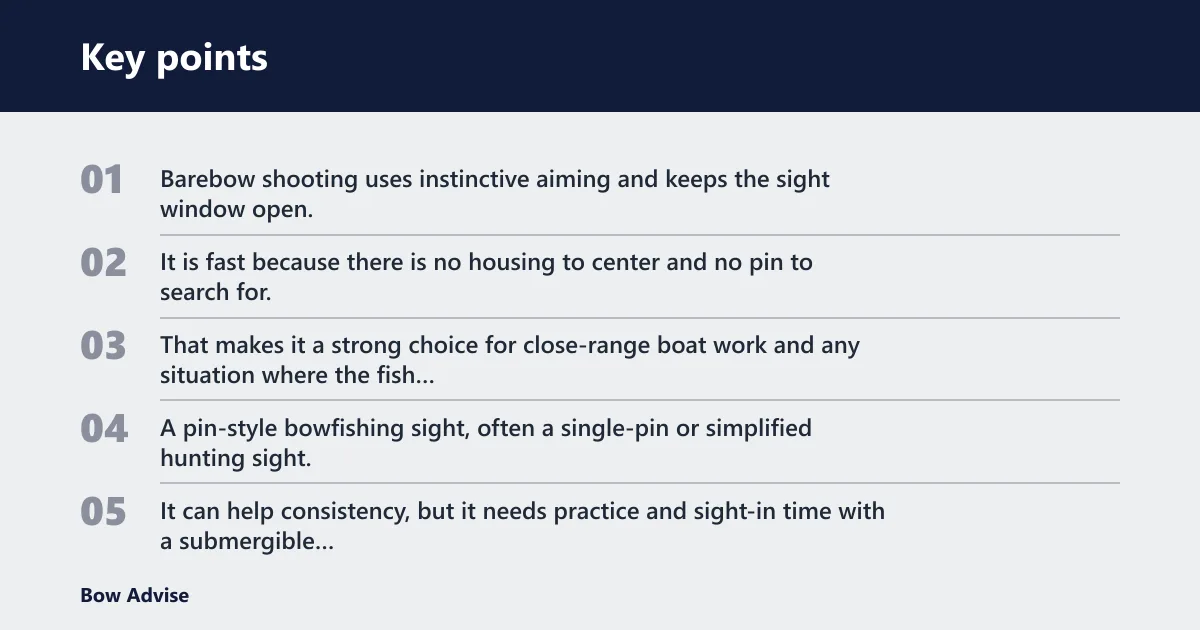
Barebow shooting uses instinctive aiming and keeps the sight window open. It is fast because there is no housing to center and no pin to search for. That makes it a strong choice for close-range boat work and any situation where the fish moves before the shooter can settle.
Pin-style bowfishing sight
A pin-style bowfishing sight, often a single-pin or simplified hunting sight, gives a clear aiming reference. It can help consistency, but it needs practice and sight-in time with a submergible practice target or similar setup. Without that practice, the shooter may still miss high or lag behind the fish.
Refracting laser sight
A refracting laser sight is another bowfishing-specific aiming option. It can speed up point-of-aim learning because the shooter gets a visible reference, but it also adds hardware and can complicate the sight picture. Compared with barebow, it is usually slower; compared with a pin sight, it may be easier for some beginners to read at first.
Should I use a sight or no sight for bowfishing?
Use a sight if you need a steadier reference, shoot in lower light, or want help learning where the arrow lands as water depth changes. Use no sight if your shots are short, quick, and taken from positions where an open sight window matters more than added aiming structure. The right answer changes with skill and environment.
When instinctive aiming works best
Instinctive aiming works best at close range, in clear water, and when fish appear suddenly inside the shot lane. It also helps when the shooter is moving on a boat and does not have time to line up a pin. In those conditions, extra aiming gear can slow the shot more than it helps.
When an unobstructed sight window matters most
An unobstructed sight window matters most on boats and during fast passes near structure. A clear opening makes it easier to track the fish and keep the arrow lane visible. That visibility can matter more than precision because bowfishing rewards fast target pickup, not small-group accuracy.
When does a pin-style bow sight help more than barebow?
A pin-style bow sight can help when the shooter wants a repeatable reference, especially for longer shots, dim light, or beginners moving from bowhunting to bowfishing. It slows some snap shots, but it can cut down on high misses and guesswork once the shooter has sighted in properly.
Using a single pin or simplified hunting sight
A simplified hunting sight is often the easiest repurpose because it already gives a clear index point. It can work well for bowfishing if the shooter keeps the setup simple and treats it as a reference, not a precision rig. A busy multi-pin sight can clutter the window and distract from the fish.
How practice and sight-in reduce misses
Bowfishing practice should include a submerged target so the shooter can dial in the offset and reduce trial and error. That matters because refraction and depth change the hold. With practice, a sighted setup becomes more predictable, and the shooter spends less time guessing at the correction.
When pins can slow snap shots
Pins can slow shots when the target appears and disappears quickly. The shooter may spend too long finding the pin instead of releasing the arrow. A common first-timer mistake is over-aiming a fish that is only visible for a second, then missing the window entirely.
What about a refracting laser sight for bowfishing?
A refracting laser sight fits between barebow and pin sights. It gives a visible aiming reference without forcing the shooter to interpret a traditional pin picture, which can help beginners. The trade-off is speed and complexity: the laser adds gear, and in some situations it still slows the first shot.
Where laser sights fit in the comparison
Laser sights make the most sense for shooters who want fast visual feedback and a direct aiming cue. They are a niche bowfishing option, not a universal answer. For some beginners, that cue shortens the learning curve more than a pin sight does, especially when water conditions are changing.
Speed and visibility trade-offs versus pins and barebow
Compared with barebow, a laser sight is usually slower because the shooter has to read the device. Compared with a pin sight, it may be easier to see in some low-light situations, but it still adds equipment and can clutter the setup. If the top priority is the cleanest sight window, barebow still wins.
Choose AMO Bow Sight if… / Choose No Sight for Bowfishing if…
Choose AMO Bow Sight if you are new to bowfishing, want a reference point to cut down on high misses, shoot from steadier positions, or often fish in low light where a clearer hold helps. Choose No Sight for Bowfishing if you shoot close, fast, and often from a boat where target pickup matters more than added aiming structure.
Choose AMO Bow Sight if…
- You are moving from bowhunting to bowfishing and want a familiar aiming reference.
- Most shots are longer than snap-close range, or the water is dark and the fish blends in.
- You are still learning refraction, depth changes, and where the arrow lands underwater.
- You want repeatable practice with a submerged target before fishing pressure starts.
Choose No Sight for Bowfishing if…
- You shoot from a boat and need the fastest possible target acquisition.
- The fish are often close, moving quickly, or appearing only briefly in the lane.
- You value an unobstructed sight window more than added aiming reference.
- You already understand hold-over for refraction and can correct by feel.
Choose by shooter and setting
- Boat shooter: no sight if shots are fast and close; pin sight if the boat position is steady and light is poor.
- Shore shooter: pin sight if ranges vary; no sight if fish cross the shallows at short range.
- Beginner: pin sight or laser sight to learn point-of-aim faster.
- Experienced shooter: barebow if speed and visibility matter most.
Frequently asked questions
How to aim a bow without sights
Aim a bow without sights by using instinctive aiming and a consistent hold relative to the fish, then correct for refraction by aiming lower than the visible target. This works best at close range, where the shot is fast and the open sight window helps more than a reference point.
How to sight in a bow sight
To sight in a bow sight for bowfishing, start with a submergible practice target and adjust for the underwater offset at the ranges you expect to shoot. Practice matters because the fish appears higher than it is, and the hold changes with depth and distance.
Is a sight worth it for bowfishing
A sight is worth it when you need more consistency than a bare bow gives, especially for beginners, low light, or longer shots. It is less useful when speed and an open sight window matter most, such as short boat shots on moving fish.
Do bowfishing sights slow down shot speed
Bowfishing sights can sometimes slow shot speed because the shooter has to find and use a reference point. That extra step matters most in fast, close shots. A barebow setup is usually quicker when the fish only stays in the lane for a moment.
How do water refraction and depth affect bowfishing aim
Water refraction makes the fish appear higher than it really is, so the shooter has to aim lower than the visible image. Depth and distance change how much lower, which is why a shallow fish and a deeper fish do not use the same hold-over.
Can I use a hunting sight for bowfishing
Yes, a hunting sight can often be adapted or repurposed for bowfishing, especially if it is simplified to reduce clutter. The trade-off is that hunting sights are built for precision, while bowfishing rewards speed and a clear sight window more than tiny aiming adjustments.