Muzzy Arrow vs AMS Arrow for Bowfishing: Which Fits?
Choose AMS if you want the safer first buy for most anglers, because its reel-and-arrow package is easier to match and it feeds line with less guesswork. Choose Muzzy if you want a cheaper backup arrow and already know your tip and reel setup. A poor match can bend shafts, loosen tips, and make the reel feed badly, which wastes fish and money. This guide compares durability, tip replacement, reel compatibility, and season-long cost for freshwater and saltwater bowfishing.
This guide is part of our Bowfishing from shore and without a boat series.
Core Differences Between Muzzy And AMS
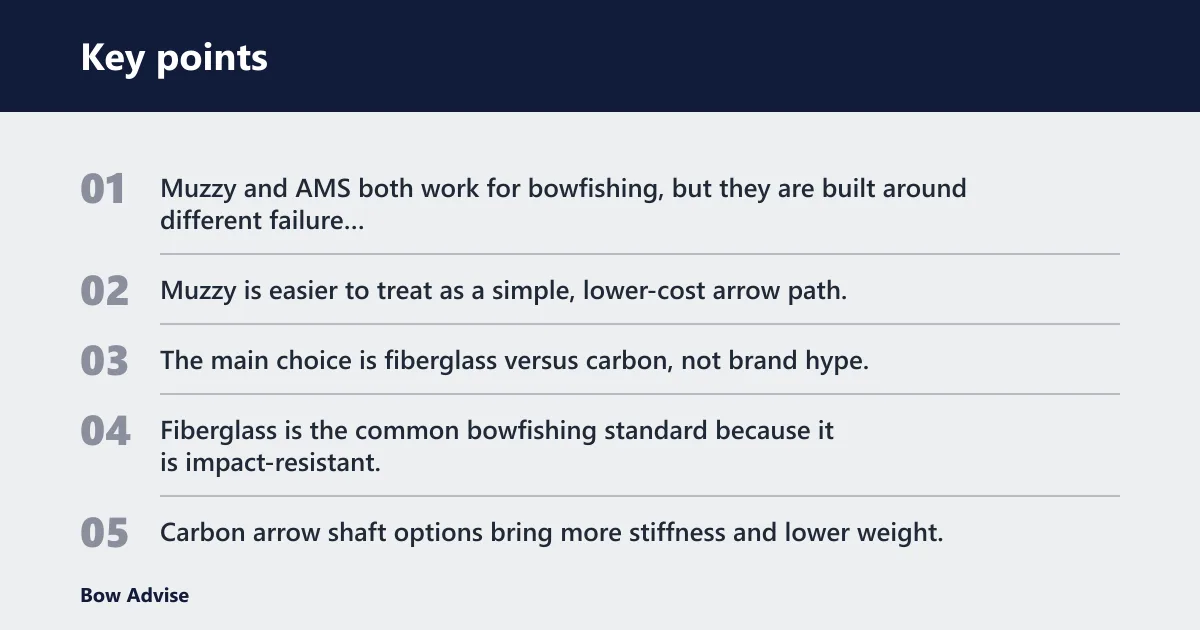


Muzzy and AMS both work for bowfishing, but they are built around different failure tolerances. Muzzy is easier to treat as a simple, lower-cost arrow path, while AMS leans toward a more integrated system with stronger out-of-the-box reel matching.
| Decision factor | Muzzy Arrow | AMS Arrow for Bowfishing | Winner |
|---|---|---|---|
| Shaft durability | Usually fiberglass-focused, which is common in bowfishing and more forgiving on impact | Commonly paired with fiberglass shafts in bowfishing kits; system fit matters more than raw shaft hype | Tie |
| Tip retention | Good when the tip and ferrule stay tight, but check for loosening after repeated hits | Strong when matched to AMS’s reel-and-arrow system; free-spool helps keep line tension cleaner | AMS |
| Visibility | Depends on shaft color and fletching choice | Depends on shaft color and fletching choice | Tie |
| Retrieval speed | Fast with the right reel, especially on push-button or spin-style setups | Fast with bottle-style free-spool reels and the Retriever Pro concept | AMS |
| Saltwater maintenance | Hardware choice matters; rinse care is essential after every trip | Also needs rinse care, but system buyers often pair it with more purpose-built hardware | AMS |
| Replacement parts | Broadheads and components are easier to swap if you already know the setup | System parts are clear, but the arrow/reel ecosystem is more specific | Muzzy |
| Beginner forgiveness | More forgiving if the goal is a simple, lower-cost setup | More forgiving if the goal is clean line management and fewer feed issues | AMS |
| Total season cost | Often lower if replacement arrows and parts are chosen carefully | Can stay controlled, but the matched system can cost more up front | Muzzy |
Shaft durability and feel
Bowfishing shafts take blunt abuse. The main choice is fiberglass versus carbon, not brand hype. Fiberglass is the common bowfishing standard because it is impact-resistant, visible in water, and usually cheaper to replace after a bad hit or a shaft strike on rock, dock wood, or a hard fish.
Carbon arrow shaft options bring more stiffness and lower weight, but they also bring higher breakage risk and a cost premium. In bowfishing, that trade-off only makes sense in narrow use cases, such as a shooter who wants a lighter arrow and accepts that a hard impact can crack or splinter a shaft more easily than fiberglass.
A common first-timer mistake is choosing carbon because it sounds stronger. For bowfishing, “stronger” should mean more forgiving after impacts, not just stiffer in the hand.
Which tip design holds fish better?
Fish retention comes from barb design, tip sharpness, and whether the system stays tight after impact. A bowfishing point with a removable tip can be easier to service, but that same architecture can loosen if the ferrule, nut, or retaining hardware is not checked often.
Muzzy’s broadheads are sold in multiple styles and weights, and Muzzy says its Trocar HB and HBX use 0.035-inch-thick blades that deploy to a 1 5/8-inch expandable cutting diameter. That matters because tip geometry affects both penetration and the chance of a shot staying put long enough for the reel to do its job. Muzzy also says to check and touch up blades in the field.
AMS bowsfishing arrows are usually judged less by blade marketing and more by how the point integrates with the rest of the retrieval setup. For bowfishing, a point that resists loosening and can be replaced quickly after a bent barb or stripped thread is often the better long-term design.
Which arrow works better with your reel system?
Reel compatibility matters as much as the arrow itself. Muzzy offers a bowfishing spin kit with an ambidextrous reel, and the Muzzy XD Pro is described as a spincast, push-button reel. That makes Muzzy a practical fit for anglers who want a familiar push-button release and simple line control.
AMS leans into the bottle-style free-spool approach. The AMS Retriever Pro uses 200 lb braided Dacron and 25 yards of line, and it is described as a bottle-style reel with always free-spool. That setup can help with rapid line payout and clean recovery when the fish runs hard.
Picture a shallow carp shot at dusk. If the line feeds cleanly, the arrow stays trackable and the second shot comes faster. If the reel binds or the slide snags, the line can twist around the shaft and turn a straightforward follow-up into a mess.
Safety, line attachment, and snag risk
Bowfishing arrow safety is mostly about the slide, tether, and how the line is attached. The bowfishing arrow slide design matters because a slide keeps the line moving along the shaft instead of whipping loose at release, which can reduce snag risk and help retrieval speed.
Fast follow-up shots need clean line management. A bowfishing reel system with a strong line, a proper slide, and enough free-spool to pay out without jerking will recover more cleanly than a setup that forces the line to drag across the shaft or hang on the rest.
What repeated impact usually does to each shaft type?
Repeated hits usually show up first as bent shafts, nicked coatings, cracked inserts, or tips that begin to loosen. Fiberglass tends to tolerate abuse better, but it can still splinter or warp after enough hard impacts. Carbon can hold a straighter feel, yet a hard side hit can end the shaft faster and at a higher replacement cost.
For high-volume bowfishing, the practical question is not which shaft sounds tougher. It is which one still works after a bad shot, a ricochet off a bottom edge, or a fish that drags the shaft into rough cover.
📊 Muzzy’s Trocar HB and HBX use 0.035-inch-thick blades. Source: Feradyne.
What is the difference between Muzzy and AMS bowfishing arrows?
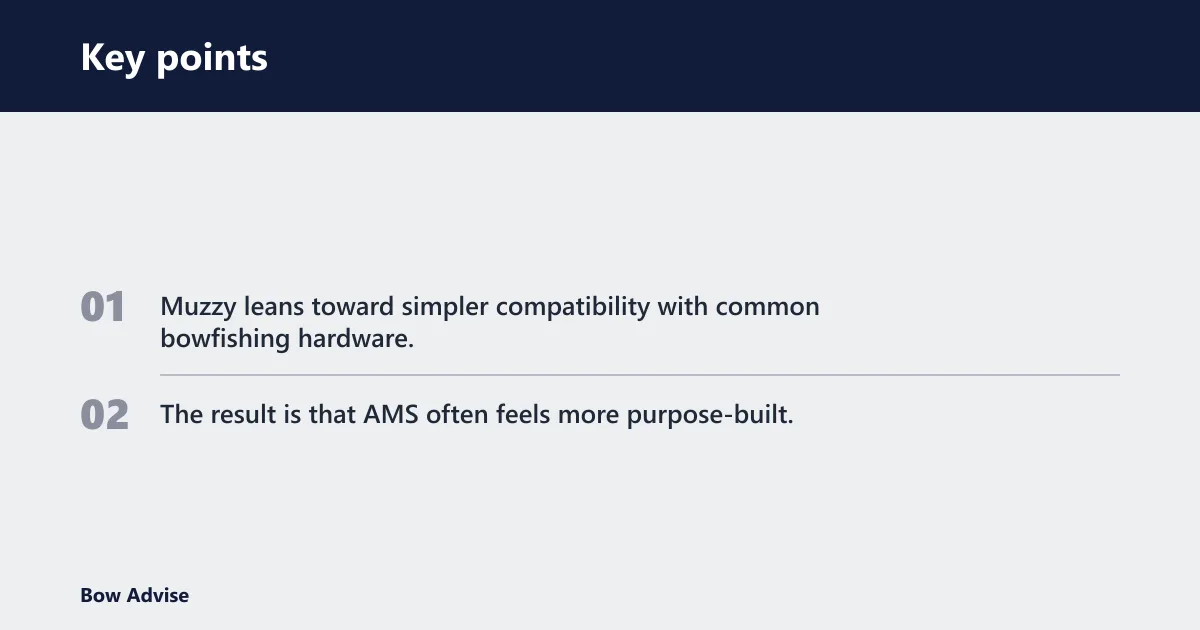
The difference is mostly system philosophy. Muzzy leans toward simpler compatibility with common bowfishing hardware, including its spincast-style options, while AMS is better known for bottle-style reel integration and always free-spool handling. The result is that AMS often feels more purpose-built, and Muzzy often feels easier to keep economical.
Quick spec-style comparison
| Category | Muzzy Arrow | AMS Arrow for Bowfishing | Winner |
|---|---|---|---|
| Reel pairing | Spincast/push-button and ambidextrous spin kit options | Bottle-style free-spool system | AMS |
| Line package | Varies by kit | 200 lb braided Dacron, 25 yards | AMS |
| Typical buyer fit | Cost-aware shooter, backup arrow buyer | First-time buyer who wants a matched retrieval system | Tie |
| Parts ecosystem | Straightforward, especially for basic replacement use | Good, but more tied to the AMS system | Muzzy |
Which bowfishing arrow is more durable in saltwater?
Neither arrow is saltwater-proof. The more durable choice in saltwater is the one with fewer corrosion-prone parts, a better rinse routine, and a reel setup that uses stainless steel or aluminum hardware where possible. AMS has the edge when the full system is matched for saltwater use, but only if the user keeps up with maintenance.
Saltwater wear usually shows up in hardware first: screws, ferrules, line guides, slides, and reel parts. A fiberglass shaft itself is not the main corrosion concern; the metal attachments are. After every trip, rinse the arrow, slide, and reel, then dry the gear before storage.
What to check before buying for saltwater: stainless steel or aluminum parts, easy replacement of the tip and slide, and line compatibility that will not abrade quickly in wet use. If a package hides those details, it is a warning sign.
Are Muzzy bowfishing arrows good for beginners?
Yes, if the beginner wants a simpler, usually lower-cost path and does not want to learn a more specialized reel system on day one. Muzzy is a reasonable first buy when the goal is to get shooting, replace a damaged part without much trouble, and keep the setup familiar.
A beginner still needs to match the arrow to the reel. The wrong slide or reel can create tangles, slow recovery, and lost shots, which feels like bad arrow quality even when the real issue is setup mismatch.
What arrow length and shaft material should I choose for bowfishing?
Choose the shaft material first, then the length that matches the bow and rest geometry. Fiberglass is the safer default for most bowfishing because it is more forgiving on impact and usually costs less to replace. Carbon only makes sense if the user accepts a higher breakage risk and wants a stiffer, lighter shaft.
Arrow length should match the setup so the shaft clears the rest and the point does not sit awkwardly near the bow hand. Most buyers should check the manufacturer’s listed length for the exact kit, because reel placement and rest height affect what “works” in practice.
Are replacement parts easier to get for Muzzy or AMS arrows?
Muzzy usually has the edge on replacement simplicity. That is because basic bowfishing arrows, tips, and common components are easier to sort by part type when the setup is not locked into a more specialized system. If the goal is to keep spare arrows and points on hand without much thought, Muzzy is simpler.
AMS has solid support, but its advantage comes from the whole reel-and-arrow package, not from a loose collection of generic parts. Buyers who lose arrows often should think about the point, slides, line, and reel-feed compatibility too.
Which bowfishing arrow is safer for fast follow-up shots?
AMS is usually safer for fast follow-up shots when the reel and arrow are matched correctly, because the always free-spool style helps line payout stay cleaner. That can reduce jerks, snag risk, and the half-second loss that happens when line hangs up during a second shot.
Muzzy can also be fast, especially with a push-button or spincast reel, but speed depends more on the shooter’s setup discipline. If the line attachment or slide is sloppy, any speed advantage disappears.
Is AMS better for carp, gar, or saltwater bowfishing?
AMS is often the better fit for carp, gar, and saltwater when the buyer wants a cleaner retrieval system and a purpose-built reel package. That matters more on larger fish, where line payout and recovery control can decide whether the shaft stays connected long enough for a clean landing.
For carp and other lighter freshwater targets, both brands can work. For gar and saltwater fish, the better choice is the one with stronger hardware, easier rinse care, and less chance of reel-feed trouble under load.
Can I use the same bowfishing arrow with different reel setups?
Sometimes, but only if the slide, line attachment, and shaft length are compatible with both systems. A bowfishing arrow that works on a bottle-style reel may not feel as clean on a push-button reel if the line path or recovery speed changes too much.
It is safer to treat the arrow, reel, and slide as a matched system. Switching between reel types without checking line weight, attachment style, and feed path can create tangles or poor recovery even when the shaft itself is fine.
Decision matrix: Muzzy vs AMS across 8 field-tested criteria
The scoring below uses a simple 1-to-5 scale, with higher numbers meaning the better field choice for that criterion. The point is not that one brand wins every row. It is that each row reflects a failure point that costs fish, time, or replacement parts during a real season.
| Criterion | Muzzy | AMS | Winner |
|---|---|---|---|
| Shaft durability | 4 | 4 | Tie |
| Tip retention | 3 | 4 | AMS |
| Visibility | 3 | 3 | Tie |
| Retrieval speed | 3 | 5 | AMS |
| Saltwater maintenance | 3 | 4 | AMS |
| Replacement-part availability | 4 | 3 | Muzzy |
| Beginner forgiveness | 4 | 4 | Tie |
| Total season cost | 4 | 3 | Muzzy |
How the durability and retrieval rows shake out
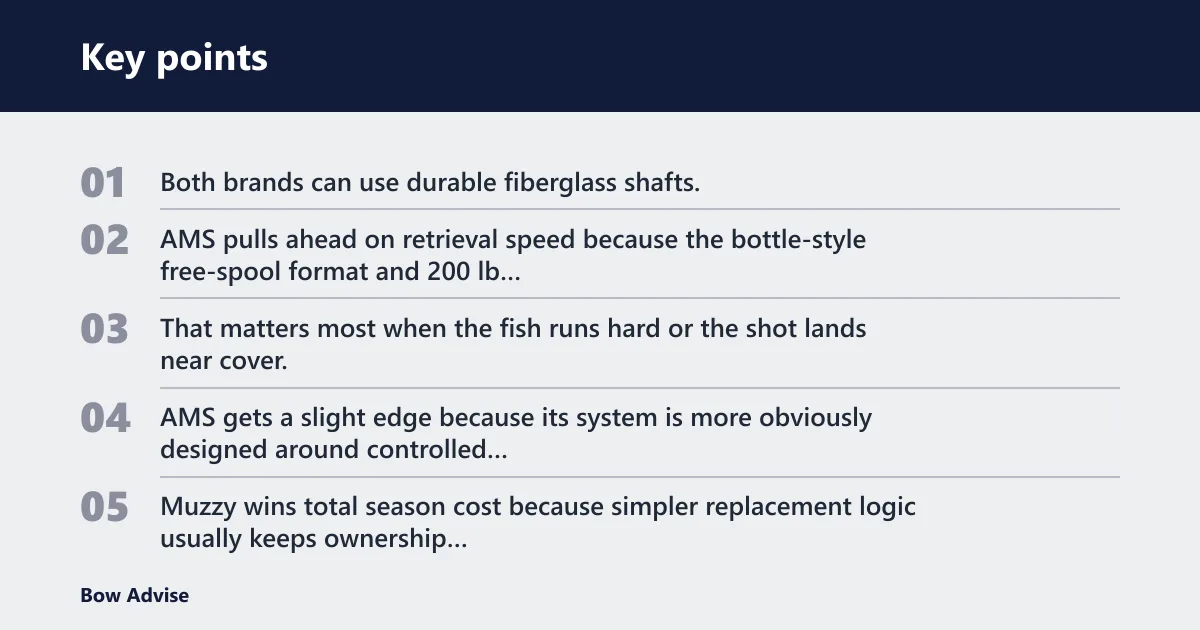
Both brands can use durable fiberglass shafts, so shaft life is close when the arrow is not abused. AMS pulls ahead on retrieval speed because the bottle-style free-spool format and 200 lb braided Dacron, 25 yards line package are built around smooth payout. That matters most when the fish runs hard or the shot lands near cover.
How the maintenance and cost rows shake out
Saltwater care is never optional. AMS gets a slight edge because its system is more obviously designed around controlled line management, but both require rinsing and drying. Muzzy wins total season cost because simpler replacement logic usually keeps ownership cheaper once broken tips, bent shafts, and lost arrows are counted.
How the beginner rows shake out
Beginner forgiveness is a tie because both can be easy or frustrating depending on setup quality. A clean arrow-slide match matters more than the logo on the shaft. If the reel feeds poorly, the shooter will blame the arrow, but the problem often sits in the system around it.
Choose Muzzy Arrow if… / Choose AMS Arrow for Bowfishing if…
Choose Muzzy Arrow if you want a lower-cost entry point, plan to keep spare parts simple, or prefer a spincast or push-button style reel. Muzzy also fits buyers who expect to replace arrows during a long season and want a straightforward path to doing that without reworking the whole setup.
Choose AMS Arrow for Bowfishing if you want a more integrated reel-and-arrow system, care about faster line payout, or expect more shots where clean retrieval matters. It is the stronger pick for anglers who value bottle-style free-spool behavior and want fewer feed problems under real bowfishing pressure.
For carp in freshwater, either can work. For gar, heavy shot volume, or saltwater, AMS gets the nod if the buyer is willing to maintain the hardware properly. For the lowest season cost, Muzzy is the more practical buy when the shooter already knows which tip, slide, and reel layout will stay in the boat.
Frequently asked questions
Which is better for bowfishing: Muzzy arrows or AMS arrows?
AMS is usually better for anglers who want a matched retrieval system and faster line payout. Muzzy is usually better for buyers who want a simpler, often cheaper path and already know their reel setup. The right answer depends on reel type, saltwater exposure, and how often arrows get damaged.
Do Muzzy and AMS arrows use the same arrow tips?
Not always. Tip compatibility depends on thread pattern, shaft interface, and the exact point design. Bowfishing points with removable tips can be easier to service, but the buyer still needs to verify fit before mixing parts from different brands.