Best Bow Stabilizers for Tree Stand Hunts (2026): We Compared
For many tree-stand hunts, a common starting point is a 6–8-inch front stabilizer with about 3–6 ounces. The Bee Stinger Sport Hunter Xtreme is the best all-around pick because its 6, 8, and 10-inch options and removable weights make it easier to fit tighter stands without giving up steadiness. Too much length can hit rails, brush, or ladders and add noise.
This guide is part of our Hunting gear comparisons for archers series.
Quick comparison
| Product | Badge | Best for | Price | ||
|---|---|---|---|---|---|
 | Trophy Ridge Hitman Archery Bow Stabilizer Kit, 6" & 8"Trophy Ridge | Our pick | 6" & 8" · 2-piece kit · Quick connect | $142.05 Price as of 15 Oct 2026 | View |
 | ZSHJGJR Archery Bow Stabilizer 6" 8" 10" 12" for CompoundZSHJGJR | Budget pick | 6" · 3K carbon · Damping system | $23.99 Price as of 15 Oct 2026 | View |
 | xxiaojun Carbon Bow Stabilizer,Balance Bar with Weights andxxiaojun | Also great | 6"-15" · Carbon · Damping system | $36.99 Price as of 15 Oct 2026 | View |
This roundup compares stand clearance, front-heavy balance, and shot angle first. What matters more is whether the stabilizer clears the rail at full draw and settles the bow after the shot.
How we chose
Tree-stand fit came first. Shorter front profiles matter when a rail, ladder, or branch sits close to the bow at full draw.
Length and weight range came next. Medium hunting lengths commonly fall in the 5 to 8 inch range, while longer 10-inch-plus setups fit open terrain better. For youth and beginners, 3 to 4 inch stabilizers are typically best.
Removable weights mattered because quivers, sights, and rests change front-back balance. Dampening material mattered too, since carbon fiber, aluminum, and rubber inserts change how much shot shock reaches the grip and stand rail.
Offset mounting was only counted when accessory balance actually needed it. If the bow already has an offset mounting hole, an added offset stabilizer may be unnecessary.
Tree stand stabilizer table
| Scenario | Recommended length | Weight range | Add removable weights? | Common mistake to avoid |
|---|---|---|---|---|
| Tight box blind | 3–5 inches | Light to moderate, about 2–4 ounces | Usually no | Choosing a bar that hits the window frame or rail |
| Open tree stand | 6–8 inches | Moderate, about 3–6 ounces | Yes, if the bow feels nose-heavy | Running a bar so long that it brushes the rail or ladder on the draw |
| Heavy-accessory compound | 8–10 inches | Moderate to heavier, about 4–8 ounces | Yes | Ignoring quiver, sight, and rest weight on the front of the bow |
| Beginner bowhunter | 3–6 inches | Light to moderate, about 2–5 ounces | Maybe | Starting with too much length and too much front weight at once |
| Windy setup | 6–10 inches | Moderate to heavier, about 4–8 ounces | Yes | Confusing steadiness with sluggish aim and poor clearance |
Bee Stinger Sport Hunter Xtreme: best all-around
- Dual 6" and 8" stabilizers included
- Quick connect and disconnect system
- Pre-assembled with removable 1 oz weights
The Bee Stinger Sport Hunter Xtreme suits hunters who want one stabilizer family with enough size choices to fit different stands. Its 6, 8, and 10-inch versions, three one-ounce weights, and harmonic dampener make it easy to tune front weight without jumping to an overly long bar.
The 10-inch version is the open-stand option in this group. Bee Stinger lists it at 12 ounces, which gives more front steadiness, but the extra length is harder to manage near rails, brush, and ladder hardware.
The drawback is simple: the longer version can be too much for tight lanes. In a narrow tree stand, a 10-inch front bar may feel steadier on paper and still be the wrong fit if it crowds the shot window.
Trophy Ridge Static: best for budget flexibility
- 3K carbon fiber body with flexible core
- Soft rubber vibration damping ball
- Four length options: 6" to 12"
The Trophy Ridge Static fits hunters who want size choices without a complex setup. It comes in 3, 6, 9, and 12 inches, with two one-ounce weights, a large dampener, and a wrist sling, so it can serve as a short beginner option or a longer open-stand bar.
The 3- and 6-inch versions make the most sense for compact stands and simple bow setups. The 12-inch model only starts to make sense when the stand is open enough that rail clearance is not a concern and the bow already points naturally without crowding the rest or quiver.
The drawback is the spread between its shortest and longest options. The 12-inch version can be too long for many tree stands, and the weight kit is less flexible than models that offer more removable stack options.
NAP Black Apache: best for compact tuning
- Five length options from 6" to 15"
- Harmonic shock absorbing head
- Improves balance and reduces vibration
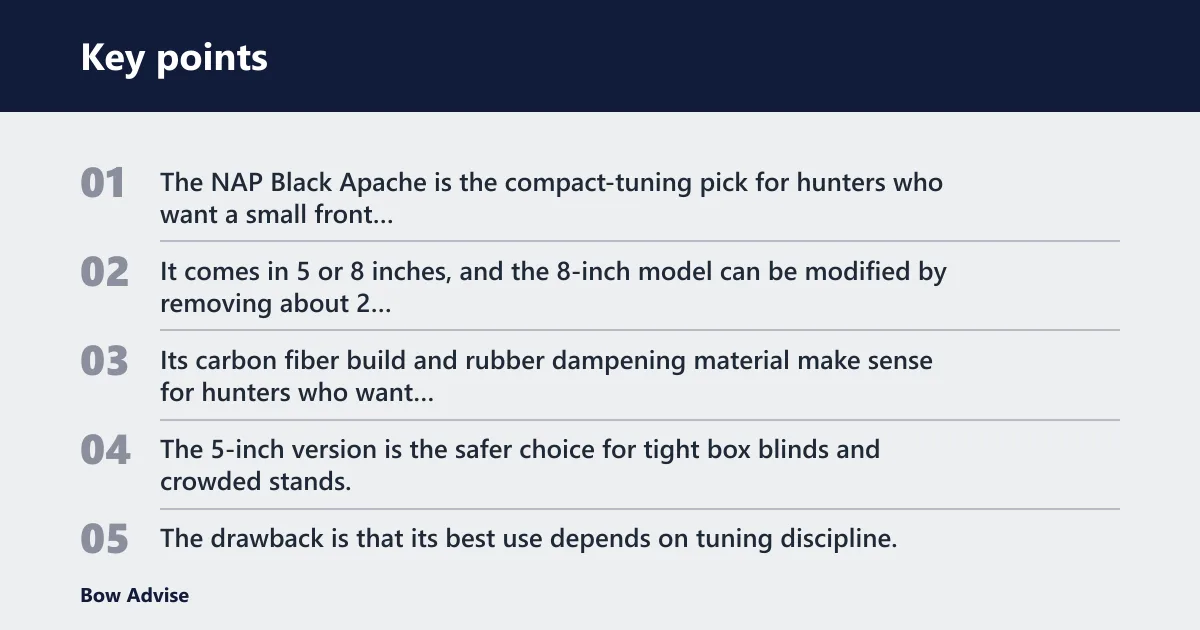
The NAP Black Apache is the compact-tuning pick for hunters who want a small front profile with some room to change feel. It comes in 5 or 8 inches, and the 8-inch model can be modified by removing about 2 ounces, which can help when the bow feels too nose-heavy for a short stand shot.
Its carbon fiber build and rubber dampening material make sense for hunters who want vibration control without a bulky front bar. The 5-inch version is the safer choice for tight box blinds and crowded stands, while the 8-inch version works better if the rail is clear and the bow needs more calm at full draw.
The drawback is that its best use depends on tuning discipline. If the bow already carries a heavy quiver, sight, or rest, the 8-inch version can still feel front-loaded unless the removable weight change is set carefully.
SAS Archery Aluminum Bow Stabilizer: best for simple durability
The SAS Archery Aluminum Bow Stabilizer suits hunters who want a straightforward, durable front bar in 5, 8, or 11 inches. Its aluminum body, camo and black options, and air-through design keep it simple for stand hunting where ease of handling matters more than a fancy weight system.
The 5-inch and 8-inch versions are the practical tree-stand choices. The 11-inch version belongs only in more open setups where the bow clears the rail and limbs cleanly, and where a longer front profile will not interfere with the draw or the shot angle.
The drawback is that aluminum can feel less refined than carbon-based setups with more advanced dampening parts. It is a sensible option, but hunters who want more weight tuning may outgrow it quickly.
Which one should you buy?
Choose the Bee Stinger Sport Hunter Xtreme if you want the best all-around tree-stand pick and expect to move between tighter and more open stands. Its 6- to 10-inch range and removable weights make it the most adaptable of the round-up-style choices here.
Choose the Trophy Ridge Static if you want straightforward sizing from very short to very long and like having a wrist sling included. Choose the NAP Black Apache if compact tuning matters most and you want a short stabilizer that can shed 2 ounces from the 8-inch model.
Choose the SAS Archery Aluminum Bow Stabilizer if you want a simple, durable front bar and do not need a complex weight kit. For heavier compounds, start with 8 inches and add weight only if the bow still feels jumpy after the quiver is mounted.
Say your stand has a narrow shooting rail and a quiver on the bow. Start short, around 5 to 6 inches, and keep the front weight modest. If the bow still dips forward after you settle into full draw, add a removable ounce before adding length.
Suppose your tree stand opens into a wide lane and your bow already carries a sight, rest, and quiver. A 6- to 8-inch stabilizer can calm the front end without crowding the rail, while a 10-inch option only makes sense if the bow stays clear through the whole shot cycle.
How to balance a bow with stabilizers
Balance starts with the front load the bow already carries. A quiver, sight, and rest all change how nose-heavy the setup feels, so a stabilizer should correct that feel instead of fighting it. The goal is a bow that settles without tipping hard forward or drifting back.
Begin with the stabilizer mounted straight ahead. Then add or remove weight until the bow holds naturally at full draw and does not roll toward the rail. Removable stabilizer weights are useful because they let the hunter tune the feel without swapping bars.
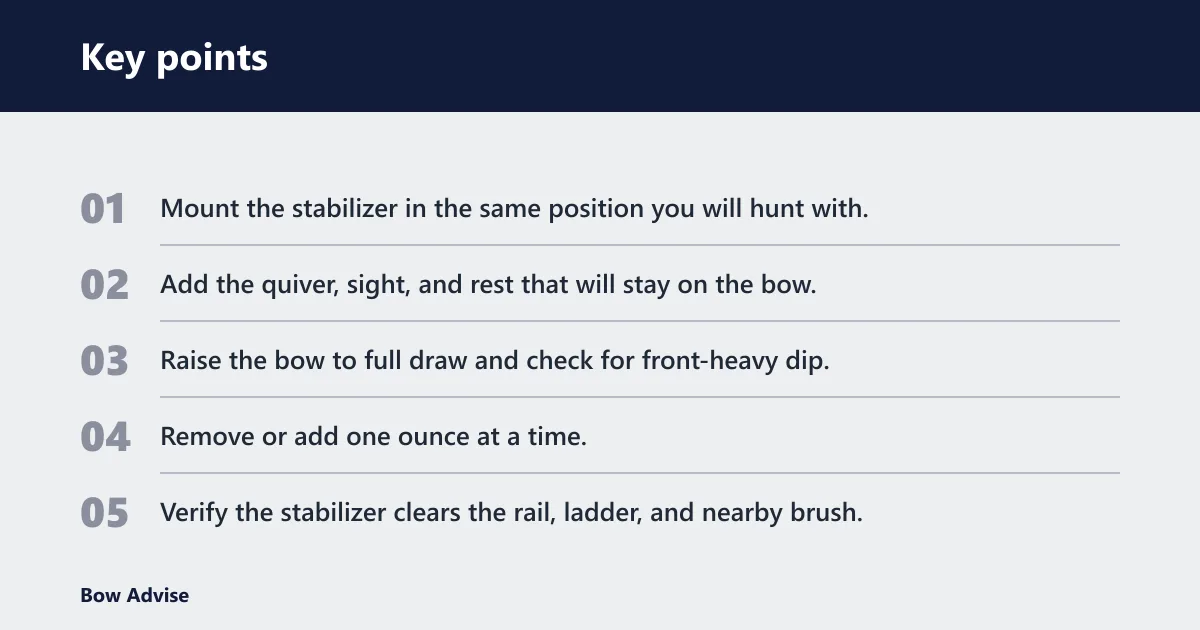
- Mount the stabilizer in the same position you will hunt with.
- Add the quiver, sight, and rest that will stay on the bow.
- Raise the bow to full draw and check for front-heavy dip.
- Remove or add one ounce at a time.
- Verify the stabilizer clears the rail, ladder, and nearby brush.
Field-check checklist before season
A quick field check is worth more than a guess. The right stabilizer should clear the stand, quiet the shot, and leave the bow easy to hold through the aiming window.
- Draw the bow next to the actual rail or blind opening.
- Check for contact with the rail, ladder, strap, or bow rope.
- Confirm the bow does not tip hard forward with the quiver attached.
- Watch for post-shot bounce or visible vibration at the grip.
- Make one weight change at a time and repeat the draw check.
When an offset stabilizer is worth the cost
An offset stabilizer helps when bow-mounted accessories create side or front imbalance that a straight bar cannot correct well. It can be more expensive than a standard model because the mount and geometry are doing extra work, not just adding weight.
It is not automatically needed for tree-stand hunting. If the bow already has an offset mounting hole, that factory setup may be enough to fix accessory balance without buying a separate offset bar.
What size stabilizer works best for tree stands
For most tree stands, 5 to 8 inches is the practical range. That length usually gives enough balance and vibration control without crowding the rail or brush. Move shorter when clearance is tight, and move longer only when the stand is open enough to support it.
5 inch vs 8 inch for hunting
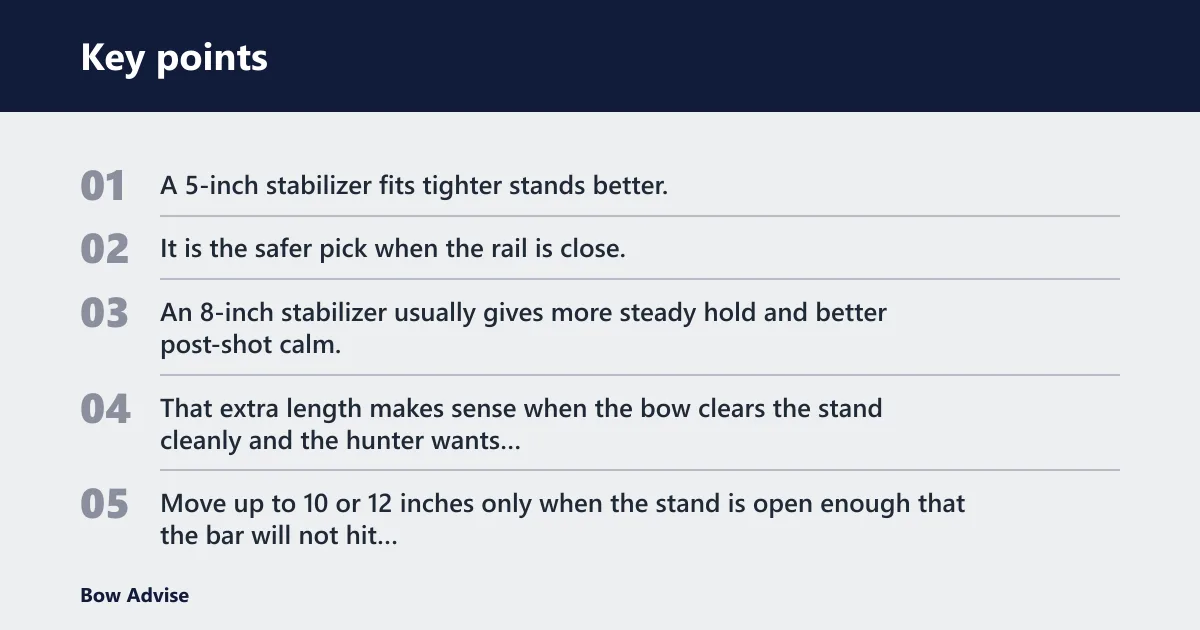
A 5-inch stabilizer fits tighter stands better. It is the safer pick when the rail is close, when a ladder or limb sits near the shot window, or when the bow needs to stay compact for awkward angle shots.
An 8-inch stabilizer usually gives more steady hold and better post-shot calm. That extra length makes sense when the bow clears the stand cleanly and the hunter wants a little more front settling without jumping to a target-style bar.
When to move to 10 to 12 inches
Move up to 10 or 12 inches only when the stand is open enough that the bar will not hit the rail or brush. Longer bars are most useful when the bow already fits the setup and the main goal is extra steadiness in open shooting lanes.
Advanced Hunter’s guidance places 10-inch-plus stabilizers in open terrain hunting, and that same logic applies to roomy stands. A long bar is a poor trade if it slows the shot or forces awkward clearing at full draw.
How weight changes the feel
More weight usually makes the bow settle better after the shot, but it also makes the front end harder to hold. That matters in a tree stand, where long holds are common and the shot angle can already feel awkward.
Removable weights help tune that trade-off. They can offset the mass of a quiver, sight, or rest, but too much front weight can make the bow feel slow and can exaggerate fatigue during a long wait at full draw.
Is an offset stabilizer necessary?
No, not for every tree-stand bow. An offset stabilizer is useful when accessories pull the bow out of balance and a straight stabilizer does not correct the feel well enough, but many hunting bows do fine with a standard front bar and sensible weight tuning.
If the bow has an offset mounting hole, start there before buying a separate offset setup. That factory option may solve the balance issue while keeping the bow simpler, lighter, and easier to manage in a stand.
Frequently asked questions
What size stabilizer bow hunting
For hunting, most shooters end up in the short-to-medium range. Advanced Hunter recommends 5 to 8 inches as the medium hunting range, which fits most stands better than long target-style bars. Go shorter for tight rails and longer only when the stand is open and the bow still clears cleanly.
What does a bow stabilizer do?
A bow stabilizer helps balance the bow and reduce vibration after the shot. In tree stands, that matters because a calmer bow is less likely to bounce into the rail or send extra noise into the stand. The right stabilizer also helps the bow hold steadier during aiming.
What length stabilizer is best for a tree stand
For most tree stands, 5 to 8 inches is the best starting point. That range usually leaves enough room around the rail and limbs while still giving useful steadiness. Longer bars can work, but only when the stand is open enough to avoid contact and noise.
Should I use a 5 inch or 8 inch stabilizer for hunting?
Use 5 inches for tight stands and 8 inches when you have more clearance and want a steadier hold. The 5-inch setup is easier to keep out of the rail. The 8-inch setup gives more calm, but only if the extra length does not interfere with the shot.
Do heavier stabilizers help in windy tree stand shots?
Heavier stabilizers can help the bow settle in wind, but only up to the point where the front end becomes tiring to hold. In a tree stand, a little extra weight can calm movement, yet too much can slow the aim and make the shot harder to control.
Is an offset stabilizer necessary for tree stand hunting?
Usually no. An offset stabilizer is worth considering only when accessories create a balance issue that a straight stabilizer cannot fix well. If the bow already has an offset mounting hole, that may be enough. For many tree-stand setups, a standard front stabilizer is the simpler choice.