Muzzy Trocar Broadhead Review
Muzzy Trocar broadheads are worth buying if the head matches the bow. Standard Trocar models fit compound and recurve setups better, while Trocar Crossbow versions are made for crossbows and higher impact speeds. Pick the wrong model, or leave the bow untuned, and arrow flight can wander and penetration can drop.
Pros and cons


Strengths by model family
- HB and HBX give hunters a hybrid option with 0.035-inch-thick stainless steel blades and a solid-steel ferrule.
- HBX is commonly described as adding about a 1 5/8-inch expandable cutting diameter while still keeping a 1-inch fixed cutting diameter before impact.
- MX-3 keeps things simple with a 100-grain, 3-blade layout and a 1-1/4-inch cutting diameter.
- MX-4 is commonly described as having about a 1-1/8-inch cutting diameter and a 4-blade design for hunters who want a smaller cut and more controlled arrow flight.
- Crossbow models are built around crossbow use, with 100 or 125 grain options and a 1 3/16-inch cutting diameter.
Tradeoffs that matter before buying
- Expandable designs can cut more tissue, but they also add moving parts and more setup sensitivity.
- Larger cutting diameters usually trade some penetration margin for hole size.
- Shorter, compact heads are usually the safer pick on faster setups.
- Fixed-blade broadheads still depend on tuning, arrow spine, and vane setup.
- Practice blades were discontinued in 2017, so maintenance now depends on replacement blades and edge care.
Trocar model matrix
This family works best when buyers compare bow type, grain weight, cut size, and blade count together. The table below separates the main Trocar choices so the differences stay clear.
| Model | Bow type | Grain weight | Cutting diameter | Blade count | Best use case |
|---|---|---|---|---|---|
| Trocar HB | Vertical/compound bows and crossbows | Varies by setup | Expands to 1 5/8 inches | Fixed-blade/hybrid line | Hunters who want a hybrid Trocar with a larger expandable cut |
| Trocar HBX | Crossbow-oriented, also listed for vertical/compound bows | 100 grain | 1 inch fixed, expands to 1 5/8 inches on impact | Hybrid design | Crossbow hunters who want a compact starting profile with more cut on impact |
| MX-3 | General fixed-blade hunting use | 100 grain | 1-1/4 inches | 3 blades | Deep penetration with a moderate cut |
| MX-4 | General fixed-blade hunting use | 100 grain | 1-1/8 inches | 4 blades | Smaller cut, tighter flight profile, and a hardened steel Trocar tip |
| Trocar Crossbow Broadhead | Crossbow use | 100 or 125 grain | 1 3/16 inches | Crossbow-specific design with right helical blades | Crossbow hunters who want a dedicated head in a three-pack set |
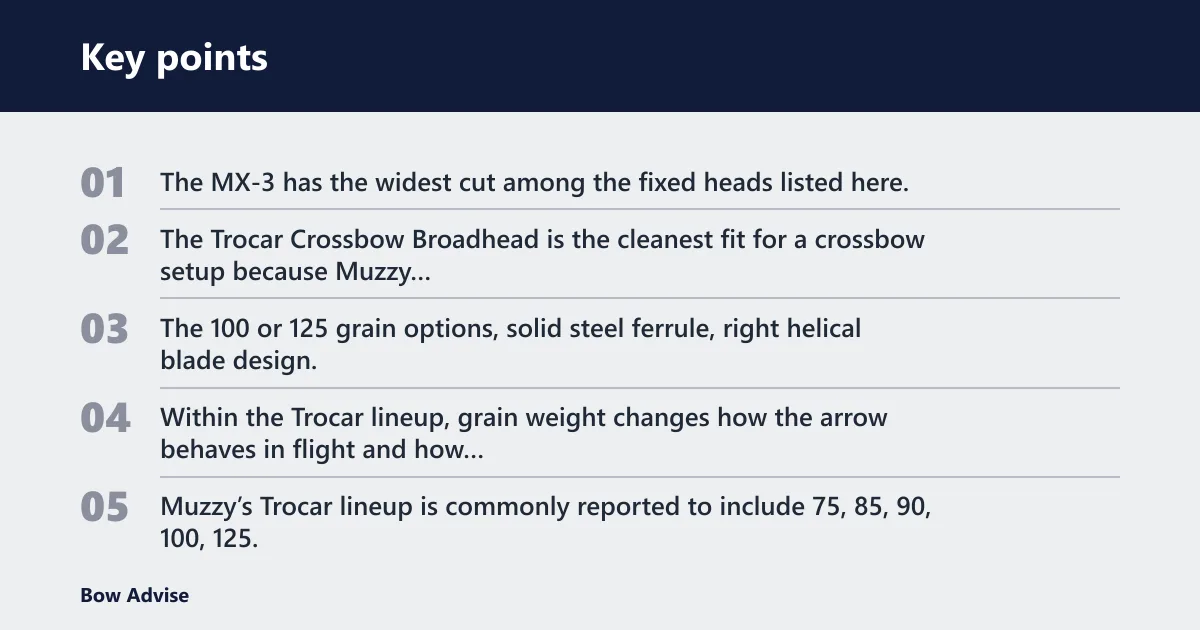
That matrix shows the main decision point. The MX-3 has the widest cut among the fixed heads listed here, the MX-4 is the tightest non-expandable option, and the HB/HBX lines sit in the hybrid category where impact deployment matters.
Crossbow-specific fit by setup
The Trocar Crossbow Broadhead is the cleanest fit for a crossbow setup because Muzzy built it for that role. The 100 or 125 grain options, solid steel ferrule, right helical blade design, and 1 3/16-inch cutting diameter make it a different choice from the HB and HBX line, even though those heads can also be used on crossbows.
Grain weight and cut size comparison
Within the Trocar lineup, grain weight changes how the arrow behaves in flight and how much total arrow weight the setup carries. Muzzy’s Trocar lineup is commonly reported to include 75, 85, 90, 100, 125, and 150 grain options, so the right choice depends on spine, speed, and the rest of the arrow build. Faster setups usually benefit from shorter, compact heads.
What is the difference between HB and HBX?
HB and HBX are both Trocar hybrid-style heads with 0.035-inch-thick stainless steel blades, but HBX is the more clearly defined 100-grain, crossbow-oriented model with a 1-inch fixed cutting diameter that expands to 1 5/8 inches on impact. HB is broader in its fit and is listed for vertical/compound bows and crossbows too.
Design differences
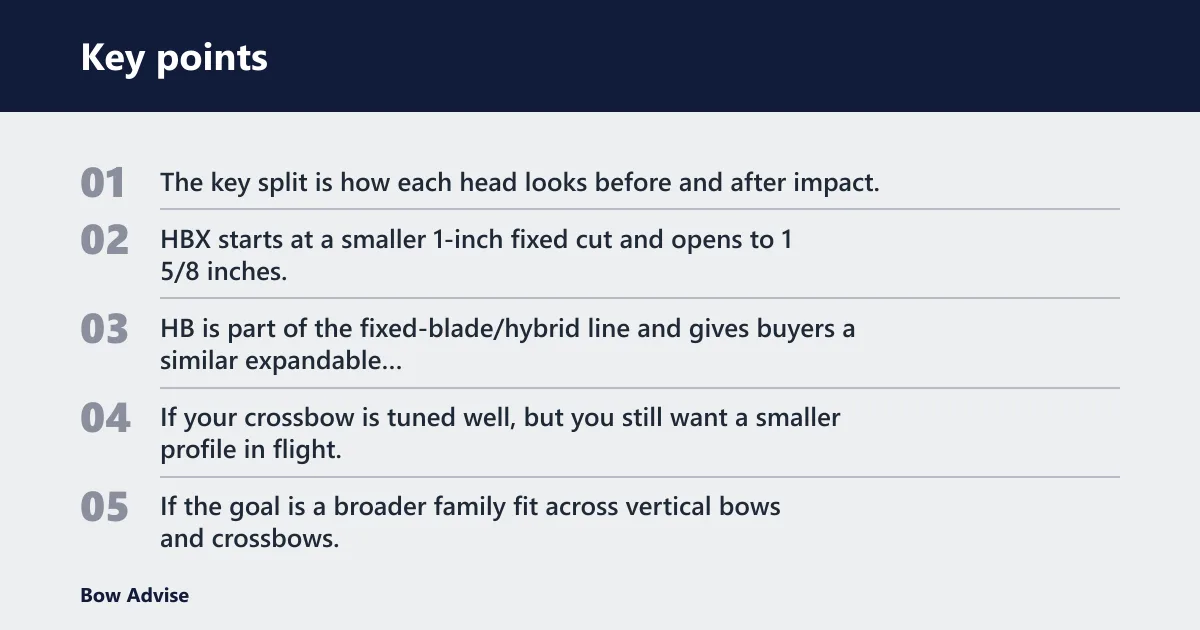
The key split is how each head looks before and after impact. HBX starts at a smaller 1-inch fixed cut and opens to 1 5/8 inches, which makes it the more compact option in flight. HB is part of the fixed-blade/hybrid line and gives buyers a similar expandable broadhead concept without the same crossbow-first positioning.
If your crossbow is tuned well, but you still want a smaller profile in flight, HBX is the cleaner match because it starts compact and is built around that use case. If the goal is a broader family fit across vertical bows and crossbows, HB is the less narrow choice.
Best bow setup for each
HBX is the safer pick for a hunter who wants a crossbow-oriented hybrid broadhead and a fixed 100-grain class. HB makes more sense when the buyer wants the Trocar hybrid idea without limiting the setup to one bow type.
Which Trocar model fits your bow?
The right Trocar comes down to bow type, tuning tolerance, and how much cut size the setup can support. Compact heads usually fit fast arrows better. Larger cuts can be worth it on strong, well-tuned setups when hole size matters more than the smallest possible front-end profile.
Compound and vertical bow picks
For many compound and vertical-bow setups, the MX-4 is the most forgiving choice among the fixed heads listed here because it keeps the cut to 1-1/8 inches and uses a compact 4-blade layout. The MX-3 is the better pick when the hunter wants more cut, since its 1-1/4-inch diameter is larger and still stays in a 100-grain package.
HB fits buyers who want the hybrid Trocar approach, while HBX makes sense when that same hybrid idea must stay crossbow-oriented. The bigger the cut, the more the setup depends on clean arrow flight and correct spine.
Crossbow picks
For crossbows, the Trocar Crossbow Broadhead is the most direct fit. HB and HBX can also be used in crossbows, but the dedicated crossbow model is the clearer choice when the goal is the most model-specific fit.
Picture a high-speed crossbow shooting a stiff shaft with a compact vane package. That setup usually favors a head that stays stable in flight and does not ask the arrow build for extra forgiveness. The crossbow-specific Trocar fits that need better than a broad, one-size-fits-all head.
Speed and penetration priorities
When penetration matters most, the MX-3 and MX-4 are easier to justify than a larger expandable setup because they stay compact. The MX-3 adds cut size, while the MX-4 gives up a little diameter for a tighter 4-blade profile. Hunters who prioritize hole size over the smallest possible cutting surface usually lean toward HBX or the crossbow model.
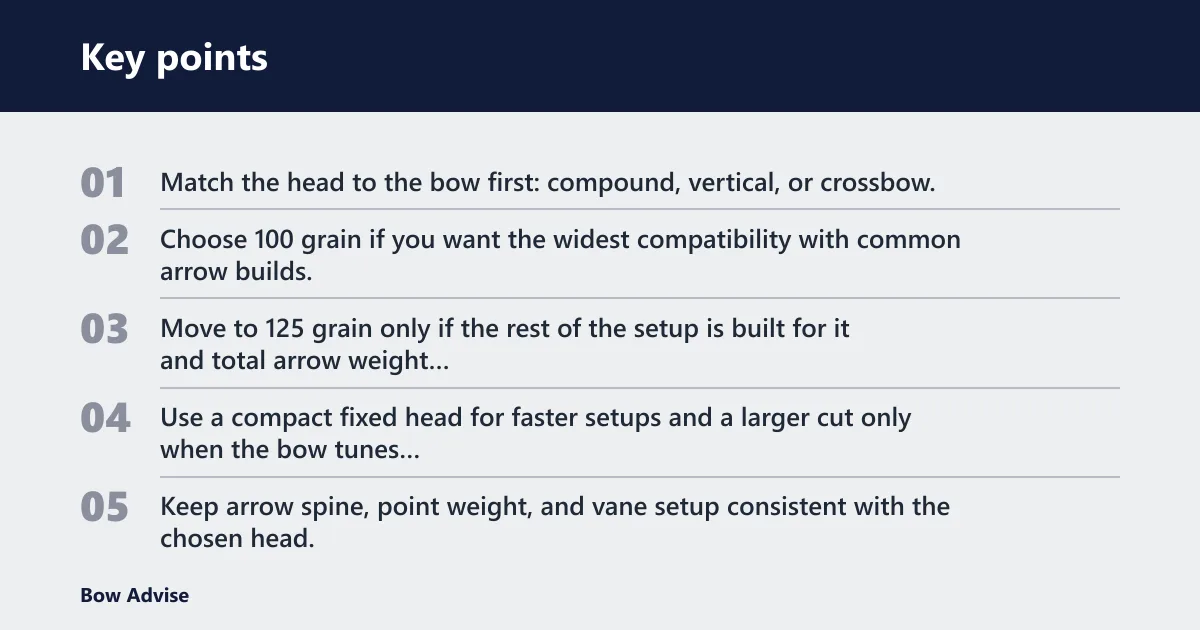
- Match the head to the bow first: compound, vertical, or crossbow.
- Choose 100 grain if you want the widest compatibility with common arrow builds.
- Move to 125 grain only if the rest of the setup is built for it and total arrow weight is part of the plan.
- Use a compact fixed head for faster setups and a larger cut only when the bow tunes cleanly.
- Keep arrow spine, point weight, and vane setup consistent with the chosen head.
Are Muzzy Trocar broadheads good for deer?
Yes, Muzzy Trocar broadheads can be a good deer choice when the model matches the setup. For most deer hunters, the MX-4 or MX-3 offers a practical balance of cut size and control, while HBX or the Trocar Crossbow Broadhead makes more sense for crossbows. The best deer choice is usually the one that tunes cleanly and flies predictably.
Deer-hunting use cases
Deer do not require the largest possible cut to get the job done. On a tuned bow, the MX-4’s 1-1/8-inch cut gives a compact profile that can be easier to settle into flight, while the MX-3 gives more cut at 1-1/4 inches if the setup can support it. HBX is attractive for crossbow hunters who want a hybrid broadhead that opens on impact.
When a smaller cut makes more sense
A smaller cut makes more sense when the bow is very fast, the arrow is short, or the hunter wants the least amount of steering from the broadhead. In those cases, the MX-4 or the crossbow-specific Trocar is often the more practical choice than a wider expandable option.
When a wider cut is worth the tradeoff
A wider cut is worth it when the setup is already tuned and the hunter wants more tissue damage from a clean shot. That tradeoff is more reasonable on a compound or vertical bow with good arrow flight than on a finicky setup that already shows broadhead planing.
A common first-timer mistake is choosing the biggest cutting diameter available, then blaming the head when the arrow impacts left or right of the field-point group. On a 280 to 320 fps compound setup, a smaller compact head often solves the problem before a larger cut ever helps it.
Replacement blades and sharpening
Muzzy offers Trocar replacement blade kits, and that matters because the company says practice blades were discontinued in 2017. For hunters who keep the same head in rotation, the practical path is to inspect the edge, replace damaged blades when needed, and only touch up a blade if the edge is still intact.
What Muzzy offers for blade replacement
The replacement-blade option is the cleanest maintenance route for most Trocar heads. It avoids forcing a worn blade back into service after a hard impact. That is especially useful for hunters who want the same point of impact from a consistent head setup across multiple seasons.
What the discontinued practice blades mean
Because practice blades were discontinued in 2017, buyers should not expect a separate practice-blade path to be part of current maintenance planning. The takeaway is simple: use the field head carefully, inspect it often, and keep replacement blades on hand if the head will be reused.
Practical maintenance path
If the edge is intact, Muzzy says blades can be resharpened. If the edge is damaged or rolled, replacement is the better option. That is usually cheaper than replacing an entire broadhead, especially on a multi-pack setup where only one or two blades may need attention.
- Inspect the ferrule and blade edges after each use.
- Keep only heads with straight ferrules in the hunting lineup.
- Touch up edges only when the blade material is still sound.
- Replace blades when chips, bends, or heavy edge damage appear.
- Retune if the replacement blade changes point of impact.
Who it’s for
The Trocar family is best for hunters who want a fixed or hybrid broadhead matched to a specific setup, not a generic one-head-fits-all answer. It suits compound and vertical-bow users who will tune their arrows, and it suits crossbow hunters who want a model built for that job. It is less appealing for buyers who want the widest cut with the least tuning attention.
Best match for new buyers
New buyers usually do best with the MX-4 or the Trocar Crossbow Broadhead, depending on bow type. Both offer a more straightforward setup than a larger expandable broadhead. A 100-grain head is the safer default if the rest of the arrow build is already standard.
Best match for tuned setups
Tuned setups can take advantage of the MX-3 or HBX because those models give more cutting surface without abandoning the Trocar family’s compact logic. Hunters who already know their spine and vane package are more likely to benefit from the larger cut options.
When to choose another fixed blade
Another fixed blade may be the better answer if the bow is still hard to tune, if arrow flight is inconsistent, or if the setup cannot tolerate a larger cut. In that case, the better move is usually a smaller, simpler head rather than a more aggressive one.
Frequently asked questions
What is the cutting diameter of the Muzzy Trocar broadhead?
The answer depends on the model. HBX expands to 1 5/8 inches, the Trocar Crossbow Broadhead measures 1 3/16 inches, the MX-3 measures 1-1/4 inches, and the MX-4 measures 1-1/8 inches. Buyers should compare the cutting diameter by model, not by the Trocar name alone.
Which Muzzy Trocar model flies more like a field point?
The most field-point-like choice is usually the most compact head that matches the bow and arrow tune. Among these Trocar options, the MX-4 and Trocar Crossbow Broadhead are the smaller-profile fixed heads, while HBX starts at 1 inch before expanding. Clean tuning matters more than brand alone.
Is the Muzzy Trocar 100 grain or 125 grain better?
Neither is automatically better. A 100-grain head is the more common starting point and fits more setups, while 125 grain can help hunters who want more total arrow weight and have a build tuned for it. The right answer depends on spine, speed, and the rest of the arrow setup.
How does the Muzzy Trocar compare to other fixed blade broadheads?
Compared with other fixed blades, the Trocar lineup stands out because it is split into different use cases rather than one generic head. The MX-3 offers more cut, the MX-4 is more compact, and the crossbow-specific model is built around crossbow use. That makes fit more important than a simple brand comparison.
Are Muzzy Trocar broadheads good for crossbows?
Yes, especially the Trocar Crossbow Broadhead and HBX. Muzzy says HB and HBX are for crossbows and vertical/compound bows, but the dedicated crossbow model is the clearest fit because it is designed around that use case. Crossbow hunters should still confirm tune and bolt spine.
Can you sharpen Muzzy broadheads or do you need replacement blades?
Muzzy says blades can be resharpened if the edge is intact. It also offers Trocar replacement blade kits, and practice blades were discontinued in 2017. In practical terms, sharpen only sound edges and replace damaged blades instead of trying to save a bent or chipped one.