Arrow Rest Cost: What to Pay for the Right One
Arrow rest cost usually runs about $40 to $250 for hunting bows: about $40 to $80 buys a basic fixed or entry drop-away rest, about $100 to $180 gets better adjustability and a quieter launch, and about $180+ is commonly where micro-adjust, built-in containment, or premium drop-away designs appear. Buy too cheap and you may give up clearance, tune range, and durability; buy too high and you pay for features your setup will not use. This guide compares each price tier, explains what the money buys, and helps you choose the better hunting value.
Arrow rest types and price tiers


An arrow rest supports the shaft at the front end during draw and release, but price only makes sense when matched to use. Fixed rests, drop-away rests, limb-driven rests, and cable-driven rests all sit in different price bands, and the right choice depends on bow type, practice volume, and how far you shoot.
For a hunter, the biggest cost jump usually comes from better adjustability, quieter operation, cleaner arrow launch, and more precise mounting. A beginner hunting setup often gets more value from a simple, reliable rest than from a premium model with features that never get used.
Arrow rest cost comparison table
| Tier | Expected price range | Key features | Likely user type | Hidden setup costs | Buy or not buy |
|---|---|---|---|---|---|
| Budget fixed | $40 to $80 | Simple containment, fewer moving parts, easy field use | Beginner hunter, short-range whitetail hunter, infrequent shooter | Mounting shims or hardware, basic tune time | Buy if you value simplicity over fine adjustment |
| Budget drop-away | $60 to $110 | Cleaner clearance than a fixed rest, more speed-oriented setup | Hunter who wants a step up without paying for premium controls | Timing setup, cable tie or activation cord, tuning labor | Buy if your bow tunes cleanly and you shoot past close range |
| Mid-range | $100 to $180 | Better adjustability, quieter operation, stronger hardware | Western hunter, bowhunter who practices enough to benefit from tuning | More careful installation, possible replacement parts later | Buy if you want a better balance of cost and control |
| Premium | $180 to $309.99 | Micro-adjust windage and elevation, containment, precise locking mounts | Target crossover shooter, precision-minded hunter, modern compound owner | Higher install labor, compatibility checks, sometimes specific mounting parts | Buy only if your bow and shooting style will use the extra control |
Hoyt lists the UltraRest at $199.99 MSRP, the UltraRest Integrate MX at $299.99 MSRP, and the UltraRest Integrate MX2 at $309.99 MSRP. Field & Stream describes the UltraRest Integrate MX as having ultra micro-adjust windage and elevation, mounting to the back of most modern-day bow risers, and locking to the riser with a two-part locking system.
Which rest type fits your bow?
Fixed rests suit simple hunting setups and short-range work, while drop-away rests are more common when arrow flight quality matters at longer distance. Limb-driven and cable-driven rests are usually chosen by compound bow shooters who want more tuning control, but the setup process is less forgiving than a fixed rest.
Fixed rests and Whisker Biscuit setups
A fixed rest is the easiest place to start when the goal is dependable arrow support. The Whisker Biscuit is a fixed rest with bristles that hold the arrow through the shot cycle, and it stays popular because it is budget-friendly and forgiving for beginners.
Field & Stream notes that a circular Whisker Biscuit can create arrow interference beyond 40 or 50 yards. That matters most for hunters who stretch distance, but it matters less for close-range shots where repeatable containment and simple operation matter more than absolute clearance.
A common first-timer mistake is buying a more advanced rest for a bow that only sees a few practice sessions a year. In that case, the added cost can buy adjustment options that never get used, while a good fixed rest would have been simpler and more durable.
Drop-away rests for hunting accuracy
Drop-away rests fall away after the shot, which helps with cleaner arrow flight and less contact on the way out. That is why many hunters and target crossover shooters prefer them when they want better clearance and more consistent vane behavior.
Outdoor Life lists the QAD Ultra-Rest Hunter as Best Budget Drop Away, which shows how far the category has moved down in price. A budget drop-away can be a strong value when the bow is tuned carefully and the shooter benefits from cleaner launch without buying a top-shelf model.
Limb-driven and cable-driven rest differences
Outdoor Life separates compound-rest designs into fixed, limb-driven, and cable-driven categories. Limb-driven rests use limb movement to activate the launcher, while cable-driven rests use the bowstring or cable system, and that difference affects timing, tuning, and failure points.
Limb-driven models often appeal to shooters who want fine control and cleaner arrow escape. Cable-driven rests are common in premium hunting rests, but they need careful timing because cord stretch or timing drift can change launch behavior over time.
Are drop-away rests worth it?
Drop-away rests are worth the extra money when cleaner arrow flight, better vane clearance, or longer-range hunting is part of the job. They are less convincing for short-range hunters, infrequent shooters, or anyone whose bow already groups well with a fixed rest and does not need extra adjustment.
When cleaner arrow flight matters
Drop-away rests earn their price when arrow clearance starts to limit performance. That matters more for western hunting, longer practice distances, and setups where broadheads reveal small launch issues that field points do not.
Suppose a hunter shoots from a saddle at 48 yards and sees broadhead planing with a fixed rest. A drop-away may reduce contact and help the bow tune more cleanly, but only if the rest is installed and timed correctly.
When the added cost is hard to justify
Field & Stream says a whitetail and turkey hunter may not need a $300 drop-away rest. That is a useful cutoff for buyers who shoot closer ranges, practice less often, or simply want a dependable setup that does not demand extra tuning work.
If the rest adds cord routing, timing checks, and more parts that can drift, the total cost rises beyond the sticker price. For some hunters, that money is better spent on arrows, broadheads, or a cleaner bow tune.
What hidden costs should you expect?
The sticker price is only part of arrow rest cost. Installation, mounting hardware, timing labor, and later replacement parts can add enough expense to move a rest into a different value bracket, especially on premium drop-away and micro-adjust models.
Mounting hardware and bow riser compatibility
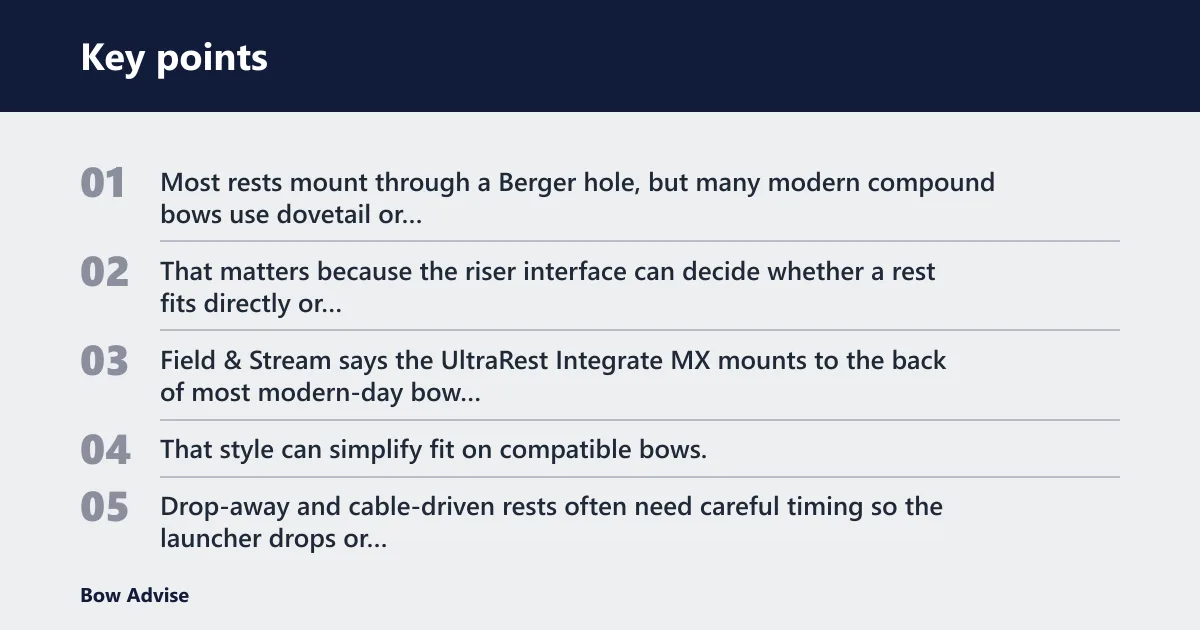
Most rests mount through a Berger hole, but many modern compound bows use dovetail or IMS / Integrate-compatible systems. That matters because the riser interface can decide whether a rest fits directly or needs extra hardware, an adapter, or a different model entirely.
Field & Stream says the UltraRest Integrate MX mounts to the back of most modern-day bow risers and locks with a two-part locking system. That style can simplify fit on compatible bows, but it can also narrow the pool of rests a buyer should consider.
Timing and tuning labor
Drop-away and cable-driven rests often need careful timing so the launcher drops or clears at the right moment. That work can be simple on one bow and annoying on another, especially if the rest is sensitive to cable travel or small changes in setup.
Cost also rises when a pro shop has to chase paper tears, vane contact, or launcher timing. The rest itself may cost $120, but labor and re-checks can make the real bill much higher.
Replacement parts and setup adjustments
Premium rests sometimes use replacement cords, bushings, screws, or lock parts that are not part of a basic fixed-rest setup. That is not a reason to avoid them, but it is a reason to budget for long-term ownership instead of only the first purchase.
Noise is another hidden cost in hunting use. A quieter rest may matter more than a lighter one, because noisy containment can become a field issue even when the bow tunes well on paper.
How mounting systems affect price
Mounting systems change both cost and compatibility. A bow riser with a Berger hole usually offers broad compatibility, while dovetail and IMS / Integrate systems can limit choices but add stability and cleaner fit on certain modern compound bows.
Berger hole mounts versus dovetail and IMS
Berger hole mounts are common and usually keep the buying process simple. Dovetail and IMS / Integrate systems often cost more because the rest and the riser interface are built to work as a matched setup, not as a universal add-on.
That can be a smart trade if the bow already supports the system. It can be an expensive mistake if the rest seems cheap at checkout but needs special parts or a different bracket to fit the riser correctly.
Why modern compound bows can limit your rest choices
Modern compound bows often push buyers toward specific interfaces, especially when the rest is meant to sit tightly against the riser. That can improve alignment and stability, but it also means a bargain rest may not fit cleanly without extra parts.
Check the riser first, then the rest. A buyer who ignores that order can end up paying twice, once for the wrong mount and again for the correct one.
- Identify the bow riser interface: Berger hole, dovetail, or IMS / Integrate.
- Decide whether the bow is for close-range hunting, western hunting, or target crossover use.
- Choose a rest type: fixed, drop-away, limb-driven, or cable-driven.
- Estimate setup cost, not just sticker price, including installation and timing.
- Buy only the features the bow and shooting style will actually use.
Frequently asked questions
What type of arrow rest is best?
The best arrow rest depends on how the bow is used. For simple hunting and infrequent practice, a fixed rest or Whisker Biscuit often gives the best value. For longer-range hunting and cleaner clearance, a drop-away usually wins. For precision-minded compound shooters, limb-driven rests often offer the best adjustability.
How much does an arrow rest cost?
Most hunting rests fall between $40 and $250, with premium models above that. Entry-level fixed and drop-away rests usually sit in the lower range, mid-tier models add better adjustability and quieter operation, and premium rests bring micro-adjustability, tighter mounts, and more exact tuning control.
What is the best arrow rest for beginners?
A beginner usually does best with a simple fixed rest or Whisker Biscuit. Those setups are forgiving, budget-friendly, and less sensitive to timing or small setup changes. They also fit the needs of many close-range hunters who want dependable arrow support without paying for premium features.
Should I get a Whisker Biscuit or drop-away rest?
Choose a Whisker Biscuit if you want simplicity, containment, and a lower price. Choose a drop-away if you want cleaner arrow flight and your bow will be tuned carefully. For most close-range hunters, the cheaper fixed rest is the better value; for longer-range use, the drop-away is often the better buy.
What arrow rest should I buy for my bow?
Start with the bow riser interface, then match the rest to your hunting style. A Berger hole bow has broad options, while IMS / Integrate bows may need a specific mount. Then decide whether your use case favors a fixed rest, a drop-away, or a premium micro-adjust model.