Best Packs for Mobile Crossbow Hunters (2026): We Compared
Compact and full-size packs are not separated by volume alone. The real split is how much gear must stay organized, quiet, dry, and close at hand while the hunter walks, waits, or climbs.
Choose a full-size pack for most mobile hunters carrying bolts, layers, water, optics, and a first-aid kit; choose a compact pack only when the route is short, the kit is stripped down, and faster access matters more than storage. Pick wrong and you get bouncing gear, slower setup, or a pack that costs comfort and shots. This guide compares both pack types.
Quick comparison
| Product | Badge | Best for | Price | ||
|---|---|---|---|---|---|
 | NEW VIEW Soft Crossbow CaseNEW VIEW | Also consider | Compact · padded · 7 pockets | $85.49 Price as of 14 Nov 2026 | View |
 | Allen Company Titan Crossbow Bolt De-Cocking HeadAC Allen | Also consider | $15.99 Price as of 14 Nov 2026 | View |
Crossbow Pack usually wins for speed and low bulk. Full-Size Pack usually wins for long carries, layered clothing, and cleaner organization under real hunting loadouts.
How we chose
The comparison uses a few practical filters: carry distance, total load, noise control, and weather protection. Those factors matter more than a simple liters number.
It also checks crossbow fit, because overall length, limb width, mounted scope height, and broadhead protection can turn a “fits” claim into a bad carry if the case is too tight or too loose.
Finally, it looks at how the pack handles the items most hunters actually carry: rangefinder, extra bolts, gloves, water, snacks, and a first-aid kit.
| Factor | Crossbow Pack | Full-Size Pack | Winner |
|---|---|---|---|
| Access speed | Faster access from a simpler layout and fewer pockets | Slower access because more storage usually means more layers of gear | Crossbow Pack |
| Load comfort on long walks | Light carry weight, but less support for a heavier kit | Better load support with hip belt support, sternum strap, and padded shoulder straps | Full-Size Pack |
| Organization and weather storage | Enough for a minimal kit, but reduced storage capacity can crowd layers | More gear organization, more weather protection options, and better dry storage for optics and electronics | Full-Size Pack |
| Brush handling | Lower profile and less bulk in tight cover | Bulkier when pushing through brush or slipping past limbs | Crossbow Pack |
| Best fit for layered season loads | Works only if layers are minimal | Handles late-season layers without crushing the rest of the kit | Full-Size Pack |
Access speed
Crossbow Pack wins when the hunter needs a fast grab on a rangefinder, extra bolts, or other small accessories. Fewer pockets and a simpler structure usually mean less digging.
Full-Size Pack can be organized well, but more organization often means a deeper layout. That can slow down access when the shot window is short.
Carry comfort
Full-Size Pack is the better choice once the walk gets longer or the load gets heavier. A hip belt, sternum strap, and padded shoulder straps matter when water, layers, and optics start adding weight.
Crossbow Pack carries easier at low weight, but comfort can drop fast once the load starts to creep up. The lighter bag helps, yet it cannot fix poor weight transfer.
Organization and weather protection
Full-Size Pack usually gives the cleaner answer here. It has room for dry storage, accessory pockets, and weather cover options that protect electronics and spare gear.
Crossbow Pack can still be weather-resistant, but the reduced storage capacity means the hunter has less room to separate wet gloves, optics, and spare clothing.
Brush and noise control
Crossbow Pack is often the better fit in tight cover because less bulk catches less brush. That matters on side-hill approaches, fence-line edges, and sapling-thick routes.
Silent zippers, compression straps, and no-rattle organization matter in both packs. A noisy pack fails fast, no matter which size it is.
Compact crossbow pack: best for short mobile hunts
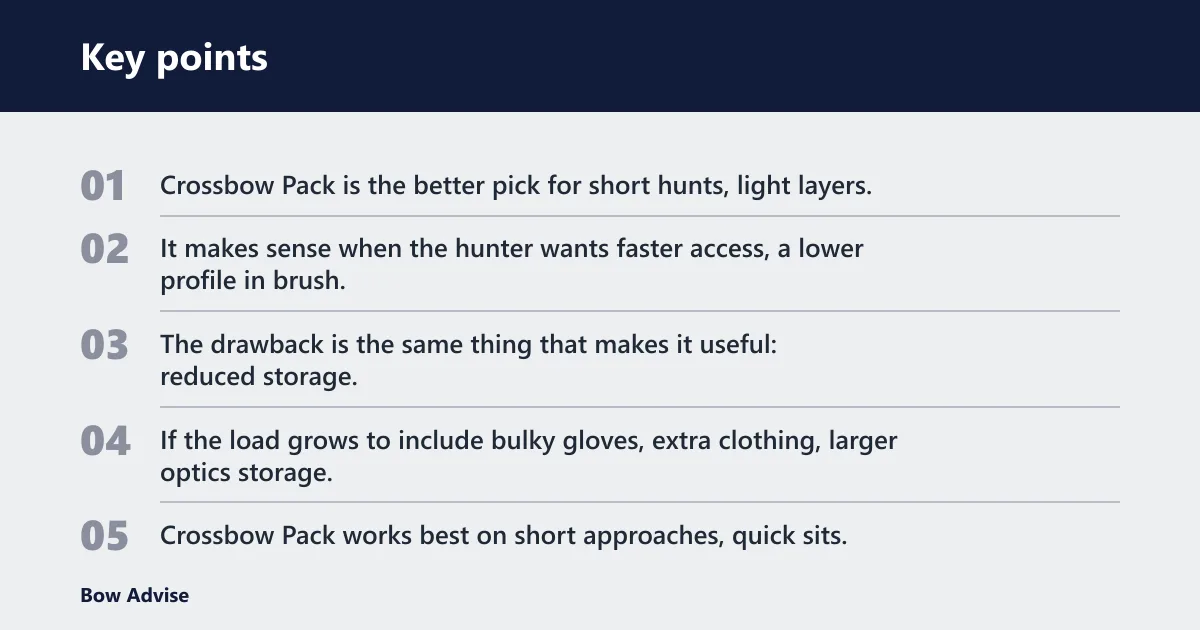
Crossbow Pack is the better pick for short hunts, light layers, and a stripped-down loadout. It makes sense when the hunter wants faster access, a lower profile in brush, and less weight on the walk in.
The drawback is the same thing that makes it useful: reduced storage. If the load grows to include bulky gloves, extra clothing, larger optics storage, or a fuller snack-and-water setup, the pack can feel cramped fast.
When compact size works well
Crossbow Pack works best on short approaches, quick sits, and spot-and-stalk routes where the hunter carries only what is needed. It also suits warmer weather, when layers stay minimal and the kit stays small.
It is a good fit when the crossbow dimensions are already close to the pack limit. Overall length, mounted scope height, and broadhead protection all matter because a tight fit can slow stowage and increase snag risk.
What it should carry
A compact loadout should hold the crossbow, bolts, rangefinder, gloves, and a small weather layer. Add a water bottle or soft flask only if the remaining pockets still close cleanly.
The safest compact packing order is simple: broadheads protected first, bolts secured next, then optics and electronics in dry pockets. That keeps metal edges and glass from knocking together.
Where compact packs fail
Compact packs fail when late-season clothing enters the picture. A puffy jacket, extra gloves, hand warmers, and a second insulating layer can eat the same space that was supposed to hold bolts and optics.
A common first-timer mistake is packing a compact bag for a cold, wet evening sit and then forcing rain gear into the last open pocket. The result is a noisy, hard-to-close pack that slows down setup and can snag in brush.
Full-size crossbow pack: best for long hauls
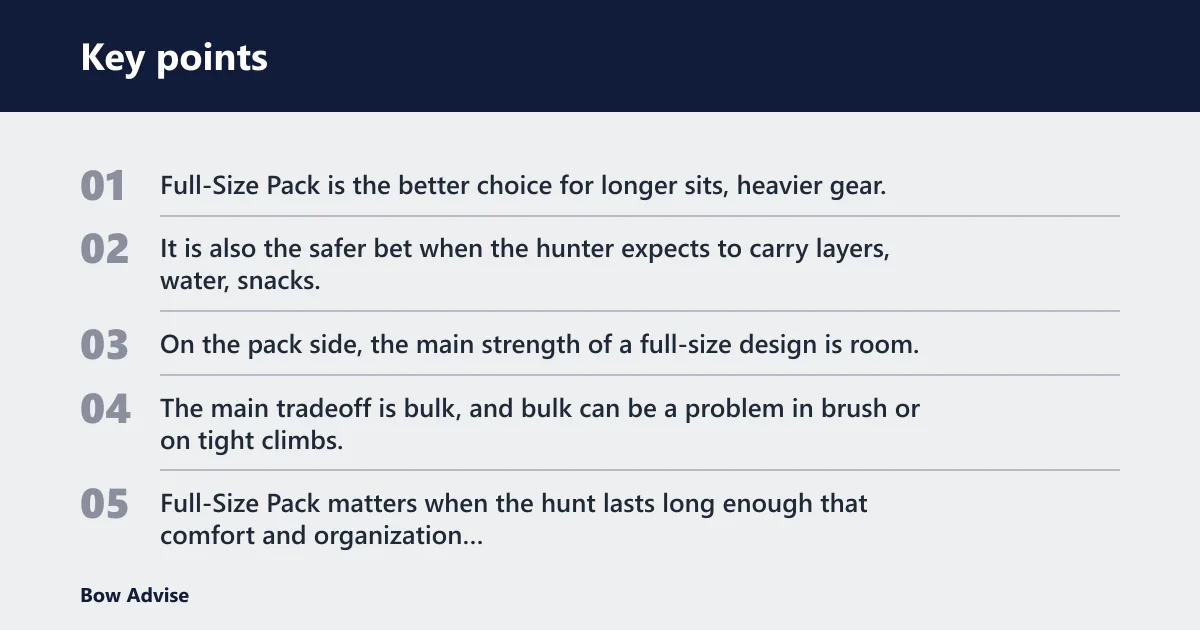
Full-Size Pack is the better choice for longer sits, heavier gear, and routes that demand better load support. It is also the safer bet when the hunter expects to carry layers, water, snacks, and extra accessories without juggling storage.
On the pack side, the main strength of a full-size design is room. The main tradeoff is bulk, and bulk can be a problem in brush or on tight climbs.
When extra volume matters
Full-Size Pack matters when the hunt lasts long enough that comfort and organization start to matter as much as speed. That usually includes all-day sits, late-season setups, and longer walks with more clothing.
It also helps when the hunter needs dry storage for optics and electronics. A rangefinder and phone do better when they are not pressed against damp clothing or loose hardware.
Where full-size packs get in the way
Full-size packs can feel awkward in brush. The extra volume catches limbs, changes balance, and can slow a stalk when every step has to stay quiet.
They also waste space if the load is tiny. A long-carry pack with a near-empty main compartment can still ride well, but the benefit of that structure disappears when the route is short and the kit is minimal.
Crossbow pack decision matrix
This matrix matches hunt type, carry distance, season, and gear list to the better choice. The warning column shows what tends to go wrong if the hunter picks the other pack size.
| Hunt type | Carry distance | Season | Gear list | Better pack | Wrong choice warning |
|---|---|---|---|---|---|
| Spot-and-stalk | Short to moderate | Warm or early season | Crossbow, rangefinder, release aid, 2-4 bolts, gloves, water | Crossbow Pack | A full-size pack can add brush drag and slow the stalk. |
| Late-season sit | Moderate to long | Cold, layered season | Crossbow, extra layer, gloves, snacks, water, first-aid kit, optics storage | Full-Size Pack | A compact pack can become cramped and noisy once layers are added. |
| Long walk to the stand | Long | Any season with heavier load | Crossbow case, bolts, rain gear, water, snacks, spare batteries, release aid | Full-Size Pack | A compact pack may ride hard on the shoulders and run out of storage. |
| Wet or snowy conditions | Moderate | Rain or snow | Waterproof shell, dry optics storage, extra socks or gloves, broadhead protection | Full-Size Pack | A compact pack can run out of dry space and leave wet gear mixed in. |
Picture a warm early-season stalk with only a crossbow, three bolts, and a small bottle of water. In that case, Crossbow Pack usually makes more sense because the smaller load does not need extra pockets or a larger frame.
Which one should you buy?
Choose Crossbow Pack if your hunts are short, your kit is light, and you need fast access in brush or on a quick stalk. It fits the hunter who carries only the essentials and wants less bulk.
Choose Full-Size Pack if you hike farther, sit longer, or carry layers, water, electronics, and extra gear. The better harness and larger layout pay off when the load gets heavier and the weather turns.
If the total carried weight stays light and the route stays short, compact usually works. If the load climbs with season changes, full-size is the safer default.
For many mobile hunters, a full-size pack is the more dependable all-around choice. Compact still wins for stripped-down, fast-moving hunts.
Choose Crossbow Pack if…
Choose Crossbow Pack if your hunt is a short walk, your gear list is lean, and you want the fastest possible access to bolts and other small accessories. It also makes sense when brush is thick and bulk is the bigger problem.
Choose Full-Size Pack if your route is longer, your season is colder, or you need room for dry storage, extra layers, and a more organized load. It is the better answer for comfort and carry support when the kit gets heavy.
Frequently asked questions
Is a compact crossbow pack big enough for hunting gear?
Yes, if the gear list stays lean. A compact pack can cover the basics: crossbow, bolts, rangefinder, gloves, and a little water. It stops being enough when the hunt adds rain gear, heavy layers, or a larger survival kit.
When is a full-size pack better than a compact pack for mobile hunting?
A full-size pack is better when the walk is long or the hunt lasts all day. It handles layered clothing, extra bolts, snacks, water, and dry storage more cleanly, which matters once the load moves beyond a minimal setup.
How much does pack size affect comfort on long walks to the stand?
Pack size affects comfort most through load transfer and fit. A larger pack with a hip belt and sternum strap can carry weight better, but only if the load is real. A too-small pack can also be uncomfortable once gear starts hanging off the pockets.
What should a crossbow pack hold besides the bow itself?
At minimum, it should hold bolts, a rangefinder, gloves, water, snacks, and a first-aid kit. In colder or wetter conditions, add a spare layer and dry storage for electronics. Broadhead protection should be part of the layout, not an afterthought.
Can a compact pack fit bolts, a rangefinder, and rain gear?
Sometimes, but only if the rain gear is minimal. A compact pack can handle bolts and a rangefinder easily; rain gear is the item that often pushes it past its limit. If the shell is bulky, the compact layout can turn tight and noisy.
How do I keep a crossbow pack quiet and easy to access in the field?
Use silent zippers when possible, tighten compression straps, and keep hard items separated so they do not rattle. Pack the items you reach for first in the outer pockets. That reduces digging and keeps the bow or case from shifting while you move.
What features matter most in a hunting pack for mobile hunters?
The most useful features are a quiet zipper system, stable carry straps, weather-resistant fabric, and a layout that protects optics and bolts. After that, look at case fit, pocket count, and whether the pack actually supports the distance you plan to walk.