Fixed Blade vs Mechanical Broadheads for Bow Hunting
For whitetail and similar game, I start with fixed blades on slower bows, lighter arrows, and steeper angles; I move to mechanicals only when bow speed, arrow weight, and tuning give enough energy and a broadside shot is likely. A bad match costs blood trail, penetration, and recoveries. This guide compares both by speed, arrow mass, shot distance, and impact angle, with setup rules I use on my own bows.
This guide is part of our Hunting gear comparisons for archers series.
Fixed blade vs mechanical broadheads: the real trade-off


Fixed blades stay simple and have no moving parts, while mechanical broadheads use blades that open on impact. That changes flight, cutting diameter, and how much I trust the head when the shot goes wrong. I do not call either design the best by itself; I match it to the bow and the hunt.
| Decision factor | Fixed blade | Mechanical broadheads for bow hunting | Winner |
|---|---|---|---|
| Flight on a tuned bow | Can expose weak tune and arrow spine issues | Often tracks closer to field points on some bows | Mechanical broadheads for bow hunting |
| Penetration confidence | Strong on quartering and bone-risk shots | Depends more on clean opening and impact angle | Fixed blade |
| Cutting diameter | Usually smaller | Mechanical broadheads generally have a larger cutting diameter | Mechanical broadheads for bow hunting |
| Tuning demand | Usually higher | Often lower on some setups | Mechanical broadheads for bow hunting |
| Reliability on impact | No deployment step at impact | Moving parts can fail to open | Fixed blade |
Flight on a tuned bow
Fixed blades can plan if the bow is not tuned well, the arrow spine is off, or the rest timing is sloppy. I see that most clearly when a field point groups tight but a fixed head starts drifting left, right, or high at distance. Mechanicals often hide some of that because the closed blades present a smaller front end in flight.
That does not make mechanicals magic. It means they can hide more of a setup problem on some bows, especially if the rig is already close.
Penetration confidence
Fixed blades usually give me more confidence when the arrow may meet shoulder, ribs at an angle, or a quartering path through the chest. The no-deployment design matters here because there is no hinge or blade opening to steal momentum at impact. Penetration is not a slogan, though; arrow flight, sharpness, impact angle, and arrow mass all push the result.
Cutting diameter
Mechanical broadheads generally have a larger cutting diameter than fixed blade broadheads. That larger wound channel can help blood trail quality when the shot is clean and the head opens as designed. The trade-off is that larger cuts do not help if the head never opens or if poor flight robs penetration first.
Reliability on impact
Fixed blades win on simplicity. There is no deployment step at impact, which removes one failure point right away. Mechanical broadheads have moving parts, and that means reliability depends on blade retention, opening mechanics, and whether the head meets hide and bone at a bad angle.
According to Fixed vs Mechanical Broadheads: Compare the Tradeoffs — The G5 MegaMeat is mentioned as a preferred mechanical broadhead.
How each broadhead flies from a tuned bow
From a tuned bow, both designs can shoot well, but they do not fail the same way. Fixed blades usually tell the truth about tune. Mechanicals can be more forgiving in flight on some rigs, which is why many hunters like them on bows that are fast and already close to dialed.
Fixed blade planing and what causes it
Fixed blade planing usually comes from a tune problem, poor arrow spine match, or a broadhead that catches air differently than the field point. If the arrow is leaving the bow crooked, the fixed head shows it fast.
Why mechanicals often track closer to field points
Mechanical heads often track closer to field points because the blades stay tucked in during flight. That smaller profile can reduce steering effect through the air. The gain is real on some setups, but I never use it as a reason to ignore tune, because a poor launch is still a poor launch.
What arrow speed and spine change in the real world
Bow speed matters because faster arrows leave less time for planing to grow into a miss. Arrow spine matters because an under-spined shaft can flex too much and magnify broadhead drift. If I change draw weight, point weight, or shaft length, I re-check broadhead flight before I hunt.
Do fixed blade broadheads penetrate better?
Often, yes, but only when the full system supports it. Fixed blades tend to hold up better when the shot hits bone or comes in at a quartering angle, yet penetration still depends on sharpness, blade angle, arrow mass, and whether the arrow reaches the target straight. I never call it a head-only problem.
Penetration and the role of blade angle
Blade angle affects how much resistance the head meets on impact. A broadhead that slices cleanly through tissue will keep more speed than one that pushes a lot of surface area. That is why a well-tuned fixed blade with a sharp edge can surprise people who assume bigger cuts always mean better results.
How impact angle changes the result
A broadside whitetail is one thing. A quartering-away or quartering-to shot is different. On an angle shot, the arrow path is longer, and any loss of alignment or cutting resistance gets magnified. That is where fixed blades usually earn my trust.
When arrow mass matters more than head type
Heavier arrows often help penetration more than a simple head swap does. If the bow is underpowered or the shaft is too light, even a fixed blade can struggle. I would rather correct arrow mass and tune first than try to solve a penetration problem with a different head alone.
Are mechanical broadheads legal everywhere?
No. Some states do not allow mechanical broadheads, and local hunting regulations can be stricter than the broadhead box suggests. I check legality before I buy heads for a season, because a legal issue on the shelf becomes a dead-end at the trailhead.
State legality and common restrictions
Some states do not allow mechanical broadheads at all. Others allow them but set minimum cutting diameter or broadhead construction rules. That means the right choice is not only about performance; it is also about whether the head is legal in the area I plan to hunt.
Why you should check regulations before buying
I do not want to set up arrows, tune a bow, and sight in broadheads only to find the head is not legal where I am headed. That wastes time and money. It also matters if I hunt multiple states, because one head may be fine in one place and barred in another.
How legality can shape your season plan
If I may cross a state line during bow season, I build around the stricter rule. That keeps my quiver and practice schedule simple. It also avoids the last-minute scramble of changing heads after the bow is already tuned.
What broadhead is best for whitetail deer?
For whitetail deer, I pick based on the shot lane and bow setup, not the species alone. Whitetail are generally smaller than elk or moose, so broadhead choice often leans more on tuning, distance, and likely impact angle. In thick cover, I lean fixed blade; for open shots with a fast, tuned bow, mechanicals can make sense.
Thick-cover whitetail hunts and short lanes
In brushy timber, I want reliability and penetration confidence more than a huge cutting diameter. Short lanes can force fast decisions and awkward angles. That is why a fixed blade gives me more peace of mind when the shot might turn into a quartering hit or brush is close to the lane.
Longer-range whitetail shots and open-country setups
At longer ranges, flight consistency matters more, because small tune issues grow as distance stretches. If the bow is fast, the arrow is matched well, and the shot is likely to stay broadside, a mechanical can give a cleaner flight path and a larger wound channel when everything opens correctly.
Low-poundage bows versus high-speed compounds
Low-poundage bows need every bit of penetration they can get, so I usually favor fixed blades there. High-speed compounds with good arrow flight can run mechanicals well, especially if the hunter wants field-point-like flight. The bow decides more than the deer does.
Choose fixed blade if… / choose mechanical if…
Choose fixed blade if your shots may include quartering angles, brushy cover, or bone risk. Choose mechanical if your bow is fast, tuned, and you want field-point-like flight on broadside deer. I also choose fixed blade when I expect stricter state rules or when I want the simplest head in the quiver.
Choose fixed blade if your setup looks like this
- Your bow is slower or runs a lower poundage setting.
- Your arrows are lighter and you want more penetration confidence.
- Your shot list includes quartering or angle shots.
- You hunt thick cover where a fast, ugly shot can happen.
Choose mechanical if your setup looks like this
- Your compound is fast and already tuned well.
- Your arrow flight with field points is clean and repeatable.
- You expect broadside deer and clear shooting lanes.
- Your state allows the head and your season plan fits its design.
Broadhead decision matrix and tuning checklist
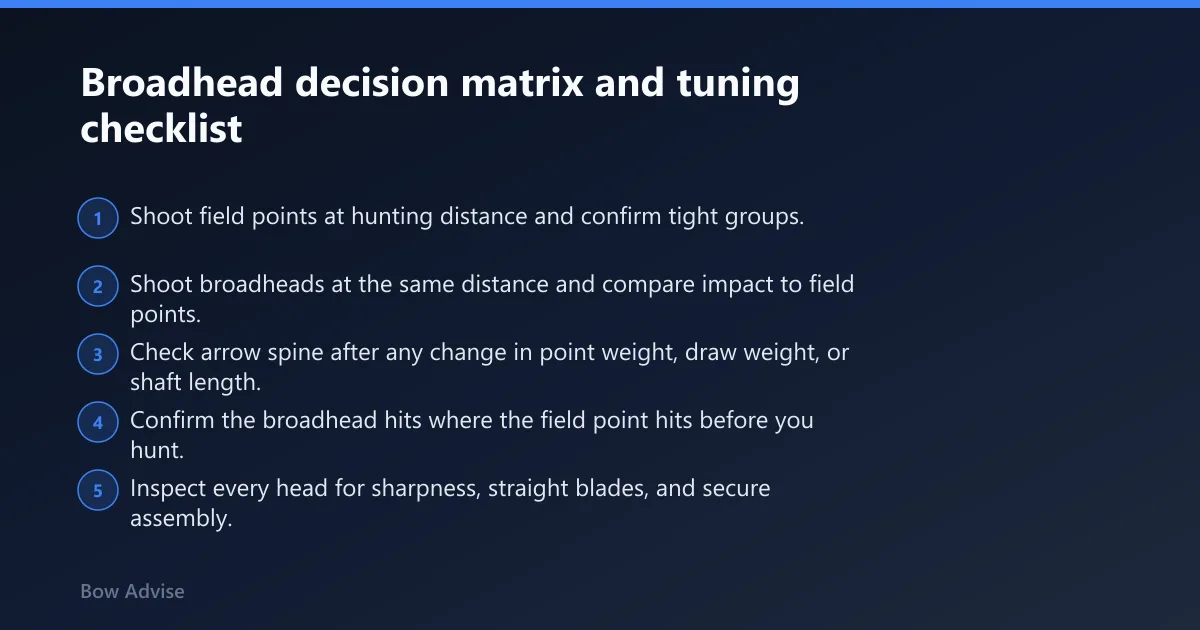
This is the one-page guide I would hand a new bowhunter. It scores the two designs by hunting condition, not by internet loyalty. I want the tool that fits the bow, the lane, and the impact angle risk.
| Hunting scenario | Fixed blade | Mechanical broadheads for bow hunting | Best fit |
|---|---|---|---|
| Low-poundage bows | Better penetration confidence | Can lose margin if deployment steals energy | Fixed blade |
| High-speed compound setups | Works well if tune is strong | Very good if flight and legality line up | Mechanical broadheads for bow hunting |
| Thick-cover whitetail hunts | More forgiving on angle and bone risk | Needs cleaner lane and opening reliability | Fixed blade |
| Longer-range western shots | Can expose tune at distance | Often tracks closer to field points | Mechanical broadheads for bow hunting |
| Quartering-bone risk shots | Strong confidence | Less forgiving if deployment or angle goes wrong | Fixed blade |
- Shoot field points at hunting distance and confirm tight groups.
- Shoot broadheads at the same distance and compare impact to field points.
- Check arrow spine after any change in point weight, draw weight, or shaft length.
- Confirm the broadhead hits where the field point hits before you hunt.
- Inspect every head for sharpness, straight blades, and secure assembly.
- Verify local hunting regulations before opening day.
Cost of ownership across a season
Fixed blades often cost less over time if I am not replacing blades frequently, because there is no deployment mechanism to maintain. Mechanical broadheads can add cost through replacement blades, practice heads, and parts that may wear or get bent. The cheapest head on the shelf is not always the cheapest head after a full season of practice and hunting.
I also think about practice heads. If I need a separate practice version, I want that cost counted before I buy. A broadhead that shoots great but forces repeated replacements can cost more than a simpler fixed blade that stays in rotation longer.
Frequently asked questions
Are fixed blade broadheads better than mechanical broadheads for bow hunting?
For me, fixed blades are better when I expect rough angles, lower bow speed, or tougher impact conditions. Mechanicals can be the better fit on tuned, fast bows with broadside shots. The right answer is setup-driven, not brand-driven.
Which broadhead flies better at longer ranges?
Mechanical broadheads often fly closer to field points at longer ranges because the blades stay tucked during flight. That said, a tuned bow with a proper arrow spine can make a fixed blade fly very well too. The real test is your bow, not the label.
Do fixed blade broadheads penetrate better than mechanicals?
Often they do, especially on quartering shots and when bone risk is part of the plan. Fixed blades have no deployment step at impact, so there is one less way to lose energy. Penetration still depends on sharpness, arrow mass, and impact angle.
Are mechanical broadheads legal everywhere for bow hunting?
No. Some states do not allow mechanical broadheads, and other states may set their own rules for broadhead design. I always check local hunting regulations before buying or carrying one. A legal head is part of the setup.
What broadhead is more reliable on quartering shots?
Fixed blades are more reliable on quartering shots in my book. They do not depend on a deployment event, and they handle angled impacts with more confidence. If I expect a quartering hit, I want the simpler head in the quiver.
Should I choose a fixed blade for thick cover hunting?
Yes, I usually would. Thick cover raises the chance of awkward angles, short reaction time, and a less-than-perfect lane. Fixed blades give me more confidence when the shot is messy and I need the arrow to keep driving.