Hunting Arrow Cost: What You’ll Actually Pay Per Arrow
A usable hunting arrow setup often costs about $10–$30 per arrow, or roughly $120–$360 per dozen, before broadheads; premium shafts and components can push that higher. Picking by shaft price alone often leaves you with arrows that tune poorly, fly inconsistently, or miss the bow weight and draw-length setup. This guide breaks down real hunting arrow costs, what each budget buys, and which bow setup each price level fits.
The real cost of a complete arrow setup
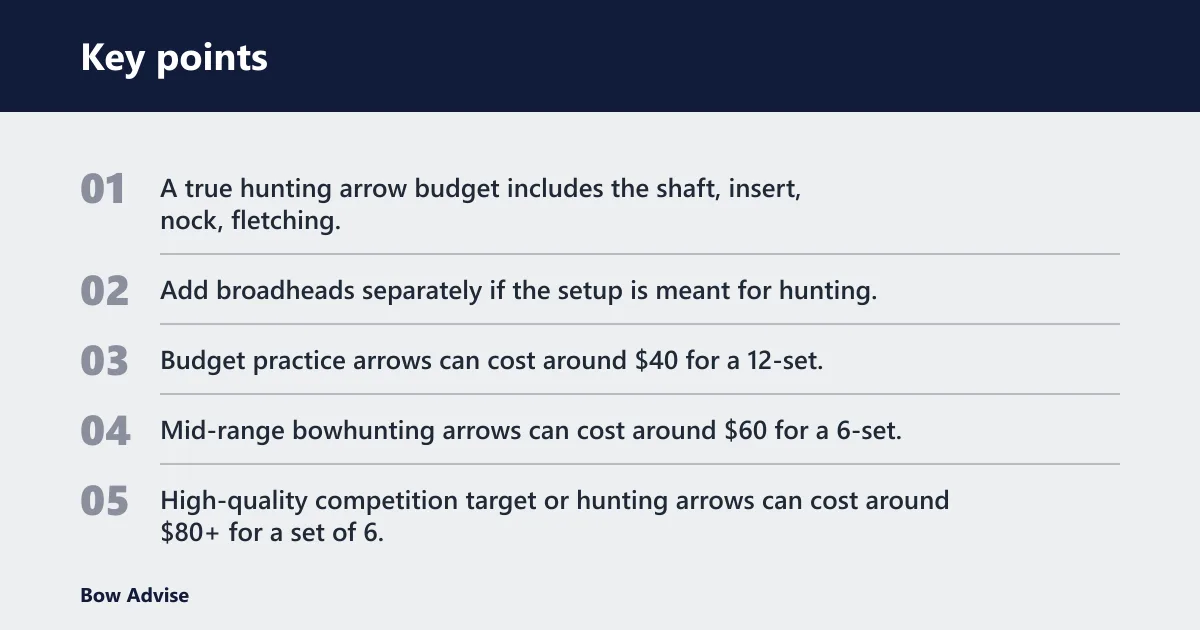


The shaft is only one line on the receipt. A true hunting arrow budget includes the shaft, insert, nock, fletching, and often field points for practice and tuning. Add broadheads separately if the setup is meant for hunting, because many kits ship with field points instead.
Typical price bands
Budget practice arrows can cost around $40 for a 12-set, which puts them in the lowest entry tier. Mid-range bowhunting arrows can cost around $60 for a 6-set. High-quality competition target or hunting arrows can cost around $80+ for a set of 6, before extra components and broadheads.
That spread is easy to miss at first glance. A pack price can look fair until the parts are added up. Pack count matters too, since 6-pack, 12-pack, and 24-pack options change the per-arrow value.
What changes the price most
Material, straightness tolerance, and pack count do most of the work. Carbon hunting arrows are the common hunting standard because they are more durable than fiberglass and usually straighter than cheaper materials. Straightness tolerance is published as a +/- figure, and tighter tolerance usually costs more.
Most hunting buyers should treat a shaft listing as a starting point, not the final cost. A low shaft price can still lead to a higher setup cost if the arrow needs extra inserts, adjustable nocks, or more replacement after poor tune.
What specs matter before you buy
The right hunting arrow needs the right spine, length, and straightness for the bow setup. Draw weight and arrow length drive spine choice, while shaft diameter and nock fit affect how the arrow works with the rest of the system. A cheap arrow that does not match those specs is rarely cheap for long.
Spine, draw weight, and arrow length
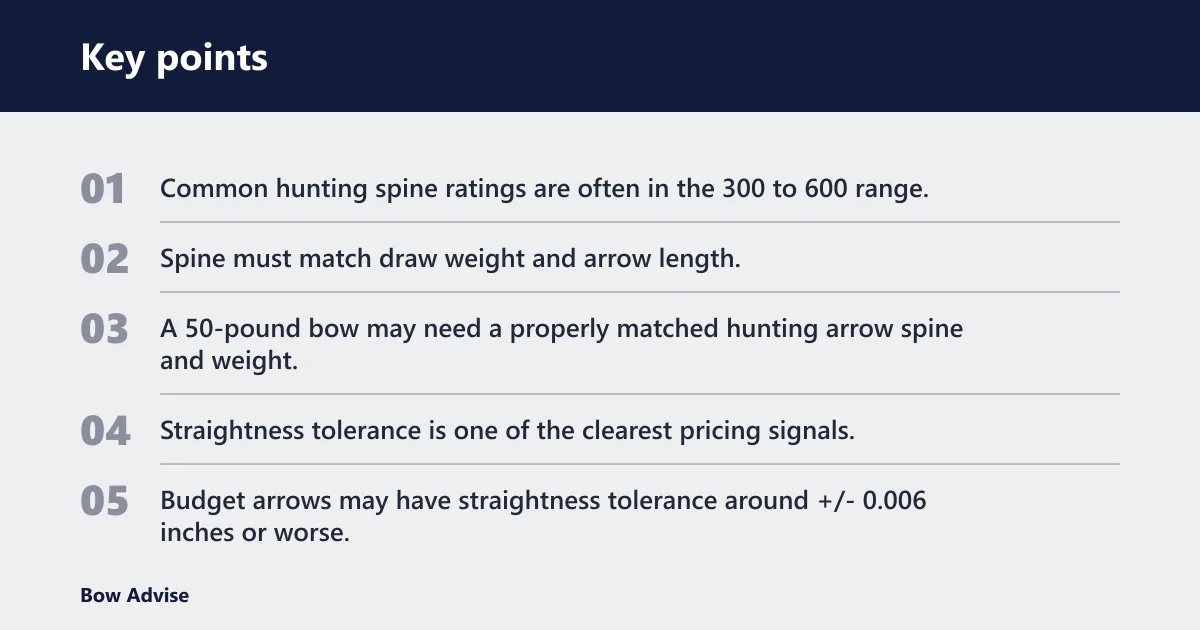
Arrow spine is the stiffness rating. Common hunting spine ratings are often in the 300 to 600 range, including sizes such as 300, 350, 400, 500, and around 550 to 600. Spine must match draw weight and arrow length, because a longer shaft and heavier bow load both change how the arrow flexes on release. A 50-pound bow may need a properly matched hunting arrow spine and weight.
Straightness tolerance and why it raises cost
Straightness tolerance is one of the clearest pricing signals. Budget arrows may have straightness tolerance around +/- 0.006 inches or worse. KEAUP arrows list a straightness tolerance of +/- 0.006 inches. Better straightness usually costs more because tighter sorting and better manufacturing raise the hit rate on consistent shafts.
If two arrows look similar but one carries a tighter straightness spec, the better shaft often costs more for a reason. That extra cost pays for consistency, not decoration.
Shaft length, diameter, and fit
Shaft length must fit the bow setup and draw length. Common hunting arrow lengths are often around 28 to 32 inches. Tiger Archery arrows are listed with a 30-inch length, while KEAUP arrows are shown as 32 inches long in the comparison table.
Diameter matters too. Tiger Archery arrows use an outer diameter of 0.309 inch. That affects nock fit, broadhead alignment, and some rest setups. A correct fit is part of the real cost, because a mismatched diameter can force replacement parts or a new shaft purchase.
Why some hunting arrows cost more
More expensive arrows usually cost more because they are straighter, more consistent, or sold with better components. Carbon shafts, tighter straightness tolerances, and factory-fletched builds raise the price. Pack count also affects the sticker price, since a 6-pack often costs more per arrow than a 12-pack.
Carbon versus fiberglass for hunting use
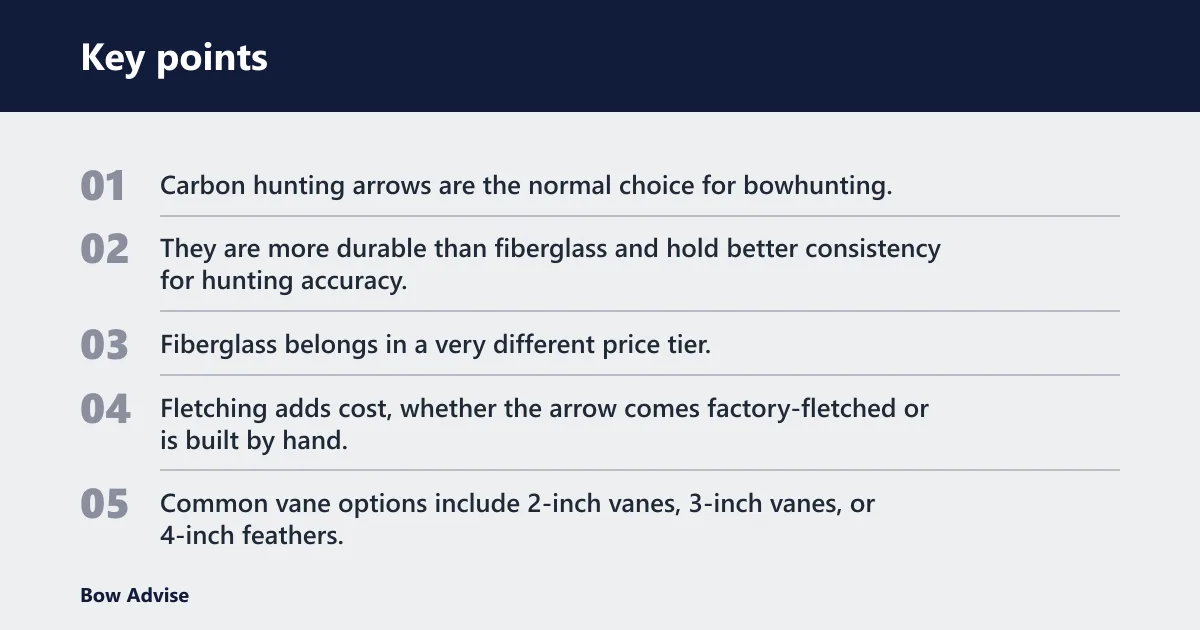
Carbon hunting arrows are the normal choice for bowhunting. They are more durable than fiberglass and hold better consistency for hunting accuracy. Fiberglass belongs in a very different price tier, and it is not the standard answer for hunting setups.
Factory-fletched arrows versus DIY builds
Fletching adds cost, whether the arrow comes factory-fletched or is built by hand. Common vane options include 2-inch vanes, 3-inch vanes, or 4-inch feathers. Vanes usually trade a little visibility and stability against drag, while feathers can offer fast stabilization but are less weather-friendly.
Factory-fletched arrows cost more up front, but they save assembly time and remove some setup error. DIY builds can save money only if the builder already has the tools and can keep nock and vane placement consistent.
How pack count changes price per arrow
Pack count changes the unit cost in a very direct way. A 6-pack often costs more per arrow than a 12-pack, and a 24-pack may lower the per-arrow cost further for practice volume. Gold Tip Hunter is sold as a 6-pack. Easton 6.5 Bowhunter Shafts are sold as a 12-pack.
For beginners, the pack count should match expected loss and tuning needs, not only the headline price. Buying too few arrows can make each breakage feel expensive.
Hunting arrow cost breakdown table
The table below shows first-buy cost and the practical replacement cost per arrow. The first-buy figure includes shaft, point, insert, nock, and fletching. Replacement cost covers the parts most likely to be replaced after loss or damage, not a brand-new full build.
| Hunter profile | Shaft price | Points | Inserts | Nocks | Fletching | Estimated total per arrow | Notes on fit |
|---|---|---|---|---|---|---|---|
| Budget practice/hunting crossover | $3–$5 | $0.75–$1.25 | $0.50–$1.00 | $0.25–$0.75 | $1.00–$2.00 | $5.50–$10 | Best for a beginner with a lower-cost bow, basic field-point practice, and a short season of light hunting use. |
| Mid-range hunting setup | $8–$12 | $1.00–$1.50 | $0.75–$1.50 | $0.50–$1.00 | $1.50–$2.50 | $11.75–$18.50 | Fits many 35-60 pound bows, better spine matching, and a hunter who wants one arrow style for practice and hunting. |
| Premium hunting setup | $13–$20 | $1.50–$3.00 | $1.00–$2.00 | $0.75–$1.50 | $2.00–$4.00 | $18.25–$30.50 | Best for tighter straightness specs, more consistent tuning, and higher confidence on longer-range or heavier-use setups. |
These totals show why the shaft alone can mislead. A $5 shaft can become a $9 arrow once the point, insert, nock, and fletching are added. A premium shaft can cross $20 after the rest of the build is included.
Which arrow setup fits your bow?
The right setup depends on draw weight range, hunting style, and whether the arrow is meant for practice, hunting, or both. A budget crossover setup can work for short-range deer hunting on a modest bow. A mid-range or premium setup makes more sense when tuning consistency and repeatable flight matter more.
Best fit by draw weight range
Lower draw weights usually do better with lighter, properly spined arrows and careful tune. Mid-range setups often land in the 35-60 pound class, which matches a lot of common hunting bows. If the bow sits near 50 pounds, arrow mass and spine need close attention.
Suppose a hunter runs a 30-inch draw length with a 50-pound bow and buys a shaft that is too weak. The arrow may flex too much, group poorly, and drive the hunter back to more expensive replacements.
Best fit by hunting distance and style
Short-range hunters who keep shots tight and predictable can often stay with a lower-cost carbon shaft if the spine and length are correct. Hunters who want more stable flight, better sorting, or broader tuning tolerance usually benefit from mid-range or premium shafts.
A common first-timer mistake is buying a pack with the right price and the wrong spine. That usually costs more than buying the correct arrow once.
When a cheaper arrow is enough
A cheaper carbon arrow is enough when the bow is properly tuned, the draw weight falls within the arrow’s listed range, and the shaft length matches the draw. It is also a sensible choice for heavy practice use where some loss and wear are expected. Cheap does not have to mean unsafe or unusable.
It does mean you should watch the published straightness spec and the diameter. Those two details often explain why one low-cost arrow behaves better than another.
Practice arrows versus hunting arrows
Practice arrows and hunting arrows overlap, but they do not serve the same job. Field points are replaceable screw-in tips and are usually around 100 grain for practice and tuning. Broadheads are different, and they are meant for hunting. Mechanical broadheads appear in some hunting-arrow kits, but they are usually separate from field-point practice arrows.
Field points and practice use
Field points make a hunting arrow useful for paper tuning, sight checks, and repeated target work. They are simple, cheap to replace, and common in 100-grain form. A practice arrow can be identical to a hunting shaft except for the tip, which is why many bowhunters keep the same shaft for both jobs.
Broadheads and hunting use
Broadheads bring different cost and purpose. They are the hunting tip, not the practice tip. Mechanical broadheads may appear in some packaged hunting sets, but they should not be confused with field points or treated as a lower-cost substitute for them.
When one arrow can cover both jobs, the shaft, spine, length, and nock fit need to be right from the start. The tip can change. The arrow’s core setup should not.
How many arrows should you buy?
Most new bowhunters should start with enough arrows to practice, sight in, and lose a few without stopping the season. A 6-pack can work for a careful hunter. A 12-pack is often better for a beginner who wants backup arrows and a buffer against breakage. A 24-pack makes more sense for heavy practice or for group use with matched arrows.
Starting pack size for new bowhunters
For a first purchase, 6 arrows is the minimum useful hunting pack, especially if the bow is already tuned and the hunter is disciplined about retrieval. For most beginners, 12 arrows is the safer choice because it covers practice wear, a lost arrow, and a few hunting-ready spares.
Replacement planning for the season
Plan for some replacement if the season includes hard practice, stump shooting, or repeated broadhead tuning. A reasonable season plan is to keep at least 2 extra arrows beyond the number carried into the field. That buffer matters because one cracked shaft can end the use of a matched set.
How many arrows should you buy for hunting and practice? Enough to build confidence and absorb breakage. For many beginners, that means 12 arrows total, with 6 set aside for hunting and 6 used for heavier practice or backups.
When 6, 12, or 24 arrows makes sense
Choose 6 if the bow is already tuned, practice volume is low, and the hunter wants a minimal field set. Choose 12 if the arrow will serve both practice and hunting through one season. Choose 24 if the setup is being shot often or used to sort by weight and straightness.
Frequently asked questions
How much do hunting arrows cost?
Most usable hunting arrow setups fall around $10–$30 per arrow once the shaft, point, insert, nock, and fletching are included. That can move higher for tighter straightness tolerance or premium components. Broadheads add extra cost if the arrow is being set up for hunting rather than practice alone.
What is the average price of hunting arrows?
A practical average for many bowhunters is about $20 per arrow.
Why are some hunting arrows so much more expensive?
Higher prices usually come from better straightness tolerance, more consistent carbon shafts, factory fletching, and cleaner component fit. Pack count also matters. A smaller pack can carry a higher per-arrow cost even when the shaft quality is good, so the price jump is not always about raw material alone.
What’s the cheapest hunting arrow that’s still worth buying?
The cheapest worth buying is usually a carbon shaft with a published spine that matches the bow, a usable straightness spec, and enough consistency to tune correctly. If the shaft is cheap but mismatched to draw weight or length, it stops being a bargain fast. Basic carbon beats fiberglass for hunting use.
How many arrows should I buy for hunting and practice?
Most beginners should buy 12 arrows. That gives enough for sight-in, practice, broadhead tuning, and a few replacements without forcing a new purchase mid-season. Six can work for an experienced hunter with a tuned bow, but it leaves very little room for breakage or loss.
What specs matter most when choosing hunting arrows?
Spine, draw weight compatibility, shaft length, straightness tolerance, and nock fit matter most. A hunting arrow should match the bow’s poundage range, the archer’s draw length, and the shaft diameter the rest accepts. Fletching size and point weight matter too, but they come after the core fit is correct.