Ground Stakes vs Wall Hangers for Gear Storage
For long-term storage, Wall Hangers for Gear Storage protect bows better when they are anchored into studs; choose Ground Stakes only for short-term, upright storage on level, dry floors. Weak support can twist limbs, knock off sights and quivers, and turn a garage into a tip-over hazard. This guide compares limb stress, accessory damage, and storage hazards so you can pick the safer setup.
| Decision factor | Ground Stakes | Wall Hangers for Gear Storage | Winner |
|---|---|---|---|
| Long-term bow protection | Better for short waits and quick access, but floor-level placement leaves more exposure to dust, damp concrete, and accidental kicks. | Better for months of storage when mounted into studs and set with proper clearance from the floor and nearby gear. | Wall Hangers for Gear Storage |
| Accessory clearance | Can leave sights, stabilizers, and quivers closer to carts, doors, and traffic in a garage. | Can be spaced to keep cams, sights, and stabilizers off the floor and away from passing gear. | Wall Hangers for Gear Storage |
| Tip-over risk | Stable on a flat surface, but a nudge, sloped floor, or uneven contact point can still send a bow down. | Once anchored correctly, the bow is less exposed to floor traffic and accidental bumping. | Wall Hangers for Gear Storage |
| Humidity and dust exposure | Closer to floor moisture, dust, and seasonal garage dampness. | Usually farther from floor moisture and easier to place in a drier part of the wall. | Wall Hangers for Gear Storage |
| Install or setup simplicity | Faster to place, with less permanent installation. | Requires studs, spacing, and a sound mount. | Ground Stakes |
Ground stakes vs wall hangers: the core trade-off
Ground stakes are simpler and faster. Wall hangers usually protect better when the bow will sit for weeks or months. The real trade-off is not just floor space, it is where the bow’s load lands, how much accessory clearance it has, and how much garage risk it faces from moisture, dust, and traffic.
What each storage system holds and how the bow contacts it
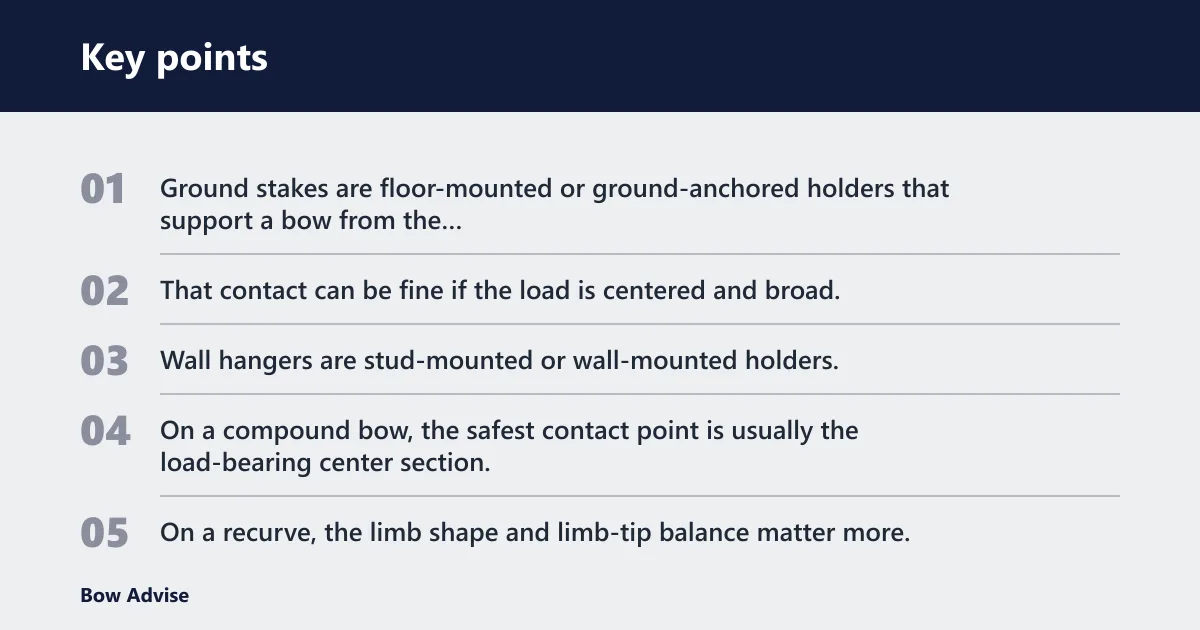
Ground stakes are floor-mounted or ground-anchored holders that support a bow from the grip, riser, or in some designs the limbs. That contact can be fine if the load is centered and broad, but narrow points can pinch finish or press on a limb surface. Wall hangers are stud-mounted or wall-mounted holders, usually in horizontal or vertical layouts, and they need enough spacing so the bow does not touch the wall, adjacent gear, or the floor.
On a compound bow, the safest contact point is usually the load-bearing center section, with no pressure on sights, rests, quivers, or the cams. On a recurve, the limb shape and limb-tip balance matter more, because slender ends and curved limbs can twist if the support is narrow or poorly placed.
The main failure risks: limb pressure, cam clearance, and tip-over
Bow limbs do not like point loads. A narrow hook can concentrate stress and leave a mark, especially if the bow sits there for a long stretch. Compound bows add cam clearance concerns, because cam edges, strings, and cables should not rub against a hanger or a nearby tool shelf.
Tip-over risk matters more with ground stakes. A bow that shifts on a garage floor can fall against concrete, a cart, or another bow. Wall hangers can fail too if they are not into studs, but a properly mounted hanger reduces floor traffic and keeps the bow out of reach of most knocks.
Where each option fits best at home or in a garage
Ground stakes fit quick-reach storage, such as a dry corner near the door or beside a prep bench. They are less suited to areas with puddle risk, loose gravel, or heavy foot traffic. Wall hangers fit a garage wall, closet, or gear room where the bow can sit above dust and away from the floor.
Say your garage floor gets damp after spring rain and the bow sits next to a mower path. A wall hanger moved to a stud above floor level is the safer choice, because the bow avoids splash zone moisture and side impacts. The same bow on a ground stake would need much more discipline to stay protected.
Bow storage decision matrix
This matrix separates compound bows from recurves because the failure points are different. The same holder can be acceptable for one and awkward for the other. Scores use a 1 to 5 scale, where 5 is best for protection or convenience in that category.
| Bow type | Limb pressure | Cam clearance | Tip-over risk | Humidity exposure | Dust exposure | Space efficiency | Install difficulty | Frequent-access convenience |
|---|---|---|---|---|---|---|---|---|
| Compound bow on Ground Stakes | 3 | 2 | 3 | 2 | 2 | 3 | 4 | 5 |
| Compound bow on Wall Hangers for Gear Storage | 4 | 4 | 4 | 4 | 4 | 5 | 2 | 4 |
| Recurve bow on Ground Stakes | 3 | 5 | 3 | 2 | 2 | 3 | 4 | 5 |
| Recurve bow on Wall Hangers for Gear Storage | 4 | 5 | 4 | 4 | 4 | 5 | 2 | 4 |
Compound bow scores across the 8 criteria
Wall hangers win more of the compound-bow rows because they keep the bow away from floor moisture, dust, and casual bumps. The cams, cables, and stabilizer need room, and a wall mount usually gives better control over that clearance. Ground stakes still score well for access, but they ask more from the room around them.
Compound bows are the harder case for low mounts because the accessory package creates more protrusions. A quiver can be removed, but many hunters store the bow with sight and rest in place, which raises the chance of contact on a cramped stake. For long-term garage storage, the wall solution gives the safer margin.
Recurve bow scores across the 8 criteria
Recurve bows are simpler, but their limb shape creates a different contact problem. A broad hanger surface can support the riser or a safe limb section without pinching the tips. Wall hangers still lead because they keep the bow higher, drier, and cleaner over time.
A recurve can tolerate a hanger better than a compound in some layouts because it has no cams to snag. Even so, stringed storage on a narrow hook is a poor idea if the load lands on a small point. If the bow is unstrung, the case for wall storage gets even stronger, because the limbs are no longer under tension and the riser can be supported with less risk.
How to read the matrix for humid garages, closets, and dry rooms
In a humid garage, the humidity and dust rows matter most. Wall hangers usually keep the bow farther from floor moisture and splash zones, but they are not magic. A climate-controlled closet narrows the gap, because both systems avoid the worst garage hazards there.
Picture a garage that swings from dry to damp each season. The bow stays cleaner on the wall, but only if the mount is into studs and the bow clears the floor by a comfortable margin. A ground stake in that same room may be convenient, yet it leaves the bow closer to condensation, dust, and floor traffic.
Which protects a compound bow better?
Wall hangers protect a compound bow better for long-term storage, especially when the bow remains assembled with cams, string, cables, sight, stabilizer, and quiver in place. Ground stakes can work for short-term upright storage, but they usually expose the bow to more floor-level dirt, bumps, and fit problems around attached accessories.
Cam, string, and cable clearance
Compound cams need room. A hanger that presses the limb near the cam pocket or leaves the cam too close to a wall can create contact where there should be none. Wall hangers have the edge because they are easier to place with enough stand-off for the axle area, string stops, and cables.
Ground stakes can be safe only if they leave the cams free and the bow cannot lean into nearby gear. If the holder grips too low or too tight, it can push on the center section and send stress into the wrong place. That is a storage problem, not a tuning problem.
Sight, stabilizer, and quiver protection
The accessory package is where a compound often loses the comparison. A sight can take a side knock, a stabilizer can hit the floor, and a quiver can snag on a door or another bow. Wall hangers let the bow hang in a cleaner zone with fewer moving hazards around it.
Ground stakes keep the bow upright, which sounds safe, but upright does not mean isolated. In a tight garage, a vertical bow can still catch a passing hand truck or a jacket sleeve. That is why the support style matters as much as the angle.
Best storage orientation for a compound bow
For home storage, a compound usually does best with the riser supported, the accessories cleared, and the cams not bearing load against a shelf or wall. Horizontal or vertical wall layouts can both work if the contact points are broad and padded. The key is stable load transfer, not the exact direction of the bow.
Hard cases add another layer of impact protection, while soft cases mainly help with dust and minor scuffs. A case is worth considering if the bow will sit in a garage with tools, bicycles, or seasonal humidity swings. For travel, a hard case is better; for home storage, a soft case can still keep dust down if the bow is not accessed every day.
Can a recurve bow hang safely?
Yes, a recurve bow can hang safely if the hanger supports the riser or another broad, safe contact point and the limbs do not bear on a narrow hook. Wall hangers are usually the better long-term choice, but a recurve stored strung needs careful spacing so limb tips, finish, and string do not take uneven pressure.
Limb shape and limb-tip vulnerability
Recurve limbs are thinner and more curved near the tips, so a small contact area can create twist or finish wear. A wide padded surface is safer than a thin hook. Wall hangers make that easier to control because they can be positioned to catch the riser or a stable limb section instead of a fragile edge.
Ground stakes can work if the holder cradles the bow without pinching the limbs. The risk is that the bow may settle slightly over time, and that shift can concentrate load at the tip or limb pocket. That matters more on a recurve because the bow depends on clean symmetry.
Stringed versus unstrung storage
A strung recurve carries tension across the limbs, so the storage point should not force the bow to sit crooked. An unstrung recurve removes that tension, which reduces stress on the limbs but does not remove the need for a safe support point. The riser still needs a clean, padded contact surface.
For long-term garage storage, many bowhunters prefer a case even for a recurve if the room has dust or moisture swings. A soft case helps with abrasion and dirt. A hard case gives more impact protection if the bow may be bumped by other gear.
Where wall hangers or ground stakes can stress the riser or limbs
The riser should carry the load, not the sight mount, arrow rest, or quiver. If the hanger touches an accessory instead of the center section, the bow can sit off balance. That is when even a good hanger becomes a problem.
A common first-timer mistake is hanging a recurve by a limb that looks strong enough to hold it. It may hold the weight for a while, but the wrong point load can leave a bend mark or a slow twist in the limb. Broad support beats clever placement.
Garage hazards that change the answer
Garages change the storage decision because they bring humidity swings, dust, and accidental contact. A bow that looks fine on day one can wear differently after a wet season, a dusty week, or a crowded weekend. The better holder is the one that keeps the bow higher, cleaner, and less exposed to impact.
Humidity swings and finish wear
Seasonal moisture swings can dull finish and encourage corrosion on exposed metal parts. A wall hanger usually keeps the bow farther from the concrete floor, where dampness often lingers. Ground stakes put the bow closer to that zone, so any floor moisture matters more.
This does not mean a wall mount solves humidity. It only reduces exposure. A dry room still beats both options, and a case helps either setup by limiting air movement and dust on strings, cams, and risers.
Dust buildup and contact-point contamination
Dust collects on garage floors, shelves, and the lower parts of hanging gear. If a bow sits on a stake, it can pick up grit on the riser or limbs and transfer that grit to strings and finish. Wall hangers are usually easier to place away from that heavy dust band.
Contact points matter here too. A padded hook can still be dirty. If the support surface is dusty or oily, it can mark the bow just as surely as a rough edge can. Clean contact points are part of the storage system.
Floor moisture, impact risk, and where each system fails first
Ground stakes fail first when the floor is wet, uneven, or crowded. Wall hangers fail first when they are not into studs, are spaced too tightly, or leave the bow’s accessories too close to the wall. The better choice is the one that avoids the more likely failure in the actual room.
Need a simple rule? If the garage is dry, open, and lightly used, either can work with good mounting. If the garage is busy, damp, or seasonal, wall hangers are the safer default.
Must-have
The direct answer is three basics: a secure bow holder, a clean padded contact surface, and a stable place that keeps the bow off the floor. For long-term storage, the holder should support the riser or another broad section without pressing cams, sights, rests, or quivers.
 As an Amazon Associate we earn from qualifying purchases. Prices and availability are accurate as of the date shown and are subject to change
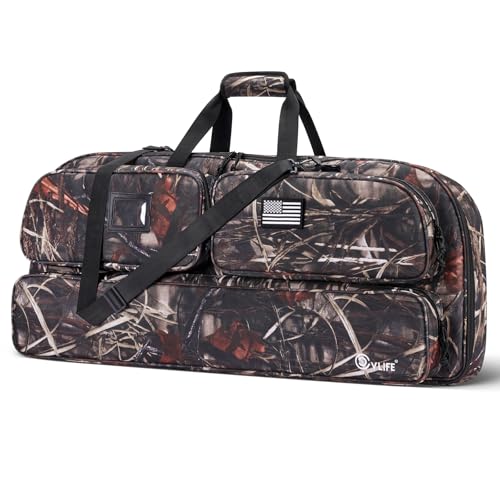
CVLIFE 37" Soft Compound Bow Case helps if the bow will sit in a garage or closet with dust and minor knock risk. The thick padding is the main benefit, and the arrow pocket gives extra organization. The drawback is simple: a soft case is less protective than a hard case against crush force or a hard fall.
Nice-to-have
Nice-to-have items improve the storage environment, but they do not replace a sound mount. For a wall setup, the bow still needs stud-backed support and enough clearance for cams, limb tips, and accessories. For a floor setup, the room still needs to be dry and free of traffic.
As an Amazon Associate we earn from qualifying purchases. Prices and availability are accurate as of the date shown and are subject to change

GlikCeil Vertical Wall Mount Hardwood fits the wall-storage side of the comparison because the hardwood build and felt pads are aimed at cleaner contact points and off-floor placement. The drawback is that it is a display-style hanger first, so the user still has to confirm stud placement, spacing, and fit for the bow’s shape and attached gear.
Consumables and spares
Storage hardware is only part of the setup. Felt pads, dust control, and a dry place to keep spare accessories matter too. If a garage sees seasonal moisture, a case or dehumidified room can be the difference between clean strings and slow finish wear.
- Check the hanger or stake for wear at the contact points.
- Keep the bow clean before storing it.
- Leave enough space for cams, limbs, and accessories to avoid rubbing.
- Use a case when the room is dusty, damp, or crowded.
- Recheck the mount after any wall movement, garage reorganization, or floor change.
Choose Ground Stakes if… / Choose Wall Hangers for Gear Storage if…
Choose Ground Stakes if you need fast access, a short-term upright hold, and a dry floor with little traffic. Choose Wall Hangers for Gear Storage if the bow will sit for weeks or months, the garage sees dust or humidity swings, or you want better separation from floor knocks and accessory damage.
For compound bows, the wall option is the safer default because cams, cables, sights, stabilizers, and quivers need room. For recurves, wall storage also wins for long-term keeping, but only if the hanger spreads load across a safe, broad point. In both cases, a bow case still helps when the room is dusty, crowded, or seasonally damp.
Frequently asked questions
Are ground stakes better than wall hangers for storing bows?
Not for long-term storage. Wall hangers anchored into studs usually protect bows better because they keep the bow away from floor moisture, dust, and foot traffic. Ground stakes are more useful for quick access and short-term upright storage on level, dry floors.
Will wall hangers damage a bow’s limbs or cams?
They can, if the hanger has narrow contact points, poor spacing, or the wrong mounting height. A safe wall hanger should support a broad part of the bow and leave cams, cables, and limb tips free. Bad mounting causes more damage than the wall itself.
Do ground stakes keep a bow more protected from humidity and knocks?
No. Ground stakes can make access easier, but they usually place the bow closer to garage moisture, dust, and floor-level bumps. They work best only in a dry, low-traffic area. Wall hangers usually provide better separation from those hazards.
Which storage option is better for a compound bow?
Wall hangers are usually better for a compound bow because they handle cam clearance, accessory spacing, and long-term protection more effectively. A compound stored on a ground stake needs extra care to keep sights, stabilizers, and quivers from being bumped or pressed against a surface.
Can I store a recurve bow on wall hangers safely?
Yes, if the hanger supports the riser or another broad, safe contact area and does not pinch the limbs. Recurve bows are sensitive to limb shape and tip pressure, so a narrow hook is a poor idea. A padded, stud-mounted wall hanger is the safer choice.
Do I need a case if I use wall hangers or ground stakes?
Not always, but it helps. A hard case gives stronger impact protection, while a soft case helps with dust and minor scuffs. In a clean, dry room, a case is less important. In a garage with humidity swings or heavy traffic, it is worth using.