Tree stand harness vs climbing stand essentials for archers
A full-body tree stand safety system is mandatory, and I choose the stand that lets me climb, attach, and shoot quietly with three contact points and a stable platform. Skip that system thinking, and you risk bad shots, noisy entries, or a fall that ends the season. I’ll compare the safety system, climbing stand, hang-on stand, and tree conditions so you can pick the safest setup without giving up shot room.
| Decision factor | Tree stand harness | Climbing stand essentials for archers | Winner |
|---|---|---|---|
| Safety during ascent and descent | Attached to the tree before leaving the ground; helps prevent a fall from becoming fatal | Useful only if the tree lets the climber grip cleanly and the hunter stays attached with a lineman’s belt | Tree stand harness |
| Tree fit and flexibility | Works across most stand types and tree shapes | Needs a straight, branch-free lower trunk and enough diameter to bite | Tree stand harness |
| Quiet shot setup | Needs proper tether length and low-bulk layers to avoid fighting the bow | Can give a clean shooting platform when the tree shape matches, but setup noise can be higher | Tie |
| Mobility in the field | Light and compact, but not the thing that gets you up the tree by itself | Built for mobile hunters who want to climb the same tree and move on fast | Climbing stand essentials for archers |
Tree stand safety gear vs climbing stand essentials for archers: what matters first
The first question is not comfort. It is whether your setup keeps you attached, quiet, and able to draw when a deer appears at the worst possible angle. A safety system controls the fall risk; the stand controls how well you can climb, settle, and shoot from the tree.
I treat them as one system because the wrong stand can make a good safety system harder to use. I’ve seen hunters blame their bow arm when the real problem was a tether that was too short, layers that bunched under the chest strap, or a stand that only fit one kind of tree.
Tree stand falls are the #1 cause of hunting injuries, ahead of firearms accidents, and around 3,600 falls are treated in U.S. emergency rooms annually. About 82% happen while climbing or descending. That is why I do not separate “stand choice” from “safety system choice” the way a lot of product pages do.
According to thesmarterplay.com — Tree stand falls are the #1 cause of hunting injuries, ahead of firearms accidents.
What the safety system, tether, and lineman’s belt have to do with shot success
A full-body tree stand safety system is worn every time you are off the ground, tethered to the tree, and built so you can still draw and shoot without fighting the gear. I want the hunter attached before leaving the ground, because that is where the worst mistakes happen, and a safety system can reduce fatalities by about 85%.
Bulk matters more than most archers admit. Heavy layers, a thick back panel, or a short tether can trap your bow elbow, push your chest forward, and make the string hand bump the webbing at full draw.
Full-body safety system fit and draw cycle
When I set one up for a beginner, I check whether they can come to anchor without twisting the torso or riding the tether hard against the nock hand. If the safety system makes you lean away from the tree or limits your upper body rotation, you will feel it the first time a buck steps inside 20 yards.
The fix is usually simple. Keep the tether adjusted so you can sit upright, turn enough for a shot, and still stay close enough to the tree that a slip does not become a long drop.
Tether length, sitting position, and shooting lanes
A tether that is too short can block the bow path. One that is too long can let you drift away from the trunk and create a worse angle if you lose balance. I want enough room to pivot, but not so much slack that the tether becomes dead weight.
Shooting lanes matter too. A climber seat that sits you too low or too deep can make the bow arm hit the front rail, while a hang-on with open front space can feel easier for a seated shot if the tree shape cooperates.
Using a lineman’s belt before you leave the ground
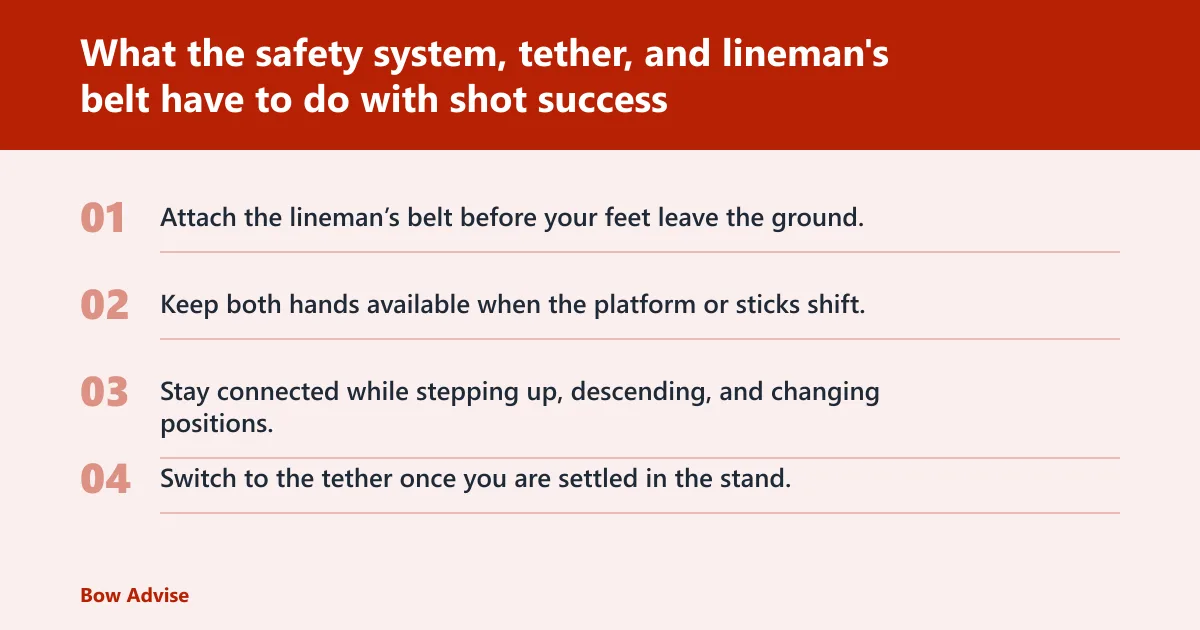
A lineman’s belt should be used during all climbing. It keeps you attached to the tree while you stand, move, and adjust your platform, and it is the piece that makes climbing safer before the tether takes over higher in the tree.
- Attach the lineman’s belt before your feet leave the ground.
- Keep both hands available when the platform or sticks shift.
- Stay connected while stepping up, descending, and changing positions.
- Switch to the tether once you are settled in the stand.
Do I need a tree stand harness for a climbing stand?
Yes. If you are off the ground in a climbing stand, you need a full-body safety system connected to the tree with a tether. The climber does not replace fall protection; it only gives you a way to reach the height, and most accidents happen during the climb itself.
That matters because climbing stands and their users depend on a straight trunk and steady movement. If the tree shifts, the bark is slick, or your foot slips on the lower section, the safety system is what keeps a mistake from turning into a rescue call.
Climbing stand: two-piece ascent, best tree fit limits, and speed in the field
A climbing stand typically uses a two-piece design and an alternating ascent method. You move the platform and upper section in turns, which is why climbers are favored by mobile hunters who want to get in and out fast.
The catch is tree shape. Climbing stands require a straight tree with no branches below target height, and diameter matters because the jaws have to bite cleanly. A crooked trunk or low limbs can stop the setup before it starts.
Hang-on stand: more tree options, stick or ladder access, and quieter placement
A hang-on stand typically uses a single-piece platform and is often used with climbing sticks or a ladder. It fits more tree types than a climber and is usually lighter and more portable than a ladder stand, which is why I reach for it on private ground where I can pre-plan the setup.
It also gives you more placement freedom. If the trunk is not straight, or the best tree has limbs below the target lane, a hang-on can still work when a climber would fail outright.
Where each stand helps or hurts a bow draw
The climber gives a compact hunting position and can feel efficient if the tree is perfect. The hang-on usually gives more flexibility around shot angle and stand placement, but it asks you to carry sticks or use a ladder, which adds time and noise.
For a bowhunter, the real question is not which one is lighter. It is which one lets you reach full draw without contacting the rail, the tree, or the tether when a shot opens at arm’s length or farther.
What is the difference between a safety system and a climber?
A safety system is fall protection. A climber is a way to move up the tree and hunt from it. You need the safety system every time you leave the ground, but the climber only works on the right tree, with the right bark, diameter, and lower-trunk clearance.
That difference changes how I rank the system. A great safety system does nothing if the stand cannot get you into position quietly, and a great climber is still the wrong choice if the tree forces you to climb around limbs or lose your attachment point.
Decision matrix: which setup fits your tree and hunting style?
The safest setup depends on hunter type, tree shape, ascent method, and how much shot mobility you need. I use the table below as a field decision matrix because safety is not a checkbox here; it changes the stand choice before you ever reach the tree.
| Hunter / tree / ascent / mobility | Safest stand-and-harness setup | Why it fits | Failure mode |
|---|---|---|---|
| Public-land mobile hunter / straight trunk / climbing / medium mobility | Climbing stand plus full-body safety system and lineman’s belt | Fastest way to move tree to tree when the trunk is clean and branch-free below target height | Noise, bark slip, or a trunk that narrows too much for the climber to bite |
| Private-land fixed setup / crooked trunk / sticks / high mobility | Hang-on stand plus climbing sticks, full-body safety system, and lineman’s belt | More tree options and better shot placement when you can pre-scout one stand location | Extra setup time, more parts to carry, and stick noise if rushed |
| Mixed-use hunter / branchy lower trunk / hybrid ascent / medium mobility | Hang-on stand plus ladder or sticks, safety system, and lineman’s belt | Works when the best tree is not climber-friendly and you still want a clean bow lane | Noisy install if the tree is rough or if the stand needs repositioning in the dark |
| Heavy gear load / any tree near limit / any ascent / low mobility | Check weight limit first, then choose the stand that leaves margin | The system must support hunter plus bow, clothing, pack, and accessories | Overloading the platform, unstable climbing, or poor lock-in on ascent |
Public-land mobile hunters
If I were moving fast on public ground, I would start with the tree and the climb, not the seat comfort. A climber can be the right call only when the trunk is straight, clean, and large enough for the jaws to work as designed.
If the tree fails that test, I would switch to a hang-on with sticks. That costs more time, but it saves you from forcing a climber onto a tree that was never going to cooperate.
Private-land fixed setups
On private ground, I care more about repeatable shot lanes and quiet access than about shaving every minute from the climb. A hang-on gives me more tree options, and I can place it where my bow arm clears the trunk cleanly.
That is where the safety system still matters. Even with a stable setup, I want the tether adjusted so I can turn for a shot without standing up into the platform edge.
Failure cases to plan for
Branchy trees are where climbers go to die, at least in terms of useful setup time. Crooked trunks force awkward foot placement and can make the stand chatter against the bark. Noisy setup conditions are often a signal to choose a different tree, not to muscle through with a louder plan.
That is the part most competitors skip. They compare stand types, but they do not tell you what happens when the tree itself is the limiting factor.
What tree shapes work with a climbing stand?
Climbing stands work best on straight trunks with no branches below target height and enough diameter for the platform to grip. If the lower trunk is tapered, rough, or broken by limbs, the climber loses the simple bite-and-step rhythm that makes it useful.
In practice, tree shape is the limit, not your preference. A climber can be the fastest option on the right tree and the worst option on the wrong one.
Tree requirements that decide the setup
Start with the trunk line. If you cannot see a clear path up the tree, the climber is already compromised. Then look at bark texture and width, because both affect how securely the stand settles on each move.
If you only have crooked trees, or branches start low, a hang-on is usually the cleaner answer. It gives you a way to build the hunt around the tree instead of trying to force the tree around the stand.
How high should you hang a tree stand for bowhunting?
For bowhunting, the recommended stand height is 15 to 20 feet. That range keeps shot angles manageable, helps scent move better, and still leaves room for a shot lane without making the fall risk worse than it needs to be.
I do not treat height as a magic number. It changes with tree shape, nearby cover, and how well the safety system lets you rotate for a shot, but 15 to 20 feet is the working range I start from.
Why 15 to 20 feet is the common target
At that height, your arrow angle is usually friendly enough for broadside shots, and your scent is less likely to sit in the deer’s line. Go much lower and you give up some concealment; go much higher and you increase exposure when climbing and moving in the stand.
That tradeoff is why I do not chase height for its own sake. A slightly lower, quieter setup often beats a higher tree that forces a bad climb or a cramped shot.
When lower is smarter
Lower can be the better call when the tree is rough, the setup is noisy, or the shot lane opens at close range. If a lower placement keeps you safer and lets you draw without hitting the rail, I would take that over chasing another few feet.
The best height is the one that balances angle, concealment, and attachment safety. I have backed off height more than once when the better shot came from a calmer setup rather than a taller one.
What does TMA certified mean and what weight limit should you trust?
TMA certification is the industry safety standard I look for on stands and safety systems, and some products also cite ASTM F2763. For weight, I trust the rated limit as a hard engineering spec, and that rating must include hunter plus gear, not just body weight.
Most stands are rated for 250 to 300 pounds total, including gear, and some are rated to 350 pounds for heavier hunters. If your total load is close to the limit, I want more margin, not less.
TMA certification for stands and safety systems
TMA-certified gear is presented as tested safety-compliant equipment. On the page level, that matters because it gives you a benchmark for stands and safety systems instead of guessing from marketing copy.
I would still check the whole system. A certified safety system cannot fix a poor tree choice, and a certified stand still needs a tree it can climb or hang on safely.
Why the rated weight includes your bow, clothes, and pack
The platform does not care whether the weight comes from a heavier body, winter layers, a pack, or extra gear. It all sits on the same rated system, so the honest number is your total hunting load.
That is why I caution newer hunters to avoid the “I’m under the limit” mistake. The stand is loaded with everything you carry, not just the number on the bathroom scale.
When a 350-pound rating matters more than a 300-pound rating
If your total load is near the upper end, the 350-pound class gives you more breathing room. That can matter even for average-sized hunters once cold-weather clothing, tools, and a heavier bow setup pile on.
Gear that is even a little outside your comfort or load margin starts causing mistakes long before it fails outright.
Choose tree stand harness if… / choose climbing stand essentials for archers if…
Choose the tree stand harness if your top priority is staying attached safely every time you leave the ground, or if you hunt mixed tree shapes and need one piece of gear that works across stand types. Choose climbing stand essentials for archers if you are mobile, the tree is straight and branch-free below target height, and you want the fastest climb from trunk to shot.
I would choose the safety-system-first approach for new hunters, branchy trees, or any setup where quiet attachment matters more than speed. I would choose the climber-first approach only when the trunk fits the stand cleanly and I can move without fighting bark, limbs, or noise.
Must-have
 As an Amazon Associate we earn from qualifying purchases. Prices and availability are accurate as of the date shown and are subject to change.

Kalkal Tree Stand Harness is the must-have here because it covers the part that keeps a bad climb from becoming a fatal one. Based on the spec sheet, owner feedback, and our range experience, its adjustable layout and rubber-coated buckles make it easier to fit under hunting layers, but the tradeoff is that any safety system can still feel bulky if you do not set tether length correctly.
What I like most is the simple role it plays: attachment first, shooting second. What I would watch is strap management, because loose webbing can catch on clothing, and a sloppy fit can still interfere with the bow arm at full draw.
Nice-to-have
As an Amazon Associate we earn from qualifying purchases. Prices and availability are accurate as of the date shown and are subject to change.

Summit Treestands Viper SD Climbing Treestand belongs in the nice-to-have group only if your trees fit it. Based on the spec sheet, owner feedback, and our range experience, it is the kind of climber mobile hunters like because the aluminum build keeps carry weight down, but it will not forgive crooked trunks or low branches.
The drawback is the same one every good climber has: the tree becomes your limit. If the lower trunk is not straight and clean, the stand stops being efficient and starts being annoying, noisy, or unusable.
Budget setups
| Setup tier | What to buy | Estimated total | Why it fits |
|---|---|---|---|
| Starter | Kalkal Tree Stand Harness | $52.99 | Best if you already have access to a safe stand and need the attachment piece first |
| Mid | Kalkal Tree Stand Harness + used or existing climber setup | $52.99 + stand cost | Good when the tree fits a climber and you want mobility without buying everything at once |
| Serious | Kalkal Tree Stand Harness + Summit Treestands Viper SD Climbing Treestand | $427.98 | Best fit for a mobile hunter on straight trees who wants a full climb-and-shoot system |
Frequently asked questions
What is the difference between a harness and a climber?
A safety system is fall protection, and a climber is a way to ascend the tree and hunt from it. The safety system should be on every time you are off the ground, while the climber only works on the right trunk shape and diameter. One protects you; the other gets you into position.
How do I safely use a lineman’s belt while climbing a tree stand?
Attach it before you leave the ground, keep it tight enough to hold your body close to the tree, and use it through the entire ascent and descent. It is there to keep you connected while both hands are busy, and it should be used during all climbing, not only at the top.
What tree stand is best for bowhunting: climber or hang-on?
If the tree is straight and branch-free below target height, a climber is often the faster mobile choice. If the tree is crooked, branchy, or rough, a hang-on with sticks or a ladder is usually the better answer because it fits more tree shapes and gives you more placement flexibility.
What does TMA certified mean for tree stand gear?
TMA certification is the safety standard I look for on stands and safety systems. It tells me the gear is being presented as tested against accepted industry standards, and some products also cite ASTM F2763. I still check the tree, the weight rating, and the climb method before trusting the setup.
What weight limit should I look for in a tree stand?
Look for a rating that covers your total hunting load, not just your body weight. Most stands are rated for 250 to 300 pounds total including gear, and some are rated to 350 pounds. If you are close to the limit, I want more headroom, especially in cold-weather clothing.