What is Archery Traditional San Bow And Arrow? A Complete Guide
Archery has fascinated people for thousands of years. The image of a skilled archer with a simple bow and arrow is powerful and timeless. In many cultures, archery is more than a sport, it is a living tradition. One of the most unique and respected forms is archery with the traditional San bow and arrow. This ancient practice, rooted in the culture of the San people of southern Africa, offers insights into history, survival, and connection to the land. But what exactly is the traditional San bow and arrow? How is it made, how is it used, and why does it matter today? This guide explores these questions, offering a clear look into a tradition that still inspires archers and historians around the world.
Who Are The San People?
The San, sometimes called Bushmen, are among the oldest groups in southern Africa. Their history stretches back more than 20,000 years. Traditionally, the San lived as hunter-gatherers, moving across the Kalahari Desert and surrounding regions. Their culture is famous for deep knowledge of nature, storytelling, and survival skills. The bow and arrow was their most important tool for hunting, providing food and materials for daily life.
San archery is not just about hunting. It is deeply connected to San beliefs, art, and community. Many San stories and dances include the bow and arrow, showing its role in both survival and culture. Today, the San face many challenges, but their archery traditions continue to be respected and studied.
What Makes The San Bow And Arrow Unique?
The San bow and arrow stands out from other traditional archery systems. Its design, materials, and use reflect the environment and needs of the San people. The bow is usually small and light, but very effective for hunting in harsh conditions.
Size And Shape
Unlike the large English longbow or the powerful Mongolian recurve, the San bow is short, often only 1 to 1. 2 meters long. This makes it easy to carry while moving through thick brush or desert grass. The bow’s shape is usually a simple curve, without the complex tips seen on some Asian or European bows.
Materials
San bows and arrows are made from natural materials found locally. The main parts include:
- Bow stave: Usually made from strong, flexible woods like wild olive or Grewia.
- Bowstring: Traditionally made from animal sinew (tendon) or twisted plant fiber.
- Arrows: Shafts made from reed or straight sticks; the head is often hardened wood, bone, or stone.
- Poison: Many San arrows use plant or beetle poisons for hunting large animals.
This combination of natural materials creates a lightweight weapon that is easy to repair and replace.
Portability
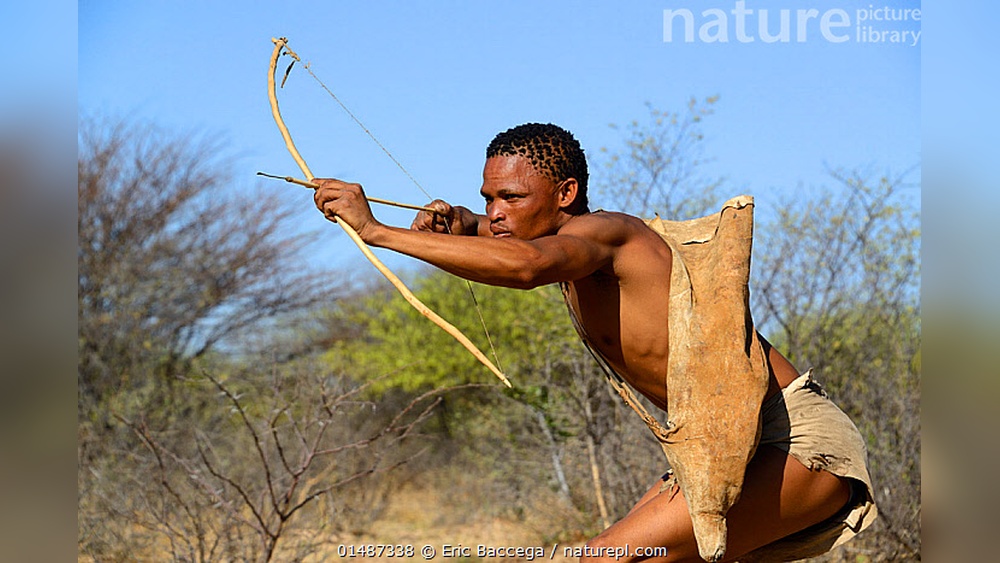
San bows and arrows are designed for long journeys. Hunters often carry several arrows, each with different heads or poisons for specific animals. The small size means the bow can be slung over the shoulder or carried in one hand, leaving the other hand free.

Credit: www.naturepl.com
How Are San Bows And Arrows Made?
Making a traditional San bow and arrow is a careful process passed down through generations. Every material is chosen for a reason, and every step matters.
Bow Construction
- Selecting Wood: The right wood is critical. Hunters look for straight, knot-free branches that bend without breaking. Wild olive and Grewia are common choices.
- Shaping: The branch is trimmed and carved. The ends are tapered to fit the bowstring.
- Seasoning: The wood is dried to the right moisture level to prevent warping.
- Stringing: Sinew or plant fiber is twisted into a string. It is tied with a simple knot or wrapped around notches at the bow’s ends.
- Finishing: The bow is sometimes polished with animal fat or wax to protect it from the desert’s harsh sun.
Arrow Making
- Arrow Shaft: Thin reeds or straight branches are cut and straightened over heat.
- Arrowhead: Small pieces of bone, stone, or metal are shaped and attached with sinew or plant glue.
- Fletching: Some arrows have feathers for stability, but many San arrows do not.
- Poison Application: The tip is dipped or smeared with a poison mixture, then dried.
Arrow Quiver
Hunters often make a simple quiver from bark, animal hide, or woven grass. This keeps arrows organized and ready for use.
Example: Poison Preparation
One famous San arrow poison comes from the Diamphidia beetle. Hunters collect the larvae, crush them, and mix the substance with plant sap. This poison can paralyze large game like antelope, making it easier to track and finish the hunt.
How Is The San Bow And Arrow Used?
San archery is not just about shooting a target. It is a complex skill that requires knowledge of the land, animals, and plants. Hunting with a San bow and arrow is a test of patience, stealth, and accuracy.
Hunting Technique
San hunters usually move quietly in small groups. They use the landscape, trees, rocks, grass, to hide their approach. When they find an animal, they get as close as possible before taking a shot. The short bow is perfect for shooting from behind cover or in thick brush.
Arrows are chosen based on the animal. For example, a small antelope might need a lighter arrow with mild poison, while a large kudu needs a heavier, more deadly tip.
Tracking
After the shot, the real work begins. Because poisoned arrows often do not kill instantly, hunters must track the animal, sometimes for hours or even a day. They look for signs: blood drops, broken branches, or footprints. This tracking skill is famous among the San and is part of what makes their hunting style so effective.
Sharing The Catch
When the animal is found, the meat is shared among the group. Every part of the animal is used, meat, skin, bones, and even tendons for bowstrings. This respect for the animal is central to San beliefs.
Comparing San Bows To Other Traditional Bows
The San bow and arrow is just one of many traditional archery systems around the world. Comparing it to others helps show what makes it special.
| Feature | San Bow | English Longbow | Mongolian Recurve |
|---|---|---|---|
| Length | 1, 1.2 m | 1.8, 2 m | 1.2, 1.5 m |
| Material | Local wood, sinew | Yew wood | Wood, horn, sinew |
| Draw Weight | Low (20, 40 lbs) | High (80, 120 lbs) | Medium (40, 70 lbs) |
| Arrowhead | Bone, stone, metal, poison | Steel | Steel, bone |
| Use | Hunting (with poison) | Warfare, hunting | Warfare, hunting |
Key Insight: The San bow’s low draw weight is balanced by the use of poison. This means hunters do not need to shoot with great force; instead, they rely on patience and tracking to complete the hunt.
The Role Of Poison In San Archery
One thing that truly sets the San bow and arrow apart is the use of poisoned arrows. This technique is both practical and sophisticated.
Why Use Poison?
The Kalahari and surrounding deserts are tough places to hunt. Large animals are strong, and the small San bow cannot always deliver a deadly shot. By using poison, hunters can take down even big game with a well-placed arrow. The poison works slowly, allowing time to track the animal without risking a dangerous chase.
Types Of Poisons
San hunters use several kinds of poisons, depending on what is available:
- Beetle Larvae: The most famous, from the Diamphidia species.
- Plant Sap: Some plants have toxic latex or juice.
- Snake Venom: Rarely, hunters use dried snake venom mixed with other ingredients.
Preparing poison is dangerous. Only skilled elders usually handle it, and the methods are kept secret within families.
Modern Studies
Scientists have studied San arrow poisons for decades. Some ingredients have inspired research into painkillers and heart medicines. However, the exact recipes are still closely guarded.
Warning: Handling traditional arrow poisons without knowledge is risky and can be deadly.
San Bow And Arrow In Modern Times
San archery is not just a thing of the past. Today, it still plays a role in San identity, education, and even tourism.
Cultural Preservation
Many San communities teach children how to make and use bows and arrows as a way to keep their heritage alive. Traditional archery is part of ceremonies, festivals, and storytelling.
Tourism And Demonstrations
Visitors to southern Africa can sometimes watch or even try San archery. This helps support local communities and educates people about San history. However, real hunting with poisoned arrows is usually not allowed for tourists.
Legal And Ethical Issues
Modern laws protect many wild animals, and hunting with poison is often banned outside San communities. San hunters must get special permits, and some areas have moved to archery for demonstration only.
Threats To Tradition
As land is lost and young people move to cities, fewer San practice traditional archery. Some experts worry that the skills and knowledge may disappear. Efforts by museums, researchers, and San elders are helping to record and teach these traditions.
The Skills Needed For San Archery
Being a good San archer means more than just shooting straight. It takes a mix of physical skill, patience, and deep understanding of nature.
Physical Skills
- Drawing the bow: The San bow is lighter than many, but steady aim is still needed.
- Quick reflexes: Hunting often means shooting at moving animals.
- Silent movement: Stealth is key for getting close to prey.
Knowledge Of Nature
- Animal behavior: Knowing when and where animals move is critical.
- Tracking: Following wounded animals over rough terrain is a unique skill.
- Plant identification: Finding the right wood, fibers, and poisons requires expert knowledge.
Social Skills
San hunting is often a group effort. Good communication, sharing, and respect for elders are all important.
Pro Tip: When learning traditional archery, spend as much time listening to elders as you do practicing with the bow.

Credit: www.alamy.com
Comparing San Arrows To Modern Arrows
San arrows are simple but effective. Here is how they compare to modern sport or hunting arrows.
| Feature | San Arrow | Modern Arrow |
|---|---|---|
| Shaft Material | Reed, wood | Aluminum, carbon fiber |
| Arrowhead | Bone, stone, metal, poison | Steel, titanium, broadhead |
| Fletching | None or feathers | Synthetic vanes or feathers |
| Length | 50, 70 cm | 70, 80 cm |
| Use | Hunting (with poison) | Target, hunting (no poison) |
Key Insight: Modern arrows focus on speed and accuracy. San arrows, by contrast, are designed for use with poison and for easy repair in the field.
My Experience With Traditional San Archery
When I tested a traditional San bow and arrow, I found it very different from the modern archery I was used to. The bow felt light but needed a careful draw. It was not about brute force, success depended on patience and smooth technique.
The arrows flew quietly and did not go very far, but I could imagine how effective they would be with a skilled hand and knowledge of the land.
One thing that surprised me was the importance of the arrow poison. Without it, the bow alone would not be enough for large animals. This system teaches respect for both the hunt and the animal. It also reminds us that technology does not always mean complicated tools, sometimes, the simplest designs are the most clever.

Credit: www.alamy.com
The Cultural Meaning Of San Archery
For the San, the bow and arrow is more than a weapon. It is a symbol of identity, history, and balance with nature.
Storytelling And Art
San rock paintings and carvings, some thousands of years old, often show hunters with bows and arrows. Many San stories explain how the first bow was made or how a clever hunter used one to save the group.
Rites Of Passage
Learning to use the bow and arrow is a key step for young San boys. It shows they are ready to help feed the group. Sometimes, special arrows are used in ceremonies or dances.
Respect For Life
San hunters are careful not to waste. They hunt only what is needed and share with others. The use of poison does not show disrespect; instead, it reflects a deep knowledge of how to use nature’s resources wisely.
Conservation And The Future
Today, the San bow and arrow faces both challenges and opportunities. Conservation groups and San leaders are working to protect both the land and the culture.
Supporting San Communities
Some projects help San people earn income by making traditional bows and arrows for collectors and museums. Others train young people in both tradition and modern skills.
Research And Documentation
Universities and museums have documented San archery techniques, materials, and stories. This helps protect the tradition, even as daily life changes.
The Role Of Archery In Conservation
Some wildlife reserves now include San guides who use traditional tracking and archery skills to monitor animal populations. This brings together old knowledge and new science for the benefit of all.
For those interested in learning more or supporting San culture, organizations like the UNESCO Courier provide trustworthy resources.