Best archery releases for hunting: wrist vs thumb trigger
Choose a wrist-strap index release if you hunt cold, wear gloves, or want the easiest stand-and-stalk option; choose a thumb trigger if you shoot calmly, want cleaner activation, and can practice enough to trust it under pressure. Pick the wrong style and you may fight the release at full draw, slap the trigger, or watch a deer walk off while you are still sorting your hand. I’ll break down how each style fits stands, saddles, spot-and-stalk hunts, hand size, late-season gloves, and target-panic risk.
Wrist release vs thumb release for hunting: the real trade-off


| Decision factor | Best archery releases for hunting: wrist | thumb trigger | Winner |
|---|---|---|---|
| Security while moving | Stays attached to your wrist; hard to drop while climbing or crawling | Handheld; easier to misplace if you set it down | wrist |
| Glove compatibility | Usually easier with bulky gloves | Can be awkward with thick gloves or cold fingers | wrist |
| Anchor feel | More fixed by the strap and wrist position | Cleaner hand anchor when practiced well | thumb trigger |
| Quiet ready position in a stand | Good, especially with a foldback wrist release strap | Also quiet, but depends on how you carry and clip it | wrist |
| Learning curve | Usually simpler for new hunters | Needs more repetition to shoot cleanly | wrist |
| Control over trigger panic | Can invite trigger punching if you slap the index trigger | Often better for hunters who can relax through the shot | thumb trigger |
Security and movement
The wrist release wins when I think about climbing sticks, pushing through cedars, or standing up in a treestand without fumbling. A wrist-strap index finger release stays with you, and that matters when your other hand is busy steadying yourself or moving gear.
A handheld thumb button release can absolutely be hunted with, but it asks more of the user. If I am crawling into a blind, packing my bow through thick cover, or climbing in low light, I trust the attached option more.
Gloves and cold fingers
Late season changes everything. Thick gloves dull finger feel, and a small handheld release can feel clumsy when your hand is cold and stiff. A wrist release usually gives me the easier grip, especially when I need to keep the bow ready without stripping off layers.
Thumb releases can work in cold weather, but the fit has to be right. If the handle is cramped or the trigger area feels crowded by gloves, your shot process slows fast.
Anchor and shot break
The thumb trigger wins on anchor control when the shooter has built a repeatable face and jaw position. I like that the release hand can settle in a cleaner place, which helps me avoid the grab-and-pull habit that ruins good aim.
The wrist release can still be very accurate, but some hunters punch the trigger the second the pin drifts into the vitals. That is where field pressure shows up and the shot gets ugly.
According to Best Bow Releases for Bowhunters: Wrist Strap vs. Thumb Release — The Wiseguy has a trigger adjustable from 16oz to 3oz.
How a wrist-strap index finger release works
A wrist-strap index finger release is strap-mounted, so the trigger sits in line with your index finger while the head clips to the hunting bow’s D-loop. For moving through brush, climbing, or sitting all afternoon, that attachment gives me a simple, secure setup I do not have to babysit.
Strap-mounted security and easy access
The biggest strength is plain reliability in the field. You put it on, it stays on, and it is ready when a deer steps out fast. That is why so many new hunters start there, and why I still keep one handy for rough hunts.
Caliper head, hook head, and trigger feel
Many wrist releases use a caliper head, which clamps around the D-loop with jaw-style contact. I also see hook-style heads on some wrist and handheld releases, and those tend to give quick engagement when the loop is easy to find by feel.
Trigger weight matters here. A very light trigger can feel crisp on the range, but in the field it can feed target panic if your finger closes too hard. The Spot Hogg Wiseguy offers a light trigger, and the trigger can be adjusted enough to let a hunter tune the feel.
Where wrist releases can drive trigger punching
When pressure hits, some hunters clamp down with the whole hand and yank the index trigger. I have seen that happen in my club with newer archers and in my own early years when my first compound was set 10 lb too heavy. I flinched for a month before I backed the limb bolts out.
That is not a release problem alone. It is a hand-speed and confidence problem. If the draw weight, anchor, or trigger feel is fighting you, the wrist release can make the mistake easier to repeat.
How a thumb button release works
A thumb button release is handheld, and the shot fires when the thumb presses a button or barrel. For bowhunters who want a cleaner anchor and less finger-trigger habit, it can feel calmer at full draw, especially after enough practice to make the grip automatic.
Handheld control and thumb activation
The release sits in your hand instead of on your wrist. That changes everything at anchor, because your hand can close around the handle in a repeatable way while your thumb finds the trigger without a hard index-finger jab.
I like that when a hunter is trying to clean up release execution instead of forcing a shot. The Carter Wise Choice comes in 3-finger or 4-finger configurations, and that style choice matters because hand size and finger spread affect how stable the handle feels.
Anchor feel and shot execution
A practiced shooter can settle into a strong anchor with a thumb button and keep the surprise break cleaner. That can cut down punching, but only if the archer trusts the shot process and does not snatch at the button the moment the pin settles.
Some handheld releases are built for hunting with the D-loop in mind. A hook-style head can make fast D-loop engagement easier, while the Tru-Fire Sear X is listed as a back tension release, which is useful if a hunter wants to break old index-trigger habits and move toward a surprise release style.
Which release works best for your hunt?
The right choice changes with the hunt, not just the archer. A wrist release is usually safer and simpler when you are moving a lot, wearing gloves, or shooting from awkward body positions. A thumb button starts to shine when the shot is calmer and the anchor has to be cleaner.
Tree stand hunting
For treestand hunting, I lean wrist release if access and quiet readiness matter most. A foldback wrist release strap helps because it folds out of the way while climbing or glassing, then comes back into play fast when a deer appears below.
Saddle hunting
A saddle hunter often appreciates the smaller bulk of a thumb trigger, especially when hand position matters more than wrist support. Still, if the setup involves awkward tether angles, cold hands, or lots of gear movement, the attached wrist option stays simpler.
Spot-and-stalk hunting
Spot-and-stalk usually favors security and speed under movement. I want a release that stays with me while I cross washouts, kneel, or draw from a weird angle, and that is where the wrist release usually feels less fussy.
Cold-weather late season hunting
Late-season hunting with heavy gloves pushes me back toward the wrist strap. Glove-friendly fit is easier when I do not need fine finger control to run the shot, and I can keep the release ready without stripping off insulation in a bad wind.
Hunter decision matrix: wrist vs thumb by real use case
Here is the practical way I sort it. I score the release that gives me fewer problems in the field, not the one that looks cooler on a target line. The numbers are my hunting judgment from range work and season use, not lab data.
| Use case | Wrist security | Glove compatibility | Anchor consistency | Quietness | Learning curve | Better fit |
|---|---|---|---|---|---|---|
| Tree stand | 5 | 4 | 3 | 4 | 5 | wrist |
| Saddle | 3 | 3 | 5 | 4 | 3 | thumb trigger |
| Spot-and-stalk | 5 | 4 | 3 | 3 | 5 | wrist |
| Cold-weather late season | 5 | 5 | 3 | 4 | 4 | wrist |
Tree stand scorecard
The wrist release wins because stand hunting rewards attached gear, low-light simplicity, and easy one-handed access. A foldback strap matters here more than most hunters admit, because it keeps the release from hanging in the way while you settle in or draw at odd angles.
Saddle scorecard
The thumb trigger wins more often in a saddle because the hand position can feel cleaner and the anchor more repeatable. That said, I only like it for hunters who already know how to control the shot without finger-jabbing the button.
Spot-and-stalk scorecard
The wrist release takes this one for me. Brush, range changes, kneeling, and quick draws all punish complicated gear, and the attached design gives you fewer chances to drop or fumble the release before the shot window closes.
Late season glove scorecard
This is the easiest call in the whole article. The wrist release is simply more glove-friendly for bulky winter clothing, and the extra touch points help when fingers are cold and your hands are already losing dexterity.
Do thumb releases help with target panic?
Sometimes, yes, but only if the shooter changes the habit that caused the panic. A thumb release can reduce punching because it removes the same index-finger trigger habit, yet it will not fix missed anchor timing, shaky aiming, or the urge to crush the button when a buck steps out.
How punching shows up in the field
On live deer, punching often looks like a tiny freeze, then a hard snatch at the trigger. I see it when the hunter settles the pin, feels pressure, and tries to force the shot before the sight picture is ready. That habit ruins more opportunities than bad gear does.
Why trigger weight matters
Trigger feel can either calm the hand or speed up the mistake. The Wiseguy’s adjustable trigger from 16oz to 3oz gives room to tune feel, and that matters because a release that is too light for a nervous hunter can become a hair trigger under buck fever.
Where a back tension release fits as an alternative
If a hunter keeps punching with an index trigger, I often point them toward a back tension style for practice. The Tru-Fire Sear X is listed as a back tension release, and that kind of setup can teach a surprise break better than another light trigger ever will.
Fit, gloves, and bow setup matter more than most hunters think
The best release is the one that fits your wrist, hand, glove setup, and draw posture without making you fight the bow. I have seen good shooters throw arrows low because their release hand felt cramped, the wrist strap pinched, or the handle changed their anchor without warning.
Wrist size, hand size, and fatigue
Shorter sits can hide a bad fit. A four-hour sit will not. If the strap bites into your wrist or the handle leaves your index finger too far from the trigger, fatigue creeps in and the shot starts to feel forced.
Glove-friendly fit and bulky winter clothing
Glove bulk changes trigger reach and thumb access. The Tru-Fire Edge Buckle Foldback has over 1 inch of length adjustment, and that kind of room helps a hunter manage winter layers. The Tru-Fire Edge Extreme has a head smaller than a dime and includes a 360-degree head rotation, which can help with compact carry and easy alignment.
The Edge Buckle Foldback uses a foldback buckle strap, and the TRUGLO Nitrus is described as a dual-jaw wrist release. The Scott Archery Ghost is described as a magnetic-trigger wrist release. Those features matter because they change how quickly you can get ready without making noise.
D-loop engagement and release head consistency
The hunting bow’s D-loop is the attachment point most modern releases use, whether the head is a hook or caliper style. I pay attention to that because a consistent connection cuts down little surprises at full draw, and little surprises become big mistakes when an elk or whitetail is looking through the timber at you.
Choose wrist release if… / Choose thumb trigger if…
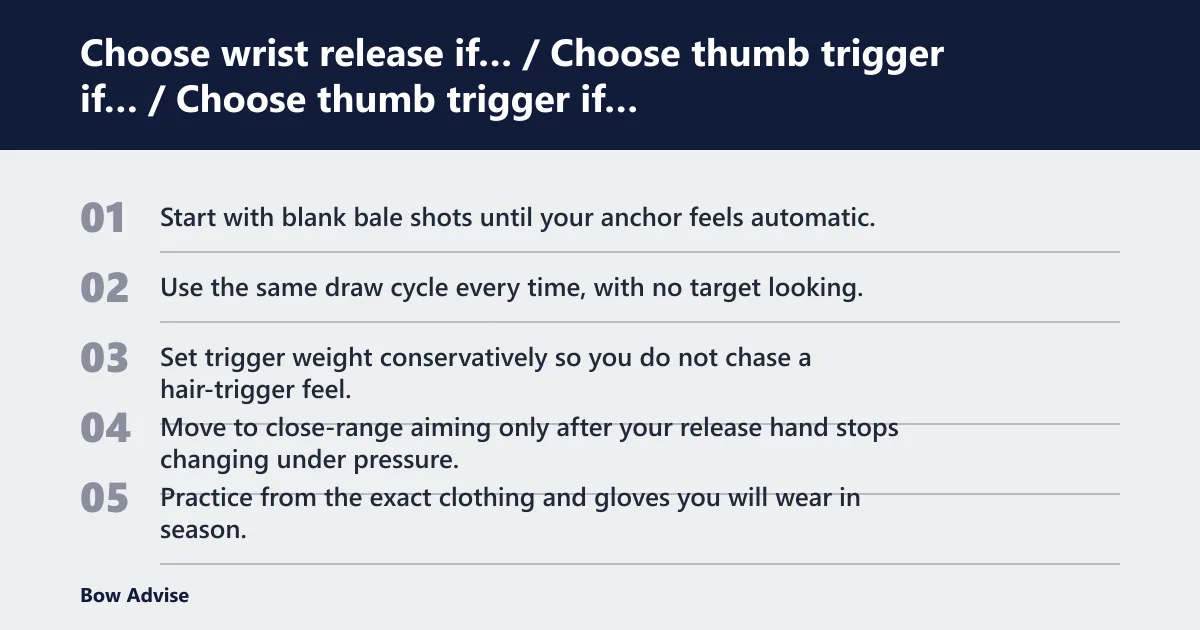
Choose a wrist release if you want security, simpler access, and better glove compatibility. Choose a thumb trigger if your anchor is already repeatable, you want cleaner hand control, and you have enough practice time to trust it when the shot turns rough. That is the honest split I use with hunters at my club.
Choose wrist release if your priority is security, gloves, and simple access
Pick wrist if you hunt from a treestand, move through brush, or spend a lot of time in cold weather. Pick wrist if your hands get cold fast, your gloves are bulky, or you want the release attached while climbing and glassing.
Choose thumb trigger if your priority is anchor control and cleaner execution
Pick thumb if you already shoot calmly and want less index-finger punching. Pick thumb if your hand size fits the handle well, your anchor feels repeatable, and you are willing to practice until the shot breaks without a fight.
How to switch styles before season
- Start with blank bale shots until your anchor feels automatic.
- Use the same draw cycle every time, with no target looking.
- Set trigger weight conservatively so you do not chase a hair-trigger feel.
- Move to close-range aiming only after your release hand stops changing under pressure.
- Practice from the exact clothing and gloves you will wear in season.
I have seen archers change sides and improve fast when the fit matches the shot. I once switched to a left-hand bow after realizing I was left-eye dominant, and my groups tightened within two weeks. The lesson was simple: fit and control beat habit.
Frequently asked questions
Is a wrist release or thumb release better for hunting?
For most hunters, the wrist release is better when the hunt involves climbing, brush, gloves, or quick access from a stand. The thumb trigger is better when the shooter already has a stable anchor and wants cleaner shot execution. I would not call either one universal.
What release should a beginner bowhunter use?
A beginner usually does well with a wrist-strap index finger release because it is easier to keep track of in the field and simpler to learn. That said, fit matters. If the strap is too small or the trigger sits awkwardly, the “beginner” choice can still feel wrong.
Do thumb releases help with target panic?
They can help some shooters because they move away from the index-finger trigger habit that causes punching. They do not fix panic by themselves. If the archer still snatches the shot, misses anchor timing, or rushes under pressure, the problem stays.
Are wrist releases better with gloves in cold weather?
Yes, usually. The wrist release is easier to run with bulky gloves because the strap holds the release in place and the trigger is simpler to access. I prefer that setup late in the season when my hands are cold and my fingers feel clumsy.
Can you hunt with a handheld thumb release?
Yes, you can hunt with a handheld thumb release, and many experienced bowhunters do. It makes the most sense for hunters who practice enough to trust the anchor and trigger timing. If you do not train with it, the field will expose that fast.
How do I choose the best release for bowhunting?
Match the release to your hunt first, then to your hand. If you hunt stands, wear gloves, or move through brush, lean wrist. If you want cleaner anchor control and already shoot with calm hands, try thumb. Test both from your real clothing before season opens.