Wrist Release vs Handheld Release: Comfort and Control
Wrist-strap releases fit beginners, hunters, and archers who want secure carry and quick use, especially when wrist comfort matters. Handheld thumb releases fit archers who want finer trigger control and less load on the wrist. Pick the wrong style, and you can get target panic, shifting anchor points, and wrist fatigue. This comparison covers comfort, control, wrist anatomy, safety, and setup so you can choose the right release aid.
This guide is part of our Archery protective gear guide series.
Wrist release vs handheld release: the real trade-off
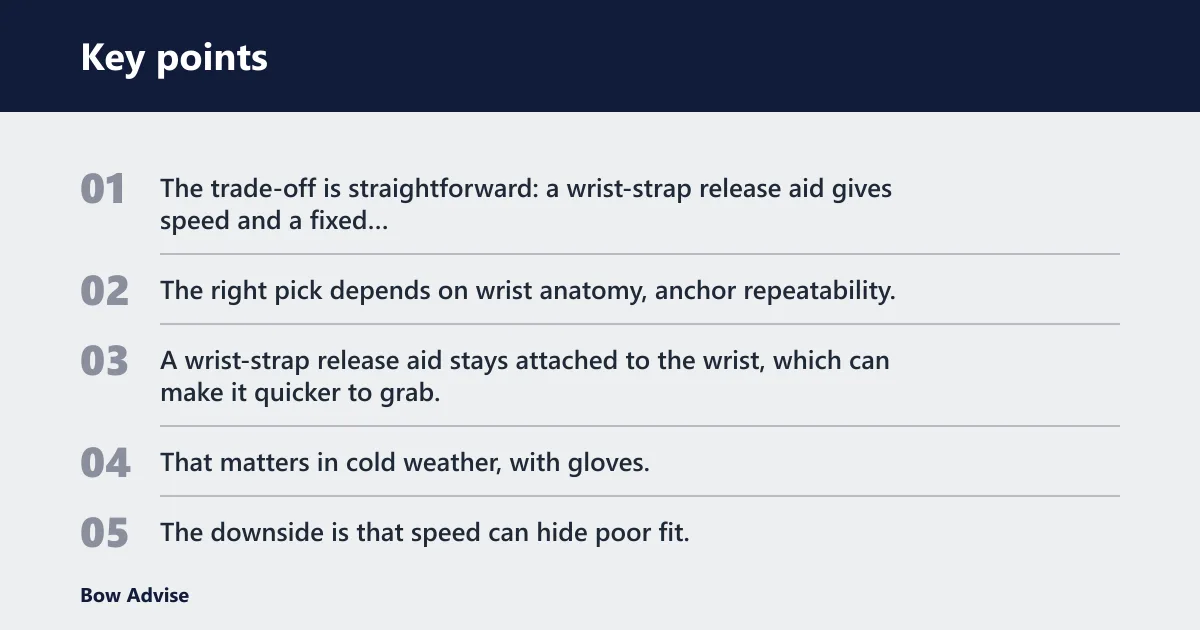


The trade-off is straightforward: a wrist-strap release aid gives speed and a fixed connection to the arm, while a handheld thumb release gives more freedom in the hand and usually more control over the shot. The right pick depends on wrist anatomy, anchor repeatability, and how stable the release feels under fatigue.
| Decision factor | Wrist Release | Handheld Release | Winner |
|---|---|---|---|
| Deployment speed | Fast to put on and ready quickly | Slower to grip and set up | Wrist Release |
| Wrist comfort | Loads the wrist joint and strap pressure points | Less direct wrist loading | Handheld Release |
| Anchor repeatability | Depends heavily on draw length and strap fit | Often easier to repeat a relaxed hand anchor | Handheld Release |
| Control under fatigue | Can get sloppy if trigger travel is too light | Better for surprise execution and back tension practice | Handheld Release |
| Safety risk from handling | Lower drop risk because it stays strapped on | Higher drop risk unless kept on a lanyard | Wrist Release |
Deployment speed is where the wrist release wins
A wrist-strap release aid stays attached to the wrist, which can make it quicker to grab, rotate into position, and use. That matters in cold weather, with gloves, or on a short hunting setup where fumbling costs time. The downside is that speed can hide poor fit.
Hand comfort is where the handheld release wins
A handheld thumb release is held in the fingers and fired with the thumb, so it removes strap pressure from the wrist region. That can matter when the wrist joint is sensitive, the strap presses near the scaphoid on the thumb side, or the user feels compression around the carpal tunnel. The hand still has to hold it securely.
Anchor repeatability often favors the handheld release
A fixed wrist strap can help some archers repeat the same anchor, but only if draw length and trigger reach match the shooter. A handheld release can also be repeated well, yet it depends on disciplined hand placement. Either system gets worse when anchor point changes from shot to shot.
Safety and handling favor the strapped option
A wrist release is less likely to be dropped because it stays strapped on. A handheld thumb release can fall free when a hand opens early, and that risk rises with cold fingers or limited grip strength. A lanyard solves part of that problem, but it does not replace good handling habits.
📊 Many target and 3D archers favor handheld thumb releases. Source: Best Release Aid for Compound Bows: Wrist Strap vs Handheld Thumb ….
How each release feels on the wrist and hand
The wrist is the part of the arm between the lower arm and the hand, and it is also defined as the wrist joint or radiocarpal joint. That joint is complex, and the wrist region includes the carpal tunnel, where the median nerve passes through. Those details matter because comfort is not only about padding; it is about where pressure lands.
Wrist joint position, strap pressure, and anchor stability
A wrist-strap release puts some load on the radiocarpal joint through the strap and how the hand sits against the handle or buckle. If the strap sits too tight or too low, it can press near sensitive structures on the thumb side of the wrist. If it sits too loose, the anchor can shift and the shot gets inconsistent.
Thumb release grip, hand relaxation, and dropped-release risk
A handheld thumb release is held in the fingers, so the hand must maintain enough tension to keep it secure without over-gripping. That relaxed hold can feel better for archers with wrist pain or limited wrist tolerance. The trade-off is that the release can be dropped or rotated poorly if the grip changes during the draw cycle.
Where scaphoid and carpal tunnel pressure can matter
The scaphoid lies on the thumb side of the proximal row, and it can heal slowly after a fracture because of poor blood supply. The median nerve passes through the carpal tunnel. That is why a wrist strap should not crowd the thumb-side wrist, and why a release that presses on sore tissue can feel far worse than its label suggests.
Which release gives better control?
Handheld thumb releases usually give better control because the shot can be cleaner, the trigger can be set more precisely, and the hand position can support a surprise break. That does not mean they automatically shoot better. Control comes from trigger travel, anchor repeatability, and how the shooter manages the shot under pressure.
Trigger travel and a crisp break
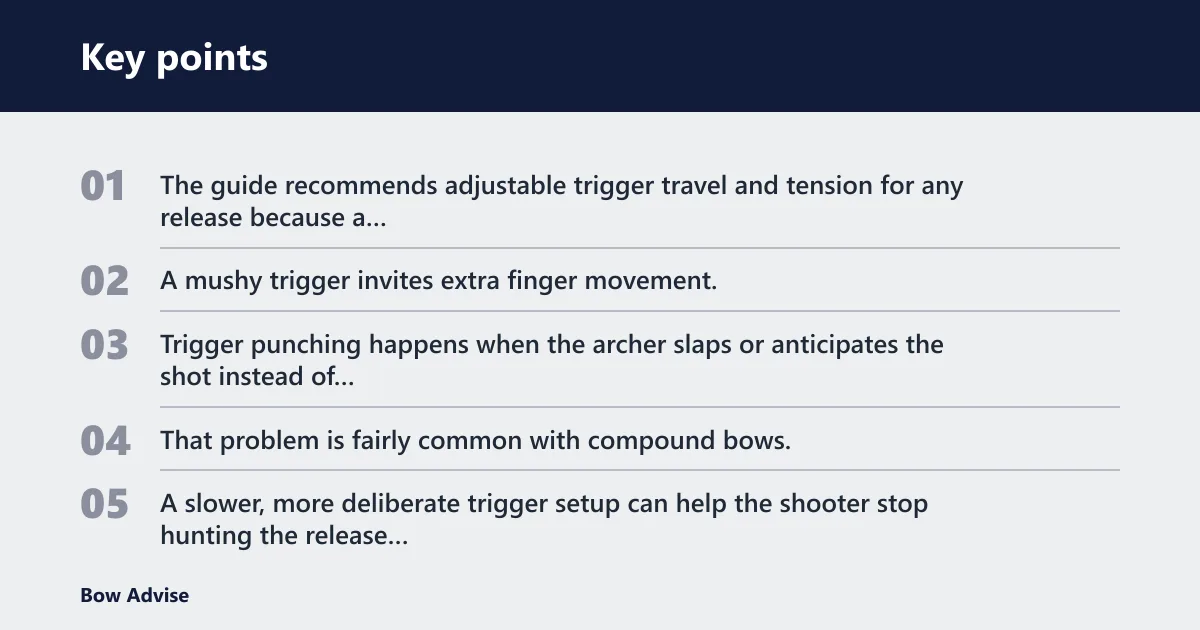
Trigger travel matters in both styles. The guide recommends adjustable trigger travel and tension for any release because a crisp, repeatable break is easier to trust than a mushy one. A mushy trigger invites extra finger movement, and extra finger movement often ruins the shot.
Trigger punching versus surprise execution
Trigger punching happens when the archer slaps or anticipates the shot instead of letting it break cleanly. That problem is fairly common with compound bows, especially when the release fires too fast or too predictably. A slower, more deliberate trigger setup can help the shooter stop hunting the release and start executing the shot.
Back-tension release mechanics for training and accuracy
Back tension release mechanics use gradual pull and rotation so the shot can fire as a surprise. That style is common in target and 3D archery because it can reduce target panic and improve follow-through. It also exposes bad setup fast; if the anchor is unstable, the shot breaks at the wrong time and the error shows up immediately.
Say your release fires the instant your thumb touches the button and your bow shoulder jumps every time. That is a classic setup for trigger punching. A cleaner break with more travel, or a back-tension style setup, usually gives the brain less reason to flinch.
Is a wrist release faster for hunting?
Yes. A wrist-strap release is usually faster for hunting because it stays attached, deploys quickly, and is easier to use when a bow is held at full draw for only a short time. Speed helps in cold weather and with gloves, but speed alone does not make it the better choice if the fit is wrong.
Fast deployment in cold weather and gloves
Hunting often rewards simple gear handling. A wrist release avoids the extra step of searching for a handheld aid in a pocket or pouch. That matters with thick gloves, numb fingers, or a short window to settle into anchor before the shot opportunity disappears.
How anchor speed compares with control under pressure
Fast deployment is useful only if the anchor lands in the same spot every time. A poor draw length or a crooked strap can move the hand enough to change anchor point and sight picture. In that case, the release may be fast, but the shot cycle becomes sloppy.
When speed helps and when it creates sloppy form
Speed helps in close cover, from a blind, or in late-season conditions when finger dexterity drops. It becomes a problem when the shooter uses the quick release as a way to avoid proper anchor discipline. The result is often rushed trigger work and poor follow-through.
How draw length and anchor point change the fit
Draw length and anchor point matter more than many buyers expect. A release that is too short forces the hand into an awkward angle, while one that is too long can push the trigger too far away and change wrist load. Fit is not cosmetic; it changes how the shot stacks up.
Why wrist-strap length and trigger reach matter
With a wrist-strap release, the hand must reach the trigger at a length that allows a clean anchor without curling the wrist. If the trigger sits too close, the index finger may bunch up and encourage punching. If it sits too far, the shooter may crane the wrist and build strain into the setup.
How a poor anchor changes repeatability
A bad anchor point changes sight picture, peep alignment, and trigger feel all at once. That is why draw length is not a guess. If the archer has to stretch for the trigger or collapse to find it, the release becomes harder to trust and the shot breaks from a different position each time.
Fit checks for small hands, limited grip strength, and long draw lengths
- Make sure the trigger can be reached without cocking the wrist hard toward the forearm.
- Check that the anchor lands in the same place with the jaw, nose, or corner-of-mouth reference used by the bow setup.
- For small hands, confirm the trigger does not sit too far out on the fingers.
- For limited grip strength, choose a handheld release only if it can be retained securely without a death grip.
- For long draw lengths, make sure the release does not force the elbow or wrist into an overextended position.
Decision table: choose wrist release or handheld release
This table maps shooter type, wrist sensitivity, and goal to a practical choice. The best option is the one that reduces fit risk while preserving repeatable anchor and safe trigger mechanics.
| Shooter type | Wrist sensitivity | Goal | Better choice | Fit risks | Control benefits | Setup checks |
|---|---|---|---|---|---|---|
| New compound archer | Low to moderate | Learn anchor and basic release use | Wrist Release | Trigger too close, strap too tight | Simple to wear and harder to drop | Set draw length first, then buckle placement |
| Hunter in gloves | Low | Fast deployment in the field | Wrist Release | Anchor rushed under pressure | Quick access and secure carry | Check trigger travel and cold-weather strap fit |
| Target or 3D archer | Low to moderate | Clean trigger and repeatable shot | Handheld Release | Drop risk, poor grip discipline | Better for surprise shot and back tension | Use a lanyard and set thumb position before drawing |
| Archer with wrist pain | High | Reduce pressure on the wrist joint | Handheld Release | Hand fatigue if grip is too tight | Less strap pressure on the radiocarpal joint | Check finger reach and keep the hand relaxed |
| Archer with limited grip strength | Moderate | Keep the release secure without strain | Wrist Release | Strap can irritate if sized wrong | No need to hold the release all day | Fit the strap so it stays stable without pinching |
Choose Wrist Release if… / Choose Handheld Release if…
Choose a wrist release if speed, simple handling, and field security matter most. Choose a handheld release if wrist comfort, cleaner trigger mechanics, and back-tension style execution matter more. One release can cover both hunting and target shooting, but only if the fit and trigger setup are matched to the task.
Choose wrist release if…
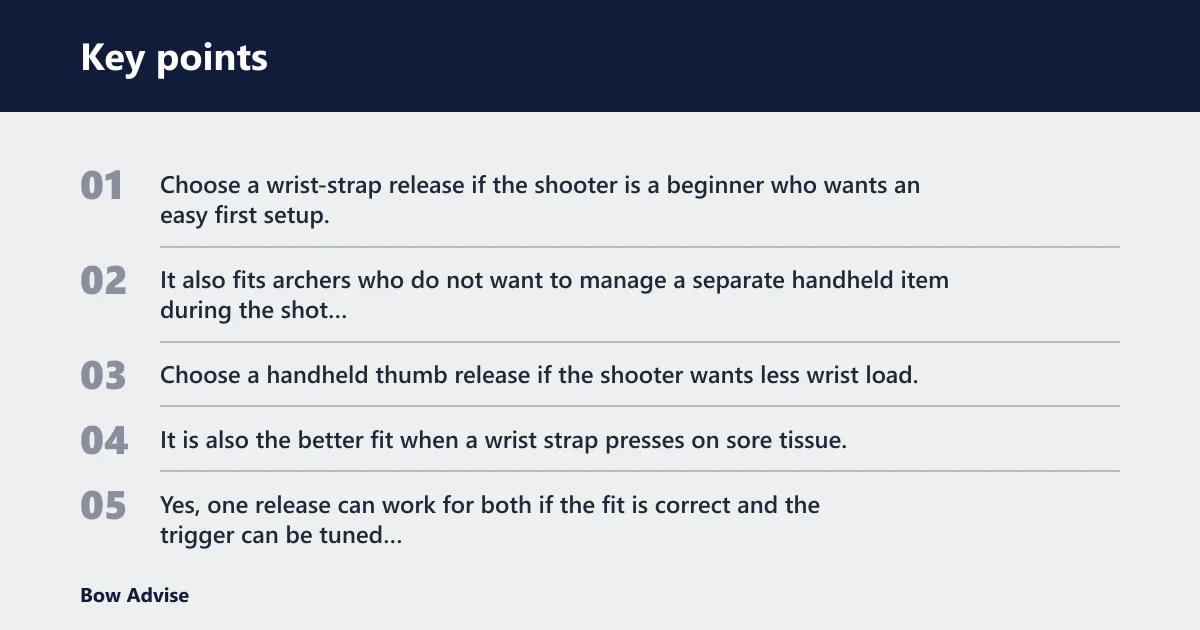
Choose a wrist-strap release if the shooter is a beginner who wants an easy first setup, a hunter who values fast deployment, or someone who needs a secure aid in cold weather. It also fits archers who do not want to manage a separate handheld item during the shot cycle.
Choose handheld release if…
Choose a handheld thumb release if the shooter wants less wrist load, better trigger discipline, or a cleaner path into target and 3D work. It is also the better fit when a wrist strap presses on sore tissue, the scaphoid area is sensitive, or the archer wants to train away from target panic.
Can one release work for both hunting and target shooting?
Yes, one release can work for both if the fit is correct and the trigger can be tuned for both control and safety. A wrist release can serve hunting and casual target work well, while a handheld release can be used for hunting if it is secured with a lanyard and the user can keep it under control in the field.
Suppose a shooter has a moderate draw length, a small hand, and a wrist that gets sore after long practice. A handheld release with a lanyard may feel better for target work, but the same shooter might still keep a wrist release for wet, cold hunts where fast deployment matters more than hand freedom.
What should I look for in a comfortable archery release?
A comfortable archery release should fit the hand, avoid pressure on sore wrist tissue, and break the shot in a way the shooter can repeat. Comfort is not only about padding. It comes from trigger travel, strap placement, hand position, and whether the design matches the shooter’s wrist anatomy and goal.
Adjustable trigger travel and repeatable break
Look for adjustable trigger travel and tension. A crisp, predictable break reduces surprise flinches and helps the archer learn a stable shot cycle. If the trigger feels too mushy or too hair-sensitive, the release is likely to create more problems than it solves.
Wrist strap fit and buckle placement
On a wrist release, the strap should sit securely without pinching the wrist joint or crowding the thumb side where the scaphoid lies. Buckle placement matters because a poorly placed buckle can press into the wrist during anchor. The strap should feel stable before full draw, not after the bow is already loaded.
Lanyard use, safety, and carry habits for handheld releases
A handheld release should usually be used with a lanyard so it is less likely to drop in the grass, blind, or gravel. Keep the lanyard short enough that the release does not swing into the bowstring. Good carry habits matter because a secure release is easier to trust and easier to retrieve.
Frequently asked questions
What is the difference between a wrist release and a handheld release?
A wrist release straps to the wrist and usually uses an index-finger trigger, while a handheld release sits in the hand and is fired with the thumb. The wrist model is faster to deploy and more secure on the arm. The handheld model usually gives finer control and less wrist loading.
Are thumb releases more accurate than wrist releases?
They can be, but not by default. Thumb releases often support cleaner trigger execution and back tension, which helps accuracy for trained archers. A badly fitted thumb release, or one used with a loose anchor, can be less accurate than a well-fitted wrist release.
Which release is better for beginners, wrist or handheld?
A wrist-strap release is usually the safer starting point for beginners because it is easier to hold onto, quicker to learn, and less demanding on grip discipline. That said, a beginner with wrist pain or a strong interest in target work may do better with a handheld release after careful setup.
Can a handheld thumb release help with target panic?
Yes. A handheld thumb release can help if it is used with surprise shot mechanics or back tension, because the archer stops trying to punch the trigger. It is not an instant fix. Bad habits can follow the shooter into any release style if the anchor and trigger work stay rushed.
How do I choose the right release size for my draw length?
Start with draw length, then check whether the trigger lands at a natural finger or thumb position at anchor. If the shooter must overreach, the release is too long or the setup is off. If the hand feels cramped or twisted, the release is likely too short or the strap is positioned poorly.