Archery Chest Protector Sizing: How to Choose the Right Fit
Choose a chest protector that clears your string-side chest at full anchor and lets your draw hand stay relaxed, then size up one step if you shoot layered winter clothing. Too small, and the string rubs fabric or hits the chest; too large, and it shifts, changes anchor feel, and can alter arrow clearance. This guide covers how to measure for recurve and traditional setups, choose cut and pad shape, and check fit over your actual shooting layers.
What a chest guard must clear
An archery chest guard covers the chest and front shoulder on the string side, keeping clothing out of the bowstring path. It should allow a full, comfortable draw and a clean let-down without tugging on the shirt or jacket underneath. Coverage matters more than padding thickness.
For recurve and traditional archers, the concern is not only the chest point itself. The guard also has to clear the front of the shoulder where the string can brush during expansion, anchor, and release. If the cut is wrong there, the guard can feel acceptable standing still and still fail in the shot.
Chest guard versus arm guard
A chest guard and an arm guard solve different problems. The chest guard keeps fabric and loose layers out of the string path across the chest and front shoulder. The arm guard protects the bow arm from string slap. One does not replace the other.
Because the two pieces protect different zones, sizing questions do not transfer between them. A chest guard must be judged by torso coverage, shoulder clearance, and how it behaves at full draw. An arm guard is a forearm fit problem.
How do you measure for fit?
Measure around the fullest part of the chest, under the arms, while wearing the clothes you actually shoot in. Then compare that number with the brand’s size chart. Do not use street size as the starting point, because shooting layers and cut shape change the result.
A measurement taken over a thin shirt can land one size too small if you normally shoot over a base layer plus a fleece or heavy shirt. The correct fit starts with the garment system, not with casual clothing size labels.
Measure the right way
- Put on the normal shooting clothes you expect to wear under the guard.
- Wrap the tape around the fullest part of the chest, under the arms.
- Keep the tape level and snug, not compressed.
- Match that number to the manufacturer’s chart.
- If the number falls between sizes, check the layer thickness and draw side before choosing.
That last step matters because the same chest measurement can land in different size bands depending on cut and layer bulk. A chart is only a starting point if the guard must work over winter clothing.
What size archery chest guard do I need?
Use chest circumference as the base choice, then adjust for the actual layer thickness you shoot in. If the chart is borderline, choose the larger size when the guard will be worn over thicker clothing or when the string-side shoulder needs more front coverage. Tightening straps cannot fix a cut that is too short or too narrow.
Competitors commonly list small, medium, and large, and some brands add X-Large. The important point is that the label is only a shorthand. The real question is whether the guard stays flat, clears the string path, and allows a normal draw without side bunching.
Borderline chart decisions
If the chest number sits between two sizes, favor the size that preserves shoulder coverage and draw clearance. Upsizing is usually the better move when winter layers add bulk, when the shooter has a broad shoulder, or when the string-side chest is close to the bowstring at anchor.
Say your chest measurement lands between Medium and Large, and you shoot with a thick shirt in cold weather. Choose Large first, then adjust the closure for snug stability. That keeps room for movement without forcing the guard to ride up under tension.
Should an archery chest protector fit over shooting clothes?
Yes. Sizing should be checked over normal shooting clothes, not street clothes. That means the guard must fit over the base layer, shirt, fleece, or jacket you expect to wear when shooting. Fit over the real layer system, because fabric compression matters more than padding thickness.
Loose clothing can change the string path, and winter clothing changes clearance again. A guard that fits over a thin shirt may pinch or rise when a thicker layer is added. The fit should remain stable across the whole shot cycle, not only at rest.
Layer thickness and cut
Thin, close-fitting layers usually need less adjustment, but even then the guard must not press so hard that shoulder rotation is limited. Heavier layers often require a larger size or a different cut, not just a tighter strap. That is especially true for traditional archers who shoot through seasonal clothing changes.
A guard can seem fine in a mirror and still fail once the bow is raised. Fabric bunches under the arm, the side edge climbs upward, and the string path becomes exposed. That is a fit problem, not a comfort preference.
Does draw hand affect chest guard sizing?
Right-handed archers typically need left-side coverage, and left-handed archers typically need right-side coverage. Some products are sold in left-hand and right-hand versions, so the hand orientation affects more than where the buckle sits. It also affects how the front shoulder is shaped and how the guard lies against the chest.
A guard can be the right chest size and still be the wrong version if the string-side panel is cut for the other hand. The result may be near-miss clearance on one side and poor coverage on the actual string side.
Right-hand and left-hand versions
For a right-handed archer, the guard should protect the left side of the chest and front shoulder. For a left-handed archer, it should protect the right side. Some models are sold in separate left-hand and right-hand versions, so the label should be checked before size is chosen.
That matters in recurve bow setup because the string can sit very near the chest at full draw. Longer draw length increases string proximity, which makes the wrong-side cut harder to tolerate even if the chest circumference looks correct on paper.
Chest guard sizing decision table
The table below converts chest measurement, clothing layer thickness, draw hand, and shooting style into a practical size band. Use it as a decision aid, not a replacement for the brand chart. If the chart and the table disagree, the chart still sets the final label; the table helps you choose which way to move when the fit is borderline.
| Chest circumference | Layer thickness | Draw hand | Shooting style | Recommended size band | Fit check focus |
|---|---|---|---|---|---|
| Smaller end of chart | Thin base layer only | Either hand, correct version | Target recurve | Small or chart-equivalent | Flat panel, no chest pinch, no ride-up |
| Mid-chart | Normal shirt plus light layer | Right-handed or left-handed as needed | Target recurve | Medium or chart-equivalent | String-side shoulder clears cleanly at anchor |
| Upper mid-chart | Shirt plus fleece | Correct version | Field or 3D | Large or next size up | Side edge stays down through draw and let-down |
| Borderline between sizes | Winter clothing | Correct version | Traditional bow | Next size up | No bunching, no string-path exposure, no shoulder restriction |
| Any chest size | Thick layers or bulky collar | Correct version | Long draw length recurve | Upsize or switch cut | Guard must not ride up when tension peaks |
Use the table with one extra rule: if the guard is technically the right size but the side edge bunches or the string-side chest is exposed, the cut is wrong. In that case, moving to a different cut is often better than tightening straps further.
Fit failure checklist
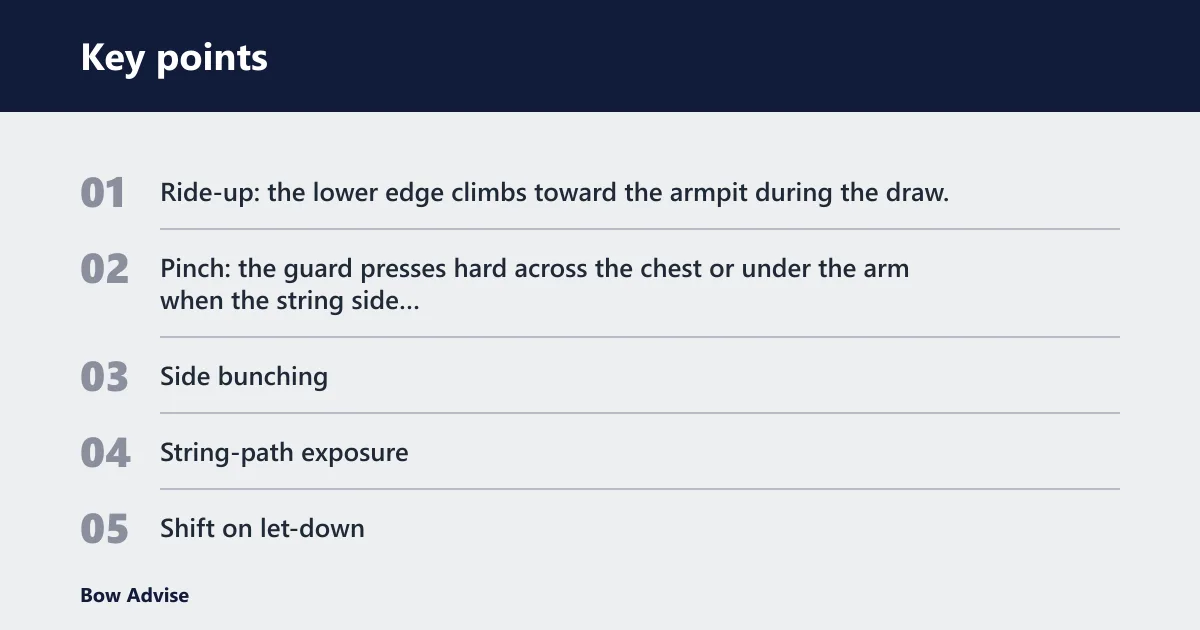
- Ride-up: the lower edge climbs toward the armpit during the draw.
- Pinch: the guard presses hard across the chest or under the arm when the string side expands.
- Side bunching: fabric folds at the edge and changes the guard’s shape.
- String-path exposure: loose clothing is still visible where the string travels at anchor.
- Shift on let-down: the guard moves when the bow is lowered, which means it is not staying in place.
How should it fit in the shot?
The fit check must happen during the actual shot, not while standing still. A chest guard should stay put during raise, draw, anchor, and let-down. If it shifts, rides up, or exposes the string path at any point, the size or cut is wrong even if the chest number matched the chart.
A snug closure is useful only if it holds the guard in position without limiting shoulder rotation. Snaps, hook-and-loop, buckle, or velcro can all work, but the closure must not create pressure points that change anchor feel or pull the guard off line.
Shot-by-shot fit check
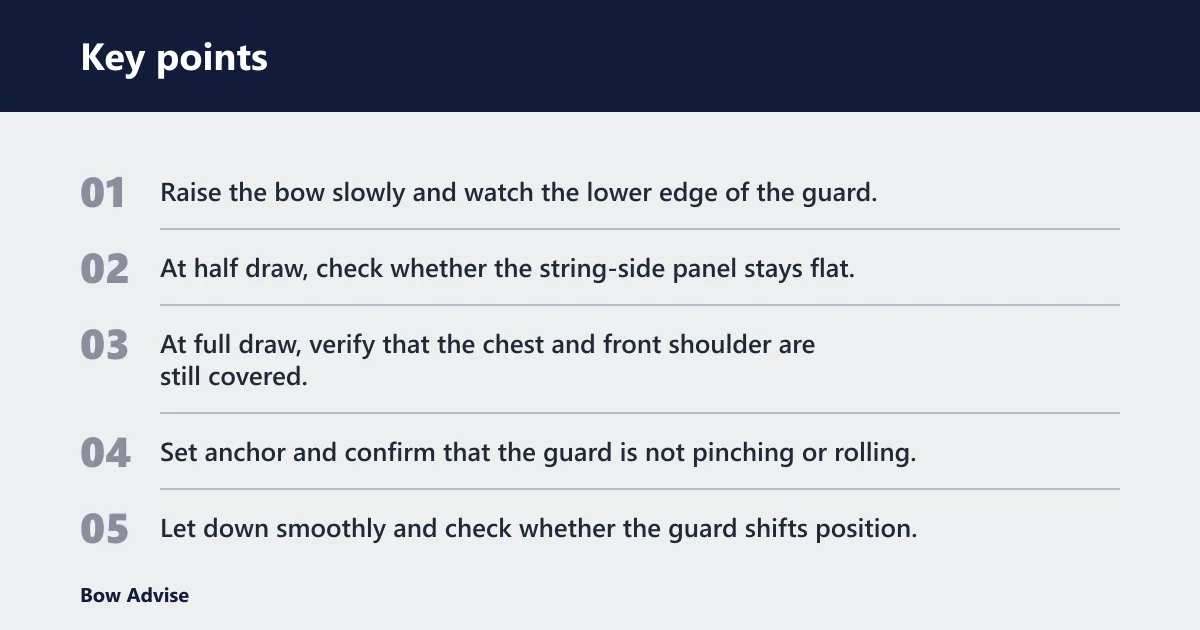
- Raise the bow slowly and watch the lower edge of the guard.
- At half draw, check whether the string-side panel stays flat.
- At full draw, verify that the chest and front shoulder are still covered.
- Set anchor and confirm that the guard is not pinching or rolling.
- Let down smoothly and check whether the guard shifts position.
If any step fails, change the size or the cut before tightening the closure further. A guard that is too small often fails first at the front shoulder. A guard that is too loose usually fails at ride-up and side bunching.
Common shot-fit scenarios
Picture a right-handed recurve archer wearing a medium-weight shirt and a guard that matches chest size but is cut too narrow on the left front edge. The draw starts clean, then the side panel climbs during anchor and the string-side chest becomes exposed. That calls for a different cut, not a tighter strap.
A common first-timer mistake is buying a guard that fits over a thin undershirt, then adding a fleece in cold weather. The guard feels fine in the house, but on the line it pinches the shoulder and rides up before full anchor. The better fix is a larger size or a style with more front coverage.
Our picks by need
Simple adjustable fit: MAXMIKO archery chest guard As an Amazon Associate we earn from qualifying purchases. Prices and availability are accurate as of the date shown and are subject to change

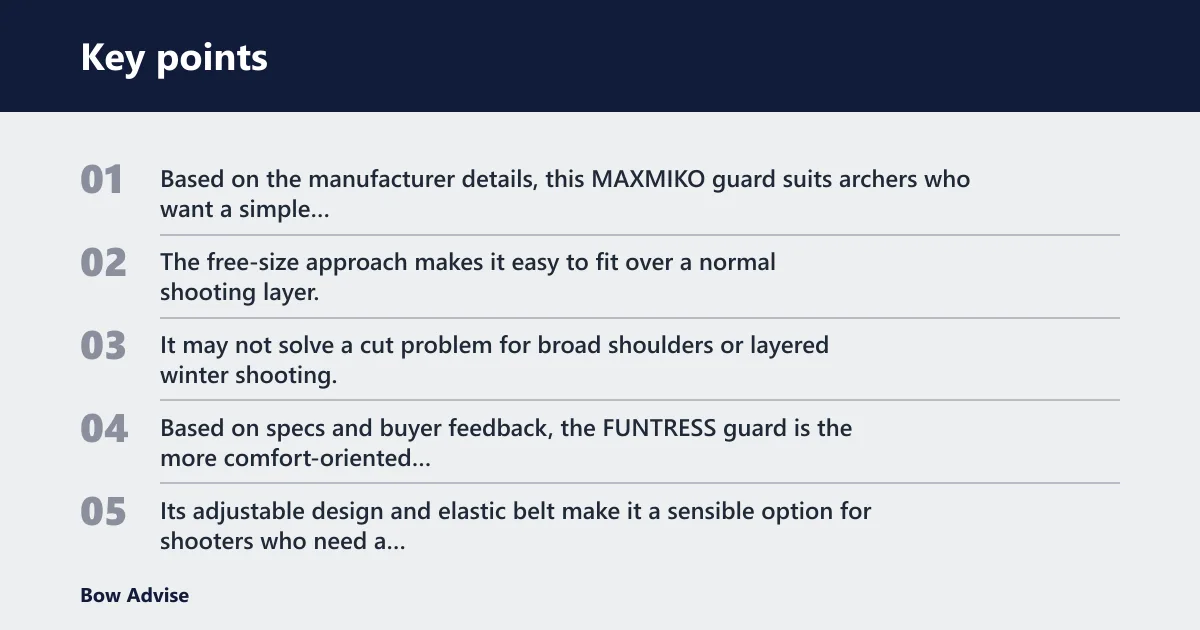
Based on the manufacturer details, this MAXMIKO guard suits archers who want a simple adjustable chest protector in breathable mesh PU. The free-size approach makes it easy to fit over a normal shooting layer, and the lightweight build should help if you prefer minimal bulk.
The drawback is that free size can be blunt. It may not solve a cut problem for broad shoulders or layered winter shooting, and the simple shape may not give enough side coverage if your string-side front shoulder needs more room.
Comfort-focused general fit: FUNTRESS archery chest protectorAs an Amazon Associate we earn from qualifying purchases. Prices and availability are accurate as of the date shown and are subject to change

Based on specs and buyer feedback, the FUNTRESS guard is the more comfort-oriented choice here. Its adjustable design and elastic belt make it a sensible option for shooters who need a stable fit over normal clothes without adding much complexity.
The tradeoff is that “fits most sizes” is not the same as a precise cut match. If you have a borderline chest measurement or need hand-specific coverage, you may still need to compare the chart carefully before choosing it.
Right-hand recurve fit: DeeRace chest guardAs an Amazon Associate we earn from qualifying purchases. Prices and availability are accurate as of the date shown and are subject to change

Based on published product details, the DeeRace model is the most specific option for a right-handed archer. It is listed in Large and made for RH archers, so it may be a better starting point when the problem is side coverage rather than simple chest circumference.
The limitation is clear: the hand-specific version narrows the audience, and the listed size is not a flexible solution if your layer system changes across seasons. It is better for a shooter who already knows the orientation and size band needed.
Mistakes to avoid
Do not size a chest guard from street clothing alone. The right fit should be checked over normal shooting clothes, because that is where fabric compression and clearance matter. Also avoid treating Small, Medium, and Large as universal labels; different brands cut the same label differently.
Another common error is ignoring draw hand. A right-handed archer needs left-side coverage, and the reverse is true for a left-handed archer. If the guard is the wrong version, it can look close enough on the hanger and still fail during anchor.
Do not keep tightening a guard that rides up, pinches, or exposes the string path. Those are fit failures, not signs that the closure needs more tension. If the guard still shifts after correct adjustment, change the size or switch the cut.
Suppose a traditional archer wears a medium shirt in mild weather and chooses a medium guard that fits the chest number on the chart. In January, the same archer adds a fleece and the lower edge starts climbing at full draw. The correct change is usually one size up, not a tighter buckle.
Frequently asked questions
How do I measure for an archery chest guard?
Measure around the fullest part of the chest, under the arms, while wearing the clothes you will shoot in. Then compare that number with the brand’s size chart. This is the most reliable way to choose a starting size because the guard has to fit over real shooting layers, not street clothes.
How tight should a chest guard be for archery?
Snug enough to stay in place, but not so tight that it shifts your shoulder position or pinches the chest during the draw. A good fit holds steady through raise, anchor, and let-down. If you need extra strap tension to stop ride-up, the guard is likely the wrong size or cut.
Do I need a chest guard for recurve archery?
Many recurve and traditional archers benefit from one because the string can sit very near the chest at full draw. It is especially useful when draw length is longer or clothing is loose. The guard helps keep fabric out of the string path and supports repeatable clearance.