3 Best Youth Archery Gear (2026): Based on Specs and Reviews
For first-time youth archers, the best protective gear is a properly fitted arm guard, plus a finger tab or glove sized to the bow hand, and a chest guard when clothing can catch the string. Poor fit leads to string slap, finger pain, and flinching that can wreck early form. This guide maps each risk area, matches it to the right gear, and points out where technique beats buying more equipment.
Quick comparison
| Product | Badge | Best for | Price | ||
|---|---|---|---|---|---|
 | LWANO Archery Gloves Leather Practice Hunting Three FingerLWANO | Our pick | Small Pink · Leather Pad · 3-Finger | $9.99 Price as of 15 Oct 2026 | View |
 | Luzhengyang Thickened Archery Finger Guard-4Pcs FingerLuzhengyang | Budget pick | 4-Piece Set · Cowhide · Adjustable Strap | $25.99 Price as of 15 Oct 2026 | View |
 | Sratte 2 Pcs Archery Glove Arm Guard Youth Kit Adjustable 3Sratte | Pair with it | 9-Inch Arm Guard · Glove Kit · 3 Straps | $13.99 Price as of 15 Oct 2026 | View |
The fastest way to buy well is to match the gear to the body area at risk, then check bow type and handedness. A child who is getting slapped on the forearm needs a different fix from one whose shirt catches the string or whose fingers hurt after only a few arrows.
How we chose
We compared youth-sized protective gear by four filters. First, it had to solve a real beginner problem such as string slap, finger pressure, or chest contact. Second, it had to fit small forearms, small hands, or smaller faces without forcing a bad setup.
Third, the gear had to make sense for the bow type. Recurve and barebow shooters generally need different finger protection than compound shooters using a release aid. Fourth, we favored items that solve the most common first-session problems before buying extras that only matter after form improves.
Youth arm guard: best for string slap
- Includes arm guard to protect forearm
- Adjustable straps fit different arm thicknesses
- Breathable fabric inner lining for comfort
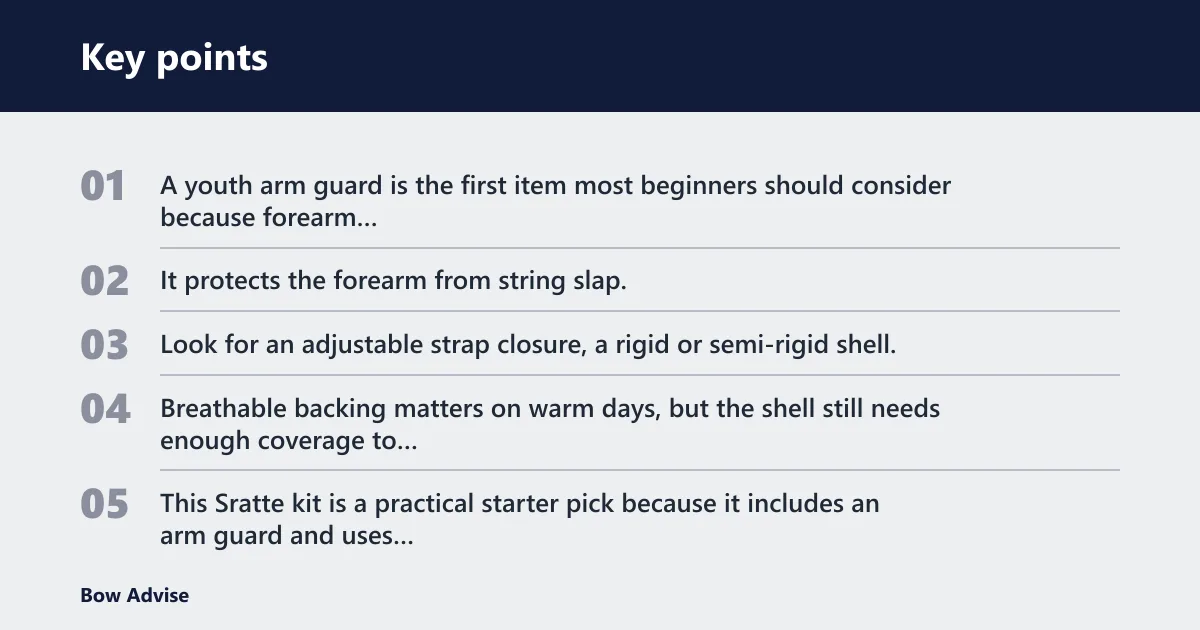
A youth arm guard is the first item most beginners should consider because forearm contact is the most common first-session problem. It protects the forearm from string slap, and it is the top pick when the child’s bow arm collapses, the anchor is inconsistent, or the draw weight is too high for clean form.
Look for an adjustable strap closure, a rigid or semi-rigid shell, and a size that sits flat on small forearms without sliding toward the wrist. Breathable backing matters on warm days, but the shell still needs enough coverage to block the string.
This Sratte kit is a practical starter pick because it includes an arm guard and uses three straps for fit control. The drawback is that a bundled glove is not the same as a purpose-built finger tab, so the package may solve arm contact better than finger comfort.
Finger tab and glove: best for finger protection
Finger protection matters for recurve and barebow shooters, not for most compound archers using a release aid. A finger tab fits the string fingers of the drawing hand, while a shooting glove is the traditional-bow option when the shooter wants full finger coverage instead of a tab face.
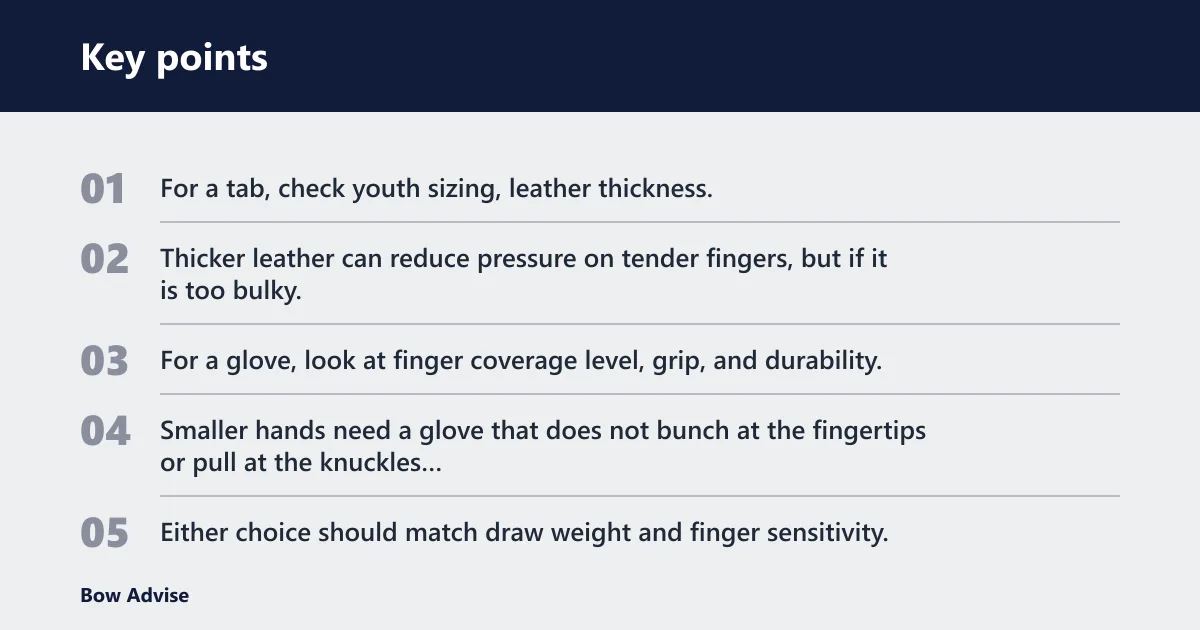
For a tab, check youth sizing, leather thickness, and whether the pattern supports split-finger or three-under shooting. Thicker leather can reduce pressure on tender fingers, but if it is too bulky, the child may struggle to feel the string cleanly.
For a glove, look at finger coverage level, grip, and durability. Smaller hands need a glove that does not bunch at the fingertips or pull at the knuckles during anchor. Either choice should match draw weight and finger sensitivity; if the bow is already light enough, the child should not need oversized protection just to survive the shot cycle.
When a finger tab fits recurve and barebow shooters
A tab is the better fit when the child shoots a recurve or barebow and wants direct string feel with less fingertip strain. It is also the cleaner option when the coach wants split-finger or three-under work, since the tab can be sized and shaped around that style more easily than a glove.
When a shooting glove is the better traditional-bow choice
A shooting glove makes more sense for traditional bows when the child wants full finger coverage and simple on-off use. It can be easier for very small hands, but it should still fit closely enough that the leather does not twist under load or dull the release.
Chest protector: best for recurve clothing contact
A chest protector is most relevant for youth recurve archers because the string can catch loose clothing or contact the chest during a poor follow-through. It is not a universal item. It helps when shirt fabric, shoulder position, or draw length puts material into the string path.
Left- and right-handed versions matter because the protector has to sit on the correct side of the torso and line up with the shooting side. Shoulder strap adjustment should let it lie flat without pulling across the neck or riding up during the draw.
Fit across the torso matters more than padding thickness. If a thinner shirt and better stance fix the contact, the child may not need a chest protector yet. Say a right-handed recurve shooter keeps catching a loose hoodie at anchor; a fitted chest protector solves that problem faster than buying a heavier bow or changing the arrow rest.
Safety glasses: best for range eye protection
Safety glasses are range eye protection, not a bow-specific performance item. They are worth considering when a program wants eye coverage, when there is nearby movement on the line, or when the shooter wears glasses and needs a close-fitting pair that will not slip during the draw.
Look for an impact-resistant lens, a fit over smaller faces, and options such as anti-fog and UV treatment for outdoor use. A poor fit is a real issue for youth because glasses that slide down the nose can distract the shooter at full draw.
They should not be treated as a fix for bow-fit problems. A child still needs a correctly matched bow, correct handedness, and clean string path. The glasses are there for the range, not to fix sloppy alignment.
What protective gear does a first-time archer need?
A first-time archer usually needs the gear that matches the body area most likely to get hit. For many youth shooters that means an arm guard first, then finger protection for recurve or traditional bows, then a chest protector only when clothing or torso position creates real string contact. Safety glasses are optional range eye protection.
Use bow type to narrow the list. Compound shooters with a release aid usually start with an arm guard and maybe eye protection, while recurve and barebow shooters often need a tab or glove right away. If the bow is too heavy, lower draw weight is the better fix than stacking on more gear.
Start with the minimum safe setup: a bow that matches the child’s strength, the correct handedness, and one piece of protection for the most likely contact point. A chest protector does not replace a too-heavy bow, and a finger tab does not fix poor anchor.
- Match the bow to the child’s draw strength.
- Confirm left- or right-handed setup before buying protective gear.
- Choose one item for the main risk area first.
- Add a second item only if a new contact problem appears.
- Check clothing, stance, and anchor before buying a third item.
Youth protection matrix
| Body area | Common beginner problem | Recommended gear | When to skip it | Fit check | Budget priority |
|---|---|---|---|---|---|
| Forearm | String slap on release | Youth arm guard | Skip only if lighter draw weight and corrected bow arm remove contact | Covers the forearm, stays put, and uses adjustable straps on a small arm | Highest |
| String fingers | Finger pinch and soreness on recurve | Finger tab or shooting glove | Skip for most compound release-aid users | Right youth size, correct leather thickness, no bunching at full draw | High for recurve and traditional |
| Chest and clothing line | String catches shirt or chest during the shot | Chest protector | Skip if fitted clothing and clean form remove contact | Correct handedness, flat torso fit, shoulder straps adjusted snugly | Medium |
| Eyes | Range debris or nearby movement concerns | Safety glasses | Skip when the program does not require them and the fit is poor | Impact-resistant lens, small-face fit, anti-fog if needed | Medium |
| Forearm and hand | Compound shooter with release aid still gets slap from poor setup | Youth arm guard | Skip extra hand gear unless the coach identifies a contact issue | Guard clears the string path and does not block wrist motion | Highest |
| String fingers | Traditional youth shooter feels finger pressure from a hard draw | Shooting glove | Skip if a lighter bow and better anchor remove the pain | Small-hand fit, clean fingertip coverage, durable palm leather | High |
Which one should you buy?
If the budget is tight, start with the arm guard. It solves the most common early contact problem, and a properly sized youth arm guard is cheaper than replacing a child’s fear of the string. If the child shoots recurve or barebow, add a finger tab or glove next.
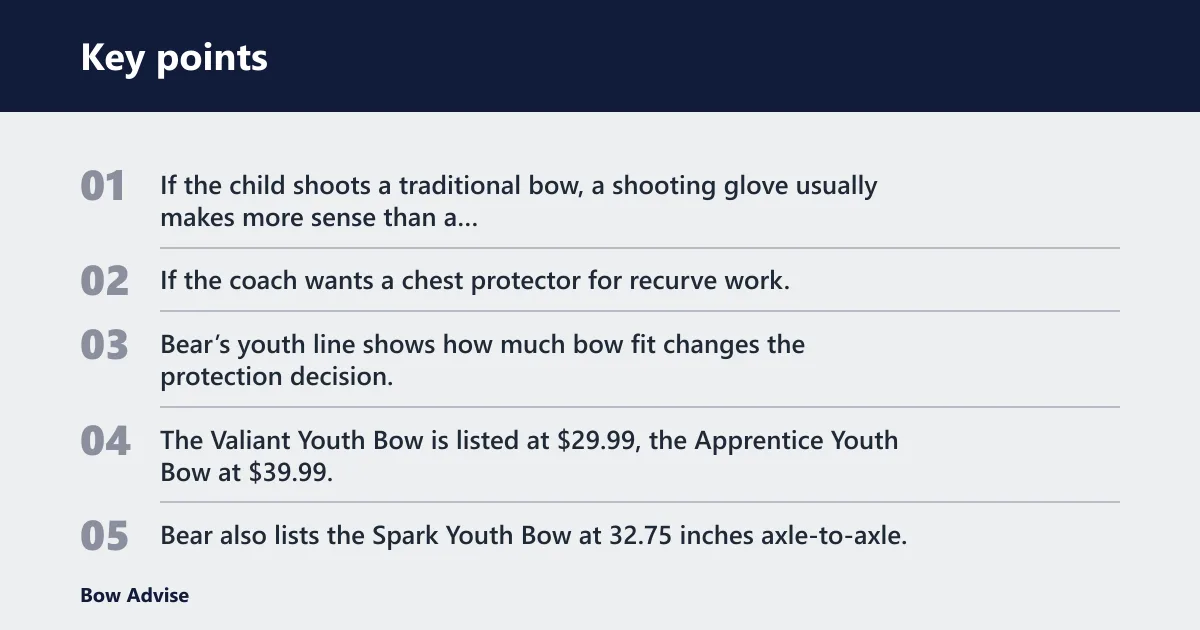
If the child shoots a traditional bow, a shooting glove usually makes more sense than a tab because it covers the fingers fully and suits the bow style better. If the coach wants a chest protector for recurve work, buy it only when shirt contact or chest contact is showing up at anchor.
Bear’s youth line shows how much bow fit changes the protection decision. The Valiant Youth Bow is listed at $29.99, the Apprentice Youth Bow at $39.99, and the Brave Youth Bow from $79.99, with a draw weight range of 5-25 lbs on the Brave Youth Bow. Bear also lists the Spark Youth Bow at 32.75 inches axle-to-axle, the Flash Youth Bow at 47 inches axle-to-axle, the Frontier RTS Youth Bow with 150 FPS speed, the Shootout RTH Compound Bow with 290 FPS speed, the Gamekeeper Jr RTH Compound Bow with 290 FPS speed, and the Limitless RTH Compound Bow at 265 FPS.
Those figures matter because a bow that is too much for the child often creates the exact problems protective gear is trying to manage. If the draw weight is too high, the first fix is lighter draw weight or a better bow fit, not a bigger stack of accessories. For compound youth shooters, Bear shows a draw length range of 12"-27" on the Gamekeeper Jr RTH Compound Bow, which is the kind of range that should be checked before buying any add-on gear.
Say a 9-year-old right-handed recurve shooter keeps getting slapped on the forearm after three arrows. The answer is not a heavier arm guard plus chest protector and gloves; it is a lighter bow, a better anchor, and one well-fitted arm guard. Suppose a teen in a hoodie keeps brushing the string across the chest at full draw. A chest protector can help, but a tighter shirt or a different shoulder position may remove the problem first.
Frequently asked questions
What protective gear do kids need for archery?
Most kids need only the gear that matches the contact point. That is usually an arm guard first, then finger protection for recurve or traditional bows, and a chest protector only when clothing or torso position causes string contact. Safety glasses are optional range eye protection, not a bow-specific requirement.
Do beginners need an arm guard for archery?
Most beginner youth archers should have one, because forearm contact is common when form is still developing. A youth arm guard with adjustable straps and enough forearm coverage can prevent repeated string slap while the child learns alignment. If the bow is too heavy, though, lighter draw weight still matters more.
Should a child wear a finger tab or shooting glove?
For recurve and barebow shooting, a finger tab is usually the first choice because it keeps the string fingers protected while preserving string feel. A shooting glove is the better fit for traditional bows when full finger coverage and simpler wear matter more. The right answer depends on bow style and hand size.
Is a chest protector necessary for youth archery?
No, not for every child. It is most useful for youth recurve archers whose clothing or chest position creates string contact. If a fitted shirt, correct posture, or a shorter draw removes the issue, a chest protector can wait. Handedness still has to match the shooting side when one is used.
What safety gear should a first-time archer wear at the range?
At minimum, the child should wear the gear that prevents the most likely contact problem for that bow type. That usually means an arm guard, plus finger protection for recurve or traditional shooting. Safety glasses can be added for range eye protection if the program wants them or the fit is good.
How do I stop string slap for a child learning archery?
Start with bow fit and form before buying more gear. Lower draw weight, correct handedness, and a proper anchor often reduce slap more than extra padding does. If the forearm is still getting hit, add a youth arm guard with a secure strap closure and enough coverage to stay in place.
What size archery protective gear should I buy for a child?
Buy youth sizing, not adult gear cut down at random. The item should fit the child’s forearm, hand, torso, or face without sliding or pinching. For chest protectors and some arm guards, handedness matters too, because the gear has to sit on the correct side of the body.
What is the safest setup for a beginner recurve shooter?
The safest beginner recurve setup is a light enough bow, correct handedness, a fitted arm guard, and a finger tab or glove sized to the hand. Add a chest protector only if clothing or chest contact is real. That setup handles the main beginner risks without piling on gear the child does not need yet.