Common Clothing Mistakes That Cause String Contact in Archery
String contact usually comes from clothing that is too loose, too bulky, or cut with stiff seams, sleeves, hoods, pockets, or cords that sit in the string path. If you ignore it, clean release, arrow speed, and consistency can drop. This guide shows the clothing features that fail most often and the simplest fit fixes to try before changing your bow setup.
What causes bowstring clearance issues with clothing?
Clothing that enters the string path usually fails at one of three points: sleeve volume, hem position, or collar and hood bulk. The bowstring needs clear space from the bow hand side at draw, anchor, and release, and that space gets smaller as draw length, anchor position, and clothing bulk increase.
Bowstring clearance and where it disappears
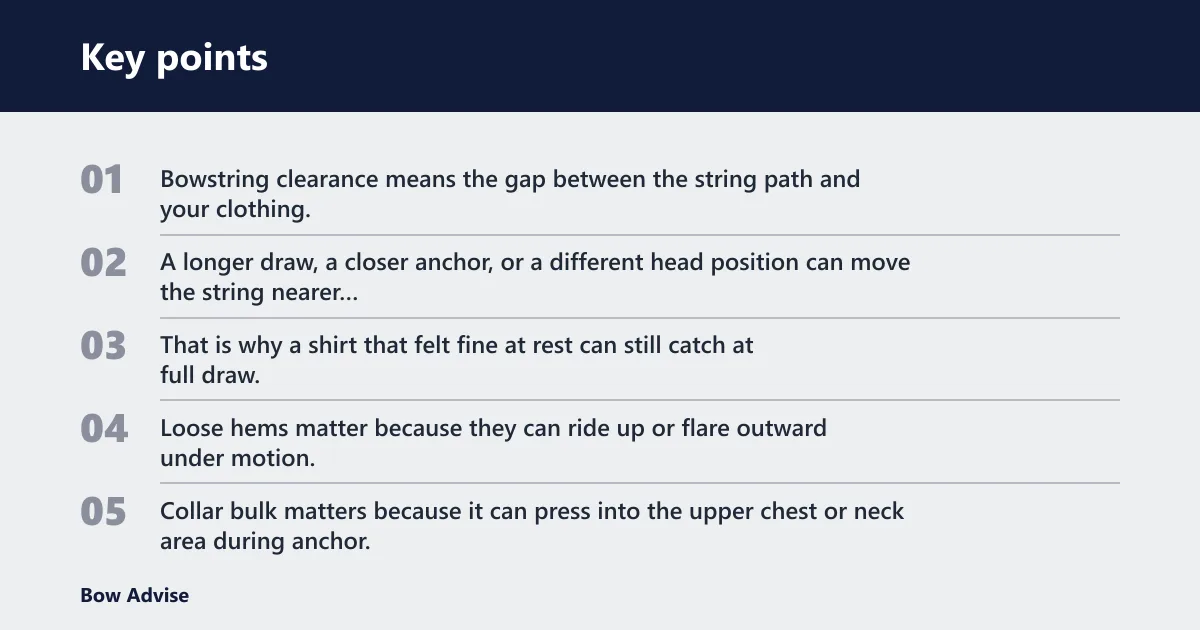
Bowstring clearance means the gap between the string path and your clothing. A longer draw, a closer anchor, or a different head position can move the string nearer to the chest, neck, bow arm, or string arm sleeve. That is why a shirt that felt fine at rest can still catch at full draw.
Loose hems matter because they can ride up or flare outward under motion. Collar bulk matters because it can press into the upper chest or neck area during anchor. Sleeve volume matters because extra cloth can hang into the path on the draw side or bunch against the bow arm.
Bow arm contact versus string-arm interference
These are different problems. Bow arm contact usually shows up as a slap on the inner forearm or near the wrist, often tied to brace height, elbow rotation, or a loose sleeve. String-arm interference usually shows up at the drawing forearm, wrist, hand, or tab area, where fabric or fasteners snag during the draw or release.
A common first-timer mistake is wearing a soft long-sleeve shirt with wide cuffs and assuming any contact means bad form. If the string drags on the sleeve before release, the sleeve design is part of the problem, even when the shot mechanics are acceptable.
Why do sleeves catch the string?
Sleeves catch the string when their shape puts cloth in the path of travel, or when fabric bunches near the wrist and elbow under tension. Tight sleeves can still fail if the cuff is thick or the seam sits badly. Loose sleeves fail faster because they offer more moving cloth for the string to grab.
Tight sleeves versus loose sleeves
Loose sleeves are commonly reported to create the largest clearance problem. They can balloon on the draw arm, fold near the elbow, or swing into the line of travel during expansion. Tight sleeves reduce that risk, but a sleeve that is tight at the forearm and bulky at the upper arm can still interfere if the seam or cuff sits in the wrong place.
Raglan sleeves usually move the seam away from the shoulder cap, which can help when shoulder bulk is a problem. Set-in sleeves place the seam closer to the shoulder point, which can feel cleaner on some archers but may add a firmer edge near the upper arm. Dropped-shoulder cuts often add the most loose cloth near the upper arm and chest, so they are a poor choice when contact is already happening.
Cuffs, elastic, and bunching
Cuff width matters as much as sleeve length. A wide cuff can fold back and leave a loose edge for the string to catch. Tight elastic cuffs can also fail if they bind above the wrist and push extra fabric back toward the forearm. The goal is a cuff that lies flat without a thick ridge.
Fabric bunching under the string arm is common when the sleeve has too much length or too much ease through the forearm. If the cloth wrinkles at the elbow crease when you come to anchor, that wrinkle can become a snag point at release.
Hoodie and jacket details that fail
Hoodies and jackets often fail because of details, not just because they are “bulky.” Drawcords, zipper pulls, pocket flaps, and shoulder volume can all sit where the string moves. A hoodie with a calm fit at rest can still create contact once the bow arm lifts and the chest opens.
Hoods and drawcords
Loose hood edges can brush the string side of the neck or upper chest. Drawcords are worse because they add a thin, mobile line that can snag or flutter into the path. If a hood is worn during practice, it should be snug enough that the edge stays flat and the cords are secured out of the way.
Zippers, garages, and pull tabs
Front zippers can create two problems: a hard ridge at the chest and a pull tab that swings. A zipper garage can help because it covers the top stop and may reduce hard-edge contact near the throat. If the jacket has a long pull tab, that tab can become the first thing the string hits.
Pockets, chest bulk, and shoulder bulk
Large chest pockets, hand-warmer pockets, and layered patch pockets add thickness where the bowstring may pass on the release side. Shoulder bulk matters too, especially on the drawing arm, because it can change how the sleeve hangs and where the fabric folds during expansion.
For a right-handed archer wearing a zip hoodie with a loose left sleeve and a dangling hood cord, the string may clear the chest but still brush the left sleeve cuff on release. That points to the sleeve and cuff, not the entire shot.
What should you wear in cold weather?
Cold-weather clothing should control bulk without freezing movement. A base layer should sit close to the body, a mid layer should add warmth without stiff folds, and the outer layer should protect from wind or rain without creating hard edges in the string path. The safest winter setup is usually the thinnest system that keeps the archer warm enough to stay relaxed.
Base, mid, and outer layers
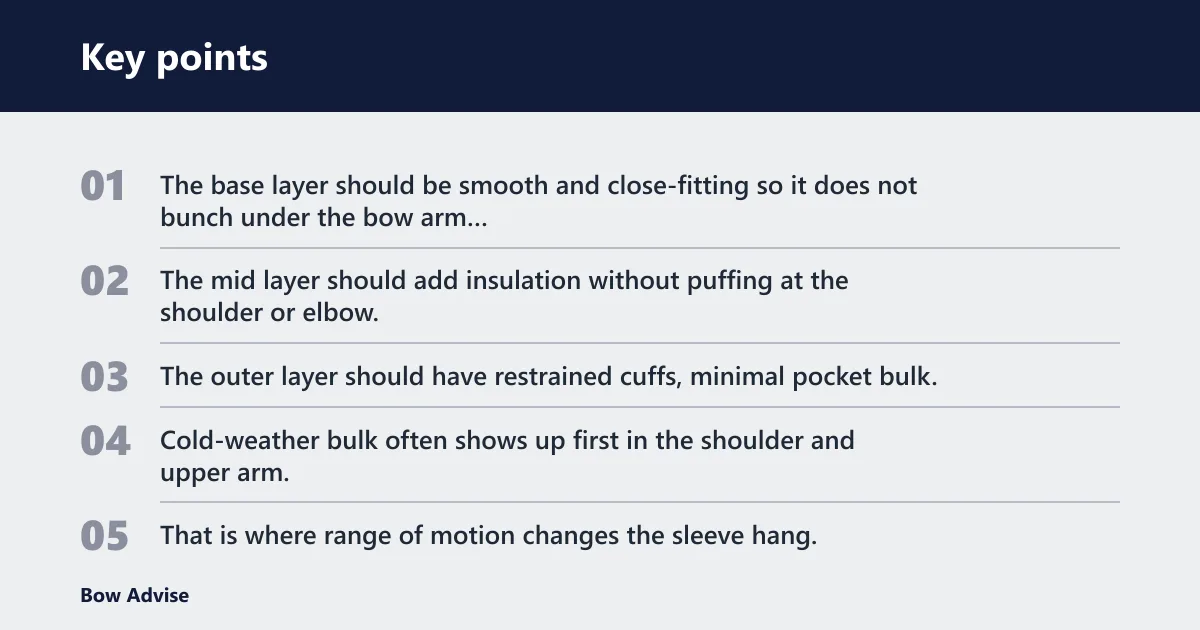
The base layer should be smooth and close-fitting so it does not bunch under the bow arm or drawing forearm. The mid layer should add insulation without puffing at the shoulder or elbow. The outer layer should have restrained cuffs, minimal pocket bulk, and a zipper that can be fully closed or safely protected.
Cold-weather bulk often shows up first in the shoulder and upper arm. That is where range of motion changes the sleeve hang, especially when the archer raises the bow arm. If the outer layer limits the anchor position, it is too bulky for clean shooting.
Wet-weather shells and snag points
Rain shells are a special case because many are thin but stiff. Stiff shell fabric can hold a fold or wrinkle that catches the string arm sleeve. Waterproof zippers, storm flaps, and taped seams may also add ridges that should be checked before shooting.
Hot-weather clothing
In warm weather, lighter cloth reduces bulk, but very thin and loose fabric can still snag if the cut is wide at the sleeve opening. Short sleeves are often safer than loose long sleeves, provided the hem does not hang near the string path when the bow arm rises.
Why does my archery string catch my sleeve?
Your string usually catches your sleeve because the sleeve is either too wide, too long, or cut in a way that puts extra cloth near the path of the string. The risk rises when the sleeve folds at the elbow, slips at the cuff, or sits too low on the forearm during anchor and release.
Fabric stretch and drape
Knit fabric usually moves better than stiff woven cloth because it drapes with the body and recovers shape after motion. That does not make every knit safe. A loose knit sleeve can still flap into the string line if the cut is wide or the cuff is open.
Woven fabric can feel cleaner when it is cut close and finished well, but it may wrinkle and hold a hard crease where the string can grab. Stretch recovery matters because a fabric that stays bagged out at the elbow or wrist will keep that extra cloth in play for the next shot.
Left-handed setup changes clothing contact
Left-handed shooters should check the same features, but the affected sleeve and side of the torso reverse. A garment that is safe for a right-handed archer may place a seam, pocket edge, or cuff fold on the wrong side for a left-handed setup. Sleeve orientation matters because the string path changes sides with handedness.
The best check is simple: stand at full draw with the actual shooting hand and actual bow arm you will use, then look for any cloth that sits within the string’s travel line from anchor to release. Do not rely on mirror-image assumptions.
How do I stop my shirt from snagging the string on release?
Stop the snag by fixing the garment first, then confirming the shot line. Most shirt snags come from wide cuffs, loose hems, shoulder seams that sit poorly, or a shirt length that shifts during anchor. A small clothing change often solves the issue without changing the bow.
Low-cost fixes before new gear
- Roll or secure loose cuffs so they lie flat.
- Swap wide sleeves for raglan or closer-cut sleeves.
- Choose a shirt with fewer chest pockets and no dangling cords.
- Zip outer layers fully or remove them if the zipper ridge sits in the path.
- Check hem length at full draw, not just while standing relaxed.
Arm guard and finger protection
An arm guard or bracer protects the bow arm from a slap, but it does not correct poor clothing fit. A bracer should cover the forearm area likely to be contacted, and the straps should be snug enough that the guard does not rotate. It is a safety layer, not a clothing substitute.
Finger protection matters on the string side for recurve and barebow. A finger tab, shooting glove, or finger guard can reduce friction and keep the release area more stable, but it will not solve a shirt sleeve that is hanging in the way. The clothing still needs a clear path.
Clothing inspection checklist
This checklist is meant to be done before every practice session. Treat it as a quick fit check, not a wardrobe decision. If a single item creates contact risk, fix that item before shooting.
| Risk feature | Fix |
|---|---|
| Wide sleeves | Choose a closer cut, roll the sleeve, or change to a raglan top that hangs cleaner at full draw. |
| Tight cuff that bunches | Use a cuff that lies flat without a thick fold at the wrist or forearm. |
| Loose hem | Tuck, shorten, or switch to a top with a hem that stays clear at anchor. |
| Hood drawcords | Remove the hood, secure the cords, or wear a layer without strings near the neck. |
| Zipper pull tab | Cover it with a zipper garage or switch to a jacket with a flatter closure. |
| Chest or hand pockets | Use a flatter top or a layer with pocket placement away from the string path. |
| Shoulder seam or bulk | Move to a smoother shoulder cut and remove unnecessary mid-layer thickness. |
| Layer stack too thick | Reduce one layer, or move to thinner pieces that still keep the archer warm and mobile. |
| Left/right setup mismatch | Check the actual shooting side for seam, cuff, and pocket contact before drawing. |
Seasonal yes/no scoring check
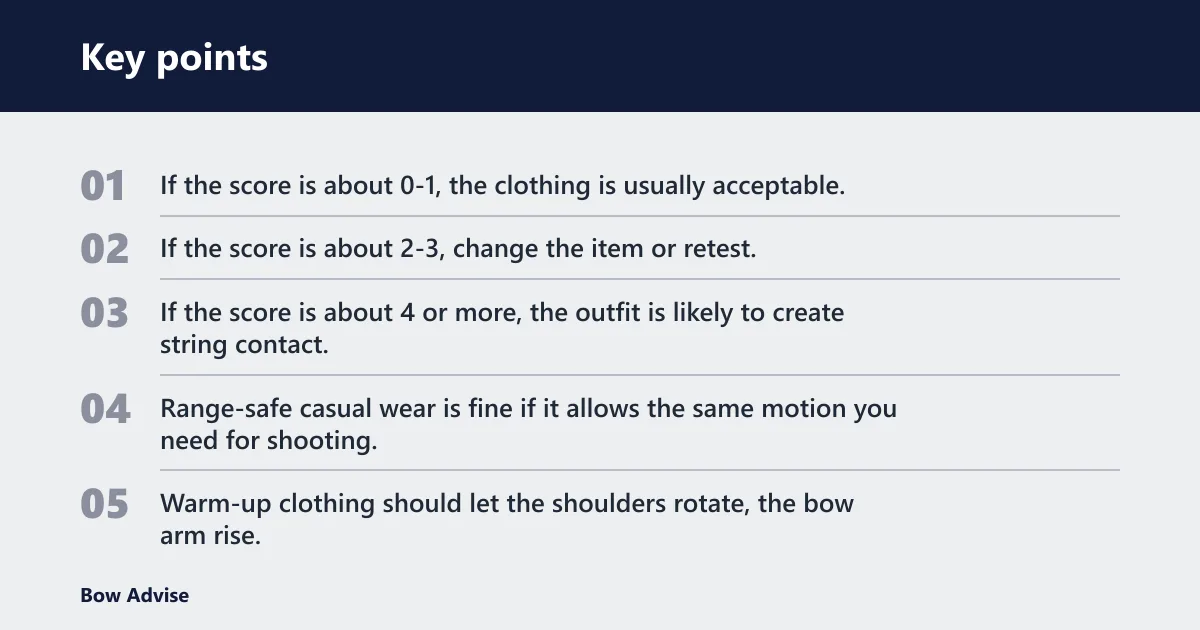
Use one point for each “yes” answer. If the score is about 0-1, the clothing is usually acceptable. If the score is about 2-3, change the item or retest. If the score is about 4 or more, the outfit is likely to create string contact.
| Season | Yes/no check |
|---|---|
| Hot | Does the shirt have wide sleeves, long hems, or loose cuffs that move into the string path? |
| Hot | Does the fabric bunch at the elbow or wrist when you draw? |
| Cold | Do base, mid, and outer layers stack so thick that the bow arm or string arm cannot move cleanly? |
| Cold | Do zipper pulls, hood edges, or pocket ridges sit near the anchor line? |
| Wet | Does the shell hold stiff folds, taped seams, or a hard zipper ridge near the string path? |
| Wet | Do cuffs or hems stick out after the shell gets damp? |
Warm-up and practice clothing
Range-safe casual wear is fine if it allows the same motion you need for shooting. Warm-up clothing should let the shoulders rotate, the bow arm rise, and the drawing side stay clean. Before shooting, check fit at full draw, because a shirt that feels comfortable while standing may still move badly under tension.
Frequently asked questions
What clothing causes the bowstring to hit you in archery?
Loose sleeves, bulky collars, hoodies, jackets with drawcords, and tops with large pockets are the most common causes. The risk rises when hems and cuffs hang into the string path, or when thick seams and zipper pulls create hard edges near anchor and release.
What clothing mistakes do beginners make in archery?
Beginners often wear baggy tops, long cuffs, and hoodies because they feel normal off the range. The mistake is assuming comfort at rest equals safety at full draw. Clothing should be checked in shooting position, not only in a mirror or while standing relaxed.
Do arm sleeves, hoodies, or jackets make string contact worse?
They can, depending on fit and detail. Arm sleeves may bunch at the forearm, hoodies add cords and soft bulk, and jackets often add zipper ridges or shoulder thickness. Any of those can be safe if the fit is flat and the string path stays clear.
How tight should archery clothing fit around the bow arm and string arm?
It should be close enough to stay flat, but not so tight that it restricts the bow arm or piles fabric at the elbow. The best fit follows the limb without loose folds, especially at the cuff, forearm, and upper arm. Check both sides separately.
What fabrics are safest for archery practice in warm or cold weather?
In warm weather, smooth lightweight knits or close-cut woven tops are usually easiest to keep clear. In cold weather, thin layers that stack flat are safer than one thick puffy layer. The safest fabric is the one that drapes cleanly and does not hold a loose fold near the string path.