Bow Sling vs Wrist Sling: Which Is Better for Safety?
For most compound and hunting setups, a Wrist Sling is the safer, steadier choice; for recurve and finger-release use, a Bow Sling usually gives better bow-hand stability with less hand torque. Without the right sling, dropped bows, uneven grip pressure, and side torque can hurt safety and accuracy. This guide compares Bow Sling vs Wrist Sling by bow retention, repeatable stability, and best fit for recurve, compound, and hunting use.
| Decision factor | Bow Sling | Wrist Sling | Winner |
|---|---|---|---|
| Safe bow retention | Good when loop length is correct and the bow can roll free after release | Very good for keeping the bow from leaving the hand after a shot | Wrist Sling |
| Bow-hand stability | Usually better for a loose, repeatable bow hand on recurve shooting | Stable for many compound setups, but can invite more grip contact if over-tightened | Bow Sling |
| Glove and cold-weather fit | Works well with thin or bare fingers; bulky gloves can make fit fiddly | Usually easier with gloves, because it anchors at the wrist | Wrist Sling |
| Follow-through and bow rotation | Supports natural bow roll and cleaner post-shot hand release | Can limit drop, but the wrist anchor may alter how the bow settles | Bow Sling |
| Best-fit use case | Recurve, barebow, and finger-release shooting | Compound bows, release aids, and hunting bows | Depends on bow type |
Bow sling vs wrist sling at a glance
In this comparison, Bow Sling means the finger sling style used to let the bow sit loosely in the bow hand. Wrist Sling means the strap that wraps around the wrist and catches the bow if it jumps forward after the shot. Both protect against a dropped bow, but they anchor to different places and change how the hand works.
The trade-off is direct. A Bow Sling gives more hand freedom and usually less torque, while a Wrist Sling gives stronger retention and can feel more secure on heavier compound setups. The best choice depends on how the bow is released, how much glove bulk is in the hand, and how much post-shot bow movement the shooter wants to allow.
They overlap in one important way: both can help the shooter relax the bow hand. Neither one replaces good grip pressure control or a tuned stabilizer. A stabilizer changes balance, while a sling helps prevent losing the bow.
What “bow sling” means in this comparison
Here, Bow Sling refers to a finger sling, not a carry sling. It usually loops around the thumb and index finger or around two fingers, depending on the design, and it must be short enough to keep the bow from falling while still letting the bow settle without a hard pull on the hand.
The core trade-off: hand freedom versus wrist retention
Bow Sling favors a looser hand and cleaner release follow-through. A wrist sling supports retention at the wrist, which many compound shooters prefer because it can feel secure when the bow rolls forward after the shot. If the sling is too tight, either type can interfere with natural bow movement.
Where the two sling types overlap
Both options aim at the same outcome: keep the bow from dropping after release. Both can improve confidence, especially in a stand or crowded range line. And both still depend on good anchor point, a consistent release style, and a repeatable bow hand.
Which sling is safer?
Wrist Sling is usually safer for pure retention, especially on compound and hunting bows where a release aid can let the bow jump forward quickly. Bow Sling can still be safe, but only if the loop is set correctly and the bow can rotate free without the hand snagging it. Safety here means preventing an accidental drop, not stopping all movement.
Dropped-bow risk after the shot
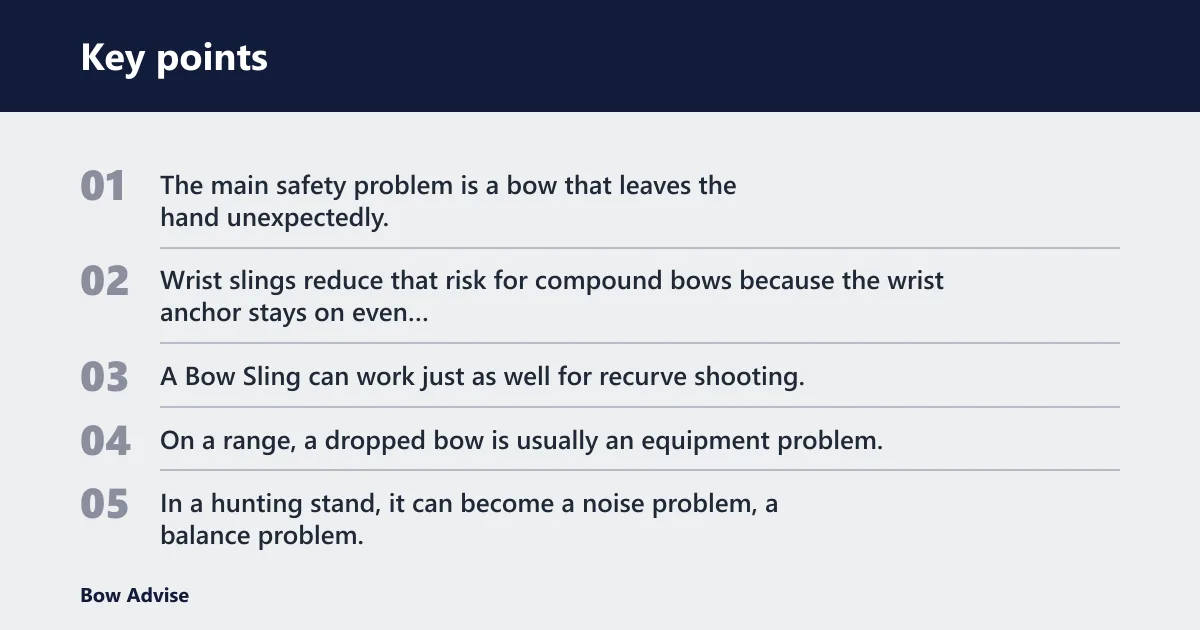
The main safety problem is a bow that leaves the hand unexpectedly. Wrist slings reduce that risk for compound bows because the wrist anchor stays on even if the hand opens during the shot. A Bow Sling can work just as well for recurve shooting, but a loop that is too long can let the bow slip out before the sling catches it.
Range use versus hunting use
On a range, a dropped bow is usually an equipment problem. In a hunting stand, it can become a noise problem, a balance problem, or a control problem if the shooter has to catch the bow with one hand. For that reason, Wrist Sling tends to be the safer pick for hunting bows, especially when shooting from an awkward angle or with a heavier rig.
Say your compound setup uses a release aid and a 12- to 15-ounce hunting stabilizer in cold weather. Thick gloves cut finger control, so a Wrist Sling is easier to manage and less likely to slip off the hand during the shot.
Gloves, cold weather, and hand movement
Gloves change the fit story fast. A Bow Sling that feels fine in bare hands can become loose or awkward over a bulky glove. A Wrist Sling generally handles glove use better because the fit is around the wrist, not through the fingers, but it still needs enough room that the strap does not pinch or slide.
Which sling gives better stability?
Bow Sling usually gives better bow-hand stability because it encourages a lighter, more repeatable grip and cleaner follow-through. Wrist Sling can be stable too, but it often works best when the shooter already controls grip pressure well and keeps the hand relaxed instead of hanging on the bow.
Grip pressure and torque control
Stability starts with bow hand pressure. A Bow Sling can reduce the chance of clamping the grip, which lowers side torque on a recurve bow. With a Wrist Sling, the bow may feel more secure, but some shooters unconsciously squeeze harder because the bow is tethered to the wrist rather than hanging from the fingers.
Follow-through and bow rotation
After release, a well-set Bow Sling lets the bow roll forward and settle without a sudden catch. That helps preserve follow-through and keeps the hand from steering the riser. A Wrist Sling also keeps the bow from falling, but if it is too short or too tight, it can stop the natural rotation and make the bow feel jumpy or blocked.
A common first-timer mistake is using a sling as if it were a balance aid. It is not. If the bow still kicks hard to one side, the cause is more often grip pressure, brace height, draw length, or stabilizer setup than the sling itself.
How sling choice changes repeatability
Repeatability matters more than a one-shot feel. Bow Sling usually wins when the shooter wants the same loose hand position every time on a recurve. Wrist Sling usually wins when the shooter wants a repeatable “catch point” on a compound setup and likes the security of the wrist anchor.
Bow sling and wrist sling setup checks
Good fit is not optional. A sling that is too loose can miss the bow when it matters. A sling that is too tight can hold the bow, but it may also create hand interference, poor rotation, or an uncomfortable anchor point.
- Set the sling so the bow can rest in the hand without being yanked downward.
- Draw and release with a relaxed bow hand, then watch whether the bow hangs cleanly or snaps against the sling.
- Check that the sling does not press into the thumb web or wrist bones.
- Repeat the same shot several times and look for the same post-shot bow angle each time.
Finger loop length and tension checks
A Bow Sling should be short enough that the bow cannot fall past the fingers, yet loose enough that the loop does not force the hand open. If the loop feels like it is pulling the bow sideways before the shot breaks, it is too short. If the bow can slide too far before the sling catches it, it is too long.
Wrist fit and adjustment checks
A Wrist Sling should sit snugly without cutting off movement at the wrist. The strap should not migrate when the bow rolls forward. If the hand has to fight the sling to settle into the grip, the fit is wrong. If the bow drops too far before the strap catches it, the sling is too loose.
Common setup mistakes and symptoms
- Too-tight finger loop: the bow feels trapped, rotation stops early, and torque rises.
- Too-loose finger loop: the bow shifts unpredictably or feels like it may slip out on release.
- Too-tight wrist strap: wrist discomfort, limited movement, and a harsh stop after the shot.
- Too-loose wrist strap: the bow bangs forward before the sling catches it.
How bow type changes the choice
Bow type changes everything because release style changes everything. Recurve bows are often shot with fingers and a looser bow hand, so Bow Sling usually fits the mechanics better. Compound bows often use a release aid and a firmer grip setup, so Wrist Sling usually fits the retention needs better.
Recurve bow use cases
For recurve, especially barebow or traditional shooting, a Bow Sling is usually the cleaner match. It supports a relaxed bow hand and lets the riser settle naturally after the shot. If the loop length is wrong, though, the bow may twist more than it should or the sling may interfere with follow-through.
Compound bow use cases
For compound, a Wrist Sling is usually the safer and more comfortable choice because the bow often sits in a more rigid grip setup and the shot is broken with a release aid. That makes retention the bigger issue than finger freedom. A badly adjusted wrist strap can still create extra movement, so fit still matters.
Suppose a compound shooter uses a thick winter glove and notices the bow hand tightening at full draw. A Wrist Sling lets the hand relax while still keeping the riser from dropping if the shot breaks unexpectedly.
How stabilizers change the decision
A stabilizer changes balance, not sling function. A front-end stabilizer can reduce bow movement and make either sling feel steadier, but it does not catch the bow. If the stabilizer is doing its job and the sling is fitted well, the shooter gets both balance and retention. If not, the sling may feel blamed for a setup problem elsewhere.
Sling decision matrix
| Bow type | Shooting style | Safety priority | Stability priority | Glove use | Recommended sling choice | Wrong choice symptom |
|---|---|---|---|---|---|---|
| Recurve | Finger release, barebow | Medium | High | Light gloves or none | Bow Sling | Wrist strap feels bulky and interrupts follow-through |
| Recurve | Indoor target, relaxed grip | Medium | High | None | Bow Sling | Hand stays too rigid and the bow rolls inconsistently |
| Compound | Release aid, target or 3D | High | Medium | Optional | Wrist Sling | Finger loop feels awkward and can pull on the hand during release |
| Compound | Hunting stand | High | Medium | Cold-weather gloves | Wrist Sling | Glove bulk makes finger loop fit inconsistent |
| Either bow type | Unsure, new shooter | High | Medium | Varies | Try both, starting with the bow’s common setup | Too-tight fit or poor hand clearance causes torque and discomfort |
Choose Bow Sling if… / Choose Wrist Sling if…
Choose Bow Sling if you shoot a recurve, want a looser bow hand, and care most about repeatable stability and clean follow-through. It also fits shooters who do not want wrist hardware on the hand and who can set the loop length carefully.
Choose Wrist Sling if you shoot a compound, use a release aid, hunt from a stand, or wear gloves often. It is the better retention choice when the main concern is keeping the bow from dropping after the shot, not maximizing finger freedom.
Either sling can work when fitted correctly. If the wrong choice leaves the bow hand tense, creates side torque, or makes the bow settle unpredictably after release, switch the sling type before changing anything else.


Frequently asked questions
Bow sling vs wrist sling: which is better for archery?
Neither wins for every bow. Bow Sling is usually better for recurve stability and relaxed hand contact. Wrist Sling is usually better for compound retention and hunting use. The better choice is the one that matches your bow type, release style, and need for safe bow retention after the shot.
Do I need a bow sling if I already have a wrist sling?
Not always. If your compound setup already uses a Wrist Sling comfortably, that may be enough. A Bow Sling becomes more relevant on recurve bows, where the hand is expected to stay lighter and the bow should roll more freely through release and follow-through.
What is the difference between a finger sling and a wrist sling?
A finger sling loops around the fingers and lets the bow sit loosely in the hand. A wrist sling wraps around the wrist and catches the bow after release. The finger sling usually favors cleaner hand freedom; the wrist sling usually favors stronger retention and easier glove compatibility.
Which sling is safer for compound bow shooting?
For most compound bows, Wrist Sling is safer because it helps prevent a dropped bow during a release-aid shot. It is especially useful in hunting or awkward shooting positions. Safety still depends on proper fit, because a strap that is too loose can still let the bow move too far.
How tight should a bow sling be?
Tight enough to stop a drop, loose enough to avoid interference. A Bow Sling should not pull the bow sideways or force the hand open. A Wrist Sling should sit snugly without pinching. If the bow hangs poorly or the hand feels trapped, the fit needs adjustment.
Can a sling improve bow stability and reduce torque?
Yes, but only indirectly. A well-fitted sling can encourage a lighter grip, which helps reduce torque and improve repeatability. It does not fix poor form or replace a stabilizer. If the bow still twists hard after the shot, the grip, balance, or tuning likely needs attention.