Insulated Hunting Pants vs Lightweight Pants
Choose insulated hunting pants only if you expect long, mostly motionless sits in temperatures around 40°F or lower; for many early-season bowhunts, lightweight pants plus a thin base layer may fit better because they move more easily and can help reduce sweat buildup. Pick the wrong pair, and you risk sweating on the hike in, cooling too fast on stand, or making more noise than deer will tolerate. This guide compares warmth, quietness, and movement so you can choose the right pant setup for early-season hunts.
| Factor | Hunting Pants | Lightweight Pants | Winner |
|---|---|---|---|
| Warmth on cold sits | Built-in insulation holds heat well for low-activity hunts. | Needs layering to cover the same ground. | Hunting Pants |
| Mobility and sweat control | Warmer, bulkier, and slower to dump heat. | Breathable, quick-dry, and usually built with 4-way stretch. | Lightweight Pants |
| Early-season treestand use | Good only when the sit is long and the air stays cold. | Better when the walk-in is active and the dawn stays mild. | Lightweight Pants |
| Active stalking and steep terrain | Can feel hot and restrictive during hard movement. | Moves better for climbing, kneeling, and drawing a bow. | Lightweight Pants |
| Noise control | Quiet fabric can help, but insulation can add bulk and swish. | Quiet enough when built with brushed or soft-shell fabric. | Tie |
Hunting pants vs lightweight pants
The main trade-off is plain: insulated pants add warmth, while lightweight pants stay cooler and move better for early-season bowhunts. That matters because early season often starts with a hike, a climb, or a stalk before the first sit. In the wrong pant, sweat becomes the first problem, and chill becomes the second.
Warmth and sit time
Insulated hunting pants are built for cold, low-activity sits. They make sense when the hunt is mostly waiting, the wind stays sharp, and the body is not making much heat. For early season, that advantage fades fast when the forecast is mild or the walk to the setup is long.
Mobility and temperature control
Lightweight hunting pants are better for early-season and warm-weather hunts because they breathe, dry faster, and usually use active-fit fabrics. That makes them a stronger choice for climbing into a stand, crossing ridges, or covering ground while spot-and-stalk bowhunting. The downside is simple: they do less to hold warmth at a dead standstill.
Hunting pants comparison matrix
Use the table below as a decision tool, not a product list. Match the temperature band, the walk-in, and the sit length to the pant type, then check the failure mode before you buy or pack a layer.
| Temperature band | Hunt style | Walk-in distance | Sit duration | Pant choice | Failure mode if wrong |
|---|---|---|---|---|---|
| 60°F to 75°F | Active stalking, scouting, or mobile bowhunting | Any distance that raises body heat | Short or intermittent sits | Lightweight Pants | Insulation traps sweat and makes the first pause feel clammy. |
| 50°F to 65°F | Treestand or saddle hunt with some movement | Moderate walk-in | 30 to 90 minutes | Lightweight Pants + layering | Insulated pants can overheat on the hike and smell up the setup. |
| 40°F to 50°F | Early-season whitetail sit or mixed movement | Short to moderate walk-in | Long sit, but not frozen conditions | Lightweight Pants + layering | Thin pants alone can leave legs cold before legal light ends. |
| 40°F or lower | Late-season or low-activity stand hunt | Short walk-in | Long, motionless sit | Hunting Pants | Lightweight pants bleed warmth too quickly and invite fidgeting. |
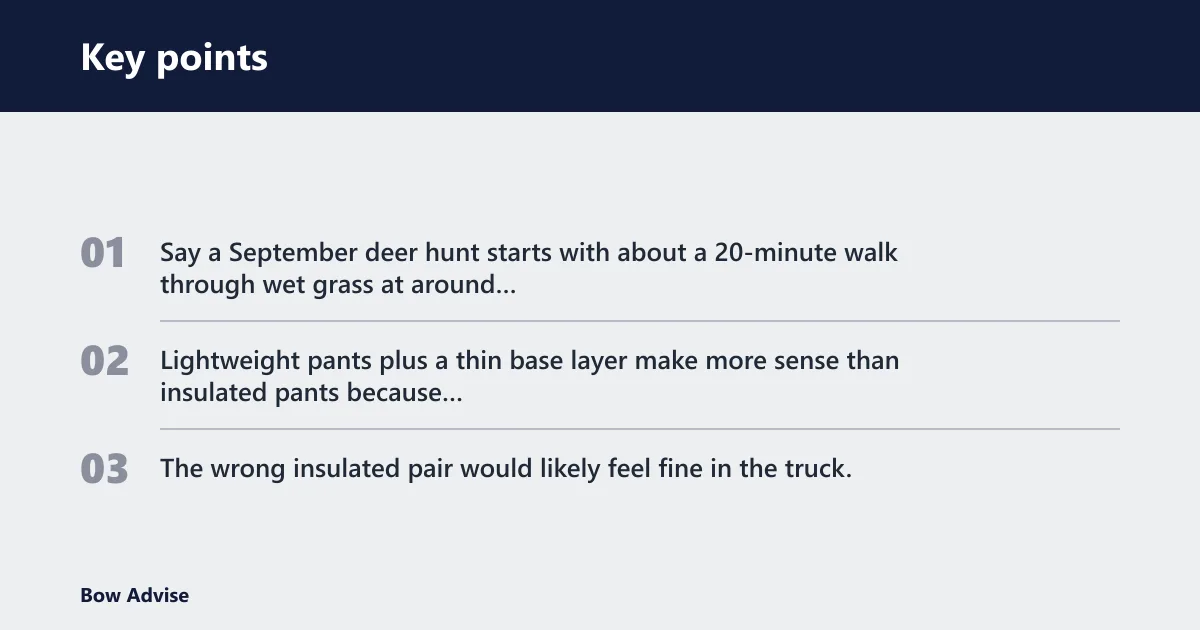
Say a September deer hunt starts with about a 20-minute walk through wet grass at around 58°F, followed by about a three-hour sit in a treestand. Lightweight pants plus a thin base layer make more sense than insulated pants because the hike matters as much as the sit. The wrong insulated pair would likely feel fine in the truck, then feel hot and damp by the first hour of daylight.
What insulated hunting pants do well
Insulated hunting pants shine when the hunt is cold and still. They are built for warmth, which is why they fit late-season sits and other low-activity hunts better than they fit most early-season bowhunts. That extra warmth helps only when the temperature and sit length justify it.
Late-season fit, early-season limit
Built-in insulation is a real advantage on long, motionless sits. The guide points to the Pro Insulated Bib as a strong option for very cold weather and says it is suited to cold, wet late-season sits. That same design logic can be too much for September deer hunting, when sweating on the hike in causes more trouble than a little cold air.
Insulation also changes how the pant vents heat. Once the leg fabric warms up, it can take longer to cool down, especially if the walk-in is steep or the stand is high.
When early-season warmth turns into a liability
Early-season bowhunts often start before sunrise and finish in rising heat. That is where insulated pants can backfire. The body heats up on the hike, moisture gets trapped, and then the hunter sits in damp fabric long enough for chill and scent problems to build.
A common first-timer mistake is dressing for the coldest part of the morning instead of the hike. The result is simple: hot legs on the climb, clammy legs at the stand, and more movement later because the pants never felt right.
What lightweight hunting pants do well
Lightweight hunting pants are the better default for early-season bowhunts because they breathe, dry faster, and move better. They are built for mobility first. That makes them the stronger option for warm weather, active stalking, and hunts where the walk-in raises body heat before the first sit.
Breathability and quick-dry performance
Breathable construction helps dump heat before sweat becomes a problem. Quick-dry fabric matters too, because dew, wet grass, and light drizzle show up often in early season. Some technical pants also add ventilation zips so heat can escape on the hike in without forcing the hunter to strip layers at the truck.
Outdoor Life names the Kuiu Attack Pant its Best Overall pick, lists it at 15.8 ounces, costs $150, and notes zip-open hip vents. That is the kind of feature set that fits early-season movement better than heavy insulation does.
Stretch and bow movement
4-way stretch fabric matters because bowhunters do not move in straight lines. They climb, kneel, pivot, and draw. Lightweight pants with active-fit fabric make those motions easier, especially on steep ground or when a setup demands a low, careful posture.
Gunscorner calls the SITKA Gear Men’s Ascent Hunting Pant its Best Overall for lightweight pants, and it lists the Nomad Men’s Stretch-lite Hunting Pants as a Best for Turkey Hunting pick. Those examples fit the same logic: mobility first, then quietness and comfort.
What matters most in early-season pants?
Quiet fabric, wind resistance, water resistance, and stretch matter most, but they do different jobs. Quiet fabric helps on close bow shots. Wind resistance slows the chill during glassing and treestand sits. Water resistance handles dew and light drizzle. Stretch keeps the pant usable when the shot angle changes fast.
Quiet fabric for bow shots
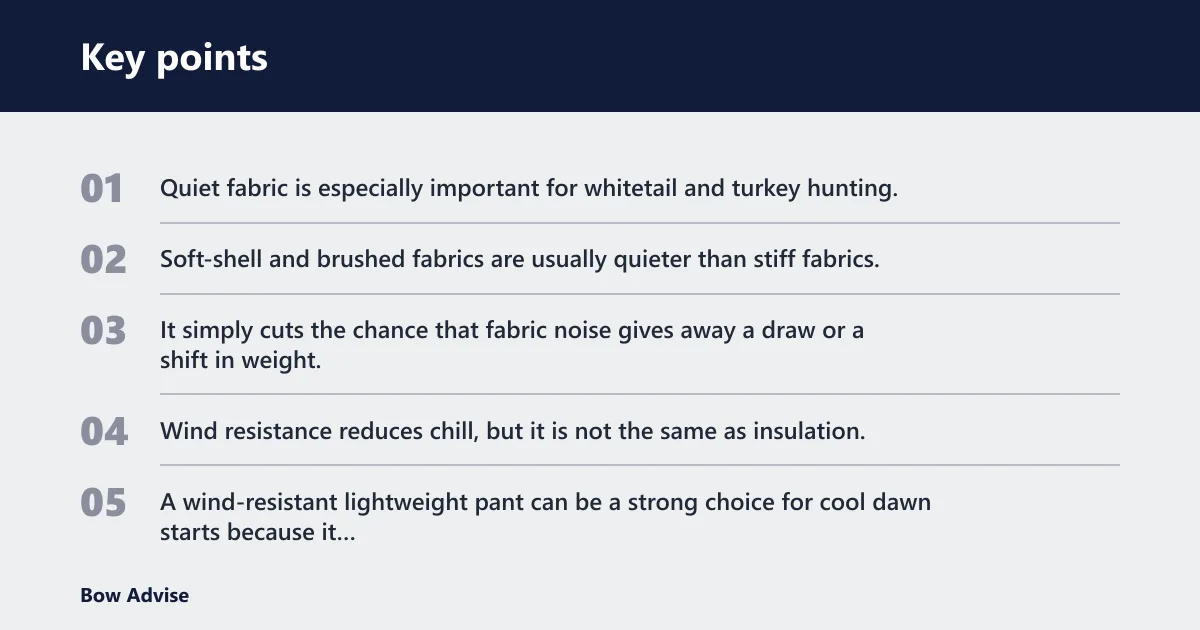
Quiet fabric is especially important for whitetail and turkey hunting, where the shot window can be short and close. Soft-shell and brushed fabrics are usually quieter than stiff fabrics. That does not make any pant silent. It simply cuts the chance that fabric noise gives away a draw or a shift in weight.
Wind resistance is not insulation
Wind resistance reduces chill, but it is not the same as insulation. A wind-resistant lightweight pant can be a strong choice for cool dawn starts because it blocks some airflow while still breathing better than a heavily insulated pant. That is why many early-season setups rely on a shell-like outer fabric rather than built-in loft.
Water resistance and DWR
Water resistance and DWR help with wet grass, dew, and light drizzle. They are useful on early-season hunts, but they are not a substitute for rain pants. If a pant is only lightly water-resistant, treat that as bonus protection, not storm insurance.
First Lite Obsidian Merino is listed by Outdoor Life as a Best Wool Blend pick, while Stone Glacier De Havilland is listed as Best for Cold Weather. Those labels tell the story well: one side favors temperature management, the other favors warmth when the weather turns cold enough to justify it.
Early-season pant setup by hunt style
Treestand hunting, saddle hunting, and active stalking do not ask the same thing from a pant. The longer you sit still, the more warmth matters. The more you move, the more breathability and stretch matter. That difference is why the same pair can fail one hunt and work well on the next.
Treestand hunting
Treestand hunting often favors quiet fabric and controlled warmth. Early-season whitetail sits can start cool and finish warm, so the right setup is often lightweight pants plus a base layer, with a wind-resistant outer layer if the forecast calls for it. If the sit is long and the temperature stays near or below 40°F, insulated hunting pants become more reasonable.
Saddle and mobile setups
Saddle and mobile hunts reward low bulk and easy movement. The hunter may climb, adjust, hang, or reposition more often than a stand hunter. That means lightweight pants usually win, especially when the setup includes a long walk-in or a lot of vertical movement.
Active stalking hunts
Active stalking hunts favor lighter, breathable pants almost every time. Elk scouting, spot-and-stalk bowhunts, and similar styles create heat fast. A technical pant with stretch and venting handles that better than insulation does.
Choose Hunting Pants if… / Choose Lightweight Pants if…
Choose Hunting Pants if you expect a long, motionless sit in temperatures around 40°F or lower; the walk-in is short; and noise control matters more than heat dumping. That fits late-season conditions, cold pre-dawn glassing, and stand hunts where the body will not be generating much warmth.
Choose Lightweight Pants if the walk-in is long, the forecast is mild, the hunt is mobile, or the setup involves climbing, kneeling, or stalking. Add a thin base layer when dawn is cool, then keep the outer pant breathable so sweat does not become the first problem of the morning.
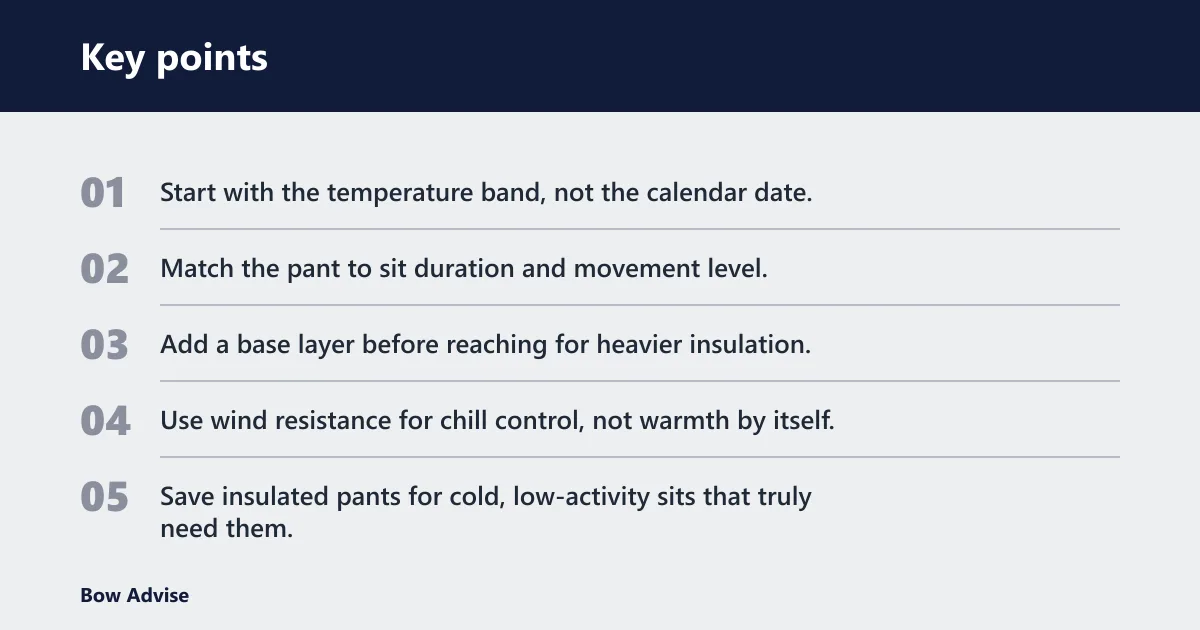
- Start with the temperature band, not the calendar date.
- Match the pant to sit duration and movement level.
- Add a base layer before reaching for heavier insulation.
- Use wind resistance for chill control, not warmth by itself.
- Save insulated pants for cold, low-activity sits that truly need them.
Suppose a saddle hunter covers about 0.6 miles before climbing into a tree at dawn. Lightweight pants with a thin base layer are the safer choice because the hike creates heat long before the sit does. For a similar hunt turned into an all-day stand sit at about 35°F, insulated pants become the smarter pick.


Frequently asked questions
Are insulated hunting pants too hot for early-season bowhunting?
Often, yes. For most early-season bowhunts, insulated pants hold too much heat on the hike in and can leave the hunter damp by the time the sit starts. They make more sense when the sit is long, the air stays cold, and movement stays low.
What pants are best for early-season bowhunting in warm weather?
Lightweight hunting pants are the better choice in warm weather. Look for breathable construction, quick-dry fabric, quiet material, and 4-way stretch. Add a thin base layer only if the dawn starts cool enough to justify it.
Do lightweight hunting pants keep you quiet enough for bowhunting?
Yes, if the fabric is chosen with bowhunting in mind. Brushed or soft-shell fabrics are usually quieter than stiff fabrics, and that matters on close shots. Lightweight does not mean noisy, but the cut and fabric finish matter more than the weight label alone.
Should I wear insulated pants for a September deer hunt?
Usually not, unless the hunt is a long, cold sit with very little movement. September deer hunts often include a walk-in that warms the body before legal light. In that case, lightweight pants plus layering usually control sweat and scent better.
Can I layer lightweight pants for early-season bowhunts?
Yes. A thin base layer can extend lightweight pants into cooler dawn conditions without forcing a switch to heavy insulation. That approach works best when the outer pant is breathable and quiet, and when the hunt includes some movement before the sit.
What hunting pants are best for active stalking versus treestand sits?
Active stalking calls for lightweight pants with stretch, breathability, and venting. Treestand sits lean toward quieter fabric and more warmth, especially when the sit is long. For early season, treestand hunters often land on lightweight pants plus layers, while stalkers usually stay with the lightest workable setup.
How do lightweight hunting pants compare to insulated pants?
Lightweight pants win on mobility, breathability, and sweat control. Insulated pants win on warmth during cold, low-activity sits. The right pick depends on whether the hunt creates heat through movement or loses heat through stillness.