Bow Sight Cost: What to Pay for Hunting Sights
Bow sight cost usually lands between $50 and $300 for bowhunters; single-pin fixed models tend to sit lower, while micro-adjust, tool-less, and rangefinder-equipped sights usually cost more. Paying for features you will not use can add weight, bulk, and $100 or more to the setup. This guide breaks down bow sight cost by hunting use-case, feature stack, and value so you can buy the right sight without overpaying.
Bow sight cost table

The fastest way to judge bow sight cost is by use, not brand. A whitetail hunter who shoots inside 40 yards does not need the same setup as a western hunter dialing past 60. The table below ties price bands to realistic features, the hunter they fit best, and the extras that are easy to skip.
| Price band | Typical features | Best fit | What to skip |
|---|---|---|---|
| Under $100 | Basic fixed-pin sight, often 3-pin; simple fiber optics; limited tool-less tuning | Beginner bows, short-range whitetail hunting, backup setups | Micro-adjust dials, illuminated pins, heavier metal housings, extra pin count |
| $100-$250 | Better pin guards, brighter fibers, second-axis adjustment, stronger housings, some 5-pin fixed or entry slider models | Most hunters who want clearer sight pictures and steadier adjustment without paying premium money | Electronic ranging, premium carbon parts, complex long-range systems if you do not dial |
| $250-$500 | Micro-adjust slider sights, sturdier mounts, third-axis adjustment, better machining, smoother dials, more durable materials | Western hunters, practiced dial-to-distance shooters, hunters who want precise setup control | Extra electronics if a dial sight already fits your use, oversized scope systems if you hunt tight timber |
| $500+ | High-end mechanical systems, electronic ranging, auto-ranging, LED pins, premium scopes, advanced adjustment systems | Hunters who truly need the features and will use them often | Anything you will not rely on in the field, especially if you mostly shoot inside common whitetail distances |
Under $100: entry-level features and tradeoffs
This tier covers the basics. You usually get a fixed-pin sight with simple adjustment and enough visibility for normal hunting distances, but not the cleanest tune or the most durable hardware. For a new bowhunter, that is often enough.
A common first-timer mistake is buying a heavy, feature-packed sight for a 20- to 30-yard whitetail setup. That money often buys capability the archer will never use, while the bow gets bulkier and harder to keep simple.
$100-$250: the value tier for most hunters
This is the range where price and performance often meet best. Better materials, clearer pins, more reliable adjustment, and more stable housings show up here without jumping into luxury pricing. For many hunters, this is the sweet spot.
It is also where the practical features start to matter. Second-axis adjustment helps keep the sight level when shooting on slopes or from a stand, and brighter fiber optics help at dawn and dusk when visibility drops.
$250-$500: premium mechanical features
In this band, bow sight cost climbs because machining, adjustment control, and durability improve. Micro-adjust sliders, cleaner dials, and more refined sight pictures are common. Premium bow sights commonly fall in the $400 to $600 range, so this band is where serious mechanical systems begin to appear.
Outdoor Life notes that the market is chasing lighter, feature-rich sights or lower cost. That is exactly why this range matters: it buys precision without forcing a move into electronic pricing.
$500+: electronic and high-end sight systems
This tier is for specialized buyers. A premium sight option reviewed costs about $1,100, and a runner-up electronic sight is listed at about $700. That is a steep jump from a standard hunting sight, so the buyer should already know the feature will be used often enough to justify it.
The Garmin Xero A1i Pro is described as an auto-ranging bow sight, and the Garmin model can target up to 100 yards on game and 300 yards on reflective targets. That kind of capability fits a narrow group of hunters, not a default upgrade.
How much does a bow sight cost?
Most hunting bow sights fall somewhere between $50 and $500, with the buying range for many hunters landing closer to $100-$300. The price jumps come from adjustment precision, material quality, visibility aids, and whether the sight ranges, dials, or auto-ranges distance for you.
What drives price jumps between tiers
Pin count, adjustment hardware, materials, and low-light features create most of the cost difference. A basic fixed sight needs fewer moving parts than a micro-adjust slider or an electronic sight, so the price climbs as the sight does more work for the shooter.
Bow sights also become more expensive when the manufacturer improves machining tolerances, adds tool-less tuning, or uses lighter housing materials. Those upgrades matter most to hunters who shoot often, travel with a rig, or spend time on steep country.
Where beginners usually overspend
Beginners often overspend on dial-to-distance systems before they have a stable anchor, consistent draw length, and repeatable groups. A simple 3-pin or 5-pin setup is often a better first purchase than a high-end slider or electronic sight.
Say your first bow is set for whitetail woods and your shots stay inside 35 yards. A $450 sight with advanced dialing can be more capability than the hunt requires, while a solid $125 sight can cover the job with less clutter.
What features make a bow sight cost more?
The most expensive bow sights are not costly because of branding alone. They cost more because they add adjustment precision, low-light visibility, tougher materials, and more complex aiming systems. Each layer solves a different problem, and each one adds price.
Pin count and pin gap setup
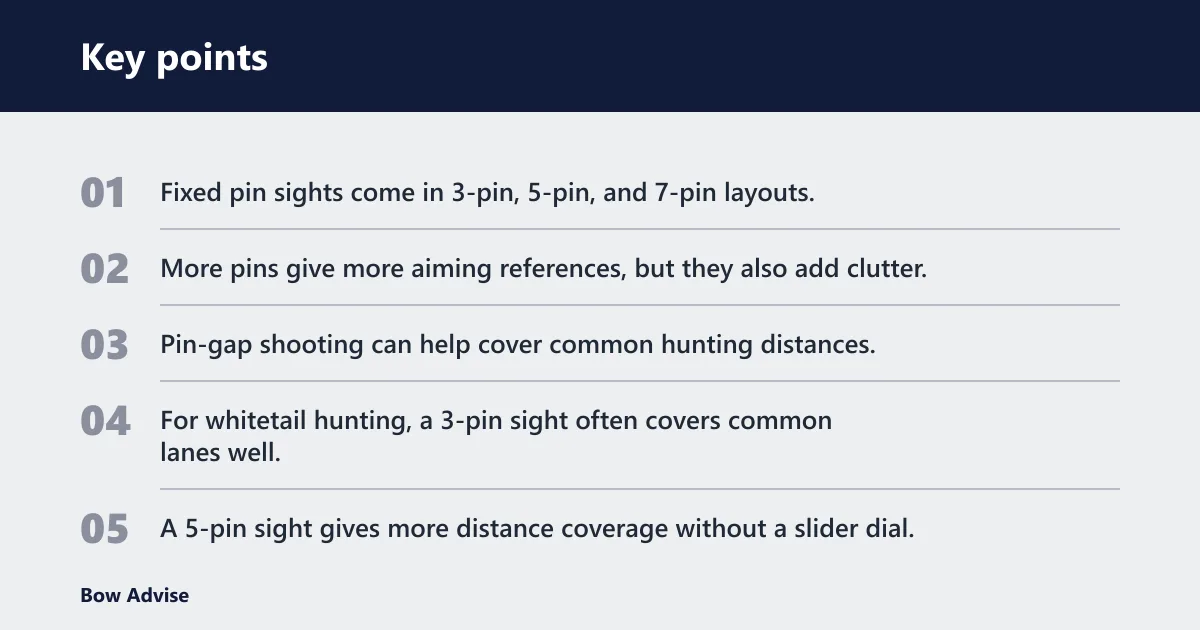
Fixed pin sights come in 3-pin, 5-pin, and 7-pin layouts. More pins give more aiming references, but they also add clutter. Pin-gap shooting can help cover common hunting distances, yet too many pins can crowd the sight picture if the pins are thick or the housing is small.
For whitetail hunting, a 3-pin sight often covers common lanes well. A 5-pin sight gives more distance coverage without a slider dial, while a 7-pin sight is usually only worth it if the hunter wants many preset references and can still read the sight cleanly.
Micro-adjustments and tool-free tuning
Micro-adjust and tool-free tuning raise cost because they make setup faster and more precise. These systems matter most when a sight needs small corrections after paper tuning, broadhead tuning, or travel. They matter less if the bow stays put and the shooter rarely changes setups.
Single-pin slider sights use micro-adjustment, a yardage tape, and dial-to-distance control. That makes them practical for long-range practice and useful for hunting, but only if the hunter is willing to range, dial, and confirm the shot before drawing.
Materials, weight, and durability
Aluminum is still the common standard because it balances cost and durability. Carbon composite can cut weight, while ballistic copolymer can keep cost down and reduce mass in some designs. Materials affect how much the sight weighs, how well it resists abuse, and how much it costs to build.
The Axcel Driver Bridge-Lock with a 3-pin Accustat scope weighed 8.5 ounces. That kind of number matters because sight weight changes how a bow balances in the hand and on the string, especially on a longer hunt.
Low-light visibility and illuminated options
Low-light gear adds cost because it helps the sight stay readable at dawn and dusk. Fiber optic pin diameter changes how bright the pin appears, and a rheostat light lets the user control brightness. Illuminated pins can help in dim timber, but they also add another feature to maintain.
For hunters who regularly sit the last 20 minutes of legal light, this is one of the few upgrades that can pay off daily. For bright midday target sessions, it is often unnecessary.
Fixed pin vs slider sight costs
Fixed pin sights usually cost less and are simpler to run. Slider sights usually cost more because they add a moving carriage, a dial, and more adjustment precision. The better choice depends on whether the hunter values speed and simplicity or wants one pin and a dial for wider distance coverage.
3-pin, 5-pin, and 7-pin fixed sights
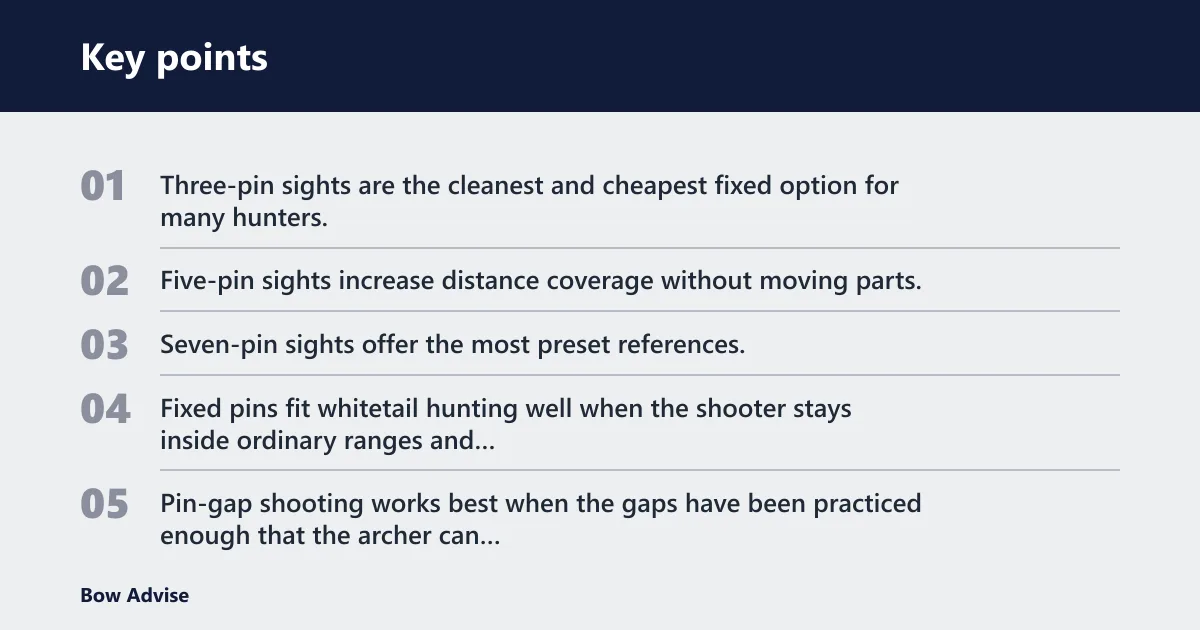
Three-pin sights are the cleanest and cheapest fixed option for many hunters. Five-pin sights increase distance coverage without moving parts. Seven-pin sights offer the most preset references, but they can create a busy sight picture and add cost without improving field use for everyone.
Fixed pins fit whitetail hunting well when the shooter stays inside ordinary ranges and wants fast target acquisition. Pin-gap shooting works best when the gaps have been practiced enough that the archer can choose a hold quickly under pressure.
Single-pin slider sights and yardage tapes
Slider sights cost more because they are built for dial-to-distance use. The yardage tape is the key feature: it lets the shooter match the dial to a known distance, then center one pin on the target. That is useful for longer practice sessions and western hunting.
The tradeoff is speed. A slider is practical in open country, but a whitetail that appears at 18 yards and moves fast may not give enough time to dial. That is why some hunters prefer fixed pins in woods and sliders on open ridges.
Which setup fits whitetail versus western hunting?
For whitetail hunting, a fixed 3-pin or 5-pin sight is often the better value. For western hunting, a slider makes more sense because longer shots, open country, and more varied distances reward dial precision. The cost difference is easier to justify when the terrain demands it.
Suppose a hunter spends most of the year in timber and only occasionally shoots 50 yards in practice. A fixed sight keeps things simple. If the hunter regularly practices at 60 to 80 yards and wants one pin for multiple distances, the slider earns its price faster.
Treestand and electronic sight costs
Pendulum and electronic sights sit at opposite ends of the use-case spectrum. A pendulum sight helps with angled treestand shots. An electronic sight adds ranging and aiming automation, but it also raises cost sharply and depends on battery power.
Pendulum sight pricing and use limits
Pendulum or treestand sights are built for downhill shot correction. They compensate for angle so the archer does not aim as if the target were level. That makes them useful from elevated stands, but they are not the best fit for all-around hunting.
Their price usually sits closer to basic or mid-tier fixed sights than to electronic systems. Their main value is specific: better aiming for steep downward angles, not broader capability everywhere else.
Garmin-level electronic sight pricing
Electronic bow sights sit in the high-end category because they combine ranging and aiming. The Garmin Xero A1i Pro is the clearest example in this group, and its price is far above ordinary hunting sights. That premium pays for automation, not just better materials.
Battery dependence is the major tradeoff. If the battery dies or the electronics fail, the sight loses its core advantage. That makes electronic systems best for hunters who want the technology and will maintain it carefully.
When auto-ranging is worth the premium
Auto-ranging is worth the premium when the hunter regularly benefits from fast distance confirmation and wants fewer manual steps before the shot. It is less useful for close-range timber hunting where the target appears suddenly and the shot window is short.
The Outdoor Life review process includes hands-on testing of the latest compound bow sights, which is useful context here: the premium is not just for speed, but for a full system that cuts steps. That only matters if those steps are a real problem in the field.
Bow sight buying checklist
Use this checklist to keep bow sight cost tied to the hunt you actually plan to shoot. The right sight is the one that matches your distance habits, light conditions, and terrain. Extra features are only worth paying for when they solve a real field problem.
- Beginners: choose a simple fixed-pin sight, usually 3-pin or 5-pin, with clear fiber optics and basic second-axis adjustment.
- Whitetail hunters: favor fast aiming, low-light visibility, and a clean sight picture over long-range dialing features.
- Western hunters: look for a slider with micro-adjustment, a reliable yardage tape, and third-axis adjustment for steep terrain.
- Every buyer: check whether the sight material, pin size, and housing weight fit the bow’s balance.
- Every buyer: skip illuminated or electronic features unless they solve a problem you already have.
Beginners
Beginners should usually stay in the under-$100 to $250 range. That buys a sight that is easy to learn, simple to tune, and durable enough for regular practice. A basic fixed-pin model is usually the safest first purchase.
Whitetail hunters
Whitetail hunters often get the most value from fixed-pin sights with strong low-light visibility. A 3-pin or 5-pin model is usually enough. Second-axis adjustment matters more than a complex dial if most shots happen from a blind, ladder stand, or tree stand.
Western hunters
Western hunters are the group most likely to justify a higher bow sight cost. A slider with third-axis adjustment, a clear scope, and durable construction makes sense when shots vary and terrain is steep. The added precision is easier to use at distance than in close timber.
Frequently asked questions
How much does a good bow sight cost?
A good bow sight for most hunters often costs $100-$250, where durability, brightness, and adjustment quality usually improve without a huge price jump. Hunters who want a premium slider or advanced setup may need to budget $250-$500, and electronic systems rise above that.
What is the best bow sight for the money?
The best value is usually a mid-priced fixed-pin or entry slider sight that matches the hunt. For whitetail, a clear 3-pin or 5-pin often wins. For open-country hunting, a dependable slider can be the better buy because it solves a real distance problem.
Is the Garmin bow sight worth it?
It can be worth it for hunters who want auto-ranging and are willing to pay for convenience. The Garmin Xero A1i Pro is an auto-ranging bow sight, and that premium only makes sense if the electronics, battery dependence, and high price all fit the hunter’s style.
What bow sight price range should a beginner expect?
A beginner should usually expect to spend about $50 to $150 for a practical starting sight, with $100-$250 offering more room for better adjustment and visibility. There is no need to start with a high-end electronic model before building consistent shooting habits.
Do premium bow sights really improve hunting accuracy?
They can, but only when the hunter uses the added features. Premium sights improve setup precision, brightness control, and sometimes stability. If the hunter never dials, never shoots at distance, or never hunts low light, the extra cost may not change field results much.