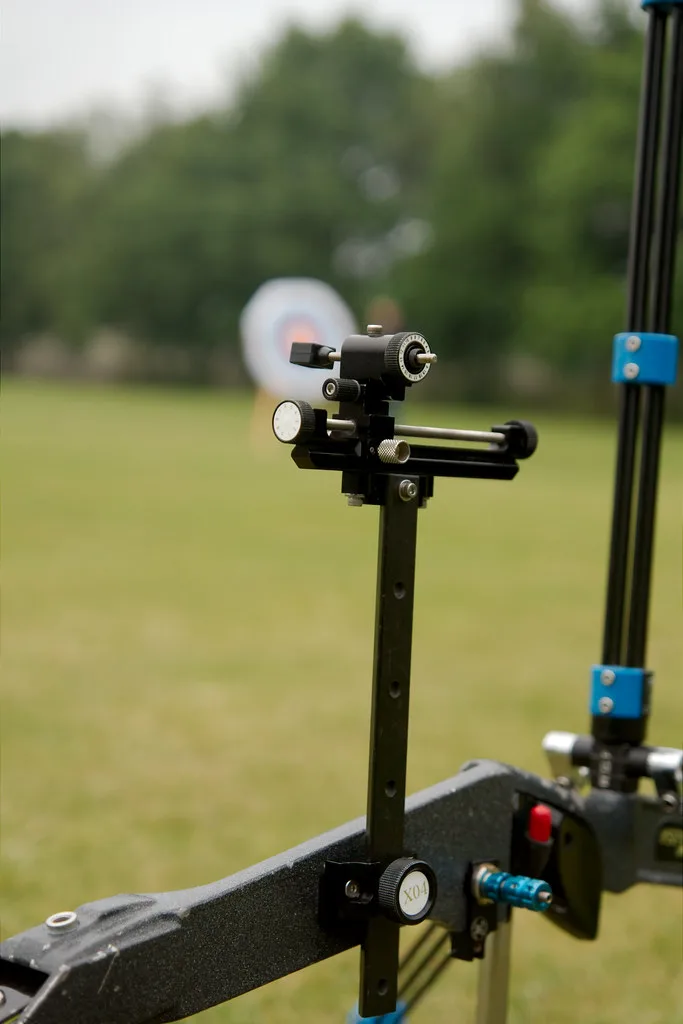
Single pin vs multi pin sight for hunting: choose by use
For hunting, I choose a multi-pin sight for treestand, blind, and low-light timber when shots are quick and distance can swing; I choose a single pin for spot-and-stalk or open-country setups when I can range, dial, and wait. Pick the wrong one, and I lose shot timing, misread yardage, or watch an animal leave before I can settle. I’ll break down each hunting scenario, the distance changes it creates, and which sight fits best.
This guide is part of our Hunting gear comparisons for archers series.
Single pin vs multi pin sight for hunting: the core trade-off
The real trade-off is speed versus exact yardage. A single pin bow sight gives me one aiming point and a slider-style mechanism for exact yardage, while a multi-pin bow sight gives me multiple fixed pins so I can shoot fast without dialing. The better choice depends on how much time I have before the animal moves.
I learned that lesson the hard way when I changed to my left-hand bow after realizing I am left-eye dominant. My groups tightened after a couple of weeks, but only after I stopped fighting a setup that did not match how I actually shoot. Sight choice works the same way: match the tool to the way the shot appears.
📊 Multi-pin sights are often set in 10-yard increments. Source: Single pin vs. multi-pin bow sights // GOHUNT. The Hunting Company.
Single pin bow sight vs multi-pin bow sight at a glance
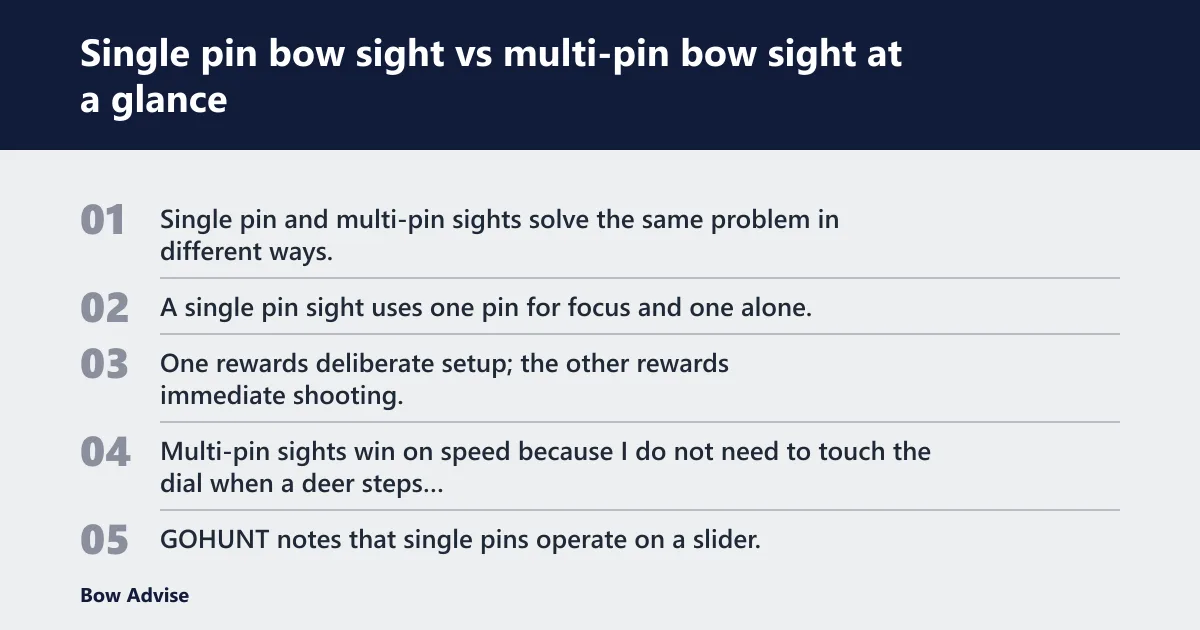
Single pin and multi-pin sights solve the same problem in different ways. A single pin sight uses one pin for focus and one alone, while a multi-pin sight comes in three, five, and seven pin models with fixed yardage marks, often in 10-yard increments. One rewards deliberate setup; the other rewards immediate shooting.
| Factor | Single pin | multi pin sight for hunting: when to choose each | Winner |
|---|---|---|---|
| Cost | Not discussed in the article. | Not discussed in the article. | Tie |
| Lifespan | Not discussed in the article. | Not discussed in the article. | Tie |
| Performance | Better for exact yardage, a cleaner sight picture, and deliberate shot process when distance is confirmed. | Better for fast shots without dialing, especially when the animal may move after ranging. | multi pin sight for hunting: when to choose each |
| Shot speed | Slower, because the shooter dials before the shot. | Fast, because the shooter can shoot on a fixed pin without touching the dial. | multi pin sight for hunting: when to choose each |
| Distance change after ranging | Best when distance stays known and stable; can leave the shooter guessing or re-dialing if the animal moves. | Better when the animal may move and the shooter needs a fallback pin. | multi pin sight for hunting: when to choose each |
| Setup / maintenance | Requires more before-season setup, including sight tape calibration and practice with the dial. | Takes less before-season fuss once sighted in. | multi pin sight for hunting: when to choose each |
| Rangefinder dependence | High, especially for exact yardage. | Lower, because the shooter can use the nearest pin. | multi pin sight for hunting: when to choose each |
| Clutter / sight window | Cleaner sight picture. | More pins can crowd the housing and cause confusion in dim conditions. | Single pin |
| Best-fit use | Open-country spot-and-stalk, longer shots, and hunts where the shooter can range, dial, and wait. | Treestand hunting, ground blinds, and low-light timber when shots are quick and lanes are already known. | Tie |
| Movement / reaction window | Works best when the shooter has time to control the shot process. | Better when reaction speed is high and less movement matters, such as from a tree or blind. | multi pin sight for hunting: when to choose each |
| Low-light timber | Can work if distances are already known and stable. | Favored because it gives a fixed reference in short, dim shot windows; fewer pins reduce confusion. | multi pin sight for hunting: when to choose each |
Shot speed
Multi-pin sights win on speed because I do not need to touch the dial when a deer steps into view. GOHUNT notes that single pins operate on a slider, and that means I am building a range-confirmed shot process instead of a quick point-and-send routine. That extra motion matters when the window is short.
Distance change after ranging
This is the failure case many writers skip. If I range a deer at 32 yards and it steps to 39 before I draw, a single pin setup can leave me guessing or scrambling to re-dial, while a multi-pin lets me move to the nearest useful pin and still shoot. That is why field movement matters more than marketing language.
Clutter and setup time
A single pin gives me a clean sight picture, but the price is time spent on sight tape calibration and practice with the dial. A multi-pin setup takes less before-season fuss once it is sighted in, though too many pins can crowd the window and slow down aiming in low light. I have seen beginners waste more time than they save by chasing every possible yardage.
How slider sights fit in
A slider sight mechanism uses a movable track, a yardage dial, and a calibrated sight tape. That setup is built for exact yardage, and it changes the whole system when paired with a rangefinder. I am no longer estimating; I am confirming distance, dialing, then shooting.
Where pin gap shooting fits, and where it fails
Pin gap shooting is the practice of aiming between fixed pins. It can work in calm practice, but under pressure it asks a lot from the shooter. In my opinion, it is less precise than dialing exact yardage, and beginners often push it too far before they have the timing to trust it.
When is a single pin sight better for bowhunting?
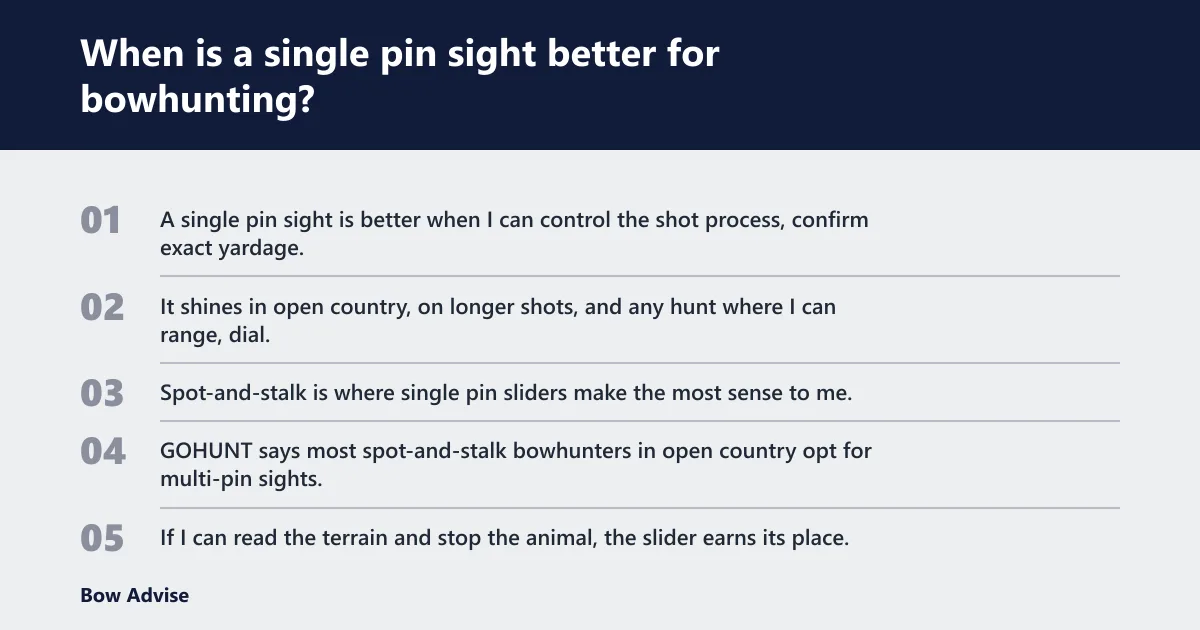
A single pin sight is better when I can control the shot process, confirm exact yardage, and accept a little more setup before season. It shines in open country, on longer shots, and any hunt where I can range, dial, and wait instead of reacting instantly to movement.
Open-country spot-and-stalk hunting
Spot-and-stalk is where single pin sliders make the most sense to me. GOHUNT says most spot-and-stalk bowhunters in open country opt for multi-pin sights, but I still favor a slider when distances are changing a lot and I have time to work the dial. If I can read the terrain and stop the animal, the slider earns its place.
Longer shots with known or confirmed yardage
If I am shooting in open country and the yardage is confirmed, a single pin is hard to beat for exact aiming. I want that one dot on the spot, not a cluster of pins. The cleaner sight picture helps me stay honest about my hold, especially when the shot is stretching past my comfort zone.
When you can afford to dial before the shot
If the animal is feeding, paused, or unaware, I have time to range, dial, and settle. That time matters. GOHUNT lists having to adjust the sight for each shot as a downside of single pins, and that downside is real only when the animal gives me no room to work.
When is a multi-pin sight better for treestand hunting?
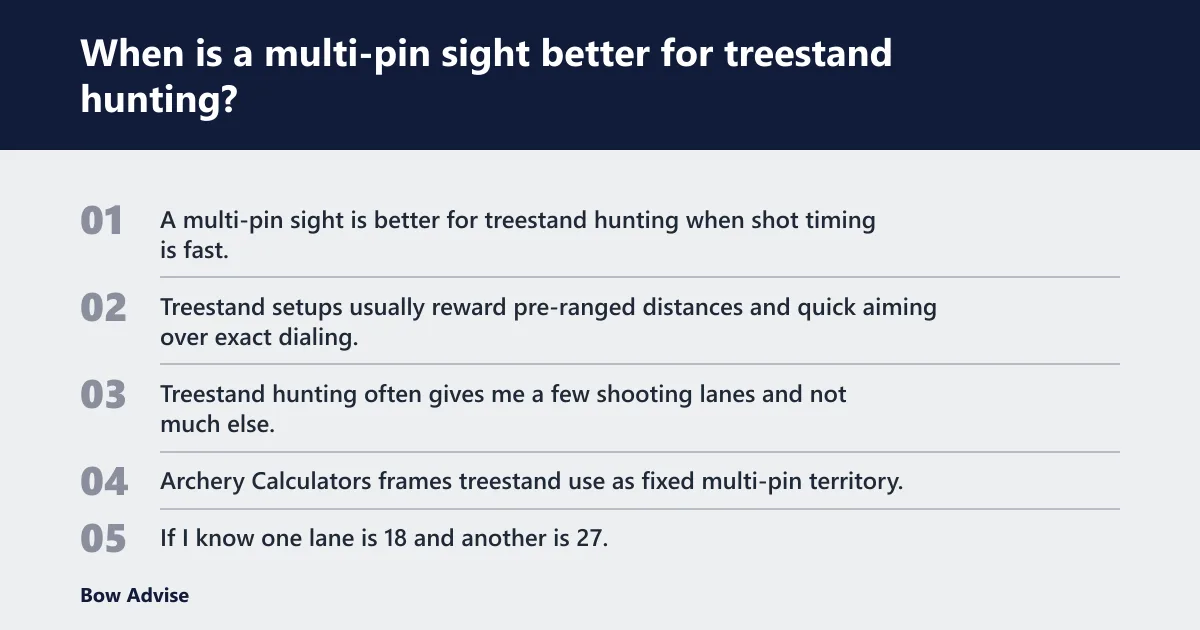
A multi-pin sight is better for treestand hunting when shot timing is fast, movement is limited, and I already know the lanes. Treestand setups usually reward pre-ranged distances and quick aiming over exact dialing, which is why fixed pins are still the better field tool for many tree setups.
Pre-ranged lanes and quick reaction shots
Treestand hunting often gives me a few shooting lanes and not much else. Archery Calculators frames treestand use as fixed multi-pin territory, and that fits my experience. If I know one lane is 18 and another is 27, I want a pin ready instead of reaching for a dial while the deer walks.
Why 3-pin and 5-pin setups cover most treestand use
Extreme Outfitters says three pins cover most hunters, like 20, 30, and 40 yards, and recommends a 5-pin if I regularly shoot 50 yards. That lines up with the way I set up for whitetail in cover. In timber and from a tree, a 3-pin is often enough; a 5-pin makes sense when the lane spacing is broader or longer.
Less movement matters from a tree
GOHUNT lists less movement as a multi-pin advantage in the field, and treestands expose every bad motion. I want the smallest possible movement sequence when a deer steps into range. A fixed pin lets me keep my body still, my bow up, and my shot process short.
What changes in a ground blind or low-light timber?
Ground blinds and low-light timber usually push me toward multi-pin sights or very simple adjustability. Inside a blind, I have limited movement space and a short reaction window. In thick cover, I also have to deal with dim pins and fast, close shots where dialing is too slow.
Limited movement space inside a blind
A blind can make a dial harder to reach without bumping the bow. That extra movement is a problem when a deer is already in the opening. I prefer a setup I can read without changing hand position, and that usually means fixed pins.
Short shot windows in thick cover
Low-light timber does two things at once: it shortens the shot window and it makes clean aiming harder. A multi-pin gives me a fixed reference when I do not have time to range again. A single pin can still work, but only if the distances are already known and stable.
How low light affects pin visibility and sight choice
Too many pins become a problem when the sight window gets busy in dim conditions. I want enough pins to cover my real shot range, not every possible distance I might imagine. In timber, more pins can mean more confusion, especially when the deer is moving and my heart rate is up.
Scenario decision matrix: treestand, blind, spot-and-stalk, and timber
Here is the practical matrix I use. I score each hunting style for reaction speed, distance variability, and rangefinder support on a simple 1-to-5 scale, where 5 means the need is high. The higher the reaction speed and variability, the more a fixed-pin sight earns its keep.
| Hunting scenario | Reaction speed need | Distance variability | Rangefinder support need | What it points to |
|---|---|---|---|---|
| Treestand | 5 | 2 | 3 | Multi-pin, usually 3-pin or 5-pin |
| Ground blind | 4 | 3 | 3 | Multi-pin with simple yardage coverage |
| Open-country spot-and-stalk | 2 | 5 | 5 | Single pin slider |
| Low-light timber | 5 | 3 | 2 | Multi-pin with fewer, brighter references |
How to read the matrix
When reaction speed is high, I do not want to dial. When distance variability is high, I need exact yardage control or a very simple fallback system. That is why spot-and-stalk points to a single pin slider, while treestand and timber push me toward a multi-pin sight with fewer pins and less clutter.
Choose a single pin sight if… / choose a multi pin sight if…
Choose a single pin sight if your distances change often, you can range, dial, and shoot, and you hunt open country or longer lanes where the animal is less likely to move before release. Choose a multi-pin sight if shots arrive fast, you want no-dial aiming, and your hunt lives in trees, blinds, or thick cover.
Choose a single pin sight if…
- You hunt spot-and-stalk or open-country setups.
- You are willing to use a rangefinder as part of the shot process.
- You can accept the extra time for sight tape calibration and dialing.
- You want one exact aiming point rather than learning pin gaps under pressure.
Choose a multi-pin sight if…
- You hunt from a treestand and already know the lanes.
- You shoot in a ground blind where movement space is tight.
- You expect fast, close-range opportunities in timber.
- You want a simpler no-dial process when the deer may stop and move again.
How many pins should a hunting sight have?
Three pins cover a lot of hunters, especially if your real shots live around 20, 30, and 40 yards. A 5-pin makes sense when you regularly shoot to 50 yards, and a 7-pin only helps if your hunting actually demands those extra marks. In dense timber, too many pins can become clutter without adding real value.
Frequently asked questions
Is a single pin sight or multi pin sight better for hunting deer?
For deer hunting, I pick the sight that matches the shot window, not the species. A multi-pin is better for quick treestand, blind, and timber shots. A single pin is better when I can range, dial, and shoot in open country or on a controlled setup.
When should I use a single pin sight for bowhunting?
Use a single pin sight when distances change often and you have time to work the dial. It fits open country, spot-and-stalk hunting, and longer shots with confirmed yardage. I would not choose it if the animal is likely to appear and leave fast.
When is a multi-pin sight better for treestand hunting?
A multi-pin sight is better for treestand hunting when lanes are pre-ranged and the shot can happen fast. That is the classic tree setup: little movement, short reaction time, and little patience for dialing. A 3-pin or 5-pin usually covers that job well.
Are single pin sights good for beginner bowhunters?
Yes, but only if the beginner is willing to learn rangefinder use and sight tape setup. GOHUNT says multi-pin sights are most popular in bowhunting, especially for beginners, and I agree with the logic. Beginners often benefit from the simpler no-dial shooting that fixed pins provide.
Do I need a rangefinder with a single pin sight?
Yes, in practice I treat a rangefinder as part of a single pin setup. The slider is built for exact yardage, and the whole system depends on confirming distance before I dial. An angle-compensating rangefinder matters even more when the shot is steep or awkward.
What are the pros and cons of single pin vs multi pin bow sights?
Single pins give me a cleaner sight picture and exact-yardage aiming, but they demand dialing and range confirmation before each shot. Multi-pins let me shoot fast with less movement, but they can clutter the housing and tempt me into pin gap shooting when I should be taking a cleaner approach.