HHA Tetra Bow Sight Review
The HHA Tetra is worth buying used or leftover if the listing matches the exact model code, housing size, pin size, and mount type. It is a plain single-pin slider with enough travel for hunting, but the wrong version can mean quiver contact, missing tapes, or a sight that does not fit the bow.
Verdict on the HHA Tetra
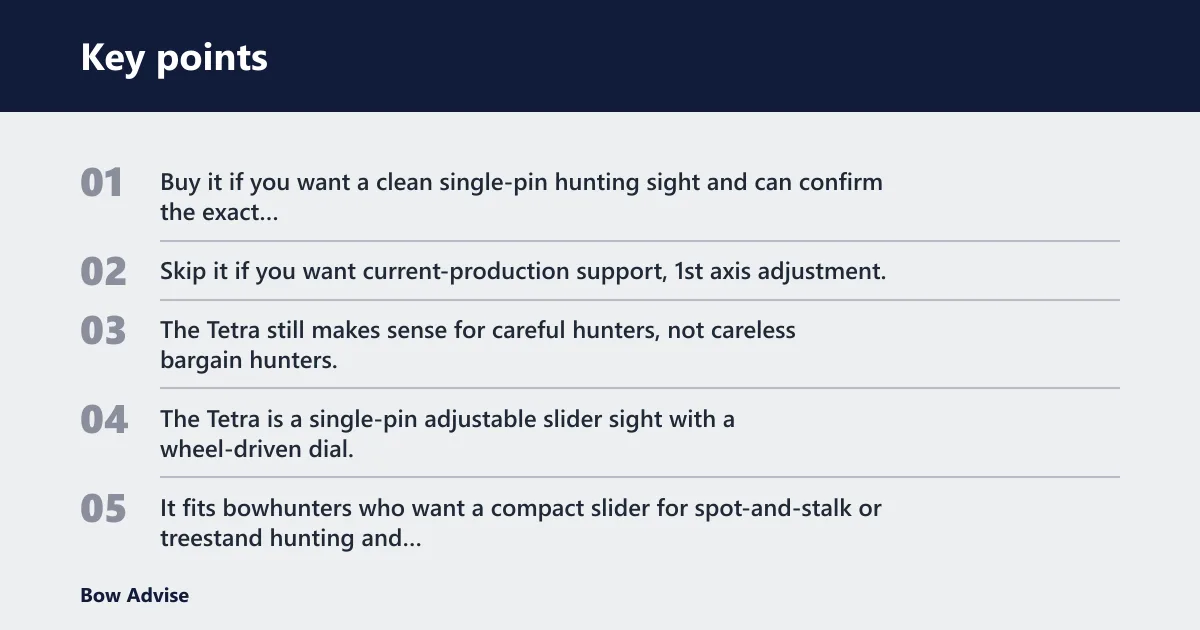

Buy it if you want a clean single-pin hunting sight and can confirm the exact configuration before money changes hands. Skip it if you want current-production support, 1st axis adjustment, or a sight that is easier to compare by modern specs. The Tetra still makes sense for careful hunters, not careless bargain hunters.
Its appeal is simple. The Tetra is a single-pin adjustable slider sight with a wheel-driven dial, 2.1 inches of elevation travel, 2nd and 3rd axis adjustment, and tool-free adjustment knobs. That setup still fits many hunting rigs.
Who should still buy it?
It fits bowhunters who want a compact slider for spot-and-stalk or treestand hunting and do not mind checking part numbers closely. It also fits a used-buying shopper who wants a single-pin sight at a lower cost than current premium models, provided the listing is complete.
Who should skip it?
Skip it if you want the latest HHA platform with 1st axis adjustment, interchangeable scopes, and clearer current-model support. Skip it too if you need a sight that changes arrows, mounts, and accessories with less risk of confusion in the used market.
Best use cases by hunting style
For spot-and-stalk hunting, the single-pin dial keeps the aiming picture simple at changing distances. For treestand hunting, it works well when shots are controlled and time is available to set the wheel. It is less forgiving if a deer is moving and the shot window opens and closes fast.
Picture a whitetail stepping from brush at 28 yards while the bow is already at anchor. A fixed-pin sight lets the hunter choose a gap quickly. A slider needs a dial change or a pre-set mark, and pressure shows up there fast.
What the HHA Tetra
The Tetra is a single-pin slider sight built around a wheel-driven elevation system. That design still matters because it lets the hunter set one pin for precise aiming rather than choosing between multiple fixed pins. HHA listed 2.1 inches of elevation travel for the Tetra series.
The sight also uses two-stage windage with a coarse slide and micro clicker, plus 2nd and 3rd axis leveling. Those features matter more than sales copy. They help the sight line up correctly on steep uphill or downhill shots and make fine setup easier.
Wheel-forward frame and practical handling
The wheel-forward frame helps with quiver clearance, but only when the full setup matches. Housing size, quiver design, and bow geometry still decide whether the rig clears cleanly. A small housing can fit one bow well and crowd another.
Tool-free adjustment knobs are another useful detail. They reduce hassle during setup and let the sight be adjusted without a drawer full of tools. Bowhunting Depot also describes the Tetra as lightweight and rugged, which fits the sight’s simple hunting layout.
What the Tetra Max changes
The Tetra Max is a later Tetra-family variant with two spools for two arrow setups. That makes it better for hunters or target shooters who want one sight and two preset arrow configurations, rather than a single hunting tune. It is not the same thing as the standard Tetra.
The Max also uses a removable wheel. That detail matters because it changes how the sight is used and set up. If a listing says “Tetra” but the photos show the Max spool layout, verify the exact model code before assuming it is the standard single-spool version.
Standard Tetra versus Tetra Max
The standard Tetra is the cleaner choice for hunters who want one setup and one dial path. The Max makes more sense if two arrow setups are part of the plan. Buyers who only want a hunting slider usually do not need the extra spool complexity.
Does the HHA Tetra work with a quiver?
Yes, many setups will work with a quiver, but that is not guaranteed by the sight alone. The Tetra’s wheel-forward frame helps, yet quiver clearance still depends on the housing size, the quiver body, and where the sight sits on the bow. It is a fit question, not a promise.
Bowhunters should watch the bow side too. A deep quiver hood, a wide arrow holder, or a sight mounted far out can create contact. That risk is highest on compact hunting bows with little side clearance.
Housing size and quiver fit
HHA listed housing sizes of 1 3/8, 1 5/8, and 1 3/4 inches. Larger housings can give a more open sight picture, but they can also crowd some quivers more quickly. The safer approach is to compare the exact housing size in the listing against the bow and quiver shape.
A common first-timer mistake is assuming “Tetra” means one fixed body size. It does not. The sight can be listed in different housing sizes, and that changes both the aiming picture and the odds of interference.
Tetra sight tape and yardage dial setup
The Tetra uses a yardage wheel, sight tape setup, and a brass needle yardage pointer. That system is meant to translate a known arrow tune into repeatable distance marks. Bowhunting Depot says the sight has a 20-100 yard water-resistant sight tape, but the tape itself is still a setup aid, not a performance feature.
Good use depends on matching the tape to the bow’s actual speed and choosing the correct strip. If the tape is wrong, the dial marks will be wrong. That is the practical risk with any slider sight, used or new.
Basic setup steps
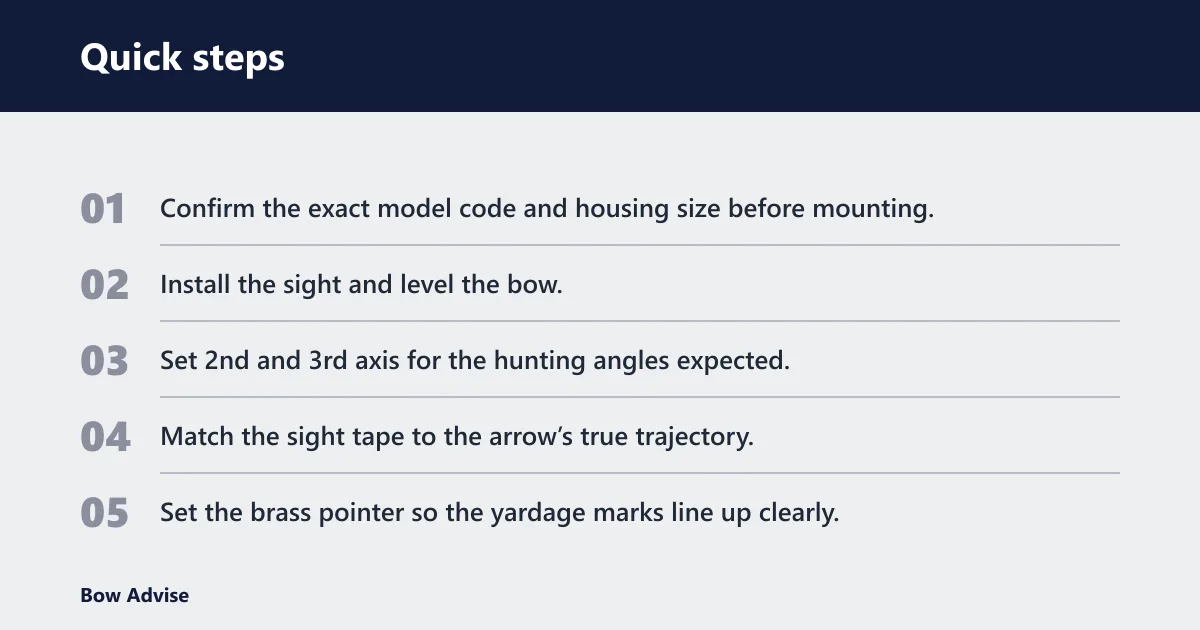
- Confirm the exact model code and housing size before mounting.
- Install the sight and level the bow.
- Set 2nd and 3rd axis for the hunting angles expected.
- Match the sight tape to the arrow’s true trajectory.
- Set the brass pointer so the yardage marks line up clearly.
- Verify that the wheel turns cleanly and returns to the same mark.
Suppose the sight is dialed for a 280 fps setup but the bow is actually slower. The marks will not line up as expected, and the hunter may miss the correct yardage under pressure. That is why used listings that omit tape details deserve extra caution.
Pros and cons
The Tetra has real strengths, but it also has limits that matter more in hunting than in spec sheets.
Pros
- Single-pin slider layout keeps the aiming picture clean.
- 2.1 inches of elevation travel covers a useful hunting range.
- Tool-free adjustment knobs simplify setup.
- 2nd and 3rd axis adjustment help with angled shots.
- Wheel-forward design can help with quiver clearance.
Cons
- Single-pin dialing is slower than a multi-pin sight when an animal moves.
- No 1st axis adjustment on the Tetra, unlike newer HHA options.
- Used listings can hide the wrong housing size, pin size, or mount type.
- Discontinued status makes exact model verification more important.
Tetra buying checklist table
Use the model code and configuration details first. A good price means little if the sight is the wrong version for the bow.
| Model code | Housing size | Pin size | Mount type | Quiver clearance | Best use case |
|---|---|---|---|---|---|
| Tetra single-pin | 1 3/8 | .010 | Verify exact listing | Best on tighter hunting rigs | Spot-and-stalk, minimal sight picture clutter |
| Tetra single-pin | 1 5/8 | .019 | Verify exact listing | Usually a safer middle-ground | Tree stand hunting, easier aiming reference |
| Tetra single-pin | 1 3/4 | .010 or .019 | Verify exact listing | Check closely with larger quivers | Hunters wanting a larger housing sight picture |
| Tetra Max | Verify exact listing | .010 or .019 | Verify exact listing | Depends on spool and housing package | Two-arrow-setup users, not basic single-setup buyers |
Used listing red flags
Watch for vague titles that only say “HHA Tetra” with no housing size, no pin size, and no mount type. Also watch for missing scope photos, missing tape strips, or a wheel that does not clearly show the brass pointer. Those gaps are where mistakes happen.
The safest confirmation steps are simple. Ask for the model code, the housing diameter, the pin size, and a photo of the sight tape area. If the seller cannot identify those items, treat the listing as incomplete, even if the price looks attractive.
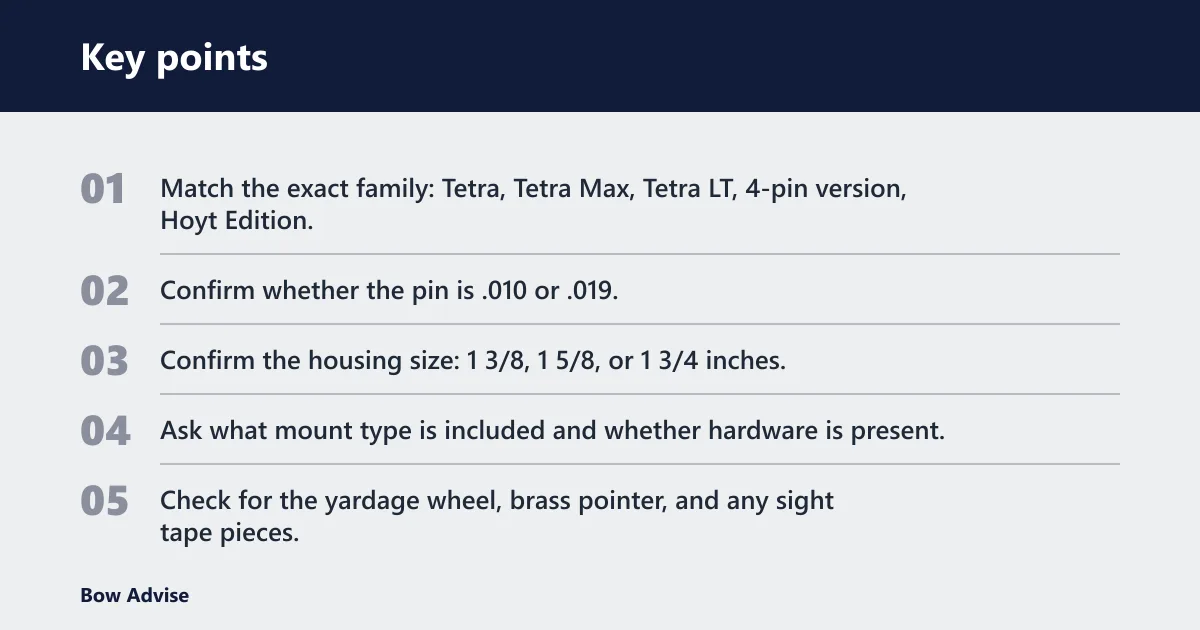
- Match the exact family: Tetra, Tetra Max, Tetra LT, 4-pin version, Hoyt Edition, or Tournament Edition.
- Confirm whether the pin is .010 or .019.
- Confirm the housing size: 1 3/8, 1 5/8, or 1 3/4 inches.
- Ask what mount type is included and whether hardware is present.
- Check for the yardage wheel, brass pointer, and any sight tape pieces.
- Inspect photos for wear around the windage block and elevation track.
Is the HHA Tetra discontinued?
Yes, HHA listed the Tetra series as discontinued by February 2026. That matters because leftover inventory and used listings become more likely, and the buyer has to do more confirmation work. It does not automatically make the sight bad. It makes the purchase more specific.
Discontinued status matters most for fit confidence and replacement decisions. The family includes the original Tetra, Tetra Max, Tetra LT, 4-pin versions, Hoyt Edition, and Tournament Edition, so buyers should not assume one listing covers every version. The wrong assumption is the expensive part.
Why leftover inventory matters
Leftover stock can be perfectly usable, but it can also sit in old packaging with incomplete details. A seller may not know whether a box contains a standard Tetra or a special edition. That is why model-code verification matters more than a generic product title.
Used-market red flags
Be cautious if the listing uses only broad terms such as “premium slider sight” or “fits most bows.” Those phrases do not identify the housing size, pin size, or exact family variant. Also be cautious if the seller cannot show the sight tape parts or the pointer.
Is the HHA Tetra better than the NYTRX?
For buyers who want current-production support and newer sight features, the NYTRX is the safer pick. It adds first-axis adjustment and interchangeable scopes. The Tetra is still useful, but it is the older choice.
That does not make the Tetra obsolete. It does mean the NYTRX is a better answer when the buyer wants the newer platform and less uncertainty about replacement or compatibility. The choice comes down to support, adjustability, and how confident the buyer is with a used sight.
1st axis versus 2nd and 3rd axis
The Tetra includes 2nd and 3rd axis leveling, but not 1st axis adjustment. That gap matters more on bows that need broader front-to-back alignment correction. Buyers who expect steep-angle hunting or want more complete axis control should lean toward the NYTRX.
When the newer sight is the safer buy
If the buyer wants the cleanest path to current production, the NYTRX is the easier recommendation. It reduces the risk of buying into a discontinued family and gives a more modern sight platform. A used Tetra still makes sense when the listing is exact and the price is right.
Frequently asked questions
Is the HHA Tetra good for hunting?
Yes, the Tetra is a solid hunting sight when the buyer wants a single-pin slider with 2.1 inches of elevation travel, 2nd and 3rd axis adjustment, and a simple wheel-based dial. It is best for hunters who value a clean aiming point and can live with a slower dial under pressure.
What is the difference between the HHA Tetra and Tetra Max?
The standard Tetra is a single-pin slider built around one arrow setup. The Tetra Max uses two spools for two arrow setups and has a removable wheel. That makes the Max more flexible for dual-config users, while the standard Tetra stays simpler for hunting.
What pin sizes does the HHA Tetra come in?
The Tetra pin comes in .010 or .019 inches. Those two options matter because they change the sight picture and the amount of aiming reference the hunter sees. The right choice depends on preference, light conditions, and how much precision versus visibility the buyer wants.
How much elevation travel does the HHA Tetra have?
The HHA Tetra offers 2.1 inches of elevation travel. That is enough for a practical hunting slider, but it should still be matched to the bow’s speed and the arrow setup. The real value comes from correct tape setup and proper calibration, not the number alone.
Which HHA Tetra model should I buy used?
The safest used buy is the exact Tetra variant that matches the bow and hunting style, with the correct housing size, pin size, and mount type clearly identified. If the listing is vague, the buyer should skip it. If the seller confirms every detail, the standard Tetra is usually the simplest choice.