Bowhunting Backpack vs Day Pack: Which Fits Better?
A Day Pack fits most treestand and mobile hunts under about 2,000 cubic inches. A Bowhunting Backpack fits longer backcountry trips, heavier layers, and load-hauling needs. Pick the wrong style and you slow access, carry extra weight, or run out of room when the hunt runs long. This guide compares volume, pocket layout, comfort, and hunt type so the right pack matches the actual field load.
| Decision factor | Bowhunting Backpack | Day Pack | Winner |
|---|---|---|---|
| Carry volume | Best for larger loads, extra layers, water, and meat-haul tasks | Best for compact gear and shorter hunts | Bowhunting Backpack |
| Access speed | Usually deeper storage with more structure | Faster reach to release, rangefinder, and calls | Day Pack |
| Stability on movement hunts | More support when the load is heavy | Less bulk for climbing, crawling, and quick setup changes | Day Pack |
| Comfort on long carries | Designed for heavier all-day or backcountry carry | Comfort is limited when the load grows | Bowhunting Backpack |
| Weather and organization | Often better suited to layered storage and weather protection | Enough for short sits, but space fills fast | Bowhunting Backpack |
Volume, access, and quiet gear choices in the field
The difference is simple: a bowhunting backpack gives you more structure, more storage, and more comfort when the hunt lasts all day or the pack has to carry extra layers, water, and haul-out gear. A day pack keeps bulk down so the items you need most stay easier to reach on short sits, mobile hunts, and treestand setups.
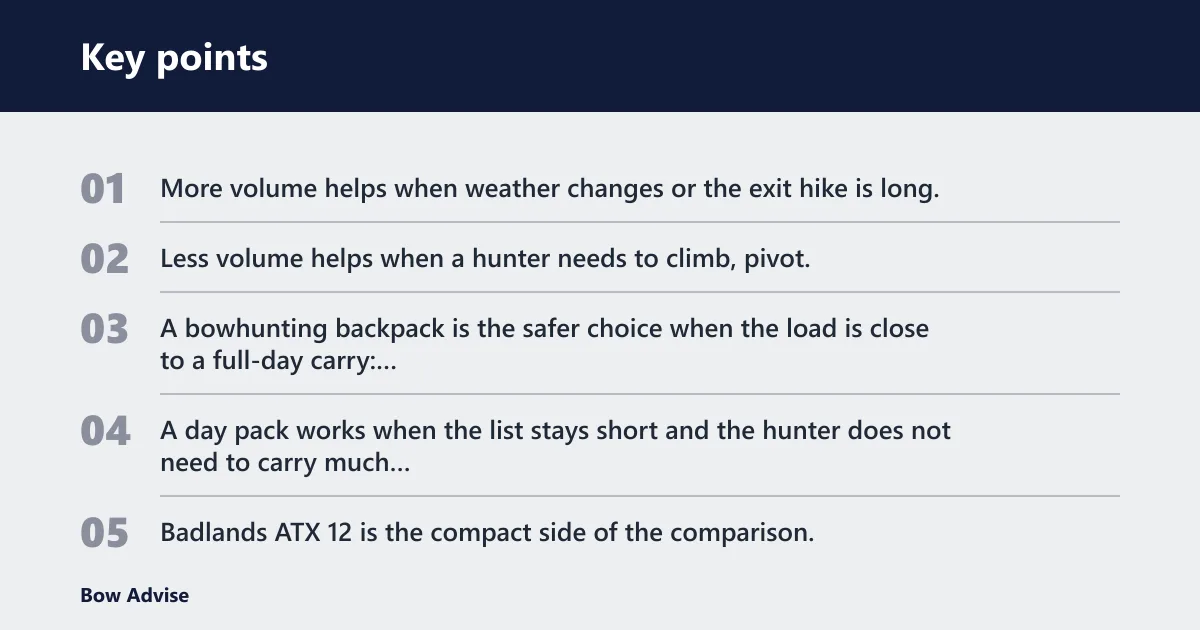
That tradeoff shows up fast in the field. More volume helps when weather changes or the exit hike is long. Less volume helps when a hunter needs to climb, pivot, or draw with less gear catching on clothing or stand rails.
Carry volume and bulk
A bowhunting backpack is the safer choice when the load is close to a full-day carry: insulation layer, rain shell, water, kill kit, snacks, and some form of haul-out support. A day pack works when the list stays short and the hunter does not need to carry much beyond the basics.
Badlands ATX 12 is the compact side of the comparison. Its weather-resistant construction and molded foam suspension fit the day-pack role well, but the smaller format means it is not meant for the same load range as a bigger internal-frame pack.
Access speed and noise
Day packs usually win when a hunter wants the fastest access to essentials. Fewer layers of storage usually means less rummaging for a release, a rangefinder, or wind check gear.
Quiet closure matters either way. Velcro-free closures and silent pocket access reduce noise when gear must be reached near live game. The Great Fit Pursuit Bruiser uses Velcro-free silent pocket closures and a dropdown gun or bow boot, which suits stand hunting and short setup changes where sound control matters.
Stability while climbing or stalking
For climbing and stalking, the best pack is the one that stays close to the body and does not swing. Compression straps and a restrained profile help keep the load from shifting when stepping onto sticks, moving through brush, or drawing a bow in tight cover.
Suppose a hunter is moving between cedar thickets with only a release, rangefinder, water, and a light layer. A smaller day pack keeps those items close and avoids the side-to-side movement that can happen with a larger, half-empty backpack.
Comfort on long carries
Once the hike stretches beyond a short access trail, a bowhunting backpack usually pulls ahead. Suspension, shoulder harness design, and airflow between the pack and back matter more as weight rises.
Badlands Pursuit uses AirTrack technology for airflow between the body and pack, and its rear compression and bedroll straps help manage bulk. It also fits a 3-liter hydration reservoir, which makes it a stronger match for warm-weather all-day use than a stripped-down day pack.
Which pack fits your hunt?
Match the pack to the hunt, not the logo. Treestand hunters and mobile hunters usually need fast access and low bulk, while backcountry hunters need storage, water carry, and a suspension that stays comfortable after hours on the move. Spot-and-stalk sits between those extremes and rewards a pack that stays compact but still handles layers and water.
Treestand hunts
Treestand hunters usually do best with a day pack unless the sit is long, cold, or far from the truck. The shorter the hunt, the more a compact format helps with silent access and less snag risk when climbing or settling into position.
Badlands ATX 12 fits this use case well. It is compact and lightweight for shorter hunts, and its weather-resistant construction is enough for a day where the load is small and the route is not extreme.
Mobile setups
Mobile hunters need freedom of movement. A smaller day pack usually wins because it keeps the profile tight during climbs, saddle transitions, and quick location changes.
A common first-timer mistake is packing a full backpack for a two-hour move-and-set hunt. The extra volume often stays half empty, then becomes dead weight when the hunter has to crawl, turn, or settle into brush.
Spot-and-stalk hunts
Spot-and-stalk usually favors a day pack unless the route includes long hikes or weather changes are expected. The priority is keeping the load stable and the essentials easy to grab without a long search.
If layers, water, and a kill kit are all that fit, a day pack is enough. If the hunt can turn into an all-day push or a steep exit, a bowhunting backpack starts making more sense.
Backcountry and all-day hunts
For all-day or backcountry use, a bowhunting backpack is usually the right call. The extra space handles food, water, insulation, rain gear, and haul-out needs without forcing the hunter to strap loose items to the outside in a way that slows movement.
Eberlestock Brute 3500 is described as fitting this role with about 3500ci capacity, dual top and front access, and an integrated load shelf. The drawback is simple: it is bigger and more expensive, so it is overbuilt for a short tree stand sit.
What features matter most?
The best pack is not the one with the longest feature list. The features that matter most are the ones that match the hunt: quiet access for close-range work, water carry for long sits, compression for stability, and suspension for long walks. Weather handling matters too, because wet gear adds weight and noise fast.
Quiet closure systems
Quiet closure means less noise when opening pockets near bedding cover or on a quiet ridge. Velcro-free closures are the cleanest way to reduce that sound, especially when the hunter needs to reach the same pocket more than once.
The Great Fit Pursuit Bruiser is built around Velcro-free silent pocket closures. That makes it a strong fit for stand hunting, but the tradeoff is that a quieter closure system can still be slower than a simple open pocket when speed is the only priority.
Hydration compatibility
Hydration carry matters on warm hunts and long hikes. A 3-liter reservoir keeps water hands-free and frees up pocket space for small items that would otherwise sit in a bottle holder.
Badlands Pursuit fits a 3-liter hydration reservoir, which is a practical benchmark for all-day field carry. A smaller day pack may still hold water, but once layers and optics go in, usable space shrinks quickly.
Compression and lash points
Compression straps and external lash points keep a pack from ballooning when the load changes. They also help stabilize odd-shaped gear such as a jacket, a rain layer, or a rolled pad.
Badlands Pursuit includes rear compression and bedroll straps, which is useful when the day starts light and ends with more gear leaving the field than entering it. That is less useful on a short hunt where the extra hardware adds more bulk than benefit.
Suspension and ventilation
Suspension matters when the pack rides for hours. Breathable mesh and airflow channels reduce heat buildup, which is useful on warm early-season hunts or steep exits.
Badlands Pursuit uses AirTrack technology for airflow between the body and pack. That makes it a stronger backcountry-style option than a minimalist day pack, though a lighter pack still wins when mobility matters more than padding.
DWR water resistance
DWR water resistance helps shed moisture from light rain, brush drip, and damp morning grass. It does not make a pack waterproof, but it helps protect the contents until the weather turns serious.
Badlands Pursuit uses C6 Durable Water Repellent treatment. That kind of finish matters more on long hunts, where a soaked layer or wet food bag becomes a problem after hours in the field.
How much gear fits?
Capacity is the cleanest way to compare these two pack styles, but the number only matters when matched to the gear list. A day pack is enough for essentials. A bowhunting backpack is for gear loads that grow past the basics and stay there for the whole hunt.
What fits in a day pack
A day pack should hold a release, rangefinder, one small layer, gloves, a water bottle or compact reservoir, calls, snacks, and a basic kill kit. That is enough for a short sit or a mobile hunt where the hunter expects to move often and stay light.
Badlands ATX 12 sits in this class. It is a compact hunting pack with weather-resistant construction, so it fits the short-hunt role without carrying the bulk of a larger internal-frame pack.
What fits in a bowhunting backpack
A bowhunting backpack should hold the same essentials plus a heavier insulation layer, extra snacks, a rain shell, a 3-liter reservoir, and more organized storage for a longer exit or a colder morning. If the hunt can stretch into the evening, the pack should also leave room for items that are not needed until weather changes.
Eberlestock Brute 3500 is built for that larger load. Its 3500ci capacity, dual access, and integrated load shelf make it more useful when the pack must do more than carry a few small items.
Where 1500 cubic inches sits in the range
1500 cubic inches is a practical middle point for a compact hunting pack. It is enough for the essentials and a modest layer, but it is still small enough to stay relevant for tree stand and mobile use.
Badlands Pursuit uses a 1500 cubic inch capacity, which places it squarely in the compact-to-mid range. That is the kind of size that works for short hunts and organized carry, but not for the larger clothing and food load that a backcountry day often brings.
| Load level | What usually fits | Best pack style | Winner |
|---|---|---|---|
| Light | Release, rangefinder, water, calls, snacks | Day Pack | Day Pack |
| Moderate | All basics plus a light layer and small kill kit | Day Pack | Day Pack |
| Heavy | Layer, rain shell, 3-liter reservoir, food, haul-out gear | Bowhunting Backpack | Bowhunting Backpack |
| Extended | Cold-weather layers, water, food, extra storage, meat-haul support | Bowhunting Backpack | Bowhunting Backpack |
Bowhunting gear load checklist
This checklist shows where the load usually fits and why. If the list stops at the basics, a day pack is enough. If it grows into layers, water, and a longer exit plan, a bowhunting backpack becomes the safer pick.
- Release: fits in either pack, but a day pack keeps it easier to reach fast.
- Rangefinder: fits in either pack; quick-access pockets matter more than size here.
- Water: a day pack can carry a bottle or smaller bladder, while a bowhunting backpack more often supports a 3-liter reservoir.
- Layers and gloves: usually fit in either pack only if the hunt is short and the layer is light.
- Calls: fit in either pack, but a smaller day pack keeps them from disappearing into deeper storage.
- Kill kit: fits in either pack in a basic form; larger kits push the load toward a bowhunting backpack.
- Snacks: fit in either pack, though backcountry hunts need more room for extra food.
- Rain shell: easier to carry in a bowhunting backpack, especially when the weather changes mid-hunt.
- List the gear you actually carry on a normal hunt.
- Group those items into fast-access and deep-storage items.
- If the load includes layers, food, and a 3-liter reservoir, move to a bowhunting backpack.
- If the load stays under the basics, choose a day pack.
Choose Bowhunting Backpack if… / Choose Day Pack if…
Choose Bowhunting Backpack if the hunt runs all day, the weather can change, or the load includes a reservoir, extra layers, and haul-out support. Eberlestock Brute 3500 fits that job best of the two because it has 3500ci capacity, dual top and front access, and a load shelf.
Choose Day Pack if the hunt is a short treestand sit, a mobile setup, or a spot-and-stalk hunt where low bulk matters more than extra storage. Badlands ATX 12 fits that job best because it stays compact and weather-resistant, while Badlands Pursuit gives a compact 1500 cubic inch option with better organization and hydration carry.
Must-have
The must-have choice is the pack style that fits the hunt first. For short, quiet, fast-access hunts, the day-pack side wins. For longer hunts with heavier carry needs, the backpack side wins.
 As an Amazon Associate we earn from qualifying purchases. Prices and availability are accurate as of the date shown and are subject to change

Badlands ATX 12 is the compact pick for shorter hunts where minimal bulk matters. Its weather-resistant construction and molded foam suspension make it a sensible day-pack option, but it will feel limited if the load starts to look like a full-day backcountry kit.
As an Amazon Associate we earn from qualifying purchases. Prices and availability are accurate as of the date shown and are subject to change

Eberlestock Brute 3500 is the stronger match for longer carries and bigger gear lists. Dual top and front access helps with retrieval, and the integrated load shelf gives it more utility for haul-out work, though the size and price make it unnecessary for many short hunts.
Nice-to-have
Nice-to-have features matter once the basic hunt type is set. These are the details that make a pack quieter, cooler, and easier to live with during a full day in the field.
The Brute 3500’s 1–2 day hunt sizing makes it useful for longer field time, but that same sizing is the drawback on short sits. It is more pack than many treestand hunters need, and the extra structure can feel excessive when only a few items are going in.
: the ATX 12 is easier
The ATX 12 is easier to justify when mobility matters. Its compact format is the point, but that also means less room for heavy insulation or bulkier water carry, so hunters should check the manufacturer’s listing for their model if they need exact storage detail beyond the listed compact design.
Consumables and spares
These are the items that make pack choice matter in practice. Water, layers, snacks, and a small kill kit should fit the pack without forcing the hunter to strap loose items outside the bag.
Badlands Pursuit is the cleanest example of a pack built for those add-ons. It has five sports pockets for organization, rear compression and bedroll straps, a 1500 cubic inch capacity, fits a 3-liter hydration reservoir, weighs 2 pounds, and uses C6 Durable Water Repellent treatment.
That combination suits a hunter who wants a compact pack with more structure than a bare day pack. It is still not the right choice for a truly heavy backcountry load, because the size stays in the compact range.
Budget setups
These setups keep the buying decision practical. The best choice is the one that fits the hunt type without paying for storage you will not use.
| Setup | Product | Price | Why it fits |
|---|---|---|---|
| Starter | Badlands ATX 12 | $139.99 | Compact, lightweight, and weather-resistant for shorter hunts |
| Mid | Badlands Pursuit | Price not supplied | Compact 1500 cubic inch pack with hydration, compression, and organized carry |
| Serious | Eberlestock Brute 3500 | $499.00 | Best for 1–2 day hunts, larger loads, and haul-out tasks |
Frequently asked questions
Should I use a bowhunting backpack or a day pack?
Use a day pack for short treestand, mobile, or spot-and-stalk hunts where the load stays light and access speed matters. Use a bowhunting backpack when the hunt runs longer, the weather may change, or the load includes extra layers, a larger water system, and haul-out gear. The hunt type should decide the pack first.
How much gear does a hunting day pack hold?
A hunting day pack usually holds the essentials: release, rangefinder, calls, snacks, water, gloves, and a small kill kit. If the pack starts carrying a heavy layer, a rain shell, and extra food, the load is moving past day-pack territory and into backpack territory. That is where bulk starts to matter.
What size pack is best for a tree stand hunt?
A smaller pack is usually best for a tree stand hunt because it keeps movement simple and reduces noise near the stand. A compact option around 1500 cubic inches is often enough if the sit is short. If the hunt is cold or all-day, more room for layers and water starts to matter more than size savings.
Is a hunting backpack too big for spot-and-stalk hunting?
It can be. For close movement, crawling, and frequent setup changes, a large backpack can create drag, swing, or snag risk. A compact day pack usually works better unless the stalk includes a long hike, a cold-weather layer, or a need to carry more water and food for the full day.
What features matter most in a quiet hunting pack?
Quiet closure systems matter most, followed by a compact shape that does not slap or shift as you move. Velcro-free closures reduce sound, and organized pockets keep gear from rattling. Water resistance helps too, because damp fabric and wet gear can become louder and heavier after the weather turns.
How do I carry water, calls, and extra layers in the field?
Use a pack that fits a hydration reservoir if the hike is long, or a pocket layout that keeps calls and the release easy to reach. Extra layers should compress inside the bag rather than hang outside. If those items no longer fit cleanly, the pack is too small for the hunt.
What pack works best for all-day hunts?
A bowhunting backpack usually works best for all-day hunts because it carries food, water, layers, and weather gear without forcing the hunter to overload external straps. Good suspension and airflow help too, since comfort matters more when the pack stays on for many hours. A compact day pack can work, but only for lighter all-day loads.
What should I look for in a pack for backcountry bowhunting?
Look for larger capacity, strong suspension, compression straps, weather handling, and hydration compatibility. Dual-access storage helps when gear must come out without emptying the whole pack. For backcountry use, the Brute 3500’s 3500ci size and load shelf fit the job better than a compact day pack.