CBE Tek Hybrid Sight Review: Who It Fits Best
The CBE Tek Hybrid Sight fits bowhunters who want fixed-pin speed with extra aiming range and who can handle more setup work; choose it over a simpler CBE single-pin or fixed multi-pin sight only if you regularly need quick mid-range adjustment. Skip that tradeoff and you may end up with slower pin pickup, more moving parts, and time spent tuning a system you do not fully use. This guide compares the Tek Hybrid with similar CBE hunting sights and breaks down where it saves time, where it does not, and who should pass.
What we know about the Tek hybrid lineup and why it matters
Public information on the CBE Tek Hybrid is thin, so the honest starting point is this: there is enough lineup context to compare it as a hybrid hunting sight, but not enough verified public detail to treat it like a fully documented current SKU. That matters because model-name confusion can send a buyer to the wrong sight.
What is verified about the Tek Hybrid?
Verified, model-specific Tek Hybrid details are limited in public listings. What can be said with confidence is narrower than many review pages imply, so a buyer should check current dealer listings and CBE product pages before assuming pin count, package contents, or current status. If those details are not listed for the exact Tek SKU, treat them as unconfirmed.
Why hybrid sights appeal to hunters
Hybrid sights split fixed-pin speed and slider-style adjustment into one hunting rig. That can save time on common shots because the sight stays simple at close range while still offering a way to fine-tune a longer distance. The tradeoff is plain: more setup steps and more chances to set the system wrong.
What this review compares against
This comparison uses the best-documented CBE hunting options around the same buyer decision: Tactic Hybrid, Trek Pro, Tactic Micro, and CX-5. The point is not brand cheerleading. It is to show which CBE sight makes the most sense when the hunter values speed, simplicity, or longer-range adjustability more than hybrid flexibility.
CBE Tek Hybrid vs CBE hunting sights
The core trade-off is straightforward. A hybrid sight can save time on in-between distances, but it usually asks more from the archer during setup, verification, and repeatability checks. Simpler fixed-pin sights are faster to live with. Premium micro-adjustable sights are easier to fine-tune, but cost more.
| Sight | Publicly verified details | Price position | Best fit in hunting use |
|---|---|---|---|
| Tek Hybrid | Public details are limited; hybrid layout is the key public signal | Unverified in current public data | Hunters who want hybrid flexibility and can manage setup friction |
| Tactic Hybrid | 1-pin and 3-pin versions, .019 blade pins, floating pin with rapid stop, rheostat sight light, sight scales | $134.99 to $144.99 | Hunters who want a documented hybrid package with clearer feature set |
| Trek Pro Sight | Premium hunting sight with micro-adjustability | $344.99 to $389.99 | Hunters who want higher-end hunting precision and are paying for it |
| Tactic Micro | 5-pin option, budget-friendly hunting sight | $94.99 | Hunters who want a lower-cost fixed multi-pin option |
| CX-5 Hunting Sight | Midrange hunting sight in CBE’s lineup | $189.99 | Hunters who want a step up from budget gear without moving to premium pricing |
Tek Hybrid vs Tactic Hybrid
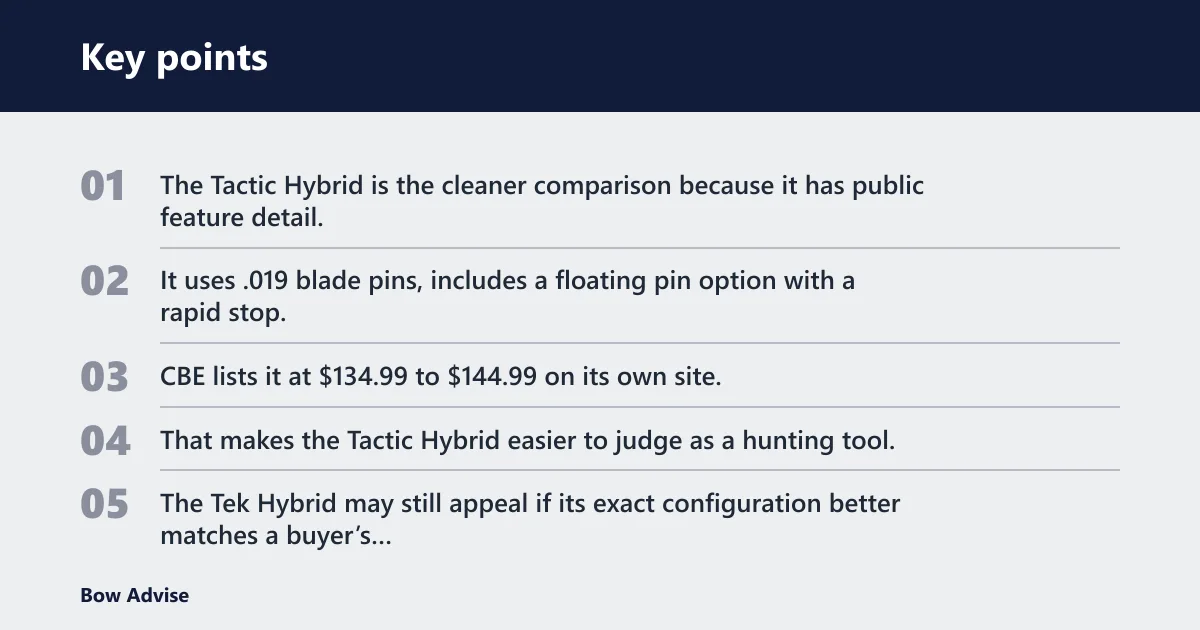
The Tactic Hybrid is the cleaner comparison because it has public feature detail. CBE sells it in 1-pin and 3-pin versions. It uses .019 blade pins, includes a floating pin option with a rapid stop, includes a rheostat sight light, and includes sight scales. CBE lists it at $134.99 to $144.99 on its own site.
That makes the Tactic Hybrid easier to judge as a hunting tool. The Tek Hybrid may still appeal if its exact configuration better matches a buyer’s style, but the buyer must verify that configuration first. Without that confirmation, the Tactic Hybrid is the safer documented buy.
Tek hybrid vs Trek Pro
The Trek Pro sits in a different price lane. The same source lists the Trek Pro Sight at $344.99 to $389.99, which puts it in premium territory. It is a better answer for hunters who want higher-end micro-adjustability and are willing to pay for finer control.
The practical split is setup effort versus precision. A hybrid sight can be faster to use in the field once set, but a premium micro-adjustable sight usually gives more refined adjustment behavior. If a hunter wants the most controlled tuning path, the Trek Pro is the more obvious CBE choice.
Tek hybrid vs Tactic Micro
The Tactic Micro is the budget lane. The same source lists it at $94.99 and places it in the hunting sight category with a 5-pin option. That makes it easier for beginners who want a familiar fixed-pin layout without paying for hybrid complexity.
Compared with a hybrid setup, the Tactic Micro usually wins on simplicity. There is less to calibrate and less to remember after travel, rain, or a sight bump. The Tek Hybrid only makes sense here if the hunter truly needs the added flexibility.
Tek Hybrid vs CX-5
The CX-5 Hunting Sight sits in the middle at $189.99. That positioning matters because it suggests a buyer can move up from budget gear without entering premium pricing. For many hunters, that middle ground is easier to justify than paying for a hybrid system with more variables.
If the goal is steady hunting use rather than experimentation, the CX-5 is the safer midpoint. The Tek Hybrid must earn its place by solving a specific range-management problem. If it does not, the CX-5 is likely the cleaner buy.
Tek Hybrid specs and setup
Because public Tek Hybrid details are limited, the most responsible setup guidance is conditional. The buyer should confirm pin count, adjustment behavior, accessory compatibility, and mount style from the exact product page or dealer listing before purchase. Without that, there is too much room for model confusion.
Pin count and pin layout
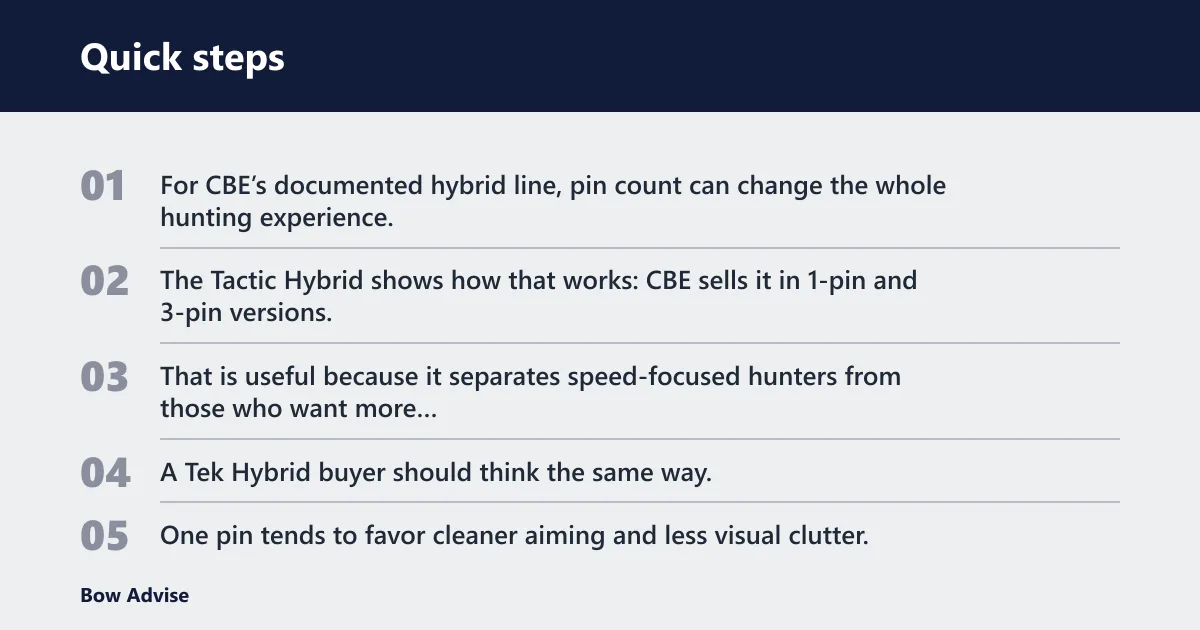
For CBE’s documented hybrid line, pin count can change the whole hunting experience. The Tactic Hybrid shows how that works: CBE sells it in 1-pin and 3-pin versions. That is useful because it separates speed-focused hunters from those who want more aiming reference without moving to a full 5-pin block.
A Tek Hybrid buyer should think the same way. One pin tends to favor cleaner aiming and less visual clutter. Three pins give more hold points for common hunting distances. Five pins usually favor a more fixed, always-ready setup.
Adjustment system and repeatability
Hybrid and slider-style sights depend on repeatable range settings. If the knob, stop, or tape reference is off, the whole advantage disappears. That is why setup time matters as much as the sight itself. A sight that is harder to reset after travel can cost more in missed practice time than in money.
Say a bowhunter dials for 42 yards, then knocks the sight out of position in a truck case. A fixed-pin sight may still be usable after a quick check, while a hybrid setup may need a full recheck before the next hunt. That extra step is the hidden ownership cost.
Sight tape and floating pin compatibility
Sight tape matters when a sight uses a range calibration system. A numbered tape system gives the archer a reference for matching yardage to the sight’s movement. CBE’s Tactic Hybrid includes sight scales, and its floating pin option with a rapid stop is built for that kind of measured adjustment.
A floating pin helps when a hunter wants one aiming point that can shift for different ranges without losing the logic of the setting. It is useful for longer shots, but it also creates one more thing to verify. If the tape or stop is wrong, the shot is wrong too.
Mount style and accessory fit
The mount style for the exact Tek Hybrid SKU should be verified from the current listing. Do not assume a dovetail bar, extension, or other mount detail unless the product page says so. That is the kind of guess that leads to a wrong purchase.
Accessory fit matters just as much. A light, tape, or extra hardware can change how bulky the sight feels on a hunting bow. If those parts are needed anyway, they should be counted as part of the real purchase price, not treated as extras later.
Should you buy the CBE Tek Hybrid?
The Tek Hybrid is a good buy only when the hunter values hybrid flexibility enough to accept more setup work. It is less attractive for first-time bowhunters, for anyone who wants simple repeatability, or for hunters who rarely need to change aiming distance in the field.
Treestand hunting
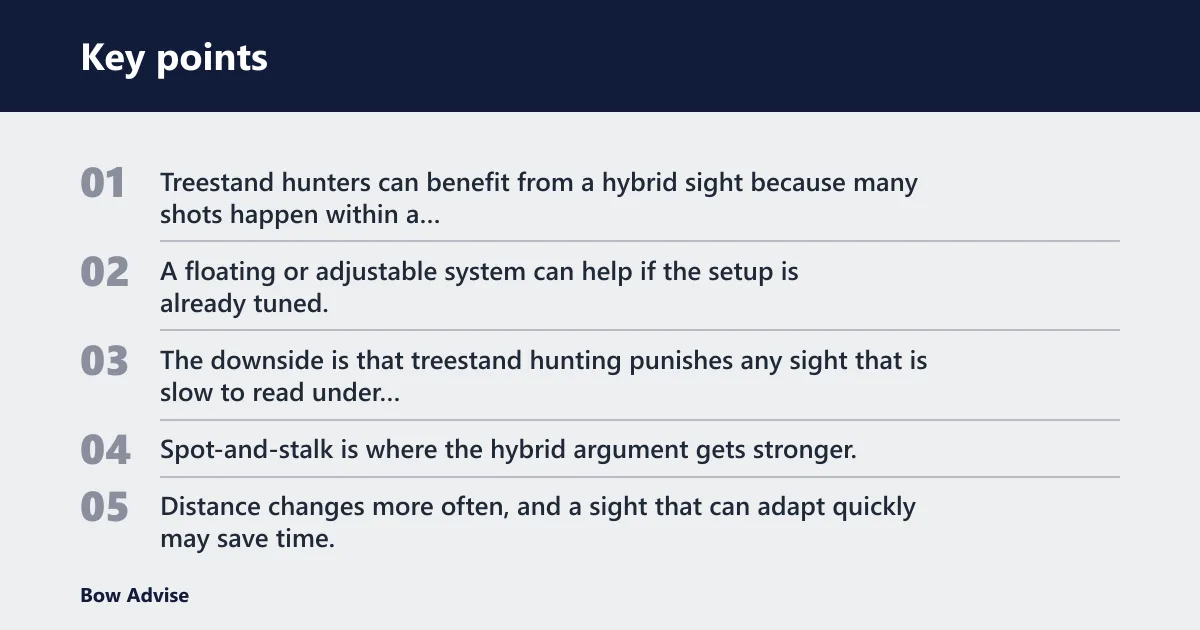
Treestand hunters can benefit from a hybrid sight because many shots happen within a familiar range band. A floating or adjustable system can help if the setup is already tuned. The downside is that treestand hunting punishes any sight that is slow to read under pressure.
Spot-and-stalk hunting
Spot-and-stalk is where the hybrid argument gets stronger. Distance changes more often, and a sight that can adapt quickly may save time. But it only works if the hunter is disciplined about setting the stop and checking the reference marks.
Low-light hunting
Low-light hunting favors clear pins and controlled brightness. The rheostat sight light in CBE’s Tactic Hybrid shows why that matters: brightness control helps prevent a pin from blooming too much at dawn and dusk. A hybrid sight without a good light plan can be harder to use than a simple fixed-pin setup.
Beginner bowhunters
Beginners usually do better with fewer moving parts. A hybrid sight adds decisions, and that can hide setup mistakes until the first hunt. A fixed multi-pin sight is often the safer starting point because it teaches aiming discipline without the extra calibration burden.
Cold-weather glove use
Cold-weather glove use is one of the clearest reasons to avoid unnecessary complexity. Small knobs, tight stops, and tape checks are harder with gloves on. If the sight is hard to manipulate with cold hands, the system becomes a liability rather than a help.
Fast close-range shots
Fast close-range shots favor an uncluttered sight picture. If most shots are close, there is little value in a more complex hybrid system. A simpler fixed-pin sight usually gets the arrow away sooner and with less visual distraction.
Maximum precision past 40 yards
Maximum precision past 40 yards often favors a sight with cleaner single-point control and stronger repeatability. The floating pin concept can help here, but only if the calibration is consistent. Hunters who care most about controlled long-range adjustment may find a premium micro-adjustable sight more dependable.
Budget setup
Budget setup is where the Tek Hybrid can lose the argument quickly. Sticker price is only part of the cost. Add a light, tapes, and any re-sighting time after travel, and the total cost can move closer to a better-documented or more capable CBE sight.
CBE Tek Hybrid decision matrix
This matrix is built for buying decisions, not for hype. A higher fit score means the sight matches the setup better. A higher complexity score means more setup work. A higher user-error risk means more ways the sight can be mis-set or misread in the field.
| Hunting setup | Fit score | Setup complexity | User-error risk | One-line recommendation |
|---|---|---|---|---|
| Treestand hunting | 4/5 | 3/5 | 3/5 | Good if the sight stays checked and the hunter values mid-range flexibility. |
| Spot-and-stalk | 5/5 | 4/5 | 4/5 | Strong fit for changing distances, but only with disciplined calibration. |
| Low-light hunting | 3/5 | 3/5 | 3/5 | Works best if brightness control and pin visibility are already dialed in. |
| Beginner bowhunters | 2/5 | 4/5 | 4/5 | Too many moving parts for most first-time buyers. |
| Cold-weather glove use | 2/5 | 4/5 | 4/5 | Small adjustments and checks are awkward with gloves on. |
| Maximum precision past 40 yards | 3/5 | 4/5 | 3/5 | Only worth it if the calibration stays repeatable after travel. |
| Fast close-range shots | 2/5 | 2/5 | 2/5 | A simpler fixed-pin sight is usually faster and clearer. |
| Budget setup | 2/5 | 3/5 | 3/5 | Better value usually comes from a simpler CBE model with less add-on cost. |
Tek Hybrid vs single-pin and fixed-pin sights
A hybrid system is not automatically better than a single-pin sight for hunting. It is better only when the hunter actually uses the extra flexibility. If the range rarely changes, a simpler fixed-pin sight can be faster, quieter in the mind, and easier to trust.
When a floating pin helps
A floating pin helps when the hunter wants one aiming point and a calibrated way to shift it for different distances. That can be valuable for open-country hunting or longer shots. The downside is that the hunter must respect the stop and the tape, or the advantage disappears.
When a fixed-pin sight is simpler
A fixed-pin sight is simpler when the hunter wants speed and low mental load. There is less to move, less to mark, and less to second-guess. For new bowhunters, that simplicity often means better field results than a more complicated hybrid setup.
1-pin vs 3-pin vs 5-pin trade-offs
One pin usually gives the cleanest sight picture. Three pins cover more common distances without turning the sight into a cluttered block. Five pins work best when the hunter wants a ready-made reference for multiple distances and does not want to dial as often.
Suppose a whitetail hunter shoots mostly inside 30 yards from a treestand. A 3-pin setup may cover all realistic shots without the extra steps of a floating system. That hunter may never use the hybrid advantage enough to justify it.
Low-light and close-range trade-offs
Low-light use rewards visible pins and controlled brightness. That is where a rheostat light can matter. Close-range use rewards speed, though, and a complex sight can be slower to read when an animal appears at 12 yards and stops for a second.
Price, accessories, and ownership cost
Sticker price should not be the final question. A sight that needs a light, tapes, or extra hardware can cost more than the number on the tag suggests. Re-sighting after travel or weather changes also has real time cost, especially on hybrid and slider-style systems.
Sticker price versus total cost
The Tactic Hybrid is listed by CBE at $134.99 to $144.99, the Trek Pro at $344.99 to $389.99, the Trek Sight at $259.99 to $284.99, the Tactic Micro at $94.99, the CX-5 at $189.99, and the Tactic sight at $74.99. Those figures show how quickly CBE spreads from entry-level to premium hunting gear.
That spread matters because a buyer may think a hybrid is the middle ground. In practice, the total cost can rise when setup time, accessories, and verification shots are counted.
Sight tape and light add-ons
Sight tape and a rheostat light are not accessories to ignore. They are part of how the sight works in real hunting conditions. The Tactic Hybrid’s included light and sight scales show why buyers should ask what comes in the box before assuming the sight is ready to hunt.
Re-sighting after travel or weather changes
Travel, temperature swings, and rough transport can expose a weak setup. Hybrid systems are more sensitive to that than simple fixed-pin sights because the repeatability of the adjustment matters. A hunter who bounces between vehicles or hunts in changing weather should budget time for checks.
Value compared with CBE alternatives
If the buyer wants a verified hybrid package, the Tactic Hybrid is easier to justify than the Tek Hybrid because the public feature set is clearer. If the buyer wants premium tuning, the Trek Pro is the more obvious step up. If the buyer wants low cost and easy ownership, the Tactic Micro is the practical choice.
Choose Tek Hybrid if… / Choose another CBE sight if…
Choose the Tek Hybrid if you have verified the exact SKU, want hybrid flexibility, and regularly need mid-range adjustment without moving to a premium price tier. Choose another CBE sight if you want simpler hunting use, lower setup friction, clearer published specs, or better value for a first bowhunting setup.
- Choose the Tek Hybrid if you are already comfortable with setup checks and sight verification.
- Choose the Tek Hybrid if your hunting style changes distance enough to justify a hybrid layout.
- Choose the Tactic Hybrid if you want a documented CBE hybrid with published 1-pin and 3-pin versions.
- Choose the Trek Pro if you want a premium CBE sight with higher-end micro-adjustability.
- Choose the Tactic Micro if you want a budget hunting sight with a 5-pin option.
- Choose the CX-5 if you want a midrange CBE hunting sight with less complexity than a hybrid system.
Frequently asked questions
Is the CBE Tek Hybrid Sight good for hunting?
It can be, but only for hunters who want hybrid flexibility and are willing to manage setup carefully. If the hunter wants a simple sight that is quick to trust, a fixed-pin CBE model is usually the safer choice. The Tek Hybrid is more specialized than universal.
How does the CBE Tek Hybrid compare to the Tactic Hybrid sight?
The Tactic Hybrid is easier to compare because its public details are clearer: 1-pin and 3-pin versions, .019 blade pins, a floating pin with a rapid stop, a rheostat sight light, and sight scales. The Tek Hybrid should be judged only after its exact SKU details are verified.
What pin setup does the CBE Tek Hybrid use?
Public Tek Hybrid details are not clear enough to state a verified pin setup for every SKU. Buyers should confirm the exact model listing before purchase. For reference, CBE’s Tactic Hybrid is sold in 1-pin and 3-pin versions, which shows how different hybrid configurations can vary.
Does the CBE Tek Hybrid come with sight tapes or a light?
That is not safe to assume without checking the exact listing. CBE’s Tactic Hybrid includes a rheostat sight light and sight scales, but those features should not be assigned to the Tek Hybrid unless the product page says so. Package contents are part of the purchase decision.
Is the CBE Tek Hybrid better than a single-pin sight for hunting?
Not for every hunter. A single-pin sight is simpler and often easier to trust under pressure. The Tek Hybrid only wins when the hunter actually needs the extra flexibility and is willing to accept more setup complexity and more chances for user error.
Is the CBE Tek Hybrid sight still available?
Public listings do not clearly settle whether the Tek Hybrid is still sold, discontinued, or renamed. That uncertainty is part of the buying risk. Before ordering, check current CBE pages and dealer inventory rather than relying on old forum references or model-name assumptions.
How do I choose between 1-pin, 3-pin, and 5-pin CBE sights?
Pick 1-pin if you want the cleanest sight picture and do not mind adjusting range. Pick 3-pin if you want a middle ground for common hunting distances. Pick 5-pin if you want more ready-made aiming references and less need to dial in the field.