Spotting Scope vs Binoculars for Archery Hunts: Need Both?
For most archery hunts, binoculars are enough. Add a spotting scope only when you need to judge distant animals from a fixed western glassing point, especially beyond several hundred yards. Carrying the wrong optic costs time, energy, and shot chances. Here’s how the two tools compare, when each fits, and what most bowhunters should carry.
| Decision factor | Spotting Scope | Binoculars for Archery Hunts | Winner |
|---|---|---|---|
| Scanning speed and mobility | Slower to deploy; usually paired with a tripod | Fast, handheld scanning with two-eye viewing | Binoculars for Archery Hunts |
| Long-range detail checks | Best for judging size, antlers, and fine detail after game is found | Good for finding game, weaker for close detail at distance | Spotting Scope |
| Pack weight and setup time | Higher weight, more gear, and slower setup | Lighter and ready faster | Binoculars for Archery Hunts |
| Low-light handheld use | Less useful as power rises and the view gets dimmer | Better for dawn and dusk scanning | Binoculars for Archery Hunts |
| Tripod dependence | Usually needs one for stable high-magnification viewing | Not required for normal use | Binoculars for Archery Hunts |
Binoculars vs spotting scope at a glance
Magnification, field of view, and viewing style
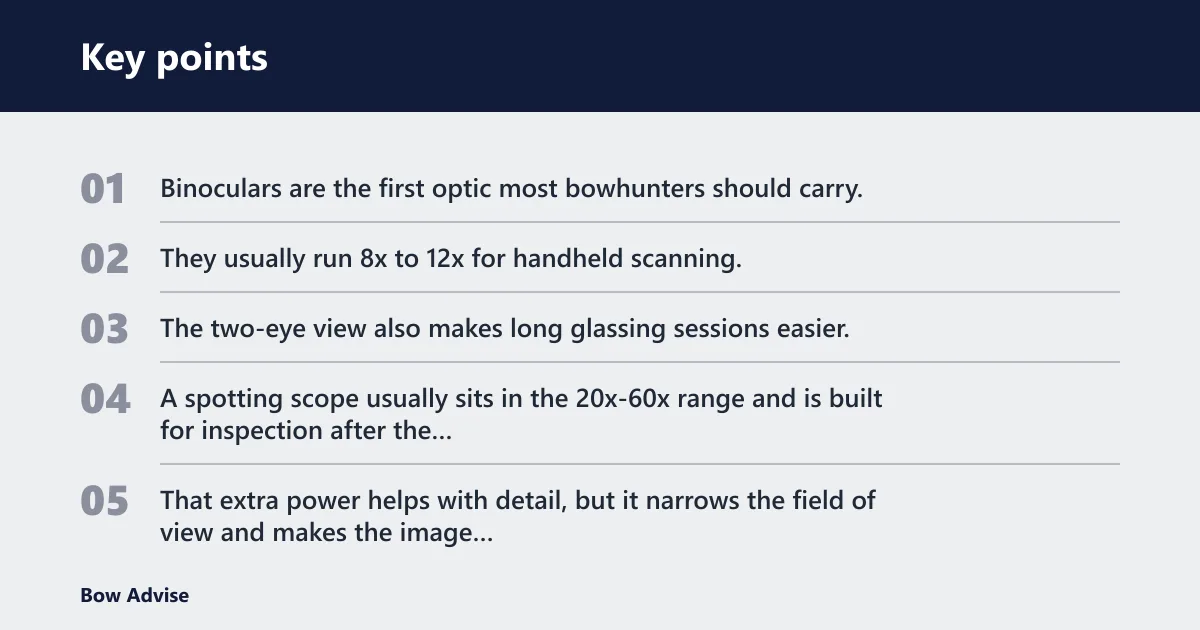
Binoculars are the first optic most bowhunters should carry. They usually run 8x to 12x for handheld scanning, and 8×42 and 10×42 are common hunting sizes. The two-eye view also makes long glassing sessions easier.
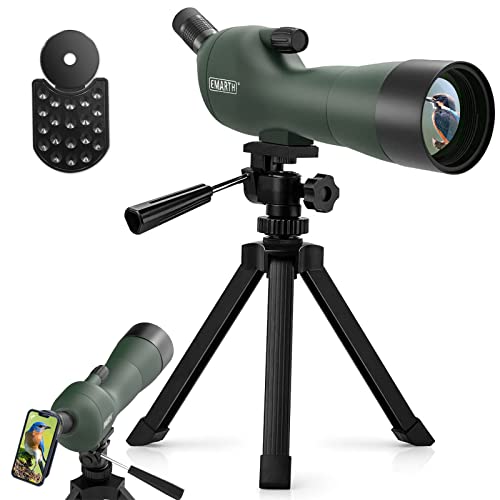
A spotting scope usually sits in the 20x-60x range and is built for inspection after the animal is already found. That extra power helps with detail, but it narrows the field of view and makes the image more sensitive to shake.
Weight, tripod need, and setup speed
Binoculars win on speed. They come out fast, stay quiet, and do not need a tripod for normal archery use. That matters when a bow is already in hand and the job is to locate movement, not study a fixed target.
A spotting scope is typically used on a tripod, and that adds weight, more setup steps, and more movement in the field. For archery hunts, that tradeoff only makes sense when the hunt style includes long glassing sessions from one spot.
Best use case for each optic
Binoculars are best for scanning, quick target acquisition, and repeated checks of cover, ridgelines, and openings. A spotting scope is best when the animal has already been found and the hunter needs a clearer look at antlers, body size, or tag details at long range.
That split matters more in archery than in some other hunting styles, because bowhunters often care less about extreme distance and more about fast, quiet, mobile observation near the shot chance.
What magnification means in the field
7x-12x binoculars and the 8×42 or 10×42 sweet spot
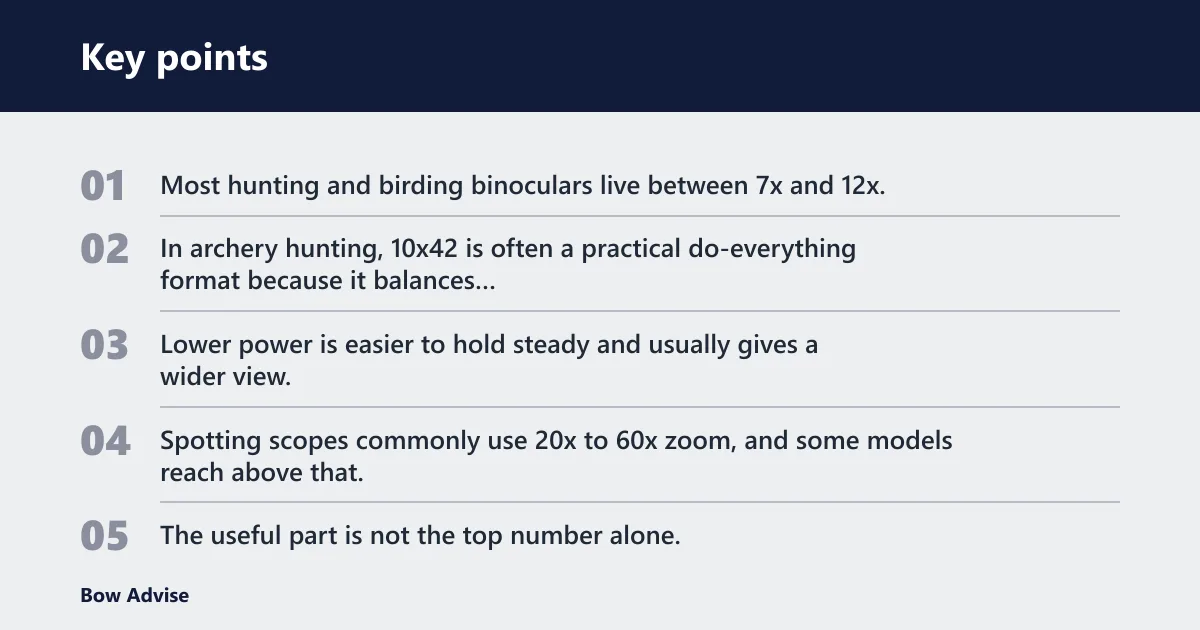
Most hunting and birding binoculars live between 7x and 12x. In archery hunting, 10×42 is often a practical do-everything format because it balances reach and portability without usually requiring a tripod system.
Lower power is easier to hold steady and usually gives a wider view, which helps when searching timber edges, cuts, or brush pockets for movement.
20x-60x spotting scopes and why power matters less than stability
Spotting scopes commonly use 20x to 60x zoom, and some models reach above that. The useful part is not the top number alone, it is whether the image stays steady enough to read detail.
It is commonly reported that image stability drops above about 20x, and a tripod may become necessary. That is why a scope can look impressive on paper but still be a poor fit for a moving archery setup.
How field of view changes what you can find
Field of view matters more for finding game than for studying it. A wide field helps a hunter locate moving animals faster, while a narrow field works better only after the subject is already centered and still.
For reference, field of view is often listed at 1,000 yards in feet. Wider numbers favor scanning; tighter numbers favor detail inspection.
Why low light changes the decision
Exit pupil in plain language
Exit pupil is the beam of light leaving the optic and reaching the eye. As magnification goes up, that beam shrinks, which is one reason higher power optics feel dimmer at dawn and dusk.
That matters in archery because many shot chances happen in first and last light. A scope that looks great at noon can become less useful when the woods darken.
Dawn and dusk scanning with binoculars
Binoculars tend to stay more practical for early and late scanning because they are easier to hold, easier to move, and less punishing when the light is poor. Two-eye viewing also reduces strain during repeated checks of a treeline or opening.
Say your whitetail setup is a timber edge 80 yards from a feeder line. A 10×42 binocular can check that lane quickly without adding tripod noise or turning every glance into a long setup.
Where a spotting scope starts to lose value in the dark
A spotting scope starts losing value as the light drops, especially when the hunter wants high power and the view becomes darker and shakier. The extra detail only helps if the image is bright and steady enough to read.
Suppose a western bowhunter has already found a bull at 600 yards, but dusk is closing in. A spotter may still help with a final antler check, yet the same scope becomes far less useful if the goal is simply to keep scanning new country.
Spotting Scope vs Binoculars for Archery Hunts decision matrix
This table maps the optic choice to common archery setups. The point is not that one tool always wins, but that the value changes with how far the hunter glasses, how long the hunt stays stationary, and how much gear can be carried quietly.
| Hunt style | Field of view need | Detail confirmation need | Tripod use | Pack weight tolerance | Binoculars alone enough? |
|---|---|---|---|---|---|
| Whitetail timber | High | Low | No | Low | Yes |
| Tree stand | Medium | Low to medium | No | Low | Yes |
| Blind | Medium | Low to medium | No | Low | Yes |
| Saddle hunting | High | Low | No | Low | Yes |
| Elk spot-and-stalk | Medium to high | Medium | Sometimes | Medium | Usually yes |
| Western mule deer | Medium | High | Often | Medium to high | No, if long glassing is central |
Whitetail timber and tree stand setups
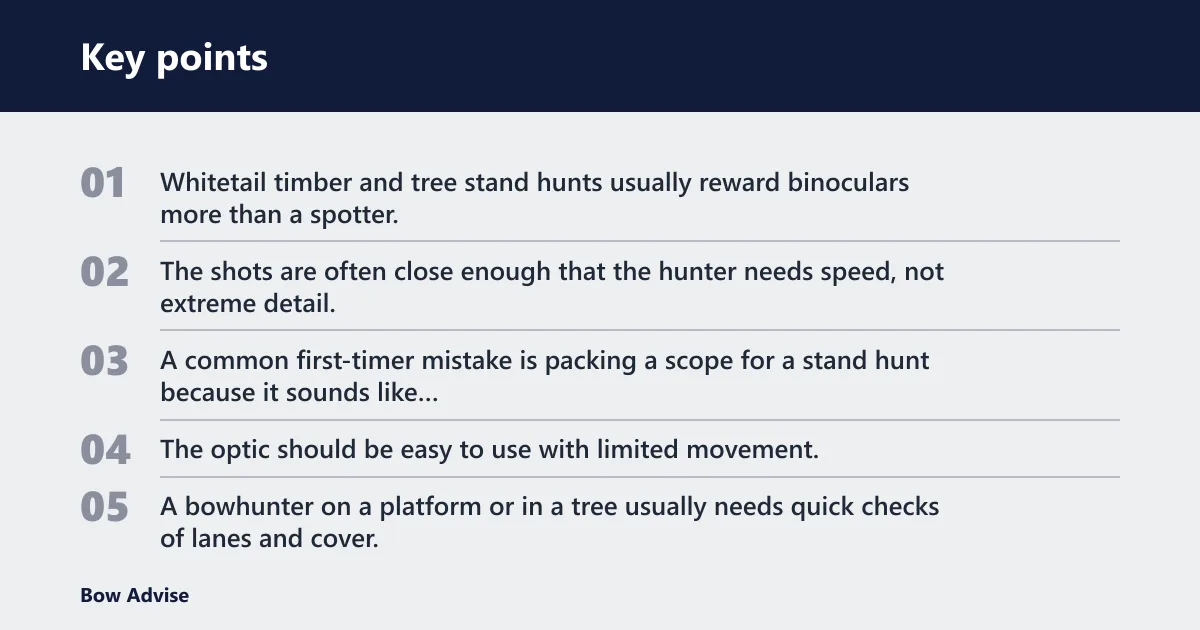
Whitetail timber and tree stand hunts usually reward binoculars more than a spotter. The shots are often close enough that the hunter needs speed, not extreme detail, and a tripod adds more burden than benefit.
A common first-timer mistake is packing a scope for a stand hunt because it sounds like “more glass.” In practice, the extra gear often stays in the pack while the binoculars do the real work.
Blind hunting, saddle hunting, and close cover
Blind hunting follows the same pattern. The optic should be easy to use with limited movement, and binoculars fit that job better because they are fast, light, and simple to keep ready.
Saddle hunting also favors binoculars. A bowhunter on a platform or in a tree usually needs quick checks of lanes and cover, not a long session of stationary long-range inspection.
Elk spot-and-stalk and western mule deer glassing
Elk spot-and-stalk can justify a spotter more often, but only when the plan includes long observation from one position. If the hunter is constantly moving, binoculars still do the bulk of the work.
Western mule deer hunting is where a spotting scope earns its keep most often. That style commonly involves repeated long-range checks from a hillside or bench, and the scope helps confirm which animal is worth a stalk.
When binoculars alone are enough versus when a spotter helps
Binoculars alone are enough for timber, stands, blinds, saddle setups, and many elk hunts where the glassing is short and the movement is frequent. They can also be enough for many archery hunters who do not need to inspect game at long range for extended periods.
A spotting scope helps when the hunt includes fixed-position glassing, repeated detail checks beyond 300 yards, or a need to judge antlers and body size before committing to a stalk.
Can you use a spotting scope without a tripod?
Not well, in most archery field use. A spotting scope can be hand-held for a quick look, but high magnification magnifies shake too much for stable detail work, and the image becomes hard to read above roughly 20x without support.
Why high magnification shakes too much by hand
At 20x and above, small hand movement turns into a large wobble in the view. That makes it hard to judge an ear, a tine, or a body line with confidence.
Binoculars tolerate handheld use better because they are built for it. A spotting scope is built for inspection, not for rapid one-handed scanning.
What the tripod adds in weight and time
A tripod gives the scope the stability it needs, but it also adds another item to carry and another step to set up. It may also create more noise and movement right when a bowhunter wants to stay quiet.
For a stationary western glassing point, that tradeoff can be worth it. For a close-range archery setup, it usually is not.
Choose Spotting Scope if… / Choose Binoculars for Archery Hunts if…
Choose Spotting Scope if the hunt is stationary, the glassing distance is long, and the main job is checking fine detail after the animal has already been found. It makes sense for western mule deer, long-range elk glassing, and any archery setup where a tripod is already part of the plan.
Choose Binoculars for Archery Hunts if speed, quiet movement, and all-day carry matter more than extreme detail. They are the better default for whitetail timber, tree stands, blinds, and saddle hunting, and they also fit most elk and mobile bowhunts better than a spotter.
If both are carried, it is usually because the hunt has two phases: binoculars for finding game, then a spotter for confirming what the animal is and whether the stalk is worth it. For most bowhunters, though, binoculars are enough and a spotting scope stays in the truck or at camp.
Frequently asked questions
Do I really need a spotting scope for archery hunts?
Most archery hunts do not need a spotting scope. A spotting scope becomes useful when the hunt includes long, stationary glassing and repeated detail checks beyond 300 yards, especially in western country. If the hunt is close cover, mobile, or tree-based, binoculars usually cover the job better.
Can I use binoculars instead of a spotting scope for hunting?
Yes, for most bowhunts. Binoculars are better for scanning, faster to use, and easier to carry, which is why they are the primary optic for many archery hunters. They give up some fine detail, but that tradeoff is usually acceptable in close-to-midrange setups.
When is a spotting scope worth carrying on a bowhunt?
It is worth carrying when the hunt involves fixed glassing points, long hours of observation, and a real need to judge antlers or body size at distance. Western mule deer and some elk setups fit that pattern. In timber, stands, and blinds, the added weight usually is not worth it.
What magnification do binoculars vs spotting scopes usually have?
Binoculars are typically 8x to 12x for handheld scanning, with 8×42 and 10×42 common hunting formats. Spotting scopes usually run 20x-60x, and some go a bit wider. The higher range helps with detail, but only when the image is stable and the light is good.
How much does a spotting scope help with judging antlers or animals at distance?
It helps a lot once the animal is already found and the hunter needs detail. The scope is built for that job, so antler points, body size, and similar features become easier to inspect. It is far less useful for the initial search because the field of view is narrow.