Open Face Reel vs Closed Face Reel for Bowfishing
Open-face reels are usually the stronger bowfishing choice because they reset faster, handle heavy line more easily, and clear faster when line piles up; choose closed-face only if you want extra spool protection and can accept slower handling. Pick the wrong reel, and you lose fish to tangles, slow reloads, and jams in wet, messy conditions. This guide compares both reel types for speed, safety, beginner recovery, boat use, and heavy-line performance.
| Decision factor | Open Face Reel | Closed Face Reel for Bowfishing | Winner |
|---|---|---|---|
| Line pickup speed | Faster reset and faster line handling after the shot | Slower pickup through the nose cone and button system | Open Face Reel |
| Tangling risk | More exposed line path, more user error risk | Spool and mechanism sit under a protective nose cone | Closed Face Reel for Bowfishing |
| Wet-hand control | Better grip options and quicker line grab in splashing conditions | Button cast is simple, but grab speed is limited | Open Face Reel |
| Beginner recovery | Recoverable if the user understands the spool and drag | Simple, but jams and line traps can be awkward to clear | Closed Face Reel for Bowfishing |
| Heavy-line handling | Better fit for larger reels, heavier line, and bigger fish | Usually limited to lighter freshwater use | Open Face Reel |
| Saltwater tolerance | Better with aluminum or high-quality graphite parts | Usually more limited in bowfishing-grade durability | Open Face Reel |
| Maintenance | More exposed, but easier to inspect and clean | Protected housing, but harder to clear when debris enters | Tie |
| Cost of mistakes | Backlash or overrun can waste time, but is often fixable | Internal snags can stall the whole setup and slow the team | Open Face Reel |
Open face reel vs closed face reel for bowfishing


In bowfishing, the real comparison is not casting alone. It is what happens after the shot: how fast the line comes back, how easily a wet hand can grab it, and how much damage one bad move does to the setup. Open-face reels are generally better for that job.
What “open face” means in bowfishing
Open-face reels include spinning reels and baitcasting reels. A spinning reel uses a fixed spool that does not rotate during the cast, and the bail opens so line peels off the spool; a baitcaster uses a rotating spool and needs thumb control to stop backlash during the cast.
That split matters in bowfishing because open-face designs give faster access to the spool and line. They are better when the team needs a quick reset after a shot and does not want to fight a covered mechanism.
What “closed face” means in bowfishing
Closed-face reels are also called spincast reels. They house the spool and line pick-up mechanism under a nose cone, and they use a button on the back for casting. That layout protects the moving parts and makes the reel feel simpler to new users.
Closed-face reels are the top choice for novice anglers and children in general fishing, but bowfishing adds more mess. Wet line, quick grabs, and heavy arrows expose the limits of that protected design.
Why the shot-to-retrieve cycle changes the comparison
Bowfishing rewards fast reset speed more than cast comfort. After the shot, the reel has to help move line cleanly while hands are wet, the boat may be rocking, and the line may be under sudden load from a fish or a missed shot.
That is why open-face reels usually win the overall comparison. Closed-face reels reduce some entry mistakes, but they can slow the entire shot-to-retrieve cycle when the crew needs speed more than simplicity.
Which reel is easier for beginners?
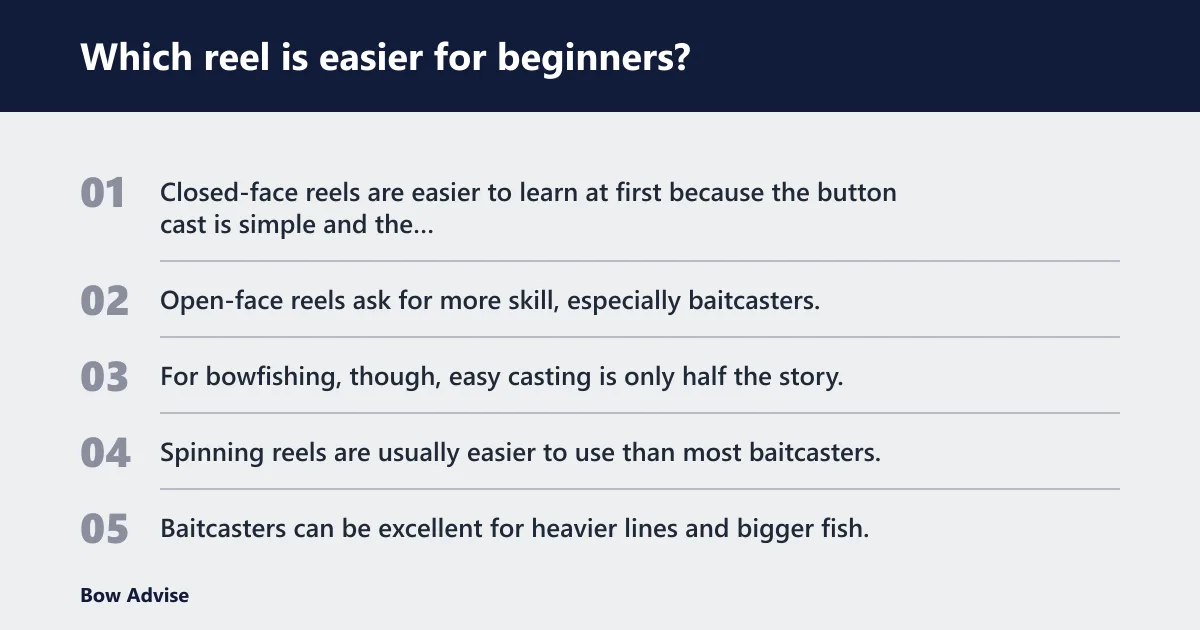
Closed-face reels are easier to learn at first because the button cast is simple and the spool is protected under the nose cone. Open-face reels ask for more skill, especially baitcasters, which need thumb control to avoid backlash. For bowfishing, though, easy casting is only half the story.
How much skill each reel asks for
Spinning reels are usually easier to use than most baitcasters, and they are versatile for light to medium tackle. Baitcasters can be excellent for heavier lines and bigger fish, but the rotating spool adds backlash risk if thumb pressure is wrong.
Closed-face reels ask for less casting skill, but they also give less control once a fish pulls line hard or the crew needs a quick correction. That tradeoff matters in bowfishing because the work happens after release, not only at the cast.
What beginner mistakes look like on the water
A common first-timer mistake is grabbing the line too late after the shot and letting it fall into a loose pile around the reel seat. Another is cranking hard while the line is still crossed, which can bind a closed-face reel or create a backlash on a baitcaster.
Suppose a beginner is on a boat with wet gloves and a 200-grain arrow setup. A closed-face reel may feel simpler for the first few shots, but the moment the line snags inside the nose cone, the fix usually takes longer than most beginners expect.
Which reel is easier to recover after a bad cast or messy grab
Open-face reels are usually easier to recover because the spool, line path, and drag system are exposed. That makes it simpler to clear loose line, reset the bail, or stop a small overrun before it becomes a full stop in the action.
Closed-face reels resist some tangles, but when a snag happens inside the housing, recovery can be slower and less obvious. For bowfishing teams that move fast, that hidden failure point matters more than the simple learning curve.
Which reel handles bowfishing line and retrieval best?
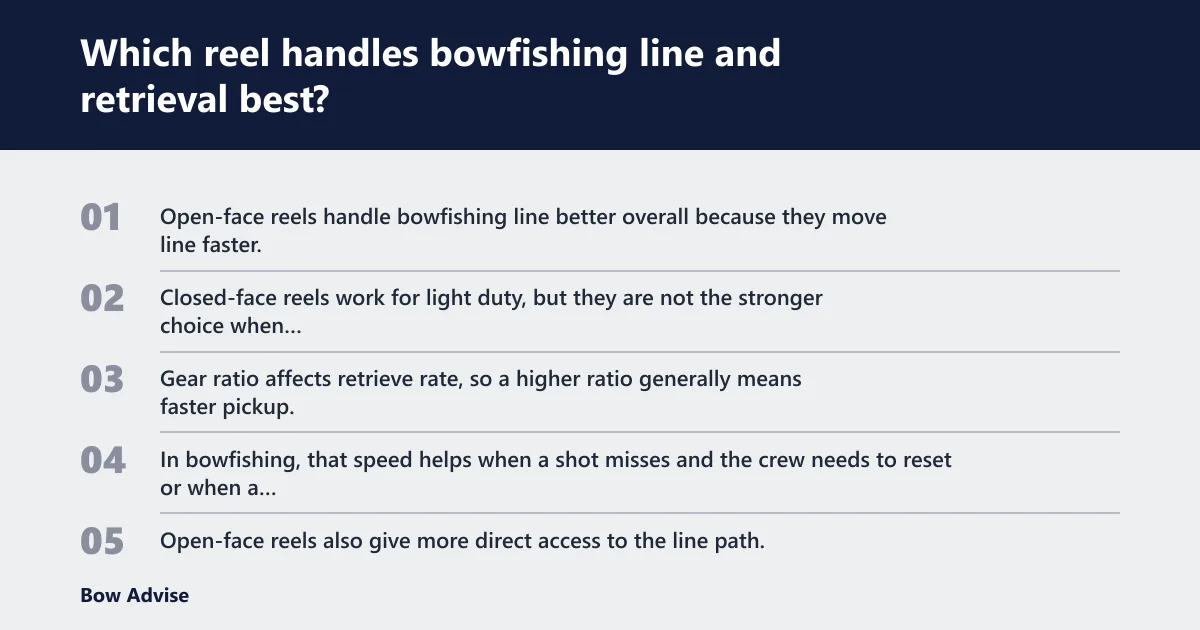
Open-face reels handle bowfishing line better overall because they move line faster, manage heavier setups more easily, and scale better to larger spools. Closed-face reels work for light duty, but they are not the stronger choice when retrieval speed and line capacity matter after the shot.
Line pickup speed after the shot
Gear ratio affects retrieve rate, so a higher ratio generally means faster pickup. In bowfishing, that speed helps when a shot misses and the crew needs to reset or when a fish runs and the line must come in fast before it fouls on the deck.
Open-face reels also give more direct access to the line path. That makes them better for rapid cleanup after splash, slack, or a sudden surge.
Heavy line and line capacity
Line capacity matters because bowfishing often uses heavier line than light freshwater rigs. Reel size and spool size should match the target species and the line diameter, or the reel becomes cramped and hard to manage under load.
Open-face reels, especially larger spinning reels, are better suited to heavier line and bigger fish. Larger spinning reels for saltwater often use aluminum or high-quality graphite for corrosion resistance, which helps when the setup sees harsh water and repeated use.
How spinning reels and baitcasters differ here
Spinning reels are fixed-spool reels. The bail opens during the cast, and line peels off without the spool spinning, which makes them easier to run with light-to-medium tackle and more forgiving for mixed crews.
Baitcasters can handle heavy lures and heavy lines very well, but the thumb-controlled cast and braking system make them less forgiving. For bowfishing, that means they can be strong performers, but only when the user can prevent backlash and manage the spool cleanly.
Do closed face reels tangle less?
Closed-face reels do reduce some tangle risk because the spool sits under a nose cone and the casting system is simpler. They virtually eliminate backlash risk in the usual sense, but they do not eliminate line problems in bowfishing. They can still jam, especially when wet line stacks unevenly.
Backlash on baitcasting reels
Backlash is the bird’s nest tangle that happens when the spool turns faster than the line leaves it. The usual cause is poor thumb control, low braking, or a cast that stalls early.
That failure mode is common for beginners, and it can waste time right when bowfishing needs speed. Baitcasters are powerful, but they punish rushed handling more than spinning reels do.
Tangle points on spinning reels
Spinning reels do not have the same backlash problem because the spool stays fixed during the cast. Even so, line can loop over itself, twist, or catch near the bail if the line is damp and handled carelessly.
In bowfishing, those issues are usually easier to see and clear. That is a practical advantage when the boat deck is wet and the team needs a fast reset.
What the nose cone does and does not prevent
The nose cone protects the spool and helps keep fingers out of the mechanism. It also reduces direct contact with the line path, which is why closed-face reels feel safer to new users.
It does not make the reel immune to line traps, missed button timing, or internal jams. For bowfishing, the nose cone protects parts, but it also hides problems that can slow the whole setup.
How do wet hands, boats, and saltwater change the choice?
Wet hands and boat movement push the decision toward simplicity, fast grab speed, and corrosion resistance. Open-face reels are easier to work by feel, while closed-face reels are easier to understand at first. Saltwater use raises the value of aluminum or high-quality graphite parts.
Wet-hand control and grab speed
Bowfishing often means splashing water, slime, and quick hand movements. An open-face reel gives faster access to the spool and drag knob, which helps when the line must be controlled without looking down for long.
Closed-face reels are simpler to cast, but the nose cone adds one more barrier between the user and the line. That barrier can slow a rapid recovery on a moving boat.
Corrosion resistance and material choice
Corrosion resistance matters more in saltwater and inshore use. Aluminum and high-quality graphite are the materials most worth watching on larger spinning reels because they hold up better than softer, lower-grade parts under repeated exposure.
Closed-face reels are generally better suited for light freshwater fishing and smaller species. That makes them a weaker fit when saltwater durability and heavier line are part of the plan.
What matters on boats versus shore
On a boat, the reel must be fast to clear and easy to control with one wet hand. Open-face reels fit that job better because the line path is visible and the drag is easier to reach.
On shore, a closed-face reel can feel acceptable for casual use, especially for a short learning session. But if the goal is serious bowfishing cadence, open-face still has the better recovery profile.
Bowfishing reel decision matrix
This matrix scores each reel type by what matters after the shot. A higher score means a better fit for bowfishing use, especially in wet, fast-moving conditions where a mistake can stall the session.
| Criterion | Open Face Reel | Closed Face Reel for Bowfishing | Winner |
|---|---|---|---|
| Line pickup speed | 5 | 2 | Open Face Reel |
| Tangling risk | 3 | 4 | Closed Face Reel for Bowfishing |
| Wet-hand control | 5 | 2 | Open Face Reel |
| Beginner recovery | 4 | 3 | Open Face Reel |
| Heavy-line handling | 5 | 2 | Open Face Reel |
| Saltwater tolerance | 4 | 2 | Open Face Reel |
| Maintenance | 4 | 3 | Open Face Reel |
| Cost of mistakes | 4 | 2 | Open Face Reel |
Open-face reels win most rows because bowfishing punishes slow recovery and hidden jams. Closed-face reels only win tangling risk, and even there the advantage is mostly about beginner comfort, not about higher performance under real bowfishing pressure.
Which reel type fits your setup?
Open-face reels are the better default for bowfishing because they reset faster, manage heavier line better, and are easier to clear after a bad grab. Closed-face reels fit a narrow lane: light-duty, simple use, and anglers who value a protected spool more than speed.
Best pick for brand-new bowfishers
If the goal is the least learning curve, start with a closed-face reel only for very casual, light freshwater use. It is simple to cast and reduces backlash risk, but it should not be the first choice for heavier arrows, bigger fish, or fast team shooting.
Best pick for boat bowfishing
For boat bowfishing, a spinning reel is usually the best open-face choice. The fixed spool, open bail, and easier handling with wet hands make it better for fast resets and line control when the deck is moving.
Best pick for heavier fish and heavier line
For heavier line and bigger fish, the best fit is usually a larger spinning reel or a baitcaster only if the user is already comfortable with thumb control and braking. Baitcasters can be strong, but backlash risk makes them less forgiving in bowfishing chaos.
Best pick for low-maintenance use
If low maintenance means fewer user errors and fewer parts to think about, a closed-face reel looks appealing. If low maintenance means easier cleaning, easier inspection, and fewer hidden failures, open-face is the better long-term choice for bowfishing.
Choose open face reel if…
Choose open-face if you want the faster bowfishing setup, better heavy-line handling, and easier recovery after a missed shot or messy grab. It is the stronger choice for boats, bigger fish, saltwater exposure, and anyone who wants the reel to keep up with the shot-to-retrieve cycle.
Choose closed face reel for bowfishing if…
Choose closed-face only if you value simplicity above speed and you are fishing light freshwater setups with smaller species. It is the safer-feeling option for complete beginners, but it gives up too much speed and control to be the best all-around bowfishing reel.
Frequently asked questions
What is the difference between an open face reel and a closed face reel for bowfishing?
An open-face reel leaves the spool exposed and includes spinning reels and baitcasting reels. A closed-face reel, also called a spincast reel, houses the spool and line pick-up mechanism under a nose cone and uses a button on the back for casting. In bowfishing, that difference changes how fast you can reset after a shot.
Is an open face reel better than a closed face reel for beginners?
Not always for the first cast, but usually yes for bowfishing overall. Closed-face reels are easier to learn at first and virtually eliminate backlash risk, yet open-face reels are easier to recover after a mistake and work better once the pace picks up on the water.
Which reel is easier to use for bowfishing on a boat?
Open-face reels are usually easier on a boat because they give faster line access and better wet-hand control. A spinning reel is the simplest open-face option for this job. Closed-face reels can feel easier at first, but their slower recovery can hurt when the boat is moving and time matters.
Do closed face reels tangle less than open face reels?
Yes, in the narrow sense that they reduce backlash and protect the spool under a nose cone. But they can still jam, trap line, or slow recovery when wet line stacks badly. In bowfishing, fewer visible tangles do not always mean less downtime.
Which reel casts farther for bowfishing line and retrieval arrows?
Open-face reels are said to offer superior casting distance and precision. That matters less than retrieval speed in bowfishing, but it still helps when you need to place line or manage distance with retrieval arrows. Closed-face reels are usually limited to shorter, simpler use.
Can you use a spincast reel for bowfishing?
Yes, but only for light-duty setups where simplicity matters more than speed. Spincast reels are the closed-face option, and they are best suited for light freshwater fishing and smaller species. They are not the best match for heavier line, bigger fish, or aggressive bowfishing use.