Bowfishing Reel vs Spincast Reel: Which One Wins?
Choose a bowfishing reel if speed, simple rigging, and lower upkeep matter most; choose a spincast reel if you want a familiar trigger-style retrieve and can handle extra bulk. Pick the wrong one, and you waste shots, burn time clearing line, or fight a setup that fails when a fish runs. This guide compares speed, setup complexity, durability, and beginner tolerance.
This guide is part of our Bowfishing from shore and without a boat series.
Bowfishing reel vs spincast reel: the core trade-off


Bowfishing means shooting fish with a bow and a tethered arrow. The split is simple. A bowfishing reel centers on line control and fast recovery, while a spincast reel leans on a push-button feel and cleaner line containment. That matters because bowfishing is close, active, and hands-on.
| Decision factor | Bowfishing Reel | Spincast Reel | Winner |
|---|---|---|---|
| Shot speed | Fast line payout and quick recovery suit repeated shots. | Slower after the shot because you still have to crank line back. | Bowfishing Reel |
| Tangles | Depends more on setup and line handling. | Enclosed housing helps reduce exposed-line tangles. | Spincast Reel |
| Bow weight | Can be lighter or heavier depending on style; hand-wrap is the lightest, retriever adds 8-12 ounces. | Usually adds less than a retriever, but still adds bulk on the riser. | Spincast Reel |
| Learning curve | More setup choices and more line management. | Push-button release feels familiar to many beginners. | Spincast Reel |
| Maintenance | More moving parts or more exposed line, depending on style. | Simple to understand, but the housing and internal parts still need care. | Tie |
| Saltwater durability | Varies by materials; exposed hardware needs routine rinse-down. | Enclosed housing helps, but corrosion still affects springs, screws, and mounts. | Tie |
| Best use case | Fast shots, higher-volume shooting, and efficient retrieval. | Beginner-friendly shore shooting and simple handling. | Depends on use case |
Shot speed
Bowfishing reel systems are built for fast line control after the arrow lands or misses. That matters when fish keep moving and the next shot comes fast. Spincast reels can work, but manual cranking slows the reset, especially during repeated-shot sessions.
Tangles
Spincast reels cut exposed-line mess because the line sits inside an enclosed housing with a push-button release. That helps new shooters who are still learning arrow handling. A bowfishing reel can work just as well, but poor rigging or loose line turns into frustration fast.
Bow weight
Reel weight changes how the bow feels at full aim and during follow-up shots. Retriever reels add 8-12 ounces to bow weight, enough to shift balance forward on a beginner rig. That extra mass can help some shooters hold steady, but it also adds fatigue during longer sessions.
Learning curve
Spincast reels are easier to picture because the release is familiar: press, shoot, crank. That simplicity lets beginners focus on target reading instead of line handling. Bowfishing reels ask for more attention to retrieval method, mounting, and line management, so they reward practice more than instinct.
Maintenance
Maintenance cost is not only about the reel itself. It also includes line replacement, mount hardware, and the time lost when a setup is slightly off. Hand-wrap reels keep ownership simple, retriever reels add mechanical complexity, and spincast reels sit in the middle.
Saltwater durability
Saltwater bowfishing changes the equation. Corrosion resistance matters, and rinse-down habits become part of the setup, not an afterthought. Any reel with springs, screws, bearings, or exposed mounts needs more care in saltwater, and poor cleanup shortens service life.
📊 Most bowfishing bows have little to no let-off and are typically designed for 40–50 pounds of draw weight. Source: Bowfishing.
How each reel works on a bow
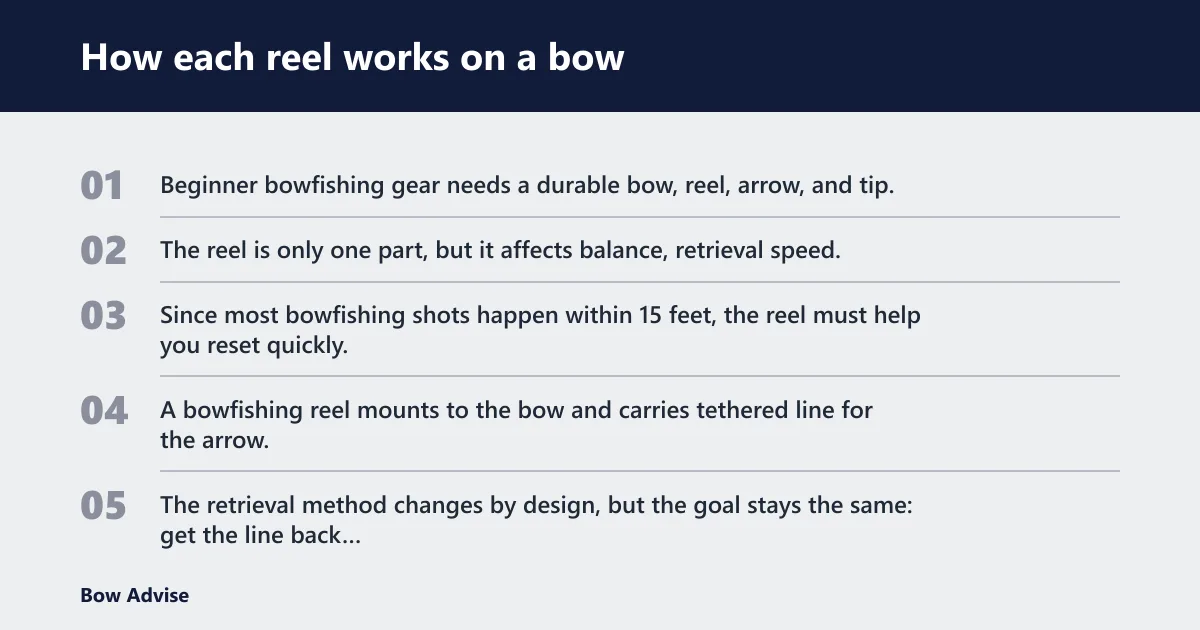
Beginner bowfishing gear needs a durable bow, reel, arrow, and tip. The reel is only one part, but it affects balance, retrieval speed, and how often line tangles break the shot rhythm. Since most bowfishing shots happen within 15 feet, the reel must help you reset quickly, not just hold line.
Bowfishing reel: tethered line, retrieval method, and mounting impact
A bowfishing reel mounts to the bow and carries tethered line for the arrow. The retrieval method changes by design, but the goal stays the same: get the line back fast enough to keep fishing. Mounting style matters because a bulky reel changes how the bow balances in the hand.
Line capacity matters less than many beginners think, because most shots are short. A practical starting point is 25-30 yards of 200-pound test line for any reel style. That is enough for close work while keeping extra line from turning into clutter.
Spincast reel: enclosed housing, push-button release, and manual cranking after the shot
Spincast reels use an enclosed housing with a push-button release. That housing helps reduce line exposure and can calm the learning process for new bowfishers. After the shot, though, line retrieval still depends on manual cranking, so speed drops compared with more purpose-built bowfishing systems.
That slower reset works for relaxed shoreline fishing or low-volume sessions. It becomes a poor fit when fish move fast, multiple shots come in a short window, or a shooter wants a quicker return to ready position.
Where retriever reels and hand-wrap reels fit in
Retriever reels use a spring inside the drum to pull line back automatically after each shot. They are common beginner-friendly options because they remove one step from the reset cycle, but they also add 8-12 ounces to bow weight and more component complexity. Hand-wrap reels are the lightest option at 2-4 ounces and cost $15-40, but they demand manual line wrapping after each shot.
That makes hand-wrap reels the fastest reload for experienced users who want simplicity and low cost. For many beginners, though, the low weight comes with a learning curve that can be harder than a spincast reel.
Which reel is easier to learn?
A spincast reel is usually easier for a beginner to understand because it uses a push-button release and enclosed housing. That does not make it the fastest option, but it does cut early mistakes. A retriever reel can feel simpler after the shot, while a hand-wrap reel is the plainest mechanically but least forgiving when line handling gets sloppy.
Beginner error tolerance and tangle reduction
Error tolerance matters more than most people expect. If the line snags, piles up, or slips under the wrong guide, a beginner loses confidence fast. Spincast reels reduce exposed-line tangles better than open, manual systems, which is why they can feel calmer in the first few outings.
Say your first setup is used from a dock with a 40-inch bow and a short tethered arrow. If the line feeds cleanly and the reel body keeps slack contained, you spend more time aiming and less time fixing knots.
Shot recovery time for new bowfishers
Recovery time is the hidden cost of an easy-feeling reel. Spincast models still need cranking, so the arrow is not back in play as quickly as with a retriever-style reset. For a beginner shooting a few fish, that may be fine. For a beginner trying to keep pace with moving fish, it can feel slow.
When a simpler reel becomes too slow
Simple is not always efficient. A reel that feels easy on the dock can become a bottleneck when the target window is short and the fish do not hold still. In that setting, the extra half-step of manual cranking or line management can cost real shots.
Side-by-side decision table and beginner matrix
This comparison works best when the choice is tied to how you shoot. The table below keeps the decision anchored to speed, balance, and upkeep instead of vague claims. It also shows why a reel that is easy to learn is not always the reel that fits higher-volume shooting.
| Criterion | Bowfishing Reel | Spincast Reel | Winner |
|---|---|---|---|
| Shot speed | Built for faster reset and line management. | Manual cranking slows recovery after the shot. | Bowfishing Reel |
| Tangles | Depends on rigging discipline and line care. | Enclosed housing helps reduce exposed-line tangles. | Spincast Reel |
| Bow weight | Retriever reels add 8-12 ounces; hand-wrap stays at 2-4 ounces. | Usually less bulky than a retriever, but still adds mass. | Spincast Reel |
| Learning curve | More moving parts or more manual line handling. | Push-button release is easier for most beginners. | Spincast Reel |
| Maintenance | More setup sensitivity, plus line and mount upkeep. | Lower setup burden, but the housing still needs care. | Spincast Reel |
| Saltwater durability | Varies by materials; exposed parts need frequent rinse-down. | Better line protection, but hardware still corrodes. | Tie |
| Best use case | Fast shots, high-volume sessions, retriever-style setups. | Beginners, shore-based shooting, simple handling. | Depends on use case |
| User type | Better pick | Why |
|---|---|---|
| Beginners | Spincast Reel | Lower learning burden and better tangle control. |
| Shoreline users | Spincast Reel or hand-wrap reel | Simple handling matters more than maximum retrieval speed. |
| Saltwater users | Bowfishing Reel with corrosion-resistant materials | Rinse-down habits and durable hardware matter more than enclosed line alone. |
How much line, weight, and balance do you actually need?
Most bowfishing shots happen within 15 feet, so giant line capacity is rarely the priority. A practical setup is 25-30 yards of 200-pound test line, which leaves room for close-range work without adding unnecessary clutter. Bow balance becomes the next filter, because heavy reels change aim steadiness and fatigue.
Typical bowfishing shot distance and practical line capacity
Short range is the norm. That means the reel does not need to carry huge amounts of line the way some fishing setups do. More line can create more mess, more drag, and more chances for poor setup to show up at the worst time.
How reel weight changes bow balance and fatigue
Weight on the front of the bow changes how long a shooter can hold steady. A retriever reel adds 8-12 ounces, which is meaningful on a lightweight beginner bow. Over a longer session, that can turn into hand fatigue and slower follow-up shots.
Picture a shoreline setup with a short draw and repeated 10- to 15-foot shots. If the front of the bow feels nose-heavy, the shooter often starts dipping the point before the fish is fully tracked.
Bowfishing line strength, braid options, and visibility
Bowfishing line commonly uses braided nylon, Dacron, or Spectra, with weights from 80 to 400 pound test. A common recommendation is a heavy test line for general use. Bright line color helps visibility during retrieval, especially when the goal is to see where slack or drag has formed.
Choose bowfishing reel if… / Choose spincast reel if…
Choose a bowfishing reel if you want faster shot recovery, higher-volume shooting, and a rig that keeps pace once you are past the first learning stage. Choose a spincast reel if your top priorities are simple handling, tangle reduction, and a familiar release style. The right pick depends on how often you shoot, not just how easy the reel sounds.
Choose bowfishing reel if…
Pick this route if you expect repeated shots in a short time, want to reset quickly, or plan to use a retriever-style setup. It also fits better when you care more about shot speed than the last ounce of setup simplicity. In saltwater, choose it only if the hardware and line care are part of the routine.
Choose spincast reel if…
Pick this route if you are learning, shooting from shore, or want fewer exposed-line headaches. It is also a better fit when the session is casual and you do not need top-end recovery speed. For a first reel, that lower friction often matters more than raw pace.
What works best in saltwater bowfishing?
Saltwater bowfishing rewards corrosion resistance and punishes neglect. Rinse-down habits matter because salt works into screws, springs, mounts, and line hardware. A reel that feels fine on day one can wear out early if the cleanup routine is inconsistent.
Corrosion resistance and rinse-down habits
Saltwater setups need regular freshwater rinse-down after use. That matters especially around mounting hardware and any moving parts inside retriever or spincast bodies. If a reel uses a spring mechanism or enclosed housing, dry storage after rinsing is part of the maintenance cycle.
Hardware wear, line care, and reel materials
Line should be checked for abrasion, stiffness, and salt buildup. Braided line holds up well in bowfishing use, but repeated salt exposure still shortens service life. Corrosion-resistant materials help, yet no reel is maintenance-free in marine conditions.
When a more complex reel is worth the upkeep
A more complex reel is worth it when the shot pace is high enough to justify the extra care. That is the trade, more speed and better retrieval logic in exchange for more cleaning and more places for wear to appear. For occasional shoreline shooting, a simpler system may be the smarter ownership decision.
What is the difference between a bowfishing reel and a spincast reel?
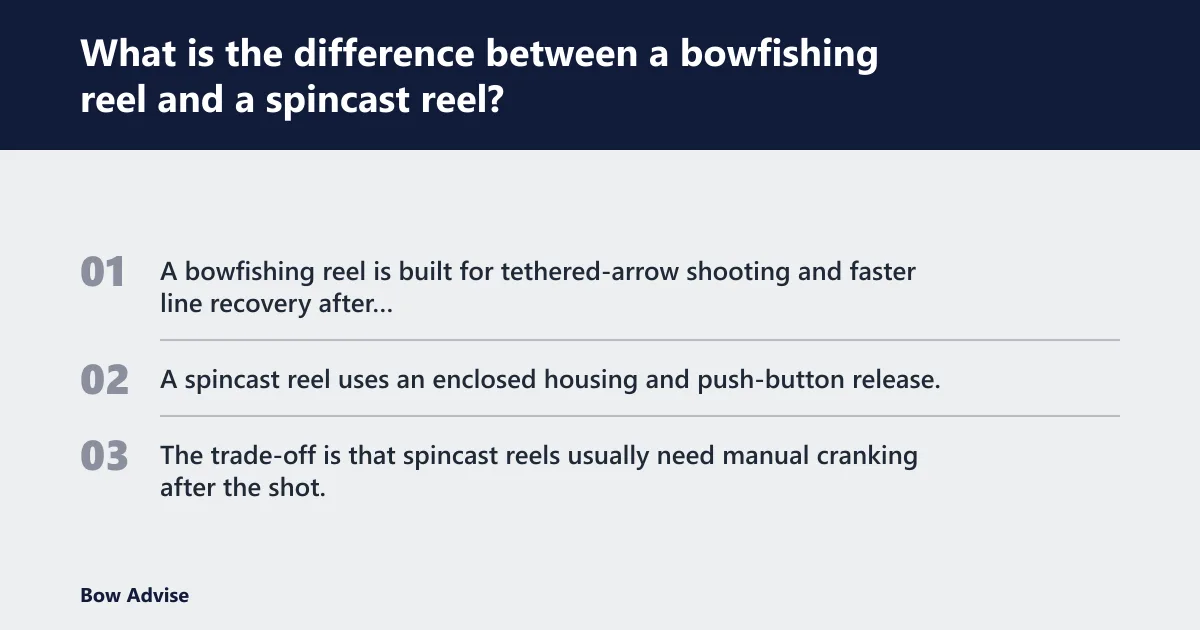
A bowfishing reel is built for tethered-arrow shooting and faster line recovery after the shot. A spincast reel uses an enclosed housing and push-button release, which helps reduce tangles and makes it easier to learn. The trade-off is that spincast reels usually need manual cranking after the shot, so recovery is slower.
Is a spincast reel good for bowfishing beginners?
Yes, a spincast reel is often a good beginner choice because it is simple to understand and reduces exposed-line tangles. That said, it is not the fastest option after the shot. Beginners who care more about comfort and fewer mistakes than raw speed often do well with it.
Which bowfishing reel is best for fast shots?
A bowfishing reel is the better pick for fast shots, especially retriever-style setups that automatically pull line back after each shot. A hand-wrap reel can reload very quickly in skilled hands, but it demands more manual line handling. Spincast reels are usually slower because you still have to crank line back.
How much does a spincast or retriever reel weigh?
Retriever reels add 8-12 ounces to bow weight according to the comparison material, which is enough to affect balance on a beginner bow. Spincast reels are usually lighter than a retriever system, but exact weight varies by model and mounting hardware. The practical issue is balance, not just the scale number.
Can I use a regular fishing reel for bowfishing?
A regular fishing reel is not the standard choice for bowfishing because bowfishing is close-range, active, and tied to the arrow line. Purpose-built bowfishing reels, retriever reels, spincast reels, and hand-wrap reels fit the task better. A regular reel also adds complexity without solving common bowfishing handling problems.
What reel works best in saltwater bowfishing?
The best saltwater choice is the reel that combines corrosion-resistant materials with a cleanup routine you will actually follow. Bowfishing reels with fewer vulnerable parts can be easier to maintain, while enclosed spincast bodies may help protect line but still need rinse-down care. Saltwater punishes every weak point.
How much line capacity do I need on a bowfishing reel?
For most beginners, 25-30 yards of 200-pound test line is a practical target. Most shots happen within 15 feet, so huge capacity is unnecessary for normal use. Extra line only makes sense if you expect unusual distances or want a margin for poor angle control.
Which reel is easier to use when learning bowfishing?
A spincast reel is usually easier to use at the start because the push-button release and enclosed housing reduce simple mistakes. It is not the fastest after the shot, but it lowers early frustration. For many beginners, that is the real advantage: fewer tangles and a cleaner learning curve.