AMS Bowfishing Reel Review
AMS Retriever Pro is the best all-around AMS bowfishing reel for most anglers because its enclosed bottle design, fast retrieval, and 35-yard line setup balance speed, safety, and easy mounting better than a basic spincast reel. Pick the wrong reel and you waste shots, fight line tangles, and spend more time fixing gear than fishing. This review covers AMS reel specs, setup fit, corrosion resistance, and which model makes sense for beginners versus high-volume bowfishers.
Verdict

Based on the listed specs and buyer-facing design, the Retriever Pro is a strong buy for freshwater beginners and boat anglers who want a simple retriever-style reel. It fits poorly if you prefer a button-release spincast feel, or if you want a reel that feels more like a control-heavy fighting reel than a draw-and-shoot system.
Specs at a glance
| Spec | AMS Retriever Pro | Why it matters |
|---|---|---|
| Retrieval per crank | 27 inches | Defines how fast slack comes back in after a shot. |
| Gear ratio | 4.3:1 | Supports steady line pickup without a complicated setup. |
| Line included | 35 yards of 350 lb Spectra braid | Ready-to-use line matters for first setup and consistency. |
| Retrieval style | Free-spooling bottle design | Lets the line leave smoothly for the shot. |
| Internal materials | Machined brass gears; stainless steel parts | These parts are tied to wear resistance and corrosion control. |
| Housing | Corrosion-resistant | Important for freshwater use and more careful saltwater use. |
| Mounting | Quick-release mount | Helps with install, removal, and switching bows. |
| Safety feature | EverGlide Safety Slide | Relevant to line handling and shot workflow. |
| Made in | USA | Useful for buyers who care about origin and parts consistency. |
| Listed price | $129.99 | Sets the value bar against Cajun and Muzzy options. |
Who it
The Retriever Pro fits anglers who want a retriever-style reel with no button to push, simple draw-and-shoot handling, and manual line tension. That makes it easier to learn than many spincast systems, especially for archers who want fewer controls between drawing the bow and sending the shot.
Freshwater beginners
For a first bowfishing reel, this is an easy fit if the goal is to keep the setup simple. The free-spooling bottle design and pre-spooled 350 lb Spectra braid remove two early setup chores, and the quick-release mount helps when the reel needs to move between bows or be removed for storage.
Boat-based bowfishers
Boat anglers often need quick, repeatable line pickup more than complex control. The 27 inches per crank and 4.3:1 gear ratio help here, while the enclosed design keeps loose line better contained than a wide-open reel body. That matters when the deck space is tight and feet, cleats, and gear can snag slack line.
Anglers who want simple draw-and-shoot handling
Retriever-style reels are built for a plain sequence: draw, shoot, retrieve. There is no release button to manage, so the learning curve stays shorter than on many spincast bowfishing reels. That simple workflow is the main reason the Retriever Pro can feel easier to trust during a fast shot window.
What works well
The best part of the Retriever Pro is that its core parts pull in the same direction: speed, simplicity, and a ready-to-fish setup. The reel is positioned as beginner-friendly and simple to operate, and the listed internals support that claim more than a generic plastic-bodied reel would.
Retrieval speed and free-spool behavior
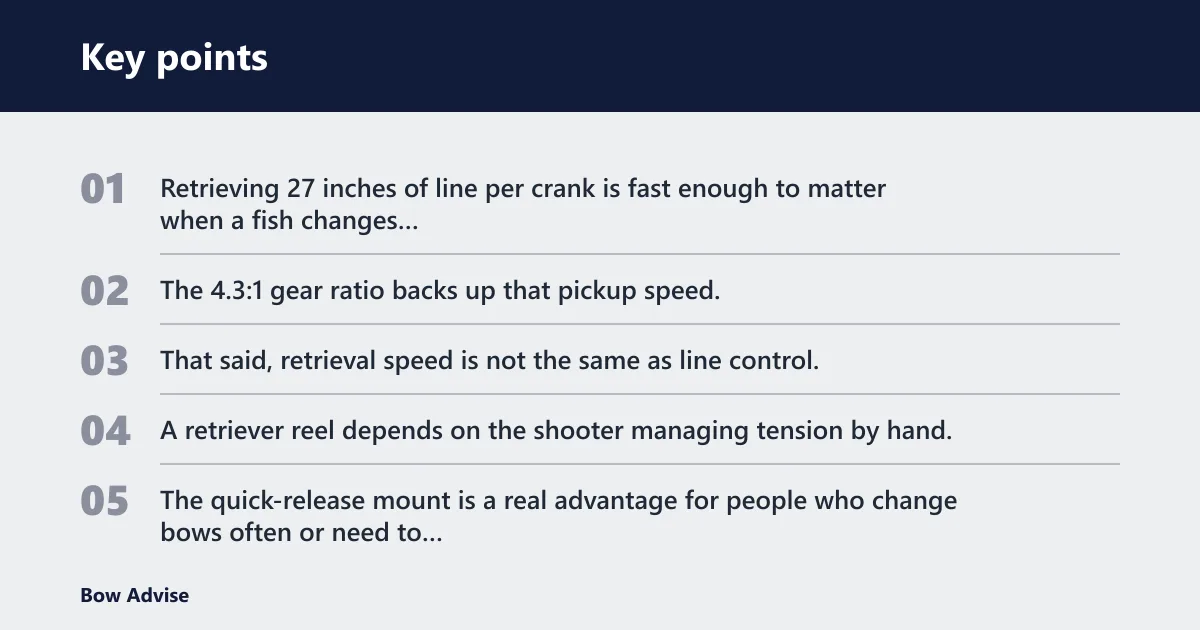
Retrieving 27 inches of line per crank is fast enough to matter when a fish changes direction or when a missed shot leaves line to recover quickly. The 4.3:1 gear ratio backs up that pickup speed, and the free-spooling bottle design helps the line leave smoothly on the shot instead of fighting the reel body.
That said, retrieval speed is not the same as line control. A retriever reel depends on the shooter managing tension by hand, so the angler still has to avoid slack loops, uneven wraps, and a messy pull after the shot.
Mounting and quick-release convenience
The quick-release mount is a real advantage for people who change bows often or need to strip accessories off a setup before transport. The mount also matters because bowfishing reels must fit securely enough to stay aligned through repeated shots, yet still allow service or removal without a long teardown.
Quick-release hardware is useful only if the bow’s mounting area matches the reel’s footprint cleanly. A loose fit can create movement, and movement can turn into poor line feed or a reel that feels like it is climbing out of position under load.
Ready-to-use line setup
The reel comes pre-spooled with 35 yards of 350 lb Spectra braid. That is a practical setup for buyers who want to fish sooner, because the line choice is already matched to bowfishing duty and the spool is not empty out of the box.
Spectra braid is a better fit here than light, stretchy line because bowfishing needs abrasion resistance and direct control. The 350 lb rating signals a high-strength line built for typical bowfishing work, not a general-purpose fishing reel spool.
What does not?
The biggest drawback is that retriever-style simplicity can hide setup problems until the first shot. Line twist, uneven wraps, and mount misalignment can all show up as function issues that look like reel defects. In many cases, the reel is fine; the installation or line handling is not.
Line twist and lift issues
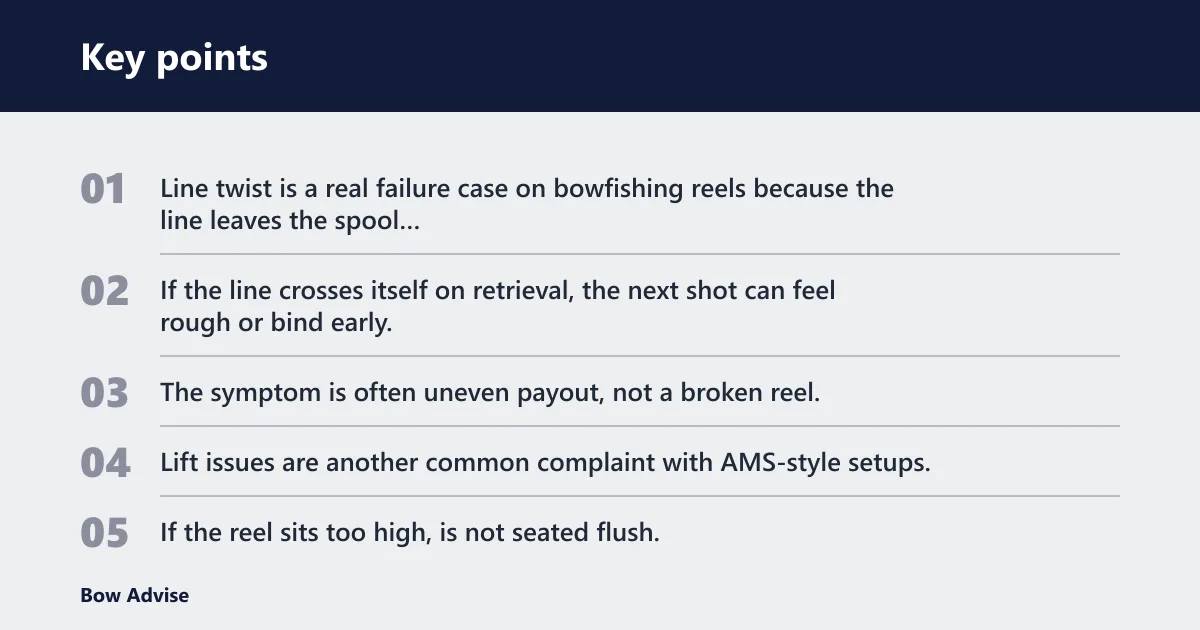
Line twist is a real failure case on bowfishing reels because the line leaves the spool under quick movement and then returns under tension. If the line crosses itself on retrieval, the next shot can feel rough or bind early. The symptom is often uneven payout, not a broken reel.
Lift issues are another common complaint with AMS-style setups. If the reel sits too high, is not seated flush, or the mount hardware is not tightened in the right order, the reel can shift during use. That usually shows up as the reel not tracking straight, or as visible movement where the mount meets the bow.
Where retriever style falls behind spincast reels
Retriever-style reels are simpler, but spincast bowfishing reels can be better when the angler wants more control over release behavior. A spincast reel uses a button or lever release, which can help with more deliberate handling of larger fish or situations where controlled pickup matters more than a very simple draw-and-shoot rhythm.
The tradeoff is mechanical complexity. Spincast reels usually bring more moving parts than a retriever reel, and that can mean more setup points, more cleaning, and more chances for a beginner to get the release wrong on the first few outings.
Saltwater caution
The corrosion-resistant housing, stainless steel parts, and machined brass gears are the right material mix for better durability, but saltwater is still harder on reels than freshwater. Salt, spray, and poor storage habits can attack fasteners, moving joints, and line contact points even when the housing itself looks fine.
If the reel is used in saltwater, rinse it promptly with fresh water, dry it fully, and avoid storing it wet in a closed gear bag. The brass gears and stainless parts help, but they do not cancel out salt residue left in threads, around the mount, or inside the line path.
Bowfishing reel decision matrix
| Retrieval style | Retrieval per crank | Line type | Beginner-friendliness | Corrosion risk | Best use case | Common failure mode |
|---|---|---|---|---|---|---|
| Retriever-style | 27 inches | 35 yards of 350 lb Spectra braid | High | Moderate; lower with rinsing and dry storage | Freshwater beginners, boat anglers, simple draw-and-shoot setups | Line twist or mount lift from poor setup |
| Spincast-style | Varies by model | Varies by model | Moderate | Moderate to higher, depending on parts and care | Anglers who want button or lever release and more controlled handling | Release misuse, extra part wear, or line control confusion |
| Freshwater beginner | 27 inches is enough for fast pickup | 350 lb Spectra braid is a ready setup | High | Low to moderate | Learning basic bowfishing with fewer controls | Overthinking the release or winding with slack in the line |
| Saltwater user | 27 inches is still useful | 350 lb Spectra braid can work, but needs care | Moderate | Higher without rinsing and dry storage | Short trips with strict rinse-and-dry habits | Salt buildup on threads, mount, or moving parts |
| Boat angler | 27 inches supports quick recovery | Pre-spooled braid saves setup time | High | Moderate | Tight deck spaces and repeated shot cycles | Loose line snagging on deck hardware if retrieval is sloppy |
Short recommendations
- Freshwater beginners: choose the Retriever Pro if you want the simplest path into bowfishing and do not need a button-release reel.
- Saltwater users: choose it only if you are disciplined about rinsing, drying, and storage after every trip.
- Boat-based anglers: choose it when fast recovery, compact handling, and easy remounting matter more than adjustable release control.
Which AMS reel is better: Retriever Pro or Retriever TNT?
The Retriever Pro is the better fit for simpler setups, while the Retriever TNT makes more sense only when the buyer wants a different retriever-style setup and is willing to verify the exact configuration before buying. For most readers, the Pro is the safer default because its listed specs are clearer and easier to match to a first bowfishing build.
Which one fits simpler setups?
Retriever Pro fits the simpler setup better because the core details are fully spelled out: 27 inches per crank, 35 yards of 350 lb Spectra braid, free-spooling design, quick-release mount, and a beginner-friendly format. That combination leaves fewer unknowns for a first-time buyer trying to match a reel to a bow.
Which one suits higher-volume shooting?
For higher-volume shooting, the deciding factor is not only speed but also how often the reel will be removed, cleaned, and checked. The Retriever Pro already covers fast pickup and corrosion-resistant parts, so it remains the cleaner choice unless the TNT’s exact setup offers a specific feature the buyer truly needs.
What to verify before buying either
- Check that the mount fits the bow’s sight holes or mounting area cleanly.
- Confirm whether the reel sits level and does not interfere with the bow’s grip or rest.
- Inspect line path clearance so the braid leaves and returns without rubbing hard edges.
- Look at how the reel locks down, because lift issues often start at the mount.
- Decide whether retriever-style handling or spincast-style release control better matches the way you shoot.
Alternatives

Cajun Bowfishing Winch Pro Reel is the clearer alternative for anglers who want one-handed operation and a fighting wheel brake. It can appeal when control matters more than retriever-style simplicity, but that added control can also mean a more complex feel for a first-time buyer. Its universal fit is useful, yet fit still needs to be checked on the actual bow.

Muzzy Bowfishing Tounament Reel is the more control-heavy option here, with an elongated hood, dual stainless steel pickup pins, and a one-way anti-reverse bearing. That setup suits anglers who want a more involved reel feel, but it is less direct than the Retriever Pro’s no-button retriever layout. The higher price also makes it a less obvious value buy for beginners.
Should you buy it?
Buy the AMS Retriever Pro if you want a retriever-style bowfishing reel that is easy to mount, quick to recover line, and ready to fish with 35 yards of 350 lb Spectra braid already installed. It is a strong match for freshwater beginners and boat anglers who value simple handling more than extra controls.
Skip it if you want spincast-style release control, if you fish saltwater often without a strict rinse routine, or if your bow setup is known to be finicky around mounts and accessory alignment. In those cases, the better decision is to choose a reel that matches the way you shoot, not just the price tag.
Frequently asked questions
Is the AMS Bowfishing Retriever Pro worth it?
Yes, for buyers who want a simple retriever-style reel with concrete, useful specs: 27 inches per crank, 35 yards of 350 lb Spectra braid, a 4.3:1 gear ratio, and a quick-release mount. It is especially worth it for beginners and boat anglers who want less setup friction and fewer controls.
How does the AMS Retriever Pro compare to spincast bowfishing reels?
The Retriever Pro is simpler. It uses a free-spooling bottle design with no button to push, so the shot cycle stays direct. Spincast reels use a button or lever release and can offer more controlled handling, but they usually bring more moving parts and a steeper learning curve.
What line comes pre-spooled on the AMS Bowfishing Retriever Pro?
It comes pre-spooled with 35 yards of 350 lb Spectra braid. That matters because it gives the buyer a ready-to-use bowfishing line setup instead of leaving the spool empty or requiring a separate line purchase before the first trip.
How much line does the AMS Retriever Pro retrieve per crank?
The AMS Retriever Pro retrieves 27 inches of line per crank. That is a useful pickup rate for recovering slack quickly after a shot, especially on a boat or in any setup where rapid line recovery helps keep the fishing rhythm moving.
Is the AMS Retriever Pro good for beginners?
Yes. It is described as beginner-friendly and simple to operate, and the retriever-style design keeps the workflow plain: draw, shoot, retrieve. Beginners still need to mount it correctly and manage line tension, but the reel itself is easier to learn than many spincast alternatives.
Can the AMS Retriever Pro be used in saltwater?
It can be used in saltwater with caution, but it is not a fit-and-forget choice. The corrosion-resistant housing, stainless steel parts, and machined brass gears help, yet salt still demands prompt rinsing, full drying, and careful storage. The mount and line-contact areas deserve extra attention.
What are the common problems with AMS bowfishing reels?
The common problems are line twist, lift issues, and mount misalignment. Line twist usually shows up as uneven payout or rough retrieval. Lift issues usually point to the reel sitting poorly on the bow or the mounting hardware not being tightened correctly. Those symptoms are often setup-related.
What should I check before mounting an AMS reel on my bow?
Check the mount fit, sight-hole alignment, and line clearance first. Make sure the quick-release hardware seats flat and that the reel does not interfere with the grip, rest, or bow movement. A secure, level mount prevents many of the problems that buyers mistake for reel defects.