Is the Garmin Xero Bow Sight Worth It?
The Garmin Xero makes sense for bowhunters who shoot at changing, unknown distances and care more about faster ranging and pin selection than price. If your shots are simple and pre-ranged, it is usually overpriced. Buy it for the wrong setup, and you pay a heavy premium for features that do little to improve hit probability. This guide breaks down when the Xero saves time and shots, when a standard sight is the better buy, and what to compare before spending.
Garmin introduced the Xero A1 and A1i as auto-ranging digital laser bow sights. The package combines a rangefinder and bow sight in one unit, then gives the archer a precise virtual lighted pin after distance is measured.
What the Garmin Xero

What the integrated range-and-sight package changes
The value in the field is shaving steps. Instead of ranging with one tool, lowering it, then finding the right pin on another tool, the Xero folds those steps into the sight picture. That matters most when a deer steps out at an odd angle and the shot window is short.
The trade-off is cost and dependence on electronics. A conventional single-pin sight and a lightweight rangefinder still make more sense for hunters who already know their distances, shoot from fixed lanes, or prefer a setup that works with no digital display at all.
A1 and A1i at a glance
| Model | Starting price | Range on game | Notable features | Battery and weather |
|---|---|---|---|---|
| Xero A1 | $799.99 | up to 100 yards | virtual lighted pin, angle-compensated ranging, silent trigger | two AAA lithium batteries, about one-year battery life, IPX7 water rating |
| Xero A1i | $999.99 | up to 100 yards | dual-color LED pins, Laser Locate, multiple arrow profiles, shot dynamics data | two AAA lithium batteries, about one-year battery life, IPX7 water rating |
Garmin Xero decision matrix
Use this matrix as a buying filter, not a popularity contest. Lower setup time and movement reduction score better because they help in the field. Lower legality risk scores better because it means fewer compliance concerns. Lower total gear cost scores better because a cheaper setup is easier to justify.
| Hunter type | Setup time | Movement reduction | Legality risk | Backup usability | Total gear cost | Buy / no-buy |
|---|---|---|---|---|---|---|
| Tree stand hunter | 4/5 | 5/5 | 3/5 | 3/5 | 2/5 | Buy if shots change often and the state allows it |
| Spot-and-stalk hunter | 5/5 | 5/5 | 3/5 | 3/5 | 2/5 | Buy if the hunter values fast ranging over cost |
| Budget hunter | 2/5 | 3/5 | 3/5 | 2/5 | 5/5 | No-buy unless the budget can absorb the premium |
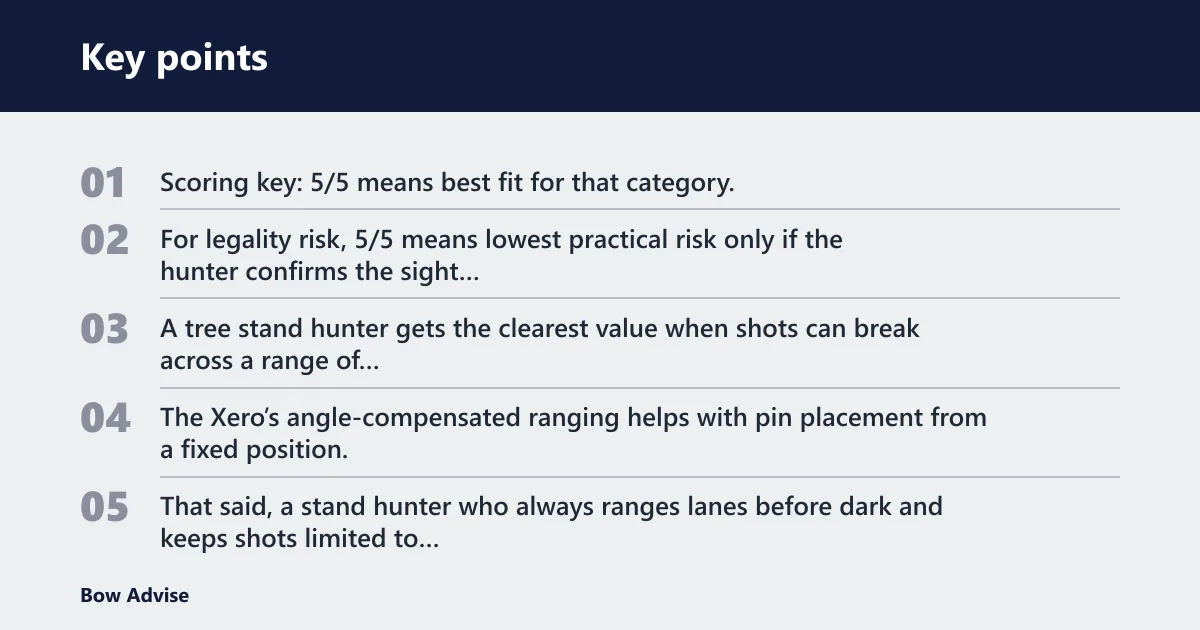
Scoring key: 5/5 means best fit for that category. For legality risk, 5/5 means lowest practical risk only if the hunter confirms the sight is allowed under current state rules; the number is not a legal opinion.
Garmin xero bow sight scorecard
A tree stand hunter gets the clearest value when shots can break across a range of distances and angles. The Xero’s angle-compensated ranging helps with pin placement from a fixed position, and the silent trigger reduces the movement that can spook deer at full draw.
That said, a stand hunter who always ranges lanes before dark and keeps shots limited to a few known distances may not recover the cost quickly. In that case, the Xero is convenient, but not necessary.
Garmin xero bow sight scorecard
Spot-and-stalk hunting is where the Xero makes the strongest case. The hunter often closes distance, then needs a fast decision at an odd angle. The sight’s at-rest and full-draw ranging reduces the number of separate actions before the shot.
Suppose a hunter is kneeling at 47 yards on an open slope and the animal starts angling away. A conventional setup can still work, but it demands more motion and more steps. The Xero trims that sequence, which can matter more than it does from a stand.
Garmin xero bow sight scorecard
Budget hunters are usually better served by a separate sight and rangefinder. The upfront price is only part of the cost. Battery replacement, potential service needs, and lower resale value all make the Xero harder to justify when the current setup already meets the hunter’s needs.
A common first-timer mistake is paying for electronics to solve a confidence problem that better practice would solve first. If the hunter already shoots well with a single-pin sight and knows exact yardage in the hunting area, the Xero may add cost without adding much real advantage.
How does the Garmin Xero work?
The Xero works by measuring distance and then placing a precise virtual lighted pin in the sight picture. The archer can range from rest or at full draw, and the system uses angle-compensated rangefinding to help with pin placement on uphill or downhill shots.
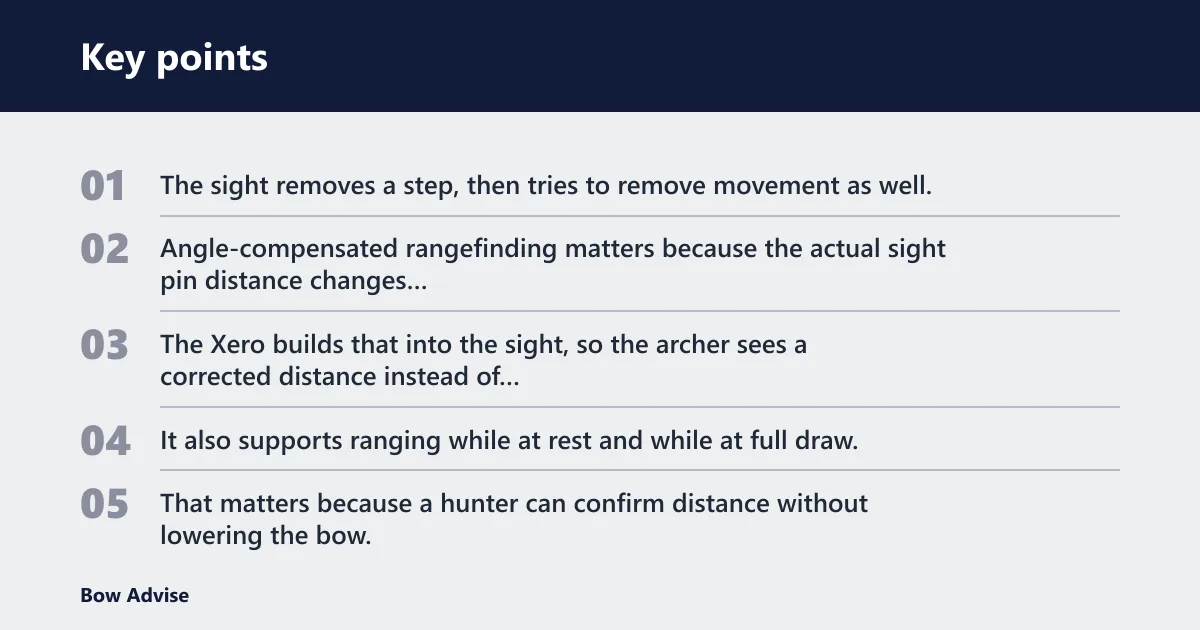
That workflow is the main draw. The sight removes a step, then tries to remove movement as well.
Angle-compensated ranging from rest and full draw
Angle-compensated rangefinding matters because the actual sight pin distance changes when the shot is uphill or downhill. The Xero builds that into the sight, so the archer sees a corrected distance instead of a plain-line number that can mislead pin selection.
It also supports ranging while at rest and while at full draw. That matters because a hunter can confirm distance without lowering the bow, which helps when the animal is already in range and the shot sequence is tight.
Silent single-button trigger on the bow grip
The Xero trigger is a silent single-button trigger mounted on the bow grip. That placement allows one-hand operation, so the archer can range without shifting grip or moving the bow much at full draw.
This is the feature that most clearly separates the Xero from a separate rangefinder. Less motion often means less chance of a busted shot. It does not make a bad angle good, though, and it does not replace basic bow setup or shooting form.
LED pin display and calibration
The LED pin display is a virtual lighted pin visible only to the archer. Brightness adjusts automatically, and the display can be configured for single-pin or multi-pin use. That flexibility helps a hunter set the sight around a preferred holding style.
Calibration is not optional. The sight must be set up for the bow and arrow setup being used, and it supports multiple arrow profiles. Hunters who switch between hunting and target setups should expect to calibrate for each profile rather than assume one setting fits all.
Garmin Xero A1 vs A1i
The A1 is the simpler buy, while the A1i adds more digital features for hunters who want a more detailed workflow. The choice is less about raw range and more about how much information and convenience the hunter wants built into the sight.
What the A1 gives you
The A1 starts at $799.99. It gives the core Xero function: auto-ranging, a virtual lighted pin, angle-compensated distance display, and the silent grip-mounted trigger. It also uses two AAA lithium batteries, runs about a year, and carries an IPX7 water rating.
For many hunters, that is enough. If the goal is faster ranging and less movement, the A1 covers the main use case without paying for extras that may never be used in the field.
What the A1i adds
The A1i starts at $999.99. It adds dual-color LED pins, Laser Locate, multiple arrow profiles, shot dynamics data, and right- and left-handed configurations. Those features push it toward hunters who want more information and more setup flexibility.
Laser Locate is the feature with the clearest post-shot value. It can send waypoint data to compatible Garmin devices, which can help a hunter return to the shot location after the arrow flight ends.
Which model fits which buyer?
Choose the A1 if the main goal is a fast, quiet range-and-pin workflow at the lowest Xero price point. Choose the A1i if the hunter wants Laser Locate, multiple arrow profiles, and the added pin options, or if left-handed configuration is required.
For hunters who only need the core function, the A1 usually makes more sense. The A1i is easier to justify when the hunter will actually use the extra data and waypoint tools.
Is the Garmin Xero legal for hunting in my state?
Some jurisdictions regulate or prohibit electronic bow sights, so the only reliable answer is the current state regulation where the hunt will happen. Hunters should check the state wildlife agency rules before opening day and again before traveling, because rules can differ by state and can change.
Do not rely on forum advice, old reviews, or generalized claims about “western states” or “certain states.” That is not enough for compliance.
How to check current state regulations
- Go to the current season rules from the state wildlife agency where the hunt will take place.
- Look for sections on electronic sights, illuminated pins, laser rangefinding devices, and archery equipment.
- Confirm whether the rule applies to all archery seasons or only some species and units.
- If the wording is unclear, contact the agency directly and save the response.
What to confirm before opening day
Confirm the sight itself is legal, not just the broad class of archery equipment. Then confirm whether illuminated pins are allowed, whether rangefinding functions are restricted, and whether the rule changes between archery-only and any later weapon seasons.
Follow the product manual, and check local laws before hunting. That is the only safe way to avoid a costly mistake in the field.
Battery life, weather and failure modes
The Xero’s practical weakness is the same as any electronic sight: it depends on power and working electronics. Garmin said the sight runs about a year on two AAA lithium batteries, and the unit has an IPX7 water rating, but hunters still need a backup plan.
What happens if the battery dies
If the battery dies in the field, the sight cannot do the job it was bought to do. That means no ranging and no digital pin display. Hunters should carry spare batteries in a dry pocket, and they should confirm whether the sight still leaves any usable aiming reference according to the manual.
The best answer is prevention, not improvisation. Replace batteries before a trip if the current set is old, and treat the one-year figure as a general runtime estimate rather than a guarantee.
Water resistance and field backup
The IPX7 rating is useful for weather, but it is not a license to ignore conditions. Rain, mud, and cold all still affect electronics and handling. A traditional backup sighting system remains wise if the hunt is remote or weather looks ugly.
Picture a cold morning where the bow gets soaked in a blind and the sight later acts erratically. A separate pin sight gives the hunter a way to keep hunting after an electronic failure. That is the main reason some archers still prefer simpler gear.
Support, service and replacement part questions
Competitors often skip ownership costs, and that is a mistake. Hunters should check Garmin’s current listing and support pages for replacement parts, service options, and current availability in 2026, because support and parts can change over time.
Resale value also matters. A sight this expensive can lose appeal quickly if the buyer pool in a given state is small or if the hunter later decides against electronic sights.
Choose Garmin Xero if… / Choose traditional gear if…
The core trade-off is simple: the Garmin Xero buys speed, reduced movement, and integrated ranging, while a conventional sight and rangefinder buy lower cost, simpler backup, and fewer legal headaches. The right choice depends on hunt style more than on novelty.
Choose garmin xero if…
- Shots often happen at unknown distances.
- The hunter values less movement at full draw.
- Current state regulations allow electronic bow sights.
- The budget can absorb the starting price and ownership costs.
Choose traditional gear if…
- Most shots happen from known, pre-ranged distances.
- The hunter wants the simplest possible backup plan.
- Battery dependence is a deal-breaker.
- The budget is tight and better spent elsewhere.
Say your whitetail setup is a 20-yard lane from a tree stand and a second lane at 27 yards. A separate sight and rangefinder are hard to beat there. The Xero becomes more appealing if the same hunter also stalks sign edges and brushy transitions where the distance changes fast.
Frequently asked questions
Is the Garmin Xero bow sight worth the money?
It is worth the money for hunters who need faster ranging, less movement, and more confidence at changing distances. It is usually not worth it for hunters who already know their lanes and shoot from predictable distances. In those cases, the extra cost buys convenience more than better field results.
How does the Garmin Xero bow sight work?
The sight measures distance, then shows a precise virtual lighted pin for that yardage. It can range from rest or at full draw, and the trigger is mounted on the bow grip for silent one-hand operation. The display brightness adjusts automatically, and the sight must be calibrated for the bow and arrows used.
What is the difference between Garmin Xero A1 and A1i?
The A1 is the base model starting at $799.99. The A1i starts at $999.99 and adds dual-color LED pins, Laser Locate, multiple arrow profiles, shot dynamics data, and right- and left-handed configurations. Both models share the core ranging-and-pin concept, battery setup, and IPX7 water rating.
What happens if the Garmin Xero battery dies in the field?
If the battery dies, the electronic ranging and pin display are gone. That is why spare batteries and a backup plan matter. Hunters should confirm current battery condition before the season, and they should know whether their sighting system still leaves any usable aiming reference if power fails.
Does the Garmin Xero help with tracking after the shot?
The A1i can. Its Laser Locate feature sends waypoint data to compatible Garmin devices, which can help a hunter return to the shot location. The standard A1 does not add that feature, so hunters who want post-shot location assistance have a stronger reason to look at the A1i.