Does Cold Weather Affect Bow Draw Weight?
Cold weather does not meaningfully change a bow’s measured draw weight, but it can make the draw feel heavier because muscles tighten, clothing binds, and release mechanics change. Ignore that difference, and you may rush the draw, mis-anchor, or lose a clean shot on game. This guide explains what actually changes in winter, how much bow weight can shift, and how to tell true poundage from feel.
This guide is part of our Shooting a Bow in Cold Weather: Gear, Strings, Arrows and Comfort series.
Where winter problems with grip and release begin

- Peak-lock helps capture draw weight readings
- Works with compound, recurve, and longbow bows
- Compact design suits field use and tuning
No. Cold air is generally not reported to materially change a bow’s measured draw weight on a standard bow scale. What changes first is how the draw feels: colder muscles pull less smoothly, winter layers alter the string path, and gloves change how the release hand behaves. That is a control problem, not a poundage problem.
On a compound bow, the holding weight at full draw and the let-off can make the winter difference feel more obvious, because any loss of steadiness stands out at anchor. On a recurve, the full draw cycle stays in your hand the whole time, so cold stiffness often feels harsher sooner.
The practical point is simple. If the bow scales the same but the shot feels worse, the bow has not suddenly become heavier. Something in the body or setup changed.
Measured poundage versus winter feel
Measured draw weight is what a scale shows at draw length. Perceived draw difficulty is what the archer feels while drawing, anchoring, and holding. Cold weather usually changes the second one more than the first.
That separation matters because a hunter can blame the bow when the real issue is sleeves, gloves, cold hands, or a seated shot after a long still-hunt. Those changes can make a normal setup feel one step heavier without changing the poundage in any meaningful way.
Where winter problems actually begin
The first winter problems are usually string clearance, grip pressure, and release control. Cold muscles reduce strength and steadiness. Bulky hunting clothing can shorten effective draw length and block the string path. Gloves can change trigger feel and finger pressure. None of that means the limbs gained weight.
Cold air is denser and can slightly reduce arrow speed, but that is separate from draw weight. The speed loss is small, only a few fps, and it does not explain most winter draw complaints.
Why your bow feels heavier in winter
Winter draw feel is often a body-and-gear issue rather than a bow issue. Cold muscles resist the start of the draw, clothing changes anchor geometry, and gloves alter how much pressure the release hand needs. The result is a draw that feels slower, rougher, and harder to control.
Cold muscles and reduced control
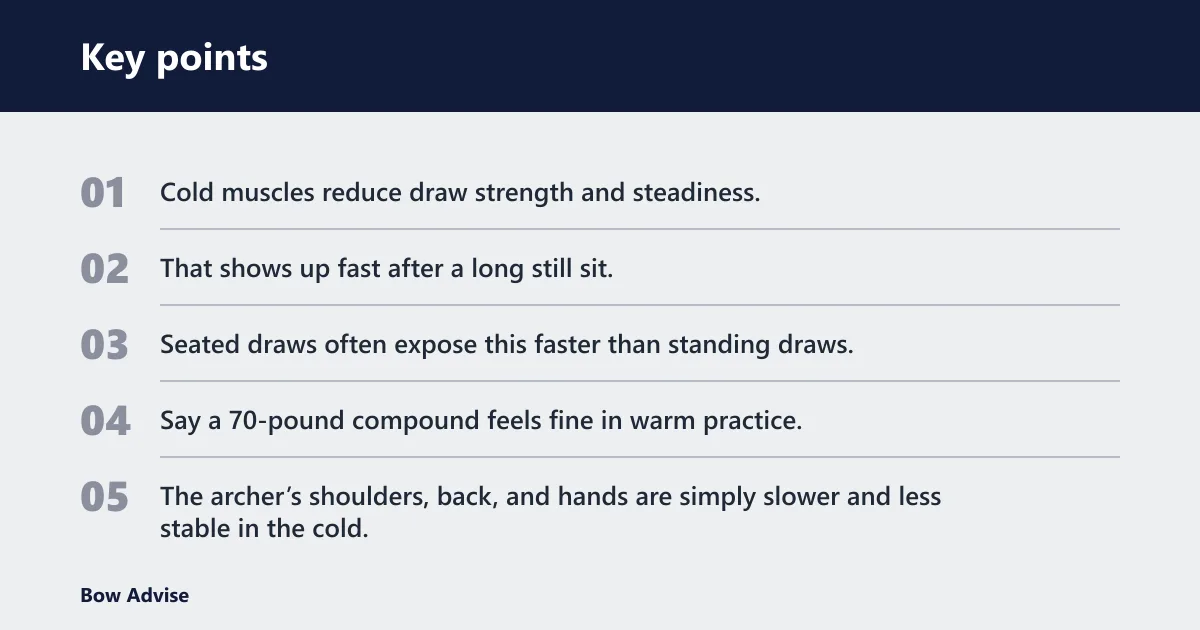
Cold muscles reduce draw strength and steadiness. That shows up fast after a long still sit, especially if the archer has been motionless for a while and then has to stand, draw, settle, and shoot in one motion. Seated draws often expose this faster than standing draws.
Say a 70-pound compound feels fine in warm practice, then feels shaky from a ladder stand in late November. The poundage may not have changed at all. The archer’s shoulders, back, and hands are simply slower and less stable in the cold.
Bulky clothing and shorter effective draw length
Bowhunting clothing layers can interfere with the draw in two ways. Thick sleeves and jackets can block the string path, and bulky layers can shorten effective draw length by keeping the bow arm and release side from settling into the same anchor point used in warm weather.
That can make the bow feel heavier because the archer has less room to finish the draw cleanly. It can also change where the anchor lands on the face, which is why a setup that feels acceptable in a T-shirt may feel cramped in a parka.
Gloves, grip pressure, and release feel
Gloved hands can change trigger feel and grip pressure. Thin gloves are usually better than thick ones for the release hand because thick material can mask trigger movement and make the release feel vague. That extra uncertainty often gets mistaken for extra draw weight.
Release aids need winter-specific attention too. A wrist strap or hinge can need more trigger travel with gloves, and cold hands can make the release body feel stiff. Warming the release and adjusting it for the glove setup matters more than forcing the bow harder.
Winter draw-weight checklist
This checklist helps separate true draw weight from winter draw difficulty. Use it as a comparison between a bare bow and the exact hunting setup you will wear afield. The goal is not to guess. It is to find the point where control starts slipping.
| Measured draw weight | Perceived draw difficulty | Likely cause |
|---|---|---|
| Same as warm-weather scale reading | Harder at the start of the draw | Cold muscles and slower shoulder movement |
| Same as bare-bow reading | Anchor feels cramped or off-center | Bulky jacket, cuff, collar, or face covering changing effective draw length |
| Same as warm-weather scale reading | Release feels jumpy or sticky | Gloves changing trigger feel and grip pressure |
| Same poundage, but shot breaks poorly | Harder to settle at full draw | Seated position, cold muscles, or poor string clearance |
| Unchanged on the scale after clothing changes | Bow still feels heavier in the hands | Perceived difficulty, not true poundage change |
Bare bow versus full hunting layers
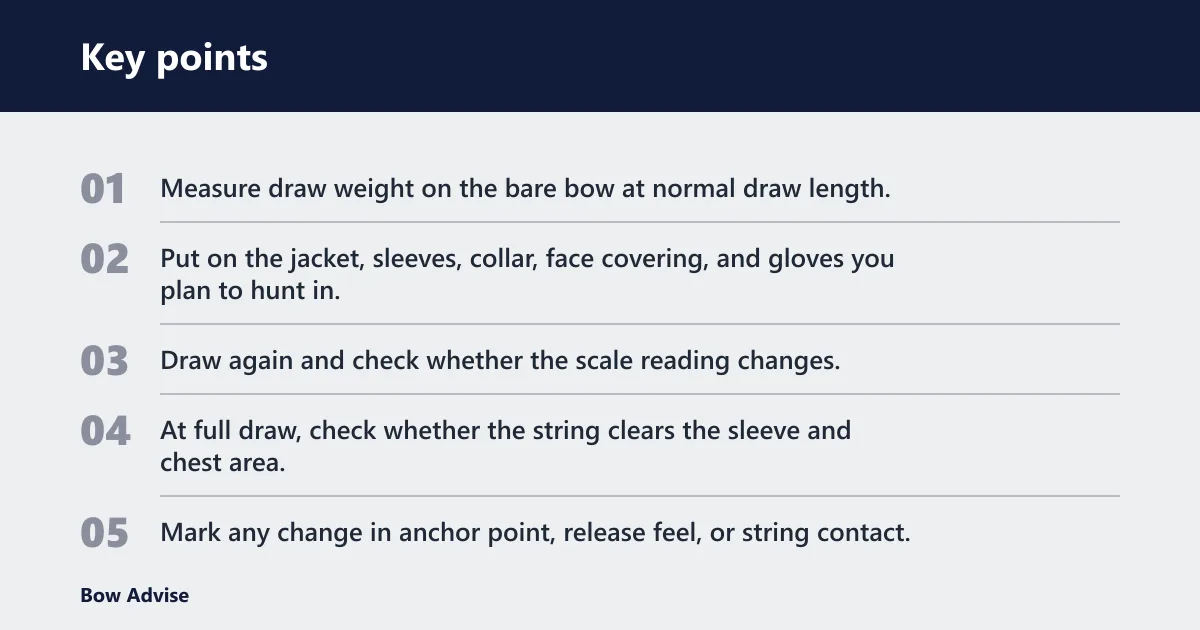
Test the bow first with the bare setup, then with the full hunting layers you will actually wear. Do not assume a jacket will “work out” in the field. Check the exact layers and gloves you will hunt in, because that is where clearance problems show up.
- Measure draw weight on the bare bow at normal draw length.
- Put on the jacket, sleeves, collar, face covering, and gloves you plan to hunt in.
- Draw again and check whether the scale reading changes.
- At full draw, check whether the string clears the sleeve and chest area.
- Mark any change in anchor point, release feel, or string contact.
Standing draw versus seated draw
Repeat the same check from a standing position and a seated position. Seated draws often expose winter weakness and clothing interference faster because the torso, shoulders, and bow arm have less room to settle into a clean motion.
- Stand and draw with the full hunting setup.
- Repeat the draw while seated on the same chair or stand height you hunt from.
- Compare steadiness at full draw and note any chest or sleeve contact.
- If seated draws feel unstable or rushed, treat that as a real field warning.
Pass or fail: when to back off 2 to 4 lb
Back off about 2 to 4 lb for late season only if control starts to break down. The common recommendation to back draw weight off about 2 to 4 lb is not for every archer. It fits hunters who cannot draw smoothly in cold layers, cannot hold steady after a long sit, or cannot keep clean clearance at full draw.
- Pass: bare bow and full layers scale the same, anchor stays repeatable, and the shot breaks cleanly standing and seated.
- Fail: sleeves touch the string, the bow arm crowds the chest, or the release hand loses control with gloves.
- Fail: seated draws feel shaky enough to rush the shot.
- Fail: the bow can be drawn, but not with repeatable form in winter gear.
In those fail cases, a small reduction is justified because the goal is safe control, not maximum poundage. A lower setting that yields a clean shot is better than a heavier setting that cannot be drawn or held well.
Does clothing affect string clearance?
Yes. Clothing can affect string clearance at full draw, and it can do so in ways that are easy to miss on a mild day. Sleeves, cuffs, collars, and face coverings can all alter the string path, and chest contact is common when layers are thick or stiff.
Sleeves, cuffs, collars, and chest contact
The main check is simple: draw to anchor and look for sleeve and chest contact. Bulky sleeves can catch the string. High collars can push the anchor point out. A face covering can change how the string reaches the nose and release hand. Those changes often shrink effective draw length as well.
A common first-timer mistake is to clear the bow in a light shirt, then put on a heavy parka and assume the shot will still be clean. It may not be. The string can brush fabric that was nowhere near the path before the layer was added.
Fixes for anchor and layer interference
Start with clothing changes before changing the bow. Trim sleeve bulk, open cuffs, or switch to outer layers that do not crowd the bow arm. If the face covering changes anchor too much, test a different mask cut or a thinner fabric around the jaw line.
If none of that restores clean clearance, then a small draw-weight reduction may make sense. The reason is not power loss. It is that the lower setting can give the archer more control margin in the same clothing.
How gloves and release aids change control
Gloves can make the draw feel heavier by changing the release hand more than the bow itself. That effect is strongest on wrist strap and hinge-style release aids, where trigger travel and finger pressure matter. Cold hands magnify the problem.
Trigger travel and finger feel in the cold
Gloved hands often need more deliberate trigger travel, because the glove softens contact and reduces fine feel. That can make the release seem sluggish. On a hinge, a cold hand may also hold the release differently, which changes pressure and timing.
Warm the release before hunting and adjust it for the glove setup you will actually use. A release that feels correct bare-handed may feel wrong once the gloves are on.
Thin gloves versus thick gloves
Thin gloves are usually the better choice for the release hand. Thick gloves can increase grip pressure, slow trigger motion, and make it harder to tell when the shot will break. For the bow hand, a warmer glove may be fine if it does not crowd the string path.
That split matters. The release hand needs feel. The bow hand needs safe grip and steady support without adding bulk where the string travels.
What changes after a winter draw-weight adjustment?
If draw weight changes, sight marks and zero should be checked again. A change in poundage can shift sight marks slightly, and it can alter speed enough to move impact at distance. The practical check is simple: recheck zero at 20 yards after the adjustment.
Sight marks, zero, and arrow speed
After a draw-weight change, expect sight marks to move slightly. A lighter setting usually gives less speed, which means the pin stack or sight setting may need to come down a touch. The exact shift depends on the bow, arrow, and tune, so the 20-yard zero is the first thing to verify.
Air density also matters here, but only a little. Denser air adds drag, and the table effect is small, only a few fps. That is worth confirming for winter shooting, but it does not change the draw-weight decision.
Minimum safe arrow weight checks
Any draw-weight change should be matched against the minimum safe arrow weight for that setup. A common rule of thumb is 5 grains of total arrow weight per pound of draw weight, so a lower poundage can change what counts as the safe floor for the arrow build.
Keep the check practical. If the winter setup drops poundage, confirm the arrow is still within the safe range and then verify the sight marks again at 20 yards.
Winter setup example
For example, a 65-pound compound may be backed down to about 61 pounds for late season if the hunter is wearing heavy layers and drawing from a treestand seat. The scale change is small, but the sight pin may still move slightly, and the 20-yard zero should be checked before hunting.
Suppose a recurve shooter keeps the same limbs but adds a thick jacket and heavy gloves. The draw weight on the scale does not change, yet the shot feels harder because the anchor shifts and the string path crowds the sleeve. That is the winter problem in plain form.
Frequently asked questions
Does cold weather make a bow draw weight heavier?
No. Cold weather does not materially change a bow’s measured draw weight on a normal scale. What changes is how the shot feels: cold muscles, thick clothing, and gloves can make the draw seem heavier and less controlled even when the poundage stays the same.
How much does draw weight change in cold weather?
For most archers, the measured draw weight does not change in any meaningful way just because the air is cold. The more useful winter question is whether the setup still feels controllable in layers. If it does not, a small 2 to 4 lb reduction may be worth checking.
Why does my bow feel harder to draw in winter?
Winter draw feel is usually caused by cold muscles, stiffer movement, bulkier clothing, and different glove feel. Those factors can reduce steadiness and make the shot feel harder even when the scale reading is unchanged. Seated draws often make that problem show up faster than standing draws.
Should I lower my draw weight for late-season hunting?
Only if winter gear or cold muscles reduce control, repeatability, or string clearance. A 2 to 4 lb reduction is sensible for hunters who cannot draw cleanly in late-season layers. It is not a blanket rule. If the bow still draws and anchors cleanly, the current setting may be fine.
Can cold muscles make me struggle to draw my bow?
Yes. Cold muscles reduce draw strength and steadiness, and they can make it harder to settle at full draw after a long still sit. That is especially common when drawing seated in a stand. If the draw becomes shaky or rushed, the body is the likely limit, not the bow.
Do I need to recheck my sight if I change draw weight for winter?
Yes. Sight marks will shift slightly after a draw-weight change, so the bow should be rechecked at 20 yards before hunting. Even a small adjustment can affect speed and impact point enough to matter. Reconfirm zero with the exact arrows, layers, and release setup you will use.