How to Keep Your Hands Warm While Bowhunting
Keep your bow hand bare or lightly covered in conditions that allow it, keep your release hand in a waist-mounted muff, and only expose the release hand at full draw when the setup and weather allow it. If your fingers start going numb, add insulation or heat before the hunt starts. Cold hands lead to missed shots, noisy fumbling, and a slower draw. This guide covers a shooting-safe warmth system, muff setup, gloves, and field-safe hand-position habits.
This guide is part of our Shooting a Bow in Cold Weather: Gear, Strings, Arrows and Comfort series.
Why cold hands hurt bowhunting
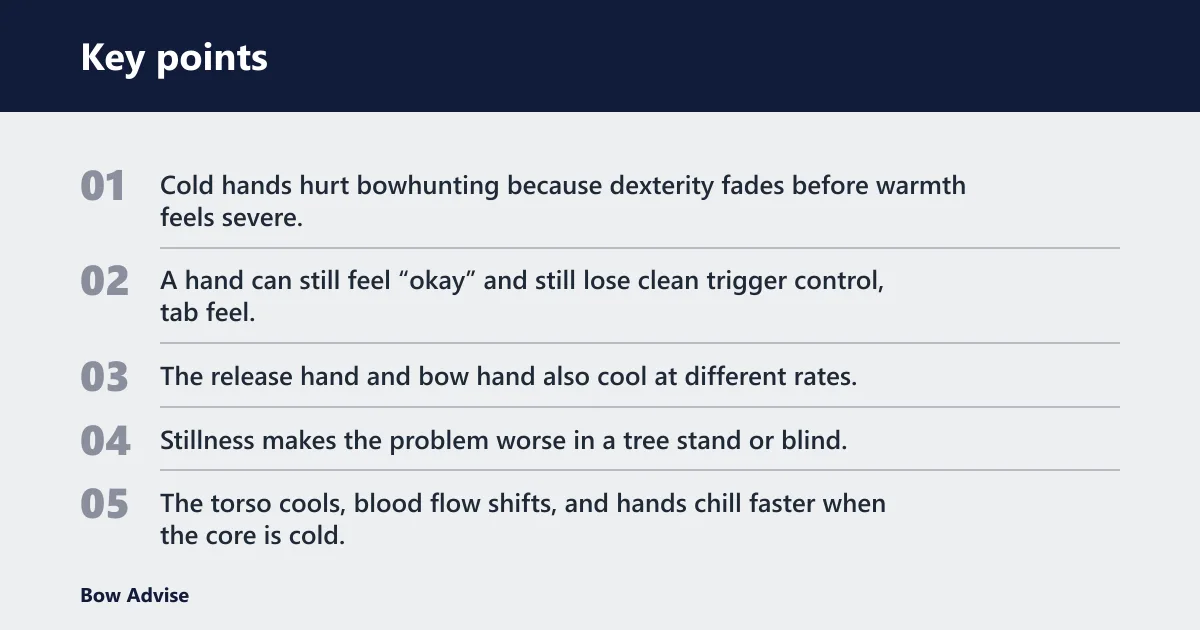


Cold hands hurt bowhunting because dexterity fades before warmth feels severe. A hand can still feel “okay” and still lose clean trigger control, tab feel, and grip pressure. The release hand and bow hand also cool at different rates, so they should not get the same fix.
Stillness makes the problem worse in a tree stand or blind. The torso cools, blood flow shifts, and hands chill faster when the core is cold. That is why hand warmth works best as part of overall cold-weather layering, not as a standalone trick.
Bow hand and release hand need different answers
The bow hand needs a clear path to the grip. It must leave any warmth system upward and forward, then settle on the riser without snagging fabric or straps. The release hand can stay hidden longer, because it does not need to reach the grip the same way.
That split matters more than many guides admit. A setup that works for one hand can slow the other, and bowhunters feel that difference the instant the string hand hesitates or the grip hand bumps into a bad opening.
Why stillness makes the problem worse
Long sits in a tree stand increase hand chill because the body is not producing much heat. A blind helps a little by blocking movement and wind, but it still leaves the hunter waiting. In both cases, a warm system that holds heat between shots is more useful than a loose glove you keep taking off.
Wind and air movement matter as much as temperature. A calm 28-degree sit feels very different from the same air temperature with moving air on exposed fingers.
Hand muff placement and draw path
A waist-mounted hand muff is often the most practical bowhunting layout because it keeps the hands low and close to the draw line. A chest-height muff can interfere with the draw path for some bows, and a chest-mounted muff is often where the bow grip or string gets caught.
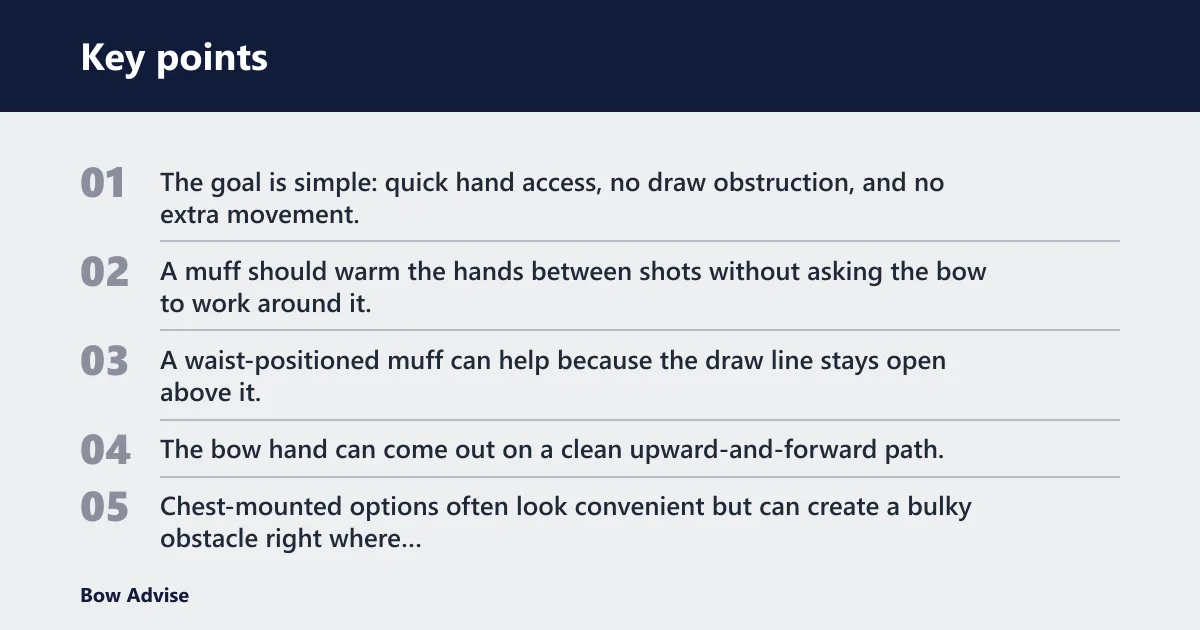
The goal is simple: quick hand access, no draw obstruction, and no extra movement. A muff should warm the hands between shots without asking the bow to work around it.
Waist-mounted versus chest-mounted placement
A waist-positioned muff can help because the draw line stays open above it. The bow hand can come out on a clean upward-and-forward path, and the release hand can stay covered until the shot window opens.
Chest-mounted options often look convenient but can create a bulky obstacle right where the bow has to travel. That is the wrong place for fabric, straps, or hard edges.
How to clear the muff for the draw
The hand should usually exit the muff upward and forward, then move directly to the bow grip. Both hands should rest near the front opening, not buried deep. That position keeps the motion short and predictable.
Before the season, practice drawing from the exact muff setup you plan to hunt with. That step matters because a muff that seems fine while standing still can feel slow once the bow comes up and the release hand starts moving at the same time.
What noisy or bulky muffs get wrong
Bulky muffs create three problems: they hang too far from the body, they make noisy fabric contact, and they block the draw path. Loose straps and stiff openings add more movement than a bowhunter wants near a quiet shot.
Say your tree-stand setup uses a thick muff with a dangling strap. On the first cold sit, the bow hand brushes that strap on the way out, and the fabric swishes as the release hand shifts. That kind of delay is small, but small delays are what bowhunters hear.
How do you keep your release hand warm?
Keep the release hand inside a waist-mounted muff until the shot window opens. That hand often gets colder than the bow hand because it waits longer and stays still. A bare hand or an ultralight liner glove inside the muff can preserve enough feel for a release aid or tab.
The mistake to avoid is burying the hand so deep that the release slows down. The hand should be protected, but still easy to pull free in one clean motion.
Use just enough insulation for feel
An ultralight liner glove fits inside a hand muff and preserves more dexterity than insulated gloves. It is a better match when the release aid still needs finger feel. The liner can also reduce the shock of cold fabric against bare skin without turning the hand clumsy.
When temperatures drop and wind picks up during a long, still sit, a hand muff outperforms gloves for keeping the release hand ready between shots. That is the point where warmth and access need to work together, not fight each other.
Keep the hand close to the opening
The release hand should rest near the front opening, not deep in the muff. If the hand has to dig out from the back of the opening, the shot window gets slower and the motion gets louder.
A common first-timer mistake is stuffing the release hand all the way in for maximum warmth, then losing precious seconds getting it back out cleanly. That trade is usually not worth it on a live bow shot.
How do you keep your bow hand warm?
Keep the bow hand path open for a fast draw. The bow hand needs less insulation than the release hand because it must move first, meet the grip cleanly, and stay silent while the arrow is still on the rest. Thin coverage works better than thick coverage here.
The best setup lets the bow hand leave the muff without snagging on straps or fabric. If the hand cannot exit cleanly, the muff has failed the main test.
Use thin coverage that preserves grip feel
Thin gloves for bowhunting can work when the weather is cool but not severe. They provide some warmth while leaving enough feel for the grip and riser. Once the hand gets too thickly insulated, pressure control gets sloppy and the grip can feel vague.
Gloves for bowhunting can fail in below-freezing conditions because warmth and dexterity pull in opposite directions. That is a serious trade for a shot that depends on steady hand position.
Let the bow hand move without snagging
The bow hand should exit the muff upward and forward, then settle into the grip in one motion. The opening should be wide enough for that path, but not so loose that fabric flaps in the wind or drags against the bow.
Picture a blind hunt on a cold evening. The bow hand leaves a waist-mounted muff, clears the front edge, and goes straight to the grip. That short path is what keeps the shot quiet.
Gloves, liner gloves, and muffs
Thin gloves are enough when the sit is short, the air is cool rather than severe, and the bow remains in hand more often than not. A liner glove is the better in-between option when the hunter wants some warmth but still needs release feel inside a muff.
Insulated gloves usually fail for bowhunting when they get thick enough to block trigger feel or make the grip unstable. At that point, the hunter often has warmth but loses the clean shot.
When thin gloves are enough
Thin gloves are best for still-hunting or mild stand sits where the hands will not stay parked for long. They can also work as backup coverage inside a larger system when the temperature is manageable and the wind is low.
They are not the answer for long, sub-freezing sits. Once the fingers go numb, fine control disappears fast.
Why ultralight liner gloves fit inside a hand muff
An ultralight liner glove is small enough to fit inside a hand muff without crowding the opening. It gives the release hand a little protection while keeping more sensitivity than a thick insulated glove.
That makes liner gloves especially useful for hunters who need to touch a release aid, tab, or rope-style mechanism and still want a quick exit when the shot comes.
How to match dexterity to temperature
Use the least insulation that still keeps the fingers functional. As the temperature drops, move from thin gloves to a muff with a liner glove, then to a warmer muff-based setup if the sit is long and still.
That order matters because bowhunting punishes slow hands more than cold hands. A setup that is warm but hard to shoot is the wrong setup.
Cold-hand setup matrix
This decision matrix ties warmth to hunt style. It uses the simplest rule: the more still the hunt, the more useful a waist-mounted muff becomes. The more mobile the hunt, the lighter and faster the hand system should be.
| Hunt type | Temperature band | Dexterity need | Recommended setup | Common failure mode |
|---|---|---|---|---|
| Treestand whitetail | 20s to 30s | High at the shot | Waist-mounted muff with bare release hand or ultralight liner glove | Hands buried too deep and slow to clear |
| Ground blind | 30s to 40s | Moderate | Muff with quick front opening and thin gloves for the bow hand | Bulky fabric blocks the bow grip path |
| Western spot-and-stalk | 30s and below | Very high | Thin gloves plus brief muff use only during long pauses | Too much insulation slows climbing, glassing, and draw prep |
| Late-season rifle-bow crossover camp | 20s and below | High | Waist-mounted muff, liner glove, and warmed core layers | Core stays cold, so hands chill again fast |
| Sub-freezing all-day sit | Below 32°F | Highest | Muff plus liner glove, with extra torso insulation before the hunt | Gloves alone cannot hold dexterity long enough |
- Muff placement: keep it at the waist, not the chest.
- Hand depth: rest near the front opening, not buried deep.
- Draw clearance: confirm the bow hand leaves upward and forward without touching fabric, straps, grip, or string.
How does hunt style change the setup?
Hunt style changes everything because it changes how often the hands move. Tree stand sits favor a waist-mounted muff. Ground blind hunts give more room for warmth tools. Mobile western hunts usually need a lighter setup because the hands come in and out more often.
Late-season camp use adds another layer: the hunter may need warmth before leaving camp, not only during the sit. Cold-weather layering matters here because a warm core helps the hands stay warmer for longer.
Tree stand sits
Tree stands create the strongest case for a muff because the hunter sits still for long stretches. That is where hands lose heat fastest, and that is where a warm system between shots matters most. The muff also stays easier to use than handwear that must come off and go back on repeatedly while seated.
A waist-mounted muff is especially useful here because the hands can stay warm until the shot, then return to the opening right away afterward.
Ground blind hunts
Ground blinds usually allow more room for hand warmth tools and less movement than mobile hunting. That makes them a natural fit for a muff-based system, especially when the bow stays pointed in a limited shooting lane.
The main caution is still the same: the muff must not block the draw path. A blind gives more room, but it does not forgive a sloppy setup.
Western spot-and-stalk hunts
Spot-and-stalk hunting usually demands more hand movement, more packing, and more time without a fixed sitting position. That makes a full-size muff less useful because hunters often remove both hands frequently.
For that style, thin gloves or a liner glove often make more sense than a bulky muff. The rule is simple: if the hands keep coming out, the system should stay light and fast.
Late-season camp use
Late-season camp can cool the body before the hunt even starts. If the core is cold, the hands will be cold too, no matter how good the hand accessory is. That is why base layers and insulation matter before gloves do.
Popular Mechanics notes that exercise can raise core temperature and help keep hands warm. For hunters, that means a short warm-up, proper layering, and a warm torso can improve hand function before the first sit.
How to keep feet warm while hunting
Feet and hands are linked because a cold core pulls heat away from the extremities. If the feet are soaked, compressed, or chilled by the ground, the whole body tends to cool faster. That makes hand warmth harder to hold during a sit.
Use the same logic as with hands: protect the core first, then insulate the extremities. Warm feet reduce overall chill, which helps the muff or glove system work longer.
Frequently asked questions
How do I keep my release hand warm?
Keep the release hand in a waist-mounted muff between shot windows, and use a bare hand or ultralight liner glove if the release still needs precise feel. The key is to keep the hand close to the front opening so it can move out quickly without digging through the muff.
How do I keep my hands warm without losing dexterity?
Choose the least insulation that still lets you draw and shoot cleanly. Thin gloves or a liner glove inside a muff preserve more control than bulky insulated gloves. If the setup slows the grip, the trigger, or the release aid, it has gone too far on warmth and lost the bowhunting tradeoff.
What is the best hand warmer for hunting?
For bowhunters, the best hand warmer is usually a waist-mounted hand muff because it keeps both hands warm between shots while leaving the draw path open. It works best when the bow hand can leave upward and forward and the release hand can stay parked until the shot opportunity opens.
Can you use a hand muff bowhunting?
Yes, and it is often the better choice when the muff sits at the waist, not the chest. A chest-mounted muff can interfere with the bow grip or string, while a waist-mounted muff keeps the shooting lane clearer. Practice the draw first so the hand exits cleanly and quietly.
How to keep feet warm while hunting: keep the core warm first
Keep the core warm first, then protect the feet with dry insulation and enough room for blood flow.