
Should You Bring Your Bow Inside After a Freezing Hunt?
Yes, bring it inside after wiping off snow, ice, and visible moisture. If the bow is dry, cold air itself is fine. Water left on the string, cams, or hardware is the problem, because it can rust metal, stiffen parts, and fog optics. This guide explains when to move the bow, how long to wait, and what to inspect before storing or shooting it.
Bring bow inside checklist
Cold alone is usually harmless. Moisture changes the answer. A dry bow can warm indoors with little risk if it stays out of sealed, humid air at first. A wet or icy bow needs a slow dry-down and a careful inspection before it goes into a case or back into service.
| Condition | First action | Wait before sealing | What to inspect first | Stop sign |
|---|---|---|---|---|
| Dry cold bow | Move to a dry room and leave it uncovered | About 20 to 30 minutes | String, limbs, cams or limb tips, then hardware | New cracks, fuzzing, or stiff parts |
| Wet or icy bow | Wipe water and slush from all surfaces | Until every visible wet spot is gone | String first, then limbs, then metal and accessories | Ice in moving parts, rust, or delamination signs |
| Suspected damage | Do not shoot; isolate the bow | None until inspected | Limbs, string or cables, cams, limb pockets, fasteners | Any split, chip, odd noise, or changed timing |
Dry cold bow
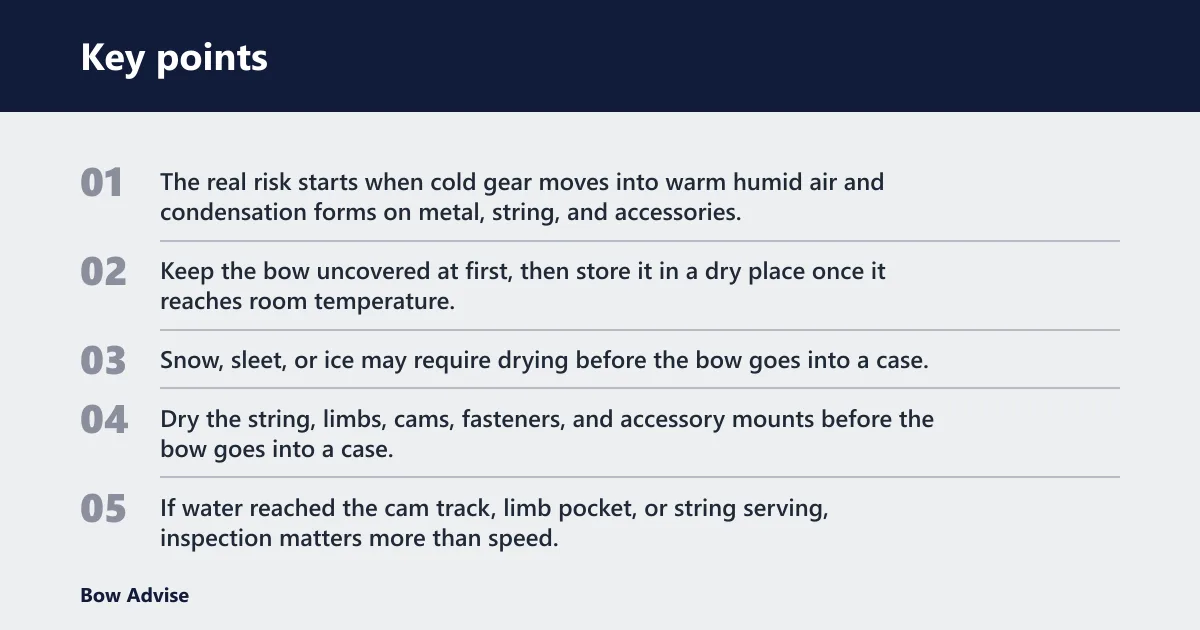
Cold, dry storage by itself is usually fine for a compound bow or recurve bow, even if temperatures stayed below freezing. The real risk starts when cold gear moves into warm humid air and condensation forms on metal, string, and accessories. Keep the bow uncovered at first, then store it in a dry place once it reaches room temperature.
Wet or icy bow
Snow, sleet, or ice may require drying before the bow goes into a case. Dry the string, limbs, cams, fasteners, and accessory mounts before the bow goes into a case. Do not trap wet gear in a sealed soft case. If water reached the cam track, limb pocket, or string serving, inspection matters more than speed.
Suspected damage
If the bow was struck, dropped, bent against a truck bed, or makes an odd sound under load, it should not be treated as routine cold-weather exposure. A suspected problem calls for a full visual check before the bow is stored or shot. Stop if the limb shows a chip, the string shows fray, or a cam no longer tracks cleanly.
Should you bring your bow inside?
Yes, in most cases. Bring it inside after the visible moisture is removed, then let it acclimate in open air before putting it in a sealed case. For a compound bow, that matters because cams, cables, peep housing, sight fasteners, and rest hardware can hold water and show problems once condensation forms. For a recurve bow, the limbs, string, riser, and limb pockets need the same dry-down, especially if snow packed around the tips or grip.
Compound bow
A compound bow has more small parts that can trap moisture. Check the cams, axles, cable slide or roller, limb pockets, sight pins, peep housing, stabilizer mount, rest hardware, and every exposed fastener. If the bow stayed dry in the cold, it can usually go indoors without drama. If it came in wet, each of those areas needs a wipe and a close look.
Recurve bow
A recurve bow is simpler, but the limbs and string still need attention after snow or sleet. Synthetic string fibers can stiffen in deep cold, then show fuzzing or wax loss after drying. Watch the limb surfaces for checking or splinters, and clear any water trapped near the limb pockets, fades, or grip area before storage.
Condensation and what it can hit
Condensation forms when cold gear enters warm humid air. It is most likely on metal fasteners, cams, sight parts, peep housings, and damp string serving, but it can also leave moisture on limb surfaces and in accessory mounts. A quick wipe helps, but the real fix is a dry-down period before sealing the bow in a case.
String and cables
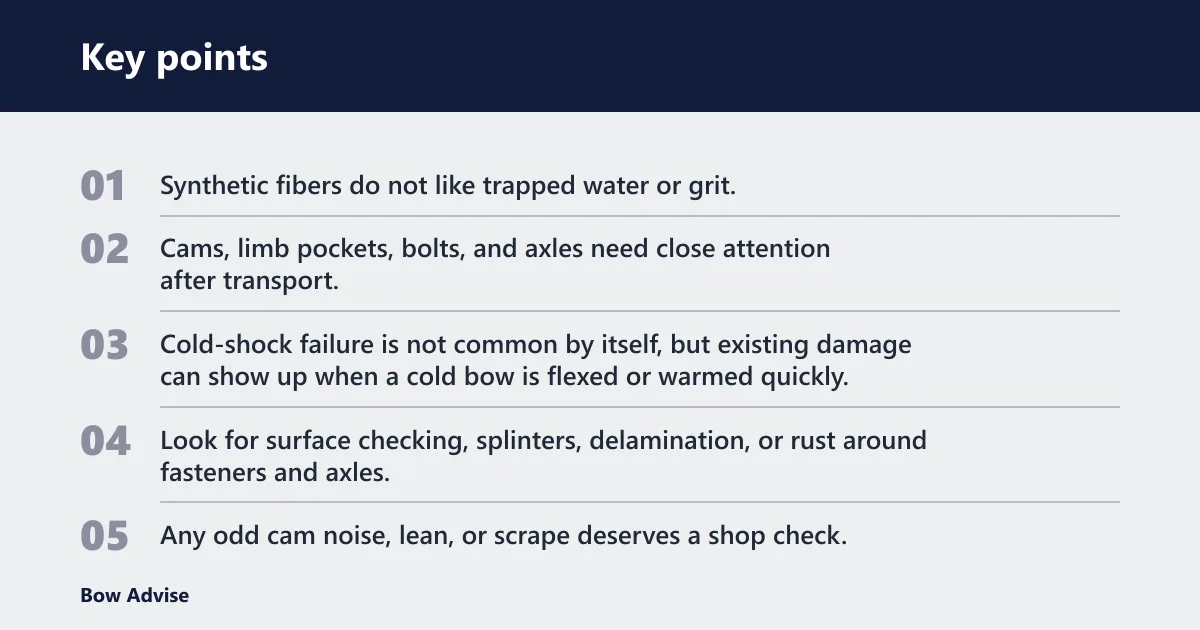
Bow string checks should look for fuzzing, abrasion from ice, flat spots, frayed serving, and visible wax loss after the bow dries. Synthetic fibers do not like trapped water or grit. If the string feels unusually stiff after thawing, inspect it again before shooting, because stiffened sections can hide wear under the serving.
Cams, limbs, and metal parts
Cams, limb pockets, bolts, and axles need close attention after transport. Cold-shock failure is not common by itself, but existing damage can show up when a cold bow is flexed or warmed quickly. Look for surface checking, splinters, delamination, or rust around fasteners and axles. Any odd cam noise, lean, or scrape deserves a shop check.
Sight, rest, and other accessories
Accessory hardware gets ignored too often. Check sight fibers for fogging or breakage, rest screws for looseness, stabilizer mounts for movement, and peep housing for moisture. A frozen rest arm or damp sight level can look minor and still affect the first shot after a cold hunt.
Post-hunt bow acclimation checklist
Use this order for a bow that came out of below-freezing conditions. The goal is to separate harmless cold from damage risk, while keeping condensation away from the parts that matter first.
Leave the bow uncovered. Set it in a dry room and keep it out of a sealed case for 20 to 30 minutes if it is only cold and dry. That lets the temperature rise without trapping humid air against metal and string.
Remove visible moisture. If snow, sleet, or ice is present, wipe the string, limbs, cams, riser, and hardware with a dry cloth. Focus on the cam grooves, limb pockets, screw heads, peep housing, and rest hardware, since those areas hold water the longest.
Inspect the string first. Look for fray, fuzzing, flattened serving, ice abrasion, and sections that feel stiff after thawing. A damaged string or cable is a stop sign, because hidden wear can worsen once tension returns.
Check the limbs next. Scan both limbs for surface checking, chips, splinters, or a line that looks like separation in the finish. Keep the bow at eye level and turn it slowly so light catches any mark that could indicate delamination.
Inspect cams and hardware. On a compound bow, look at cam tracks, axles, cable guards, limb bolts, module screws, sight mounts, and rest hardware. On a recurve bow, check the limb pockets and grip area for trapped moisture or loosened fit.
Dry accessories last. Wipe sight fibers, stabilizer mounts, quiver brackets, and any metal fastener that still shows moisture. If the bow will go into a hard case later, add a replaceable silica gel or desiccant pack after the bow is fully dry.
A compound bow may come off a stand after a long hunt in cold weather with dry snow on the riser and limbs. A 25-minute open-air warm-up and a wipe-down are usually enough before storage. If the same bow came in with packed sleet around the cam and rest, the inspection has to start with those parts, not with shooting.
A common first-timer mistake is to seal a damp bow in a soft case because it feels safer indoors. That traps humidity against the string and metal parts. A hard case is better only after the bow is dry; if the room stays humid, add a fresh desiccant pack and keep wet gear separate.
When a bow needs a shop check
A bow needs more than routine drying if inspection shows a real stop sign. Do not shoot a bow if the limb surface is cracked, the string or cables are frayed, the cam no longer tracks smoothly, or a fastener has moved. Those signs point to service, not warming up.
Stop-sign symptoms on limbs
Look for chips, splinters, lifted finish, white lines that follow the limb, and any gap that suggests delamination. A limb that makes a new creak, clicks under draw, or shows a changed bend line should not be treated as a normal cold-weather issue. That bow should go to a shop.
Stop-sign symptoms on string or cables
String fuzz that does not disappear after drying, flattened serving, broken strands, or a cable that feels stiff in one section calls for more than wax. A bow press may be needed for post-season maintenance only if inspection shows string, cable, or limb issues that require service. It is not part of routine warm-up.
Stop-sign symptoms on cams and hardware
Watch for cam lean, rough rotation, ice damage, loose axle hardware, rust around fasteners, or a rest that no longer returns cleanly. If a peep housing twists, a sight bar shifts, or a limb pocket shows movement, stop. Those are the cases where a shop check is the right next step.
Can you store it in a truck or garage?
Yes, a compound bow can stay cold overnight in a truck or garage if it is dry and protected from wet gear. Cold storage itself is usually fine. The risk rises when meltwater, slush, or humid air gets trapped in a case, or when the bow is brought from freezing temperatures into warm air and immediately sealed.
Cold overnight storage
A bow can sit in a cold truck cab or unheated garage without harm if no moisture is trapped on it. Keep it away from floor water, wet boots, and snow-covered gear. Do not leave it in a place where ice can melt and run into the cam track, sight, or limb pockets.
Case and desiccant use
Use a hard case for transport when snow or sleet is likely, but give the bow time to dry before locking it in. A silica gel or other desiccant pack helps control moisture inside a hard case when the bow must be stored in a humid space. Replace the pack if it is saturated or no longer active.
Frequently asked questions
Should you bring your bow inside after a freezing hunt?
Yes, but only after visible snow, ice, and moisture are removed. Cold exposure alone is usually fine for both compound and recurve bows. The important part is avoiding condensation and trapped water on strings, limbs, cams, fasteners, and accessory hardware once the bow reaches warm indoor air.
Can a compound bow stay cold overnight in a truck or garage?
Usually, yes, if it is dry and not packed with wet gear. Cold storage by itself is not the problem. The problem is water sitting on the bow, then freezing or melting in the wrong place. Keep the bow out of standing water, slush, and a sealed damp case.
Do I need to let my bow warm up before shooting after a cold hunt?
Yes. Warm it up only after inspection, and never shoot a visibly wet or frozen bow. Let the bow come up to temperature in open air first, then check the string, limbs, cams, and accessories. If any part still looks wet, stiff, or damaged, wait longer or skip shooting.
Will condensation damage bow limbs, cams, or strings?
It can, especially if moisture sits on metal, serving, or a limb surface long enough to hide damage. Condensation does not automatically ruin a bow, but it can lead to rust, fogged optics, string stiffness, and missed signs of limb stress. That is why drying and inspection come first.
How should I dry and inspect my bow after hunting in snow or sleet?
Start with the string, then the limbs, then cams, fasteners, and accessories. Wipe off all visible moisture, let the bow sit in open air, and look for fuzzing, fray, chips, rust, or loose hardware. If ice was packed into a moving part, check that area before anything else.
How long should I wait before wiping down or waxing the string?
Wait until the string is dry to the touch and no condensation remains on nearby parts. A quick wipe can happen right away if the bow is wet, but waxing should wait until the string has warmed and dried. Wax locks in moisture if applied too early, which is the wrong outcome.