Do Carbon Arrows Break Easier in the Cold?
Cold alone usually does not make carbon arrows break. Hidden nicks, crushed fibers, or impact damage do. Ignore winter checks and a weakened shaft can fail on release, sending a bad shot or a fragment. This guide separates temperature effects from damage-triggered failures and gives a winter-specific inspection and retirement checklist for bowhunters.
Why temperature alone rarely breaks carbon arrows
Usually, no. Temperature by itself is rarely the main reason a carbon arrow shaft fails. The bigger risk is pre-existing damage: a nick, a crush mark, a hidden micro-crack, or a shaft that was already compromised and then gets loaded hard on the shot.
Cold weather does change the hunting setup. Gloves can make inspection less precise, moisture can condense when gear moves from a heated vehicle to a freezing field, and rushed setup makes small damage easier to miss. That is why winter breakage often gets blamed on temperature when the real cause is a shaft that should have been retired earlier.
Cold weather and carbon shaft failure
A carbon arrow shaft is built from graphite or carbon construction. That material is strong, but it can fail if it is structurally compromised. Minor imperfections can cause structural failure and severe injury, so the question is not whether carbon is “weak” in winter. The question is whether the shaft is intact.
Carbon arrows cannot be straightened like aluminum or steel arrows. A visible bend in a carbon shaft typically indicates internal structural damage, which means the shaft should come out of service. Straightening is not a repair option.
Why hidden damage matters more than temperature
Hidden micro-cracks are the danger that winter hides best. They are not always visible, and they can come from impact or crushing. A shaft with hidden damage may look fine in a quiver, then buckle and snap on release. That failure can put the bow hand at risk.
Say your arrow brushes a stand rail, then lands tip-first in frozen ground and looks normal afterward. The shaft may still carry an internal crack that the eye cannot see. In that case, the safe response is retirement after a proper check.
What winter conditions change for bowhunters
Winter adds handling problems that hide damage. Thick gloves can mask a faint rough edge. Condensation can blur a fast visual check. Cold fingers can make it harder to feel a nick near the shaft ends or around the insert area. None of that changes the failure mechanism. It changes the odds of missing it.
For that reason, the right winter habit is simple: inspect before use, inspect after any hard impact, and store the arrows in a cool, dry environment away from direct sunlight or extreme heat. Transport them in a quiver or a protected case so they are not crushed in the truck, garage, or blind.
Winter arrow failure decision table
The table below separates cold-weather situations that need retirement from ones that need a close check first. Use it when a shaft has been dropped, hit, crushed, or exposed to hard winter hunting conditions.
| Cold-weather scenario | Likely failure mechanism | Retire now? | Exact confirmation step |
|---|---|---|---|
| Arrow-on-arrow impact in a tight group | Lateral crack, dent, or fiber crush from one shaft striking another | Yes, if any crack, dent, or splinter appears | Twist the shaft ends in opposite directions and look for cracks or splinters; then flex-test it |
| Arrow dropped onto frozen rock or packed ice | Edge crush or hidden micro-crack from impact | Yes, if the tip end, shaft wall, or nock end is marked | Rotate the shaft under light and inspect for nicks, dents, or a hairline crack |
| Shaft pinched in a truck door or case latch | Compression damage that may not show on the surface | Yes, if there is any flattening or rough spot | Hold both ends and bend it away from yourself and others while listening for cracking or squeaking |
| Arrow struck a shoulder or leg bone on game | Hard impact can stop, snap, or split the shaft | Yes, after any rough bone contact | Inspect the full length for splinters, cracks, and a visible bend; retire it if anything looks off |
| Arrow hit a tree, stand, or blind frame | Impact fracture near the point end or insert area | Yes, if the shaft took a solid hit | Check the impact side under bright light and perform a gentle flex test before the next shot |
| Shaft was stored loose in a cold garage and later found with a bend | Structural compromise or crush damage | Yes | A bend in carbon usually means internal damage, so remove it from service immediately |
| Nock feels loose after a temperature swing from vehicle to field | Nock damage or poor seating on the string | Yes, if the nock is cracked or will not seat firmly | Check that the nock seats properly on the string and replace it if it is cracked or loose |
| Arrow appears normal but was previously hit hard | Hidden micro-crack from prior impact or crushing | Yes, if the hard hit was severe | Do the opposite-direction twist test, then flex-test; if any sound or roughness appears, retire it |
That table leaves one rule intact: if a carbon shaft shows a crack, splinter, dent, or bend, do not try to repair it. Damaged or cracked carbon arrows should not be used. A shaft that has already failed structurally cannot be made safe by straightening or patching.
How do I inspect a carbon arrow before hunting?
Start with a visual check, then do a flex test, then confirm the nock. That order matters because winter gloves, low light, and cold fingers can hide the small damage that leads to failure. Use the shaft only if it passes all three checks and has not taken a hard hit since the last inspection.
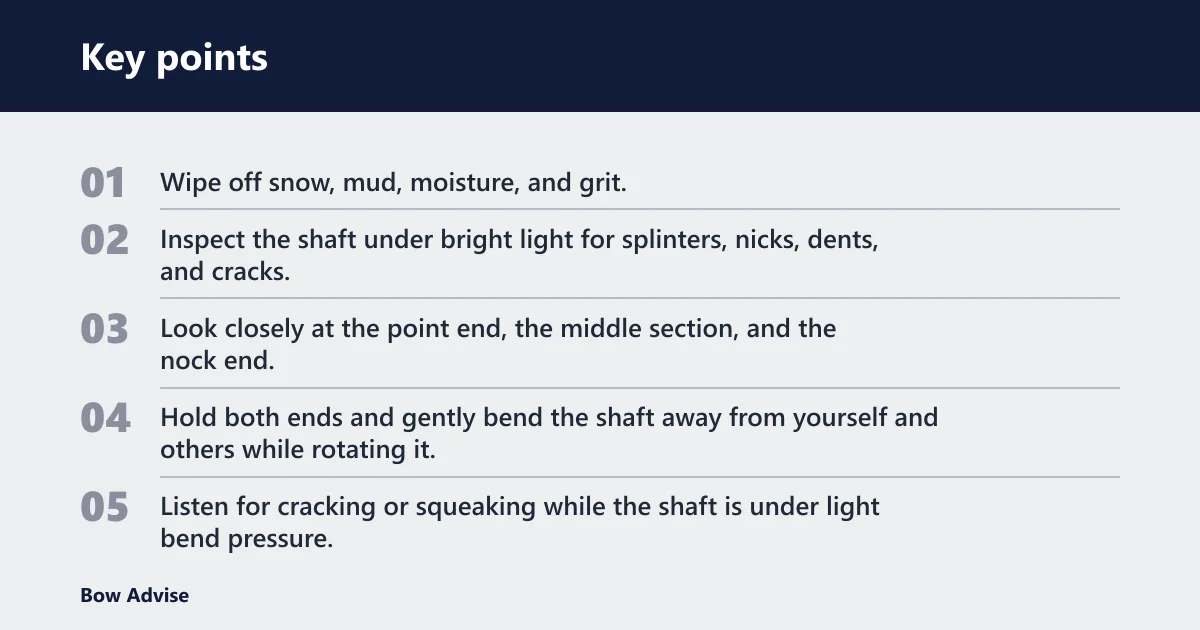
- Wipe off snow, mud, moisture, and grit.
- Inspect the shaft under bright light for splinters, nicks, dents, and cracks.
- Look closely at the point end, the middle section, and the nock end.
- Hold both ends and gently bend the shaft away from yourself and others while rotating it.
- Listen for cracking or squeaking while the shaft is under light bend pressure.
- Twist the shaft ends in opposite directions and look again for cracks or splinters.
- Check that the nock is properly seated on the string and replace any cracked or loose nock.
- Retire the shaft if anything looks or sounds wrong.
Visual check for nicks, dents, splinters, and cracks
Carbon arrows can fail from damage that is small enough to miss in a hurry. Look for surface nicks, splinters, dents, and cracks along the full shaft, not just near the ends. Pay extra attention to the section that rides the rest and the area around the insert, because those spots take repeated stress.
A carbon shaft with a visible bend should be treated as damaged. Unlike aluminum, it cannot be straightened back into service. If the shaft looks bowed, the safest move is retirement, not a closer guess.
Flex test steps and warning sounds
The flex test is simple and should be done before shooting. Hold both ends and bend the shaft gently while rotating it. Listen for cracking or squeaking, then inspect again for splinters, nicks, dents, or cracks. Any sound or roughness is a warning sign.
This check is more useful in winter than a fast glance alone. Cold weather often pushes hunters toward gloves and speed, but the shaft still needs a slow, careful pass. If the arrow was hit, crushed, or dropped, a flex test is not optional.
Nock seating and loose-fit checks
The nock must seat properly on the string. A cracked nock, a nock that feels loose, or one that sits awkwardly can create bad release behavior and add stress to the shaft. Replace damaged nocks instead of trying to reuse them.
Suppose an arrow that grouped well last week starts landing oddly after a cold snap and the nock feels sloppy on the string. That is not a reason to blame the weather first. Check the nock, then inspect the shaft for hidden damage before the next shot.
What winter storage and transport help prevent damage?
Store carbon arrows in a cool, dry environment away from direct sunlight or extreme heat. That protects the shaft material and keeps the insert, nock, and finish from getting beat up by heat, moisture, and careless handling. In transport, use a quiver or a protected case so the arrows do not get crushed or knocked around.
Winter vehicle habits matter. A heated cab, a cold garage, and a freezing field can create repeated temperature swings, but the bigger danger is physical damage during loading and unloading. Keep shafts separated from hard tools, metal corners, and door latches.
Cool, dry storage
Cool and dry is the safe baseline. It keeps moisture off the shaft and reduces the chance of hidden problems around the nock and point end. Avoid direct sunlight and extreme heat because those conditions are not part of safe storage for carbon arrows.
For bowhunters who move gear between a warm house and a subfreezing truck, the practical habit is simple: let the arrows ride in their case until setup time, then inspect them again before hunting. That helps catch damage that happened during transport.
Quiver and case transport in vehicles and field
A quiver or protected case is not only about convenience. It limits rubbing, crushing, and point damage. Loose arrows rolling under seat rails or sliding against hard gear are far more likely to pick up a nick or hidden crack than arrows that stay secured.
Do not store arrows where they can get bent under other equipment or exposed to a hot dash, heater vent, or direct sun through glass. Those conditions are avoidable, and they do not help shaft life.
How do impacts change the risk in cold weather?
Cold weather does not make impact damage harmless. It can make the consequences harder to notice. Arrow-on-arrow impact is a common source of damage in tight groups, and hard hits on bone, rocks, trees, or other hard surfaces can break shafts or create lateral cracks and dents that weaken the arrow dramatically.
Arrow-on-arrow impact in tight groups
Most arrow damage can come from one arrow striking another in the target. In winter, the shafts may be stiffer to handle with gloves, and the inspection after a group is often rushed. That makes a tiny lateral crack or dent easier to miss even though it can weaken the shaft dramatically.
After any arrow-on-arrow contact, inspect both shafts. The damaged one is the one most likely to fail later, but the shaft that got struck can also pick up a mark near the impact zone. Use the twist-and-flex checks before shooting them again.
Bone hits and other hard targets
Animal bone impact changes the risk fast. Shoulder or leg bone hits are especially hard on carbon shafts, and bone contact can stop or snap the arrow. If the arrow meets bone with enough force to deflect sharply or sound harsh, the shaft deserves a close retirement check.
Hard surfaces do the same thing. Rocks, tree bark, stand hardware, and blind frames can create the same kind of hidden compromise. A shaft that survives the shot may still be unsafe for the next one.
When a hard hit means retirement
Retire the shaft immediately after a hard impact if you see a crack, dent, splinter, visible bend, or any loose-fitting nock. Damaged carbon arrows should not be used, and they cannot be straightened like aluminum. If the shaft took a serious hit and you are unsure, remove it from service rather than gamble on a second shot.
A common first-timer mistake is to keep a shaft because it “still looks straight.” Straight-looking is not the same as sound. Hidden damage is the problem, and winter is a bad time to pretend it is not there.
Frequently asked questions
Do carbon arrows break easier in the cold?
Usually not. Cold alone is rarely the main cause of failure. The bigger issue is a shaft that already has hidden damage, crushing, or a micro-crack. If the arrow is structurally sound and stored well, winter temperature by itself is not the main risk.
Does cold weather make carbon arrows more brittle?
Cold can make weak spots more likely to fail under load, but it does not create the damage by itself. The shaft is the problem when it has been compromised by impact, crushing, or a hidden crack. That is why winter inspection matters more than blaming the temperature.
Are carbon arrows safer than aluminum arrows in winter?
They are different, not automatically safer in every situation. Carbon arrows cannot be straightened like aluminum, and a damaged carbon shaft should be retired. Aluminum can show a bend more clearly, but carbon’s hidden damage makes inspection and retirement decisions especially important in winter.
How do I know if a carbon shaft has hidden cracks?
Hidden cracks are not always visible. Use the flex test, twist the shaft ends in opposite directions, and inspect for splinters, nicks, dents, or cracks. A cracking sound, squeaking, or any visible bend is enough to retire the shaft rather than keep shooting it.
Should I replace carbon arrows after a hard impact in the cold?
Yes, if the impact was hard enough to raise doubt. Arrow-on-arrow impacts, bone hits, crushed sections, and strikes on rock or wood can weaken the shaft dramatically. If the arrow shows any crack, dent, splinter, or bend after that hit, replace or retire it.
Do carbon arrows need special storage in winter?
Yes. Store them in a cool, dry environment away from direct sunlight or extreme heat. Use a quiver or protected case for transport so the shafts are not crushed in a vehicle, blind, or garage. Good storage reduces the chance of hidden damage before the hunt.