How Cold Is Too Cold to Shoot a Crossbow?
Below 20°F, treat a crossbow as needing a warm-up and inspection before shooting; at 0°F or below, stop and inspect first if it has been exposed to snow, ice, or a cold-to-warm move. Cold can change string speed, stiffen lube, and hide damage or create a safe-shot miss. This guide gives a practical cutoff, what to check, and when to shoot, warm up, or quit.
Cold-weather cutoff for crossbows
Cold matters in three ways: safe storage, safe shooting, and the moment a cold crossbow moves into warmer air. Those are separate calls. A bow that can sit safely in a cold vehicle may still need time and inspection before it is shot, especially if snow, frost, or condensation is present.
Safe storage versus safe shooting
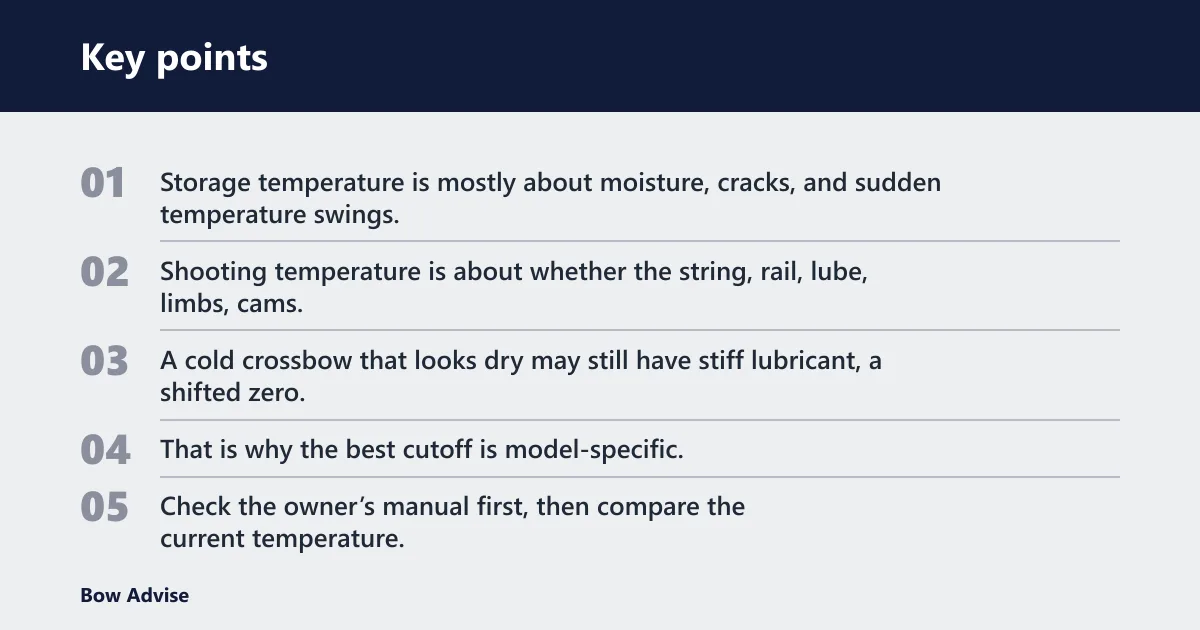
Storage temperature is mostly about moisture, cracks, and sudden temperature swings. Shooting temperature is about whether the string, rail, lube, limbs, cams, and scope still behave as they should. A cold crossbow that looks dry may still have stiff lubricant, a shifted zero, or a limb issue that shows up only under load.
That is why the best cutoff is model-specific. Check the owner’s manual first, then compare the current temperature, the weather exposure, and the crossbow’s visible condition. If the manual gives a lower limit, follow that limit. If it does not, stay more cautious below freezing and especially cautious at 0°F or below after snow, ice, or a warm-to-cold move.
When to warm-acclimate before shooting
Warm-acclimate when the crossbow has been stored cold and brought into a warmer blind, truck cab, or cabin, or when the string and rail feel unusually stiff from the cold. The goal is a slow, dry transition, not a blast of heat. Rapid warming can put condensation on metal, string, serving, optics, and fasteners.
Keep the case closed during the temperature change when possible, then open it only after the surface has had time to equalize. If moisture appears, wipe it off and inspect the limbs, rail, string, scope, and fasteners before any shot.
When to stop and inspect instead of shooting
Stop and inspect when the crossbow has visible ice, wet snow, frost on the rail, an unusual sound on the cocking stroke, a string that looks dry or frayed, or any crack in a limb, cam housing, or stock. If the crossbow was carried from a warm vehicle into extreme cold and then back again, inspection matters even more.
A practical rule is simple: if the cold changed the way the bow looks, feels, or sounds, do not trust a quick shot. Check it first.
How cold is too cold to shoot a crossbow?
There is no single temperature where every crossbow becomes unsafe. Below about 20°F, a crossbow is commonly treated as needing a warm-up and inspection before shooting. At 0°F or below, stop and inspect first if the bow has been exposed to snow, ice, or a cold-to-warm move. Manufacturer guidance still comes first.
Why below-freezing is not one universal line
Different limbs, lubricants, rail coatings, string materials, and scope mounts react differently to cold. One model may tolerate freezing air with no visible change, while another may show stiffness or a zero shift after only a short cold soak. That is why a blanket cutoff is weaker than a model-specific manual check.
Cold also changes how the shooter handles the bow. Gloves can affect grip, cocking effort can feel different, and the trigger feel can change enough to disturb the shot. None of that means every crossbow must be parked at 32°F, but it does mean the margin gets smaller as the temperature drops.
What makes extreme cold riskier
Extreme cold raises the chance of brittle limb behavior, thickened lubricant, stiff serving, and hardware movement. It also makes hidden problems easier to miss. A small crack in a limb or a loose scope base can look harmless at room temperature and become a real problem when the bow is loaded in freezing weather.
Cold-to-warm transitions add another risk: condensation. Moisture can form on the rail, string, optic, and fasteners, then refreeze or sit where it should not. That is why the storage question and the shooting question need separate answers.
What fails first in the cold
The first cold-weather problem is often not a dramatic break. It is usually a change in speed, feel, or point of impact. The most common first trouble spots are string condition, rail lubrication, scope zero, and small hardware shifts that change alignment before the limbs or cams ever show obvious damage.
String, serving, and lubricants
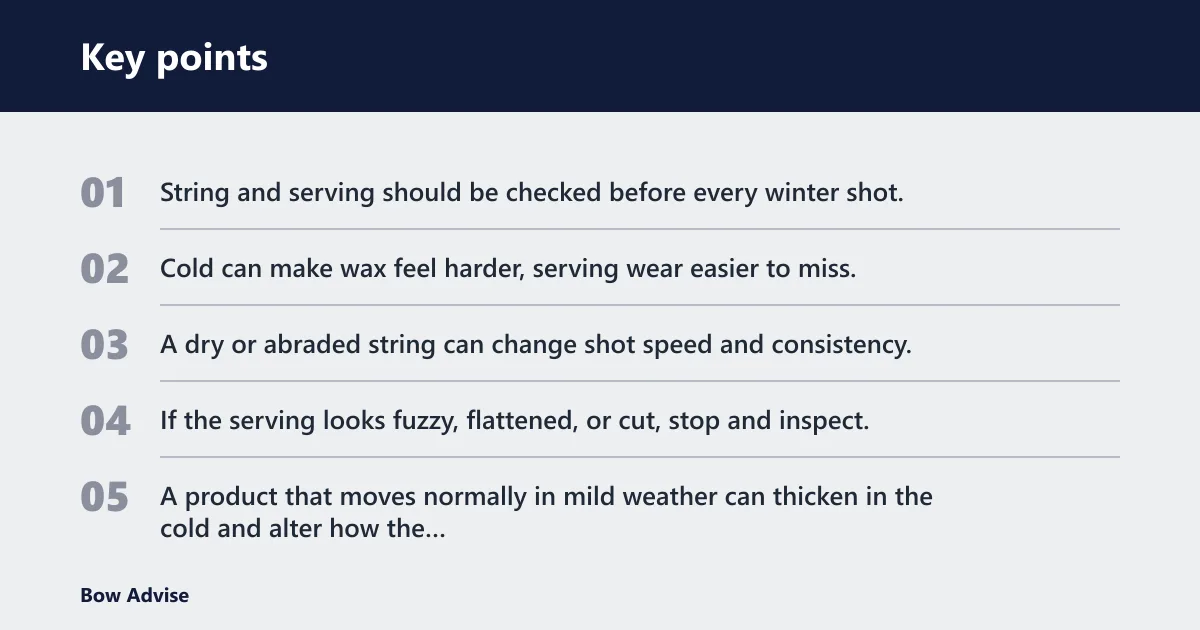
String and serving should be checked before every winter shot. Cold can make wax feel harder, serving wear easier to miss, and lubricant more sluggish on the rail. A dry or abraded string can change shot speed and consistency. If the serving looks fuzzy, flattened, or cut, stop and inspect.
Lubricants are another weak point. A product that moves normally in mild weather can thicken in the cold and alter how the string rides the rail. That is one reason a bow that felt normal in a shop may behave differently outside in freezing air.
Limbs, cams, and fasteners
Limbs are the part most hunters worry about, and for good reason. Cold storage or a hard temperature swing can reveal cracks, chips, or stress marks that were not obvious before. Inspect the limb surfaces, limb pockets, mounting points, and the area around the riser interface for anything that looks new or uneven.
Cams and fasteners need the same attention. Check for unusual wear, debris, loose screws, or any change in alignment. If a manufacturer gives a specific temperature note for the limb material or assembly, use that guidance rather than guessing.
Scope zero and reticle alignment
Scope zero can shift with temperature change, mounting movement, or a change in how tightly the crossbow and rings were clamped. Reticle yardages should be treated as a checked setting, not a permanent promise. A cold snap can expose a slightly loose mount or a zero that was already marginal.
Do not assume the reticle still matches the bolt’s point of impact after a hard cold shift. Confirm that the scope is level, the mounts are tight, and the zero still matches the intended distance before hunting.
Winter crossbow decision table
This table gives a practical cutoff framework. Use the manufacturer’s guidance first, then match the temperature band to the crossbow’s visible condition and the likely first failure point.
| Temperature band | What can fail first | Exact pre-shot action |
|---|---|---|
| Above 20°F | Scope zero, loose fasteners, string dryness | Shoot after a quick inspection and a normal safety check |
| 20°F to 0°F | Stiffer lubricant, string change, minor zero shift | Warm-acclimate, then inspect limbs, string, rail, scope, and fasteners before shooting |
| 0°F to -10°F | Condensation, brittle limb behavior, mount movement | Stop and inspect first if the bow was exposed to snow, ice, or a warm-to-cold move |
| Below -10°F | Lubricant thickening, hidden cracks, zero shift | Use only if the manual permits it and the bow passes a detailed inspection; otherwise do not shoot |
Say your crossbow has been in a truck bed overnight at 12°F, then you carry it into a heated cabin for ten minutes. The outside looks dry, but the rail beads with moisture when you open the case. That is not a shooting moment. Let it equalize, wipe it down, and inspect first.
Suppose the temperature is 8°F and the bow has stayed outside all morning. The string looks dry, the scope mount has a slight gap, and the safety lever feels different. That is enough to stop. Tighten only to the manufacturer’s listing, then re-check the bow before any shot.
Do bolts and scopes need re-checking after a cold snap?
Yes. Bolts and scopes should be checked after a cold snap, after a cold-to-warm move, and after any change in storage or weather exposure. Cold can alter the bolt’s path, the scope’s zero, and the way the mount holds. If the setup changed temperature sharply, treat the first shot as a check, not a hunt shot.
Bolt weight, shaft condition, and broadhead choice
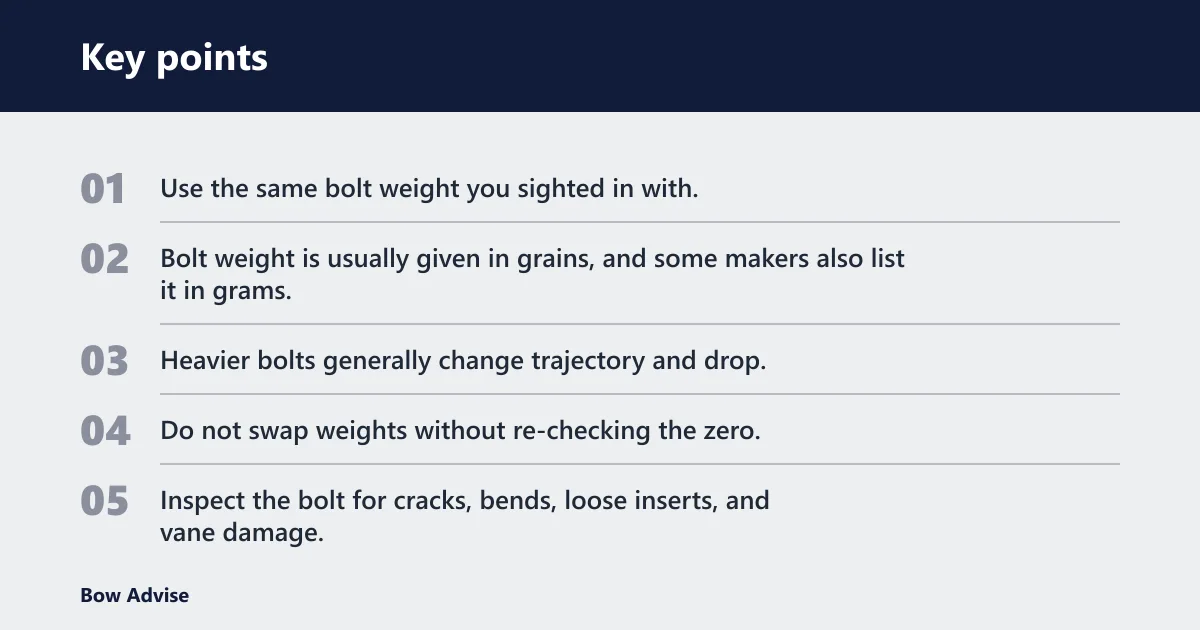
Use the same bolt weight you sighted in with. Bolt weight is usually given in grains, and some makers also list it in grams. Heavier bolts generally change trajectory and drop, while lighter bolts can fly differently and may react more sharply to tuning changes. Do not swap weights without re-checking the zero.
Cold can also reveal shaft or vane problems. Inspect the bolt for cracks, bends, loose inserts, and vane damage. Broadheads add another variable because blade alignment and drag can differ from field points. If you sighted in with field points, re-check with the hunting head you plan to carry.
Scope mounting and reticle yardages
Scope alignment matters more in winter than many hunters expect. A slightly loose ring or base can keep the reticle looking normal while the point of impact shifts. Re-check that the scope is level, the rings are secure, and the reticle yardages still match the actual impact at your chosen practice distance.
Most modern crossbows shoot between 300 and 400 fps, so small setup changes can still move the impact enough to matter on game. A faster bow generally flattens trajectory, but that does not remove the need to confirm zero after a cold snap.
Why zero can shift after temperature change
Temperature changes can affect the string, serving, mount tension, and even how the shooter holds the bow. That is enough to move point of impact without any obvious damage. A cold snap can also make the string behave differently, which changes the bolt’s launch in a way the scope will not correct on its own.
A 350fps crossbow with a 26-gram bolt drops about 10 cm at 30 meters, and at around 50 meters that same bolt drop becomes 50 cm. That is why reticle yardages should be treated as verified settings, not guesses, especially after temperature changes.
What should you inspect before winter shooting?
Before any winter shot, inspect the string, serving, limbs, rail, cams, scope, and fasteners. Also confirm the safety mechanism, the cocking method, and the bolt you plan to use. If something looks changed from the last session, stop and follow the manual rather than forcing a shot.
String and serving check
Look for dry spots, fuzzing, cuts, flat spots, and any serving separation. Winter air can make wear easier to miss until the string is loaded. If the serving has moved or the string looks tired, do not shoot until it is corrected according to the manufacturer’s instructions.
Limb and rail inspection
Inspect both limbs from end to end, including the pocket area and the edges where stress marks show up first. Look for chips, cracks, white lines, splinters, or anything asymmetrical. Check the rail for moisture, debris, or ice, because a dirty rail can change how the string rides and launch speed follows.
Fastener torque and dry-fire prevention
Check all visible fasteners before winter hunting: scope rings, scope base, limb bolts if applicable, quiver mounts, and accessory screws. Tighten only to the manufacturer’s listing. Dry-fire prevention matters too. Make sure the bolt is seated, the safety works as intended, and the cocking process is complete before the trigger is touched.
Crossbows can send a bolt a very long way, but hunting accuracy is much shorter than maximum flight distance. The best crossbowmen can hit precisely at 80 meters, yet ethical hunting still calls for closer, more certain shots. Practice with the exact bolt and broadhead setup you will carry.
Frequently asked questions
Does a crossbow lose accuracy in freezing weather?
Yes, it can. Freezing weather can stiffen lubricant, change string behavior, shift scope zero, and expose hardware that was already loose. Accuracy may stay acceptable if the bow is inspected and re-zeroed, but the chance of a point-of-impact change is higher after a cold snap.
Can I leave my crossbow in a cold truck or garage?
Often yes for storage, but storage is not the same as shooting readiness. A cold truck or garage can be fine if the bow stays dry and the manual allows that temperature range. Before shooting, warm-acclimate slowly, check for condensation, and inspect the string, limbs, scope, and fasteners.
What happens to crossbow arrows in the cold?
Use the term crossbow bolt here: cold can expose cracks, vane damage, loose inserts, and shaft issues that were not obvious before. Bolt weight and broadhead choice also affect trajectory and drop, so a winter re-check should include the exact bolt you plan to hunt with.
Do scopes and bolts need re-checking after a cold snap?
Yes. A cold snap can shift scope zero or reveal a mount that moved slightly, and a bolt can behave differently if the weight, shaft condition, or broadhead changed. Re-check alignment, ring tightness, and impact point before hunting, especially if the bow moved from warm storage into cold air.
What should I inspect on a crossbow before winter hunting?
Inspect the string, serving, limbs, rail, cams, scope, and fasteners before every winter outing. Look for dry string, frayed serving, cracks, ice, moisture, loose screws, and a shifted zero. If anything looks off, follow the owner’s manual and stop until the issue is corrected.
Is it safe to shoot a crossbow below freezing?
Sometimes, but only after a careful inspection and only if the manufacturer’s guidance allows it. Below freezing is when stiff lubricant, brittle components, and zero shifts become more likely. At 0°F or below, a crossbow that has been exposed to snow, ice, or a warm-to-cold move should be checked first.