Do Bow Strings Stretch in Cold Weather?
Yes, but cold weather usually does not stretch a bowstring much; winter point-of-impact change is often more likely to come from changes in cables, limbs, serving, or nock fit than from true string length change. Ignore that, and your bow can shoot low, lose tune, or start creeping out of spec right when shots matter most. This guide separates true stretch from cold-driven setup changes and gives a quick winter diagnosis checklist for compound and recurve bows.
This guide is part of our Shooting a Bow in Cold Weather: Gear, Strings, Arrows and Comfort series.
Cold-weather archery is mostly a form and clothing issue. Freezing air changes arrow speed only a little, usually by a few fps, so the larger risk is reading a setup shift as a failed string. Start your winter check with parts that move, rub, or stiffen.
Cold weather and string changes


Stretch, creep, and setup shift are not the same thing
True stretch means the string material itself has changed length. Creep is slow length change under load, which matters more on some materials than others. A third category is apparent change: a peep that rotates, a nock fit that changes, a cam that settles, or a serving that wears and opens up under cold, dry use.
For compounds, a changed bow feel can come from cables, cam position, or stiff accessories rather than the main string growing longer. For recurves and traditional bows, limb response and string material matter more than cams, but serving wear and brace height change still need a look.
Why a bow can feel different without the string length changing much
Cold hands make grip pressure less steady. Gloves change trigger feel. Thick layers can push the string path, alter anchor point, or rub a sleeve at full draw. All of that can move impact even if the string itself is healthy.
Warm-to-cold temperature cycling adds another layer. A bow brought from a heated house into freezing air can collect moisture on cams, axles, sight hardware, and accessory threads. That moisture can stiffen parts, slow movement, or leave a false impression that the string itself changed overnight.
Do bow strings stretch in cold weather?
Usually not in any meaningful way if the string is healthy and properly broken in. Cold can make the bow act different, but the more common winter causes are creep, serving wear, condensation on hardware, and clothing interference. If the string seems longer, first rule out setup shift before blaming temperature.
Healthy strings: what movement is normal
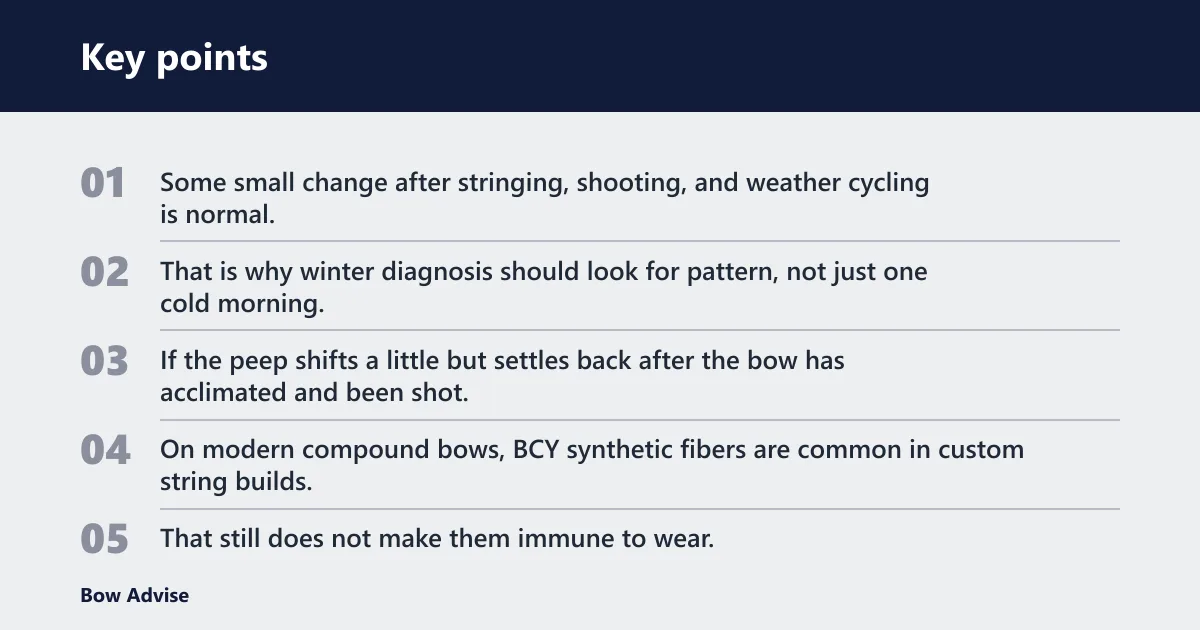
Some small change after stringing, shooting, and weather cycling is normal. That is why winter diagnosis should look for pattern, not just one cold morning. If the peep shifts a little but settles back after the bow has acclimated and been shot, the issue may be temperature-related behavior rather than true string failure.
On modern compound bows, BCY synthetic fibers are common in custom string builds, and manufacturers often back them against stretch, creep, and serving separation. That still does not make them immune to wear. It means winter changes should be checked against the whole system, not guessed from one symptom.
Signs the issue is material creep, not temperature alone
Look for a brace height or peep location that keeps drifting after several shooting sessions, not just after one cold outing. A repeated point-of-impact shift after the bow has been allowed to acclimate is more suspicious than a single low group shot on the first set in freezing air.
Another clue is consistency. If the bow shoots a different point every time it moves from warm to cold, the likely cause is temperature cycling, not a string that is lengthening every shot. If the change keeps growing after the bow has stayed cold and dry, then creep or serving movement becomes more likely.
When to suspect serving wear instead of stretch
Serving separation looks different from stretch. A serving that opens, flattens, or drifts exposes the underlying bundle or creates a rough spot at the nocking point. That can change nock fit and peep orientation without the main string length changing much.
A common first-timer mistake is calling every peep turn “stretch.” If the peep rotates but the string track, serving, and nock point are visibly worn, the repair is often to re-serve or replace the serving, not to assume the whole string is failing.
Bowstring material and winter behavior
Material choice matters more in winter than many shooters expect. Dacron and other traditional string types behave differently from modern compound string materials, especially under repeated cold use. The material does not erase temperature effects, but it changes how much creep resistance and durability you can expect.
BCY synthetic fibers and modern compound strings
Compound strings made with BCY synthetic fibers are built for low creep and better dimensional stability than older materials. That is useful in cold use because the shooter is already dealing with clothing, numb fingers, and setup shift. A string that holds length better gives fewer variables to chase.
Even then, cold can still affect the bow through cables, serving, and accessory hardware. A winter check should not stop at the main string. Measure the whole system.
Dacron versus other string types on recurve and traditional bows
Dacron is common on many recurve and traditional bows because it is forgiving and works well on setups that do not need ultra-low stretch materials. It is also generally less resistant to creep than many modern compound string materials, so winter checks matter after storage and heavy use.
For recurves, that means watching brace height, nocking point stability, and serving wear. For compounds, the same weather can show up as cam timing change, peep rotation, or a cable issue rather than a simple string-length problem.
Durability and creep resistance in cold use
Cold does not make a good string suddenly weak, but it can expose a weak one. A string that already has serving wear, uneven wax coverage, or age-related fuzzing may show those problems faster when temperatures drop. Durability and creep resistance are separate questions.
Durability answers how well the bundle survives abrasion and repeated loading. Creep resistance answers how well it holds length under tension. Winter can reveal both, but not in the same way.
Bow strings stretch diagnosis table
| Symptom | Likely cause | What to check next |
|---|---|---|
| Peep rotation after a cold move from house to field | Temperature cycling, cable settling, or nock fit change | Let the bow acclimate, then check peep alignment, cable condition, and whether the rotation repeats after several shots |
| Point of impact shifts low in freezing air | Cold air speed loss, clothing interference, or changed zero | Recheck zero in cold conditions and inspect string clearance at full draw with hunt-day layers |
| Serving looks fuzzy, flat, or spread apart | Serving wear or separation, not true string stretch | Inspect the nocking point, peep area, and any contact points; re-serve or replace the serving if it is opening up |
| Cam timing changes or the bow comes out of tune | Cable movement, hardware shift, or a cold-stiffened component | Check timing marks per the owner’s manual and confirm that axle and accessory hardware are dry and snug |
| Parts feel stiff at full draw | Cold-stiffened hardware, dampeners, or condensation in moving parts | Inspect cams, axles, rest, and sight threads for moisture or drag; dry the bow before storage |
| Extra noise or vibration on the shot | Rubber dampeners hardened in the cold | Check dampeners for cracking, hardening, or reduced flexibility; compare feel after the bow warms to room temperature |
| Brace height or peep position keeps drifting on a recurve | Traditional string creep, serving wear, or limb/string mismatch | Measure brace height against the bow maker’s spec, inspect the serving, and confirm the string type is appropriate for the bow |
Why does my bow feel different in freezing temperatures?
Freezing weather changes how the bow feels mostly through control, clothing, and stiffened parts. Cold hands hold differently. Gloves alter release. Thick layers can move anchor point or block string path. On top of that, some rubber parts harden and transmit more vibration and noise.
Cold draw weight changes and control
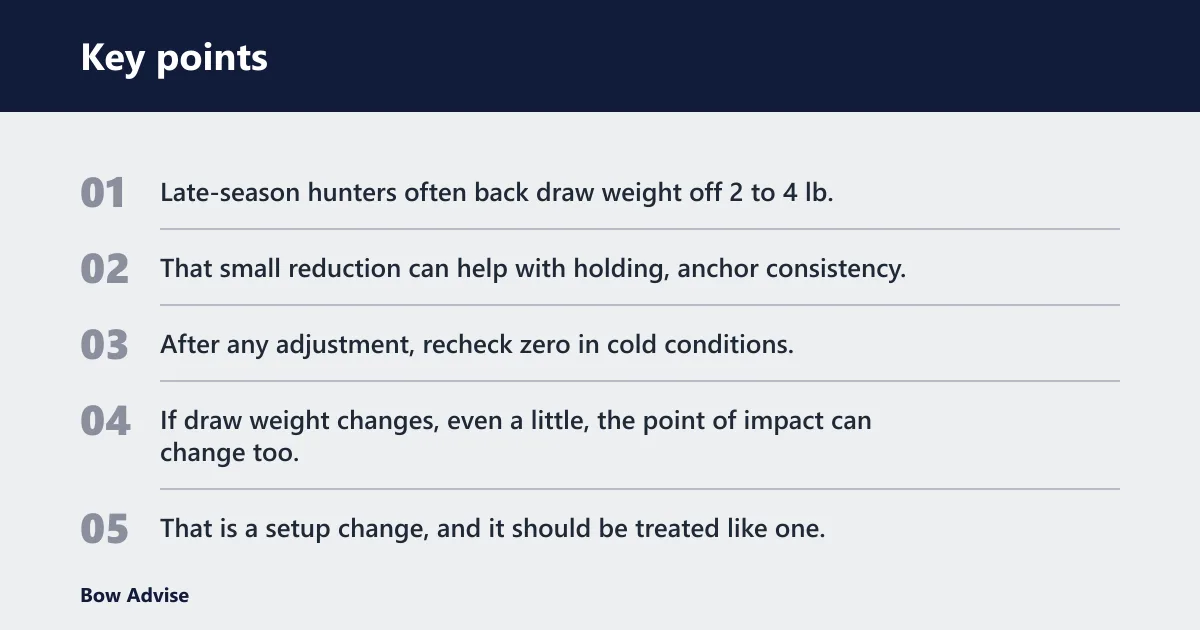
Late-season hunters often back draw weight off 2 to 4 lb. That small reduction can help with holding, anchor consistency, and a clean release when gloves and numb fingers make control less precise. After any adjustment, recheck zero in cold conditions.
If draw weight changes, even a little, the point of impact can change too. That is not string stretch. That is a setup change, and it should be treated like one.
Thicker clothing, sleeve clearance, and anchor shifts
Thicker clothing can block the string path or force the bow arm sleeve into the string. It can also change how the release hand or face anchor lands. That is why string clearance should be checked at full draw, not just at rest.
Say your setup tunes fine in a light shirt but the chest sleeve touches the string when you wear a heavy jacket. The problem is not a longer string. The problem is hunt-day clearance, and the fix is to check the bow with the exact layers and gloves you will hunt in.
Rubber dampeners, stiff parts, and vibration changes
Rubber dampeners can get cold-stiff and transmit more vibration and noise. Some can harden enough to crack over time. That does not mean the bowstring changed length; it means the damping system is behaving differently in freezing weather.
Inspect the dampeners, limb accessories, and any rubber bumpers when the bow is cold. If the bow sounds sharper in the cold, the string may be fine while the vibration path changed.
Can condensation damage a bowstring in winter?
Yes, moisture from warm-to-cold cycling can create problems, but the damage path is usually indirect. Condensation on cams, axles, accessory threads, or serving can lead to stiffness, corrosion, or wear. The bow should be stored cold and dry instead of being moved repeatedly between temperatures.
Warm-to-cold cycling and moisture on cams and axles
Moving a bow from a heated house to freezing air can cause condensation on metal and around serving contact points. That moisture can freeze, attract grit, or leave parts feeling sticky. A bow that is repeatedly cycled between temperatures is more likely to show these issues than one kept cold and dry.
That is why temperature cycling matters as much as the cold itself. The string is only one part of the system.
Drying steps after a hunt or practice session
- Bring the bow indoors and wipe visible moisture from the string, cams, axles, rest, sight, and threads.
- Let the bow acclimate in a dry space before it is stored in a case or closet.
- Check the serving, peep, and any rubber parts for dampness, stiffness, or ice crystals.
- Do not re-wax a cold, wet string and expect deep penetration; wax applies poorly in the cold.
- Before the next outing, verify brace height, peep position, and zero after the bow has settled to hunting temperature.
Storage that stays cold and dry
Storage should be consistent. Cold and dry beats warm-cold-warm cycling. That reduces condensation on hardware and helps the string and serving stay in the state they will see in the field.
Do not leave a damp bow in a sealed case overnight. Moisture trapped with a string and metal parts is a poor winter combination.
Winter setup and maintenance
Winter maintenance works best when it is done before the season, not when the mercury is already low. Wax should be applied before the season, and cold weather is a poor time for it because wax applies poorly in the cold. After setup changes, recheck zero in cold conditions.
When to wax the string
Wax the string before the season and after the string has been cleaned and dried. In winter, wax is less likely to penetrate well, so it should not be the only fix for fuzz, dryness, or surface wear. It is maintenance, not a repair for serving damage.
How much draw weight to back off for late season
Backing draw weight off 2 to 4 lb is a common late-season move. It can help with holding, shot execution, and control when heavy clothing and cold fingers make the shot less forgiving. After the change, the sight should be rechecked in cold conditions.
Why to recheck zero after any change
Zero should be checked after changing draw weight, after switching clothing layers, and after moving the bow from warm storage into hunting cold. Air density, release feel, and anchor consistency can all move the group enough to matter on a winter shot.
Suppose a compound bow is sighted in at home in a light shirt, then used at dawn in a heavy jacket. If the first cold group lands low and left, the problem may be clothing and temperature, not a stretched string. The correct response is to verify zero with hunt-day gear.
What should I check on my bow after hunting in freezing weather?
Check the parts most likely to change in the cold: the string, serving, peep, cams, axles, dampeners, and any accessory threads. Look for condensation, stiffness, wear, and a zero shift. For recurves, include brace height and serving condition. For compounds, include timing and cam behavior.
Quick five-minute post-hunt check
- Wipe the bow dry, especially around cams, axles, limb pockets, and threads.
- Inspect the serving for fuzzing, separation, or a worn nocking point.
- Look at peep rotation and note whether it repeats after the bow has settled cold.
- Check dampeners and rubber parts for hardening or cracking.
- Confirm that the bow still fits the same anchor, sleeve clearance, and string path used on the hunt.
Recurve-specific checks
On a recurve, verify brace height, serving wear, and nock fit first. If the string material is Dacron or another traditional type, watch for creeping length and serving movement after repeated cold sessions. If brace height drifts, confirm it against the bow maker’s specification rather than guessing from feel.
Frequently asked questions
Does cold weather make a bowstring longer?
Cold weather does not usually make a healthy bowstring materially longer. A length change that seems to appear in freezing conditions is often apparent stretch from creep, serving wear, or temperature cycling. If the change keeps showing up after the bow has acclimated and been shot, inspect the string and serving closely.
How much does cold weather affect bow strings?
The direct physics change is small. Cold air causes a small speed loss measured as a few fps, but the bigger effects are on form and equipment behavior. Clothing bulk, cold hands, condensation, and stiffened parts can all change the shot more than the string material itself.
Should I wax my bowstring before winter?
Yes. Wax is best applied before the season, because it applies poorly in the cold. Waxing should support the string, not replace inspection. If the serving is separating or the string is showing wear, wax will not correct the problem. Clean and dry the bow first, then wax before storage or the season.