Can You Leave a Compound Bow in a Cold Garage?
Yes, you can leave a compound bow in a cold garage if the space stays dry and the temperature does not swing hard from freezing air to warm indoor air; skip it when the garage is damp or the bow will move through repeated freeze-thaw cycles. Moisture and condensation can corrode metal parts, swell string fibers, and shorten cable life. This guide explains the storage risks, the warning signs, and the safest setup.
Cold alone is safe; moisture and temperature swings are not
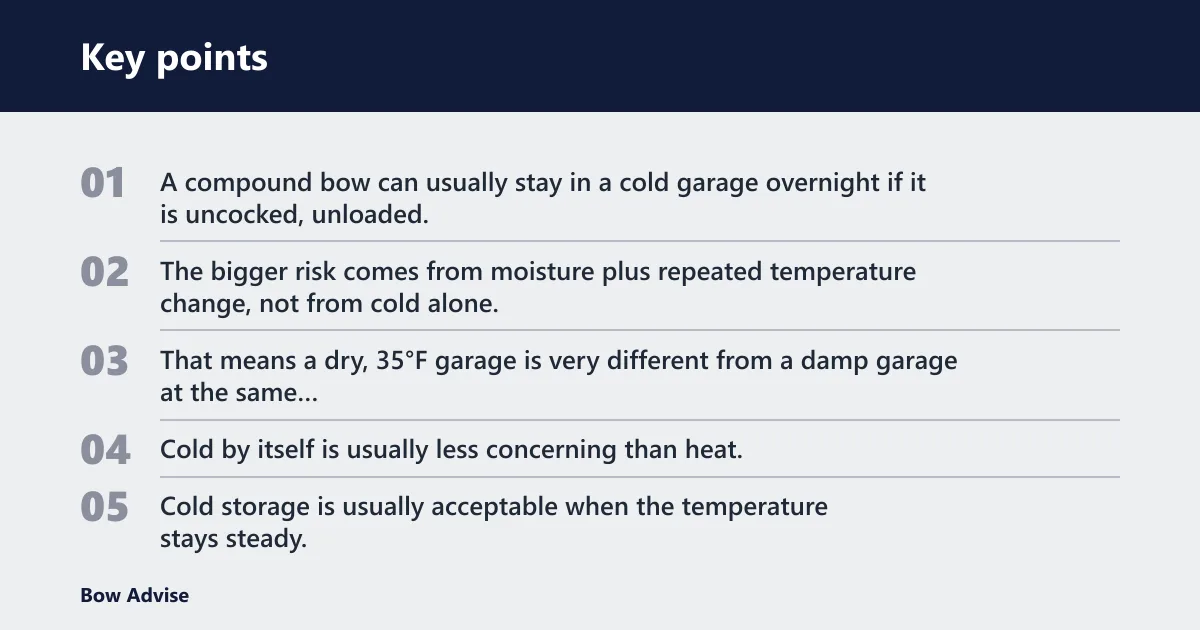


Yes, usually. A compound bow can usually stay in a cold garage overnight if it is uncocked, unloaded, clean, and dry, and if the garage stays dry with no sharp swings between freezing air and warm indoor air. The bigger risk comes from moisture plus repeated temperature change, not from cold alone.
That means a dry, 35°F garage is very different from a damp garage at the same temperature. Cold by itself is usually less concerning than heat, but temperature swings can still leave condensation on strings, cables, cams, and other metal parts once the bow moves indoors.
Cold is not the same as safe
Cold storage is usually acceptable when the temperature stays steady. A bow that sits through winter in a garage holding near the same temperature for days is less concerning than one that freezes overnight, warms at midday, then cools again. Those swings create condensation risk.
One forum user described a garage that sits between 45 and 85F for most of the year. That range is a warning sign, not a comfort sign. If the bow sees that kind of swing, the issue is not the low number alone; it is the repeated movement across warm and cold air.
The real risk is moisture, not temperature alone
Moisture can affect string fibers, cable serving, limb pockets, cams, and axle contact points. It can also move lubrication off contact surfaces. Cold weather can stiffen materials, but damp storage is the sharper threat because water reaches the hardware first.
Say your garage sits at 35°F all night and the bow stays dry. That is lower risk than a garage that stays at 35°F but gets wet shoes, slush, and dripping gear on the floor every day. The temperature is the same; the storage risk is not.
Cold garage storage risk checklist
Use this checklist to decide whether the bow can stay in the garage. It separates harmless cold from the situations that create real storage problems. The goal is to keep the bow dry, protected, and away from pressure or impact while it waits for the next range day or hunt.
| Condition | Risk level | Action |
|---|---|---|
| Dry 35°F garage | Low | Okay for short-term storage if the bow is uncocked, unloaded, clean, and dry. |
| Damp 35°F garage | Moderate to high | Move it indoors or seal it in a dry case; check for condensation and rust risk. |
| Garage with daily freeze-thaw swings | High | Avoid long storage there; frequent swings raise condensation risk on strings and hardware. |
| Bow in a soft case | Moderate | Better than open storage, but it still offers limited protection against pressure and floor moisture. |
| Bow in a hard case | Low | Best garage option for bumps, dust, pets, children, and floor impact. |
| Bow returning to warm indoor air | Moderate | Let it acclimate before inspection; watch for condensation on metal parts. |
Yes or no rule
Yes if the garage is dry, reasonably stable, and the bow is protected from impact and floor moisture. No if the garage is damp, sees daily freeze-thaw swings, or stores the bow where it can be hit, pressed, or soaked by condensation.
For long storage, a hard case is the safer choice. For short storage in a clean, dry garage, the bow can stay there without trouble if the conditions stay moderate and the bow is checked before use.
Is an unheated garage bad for a compound bow?
Not automatically. An unheated garage is usually acceptable when it is dry and stable, but it becomes a poor storage place when moisture collects, snow melts on the floor, or the bow is exposed to repeated temperature swings. Garage winter storage is commonly considered acceptable by archers if those conditions stay moderate.
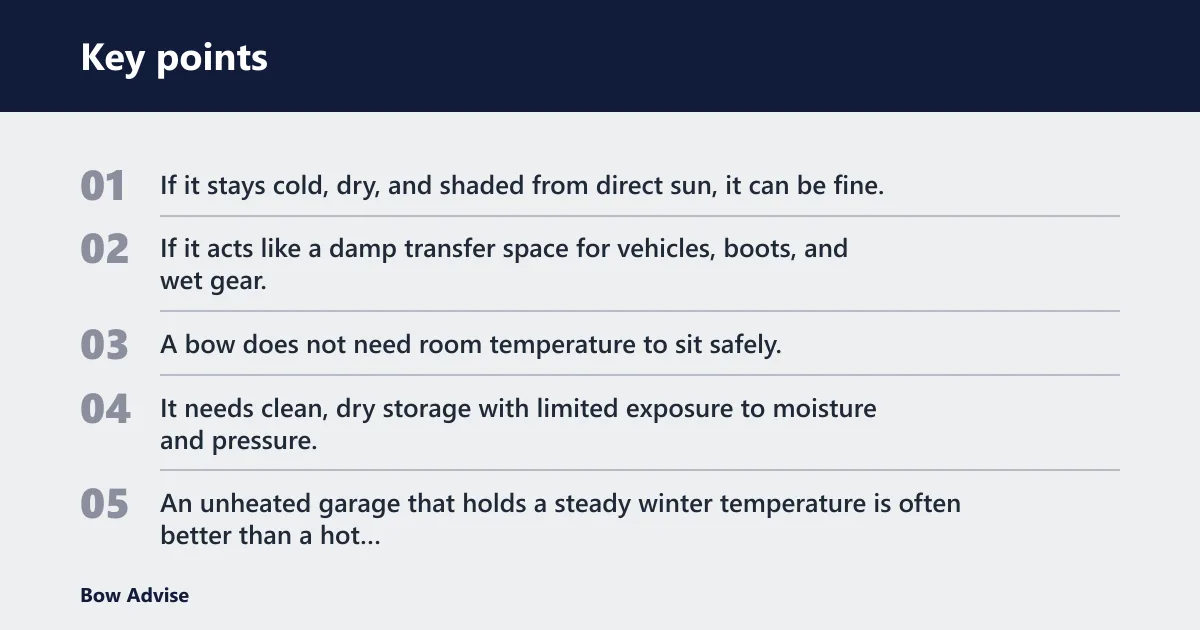
The garage itself is not the problem. The problem is how it changes over time. If it stays cold, dry, and shaded from direct sun, it can be fine. If it acts like a damp transfer space for vehicles, boots, and wet gear, the bow takes on more risk.
Dry and stable garage conditions
A bow does not need room temperature to sit safely. It needs clean, dry storage with limited exposure to moisture and pressure. An unheated garage that holds a steady winter temperature is often better than a hot room with direct sun or a vehicle that heats and cools fast.
The bow should still be stored uncocked, unloaded, clean, and dry. That applies in a garage, in a closet, or on a shelf. If the bow has been wiped down and the string is lightly waxed, it is in better shape for storage than a bow left dirty or wet.
Why damp garages are a different risk
Moisture changes the equation. Damp air can settle on strings, cables, screws, rests, and cam hardware. In the right conditions, it can also create condensation after the bow is moved from cold air to warmer indoor air.
That is why a damp 35°F garage is not treated the same as a dry 35°F garage. The temperature number does not tell the full story. Humidity, floor moisture, and the frequency of temperature change matter more.
Why cars and trucks are worse than garages
Vehicle storage is riskier because temperatures change fast. A truck bed or car interior can go from freezing to warm much faster than a garage, and that speed raises condensation risk. Heat is still the bigger long-term problem, but cars and trucks create sharp swings that are hard on stored gear.
One forum poster said to worry about extreme heat and extreme cold like -20 degrees. Another described a bow sitting in a truck at wind chill near -25 outside and still shooting after warming. That does not make vehicle storage ideal; it only shows that survival and safe storage are not the same thing.
Cold garage effects on strings, cables, limbs, and cams
Cold storage does not usually damage a compound bow on its own, but the bow’s main parts still deserve inspection after storage. The string, cables, limbs, cams, and hardware can all show wear that was easy to miss before the bow went into the garage.
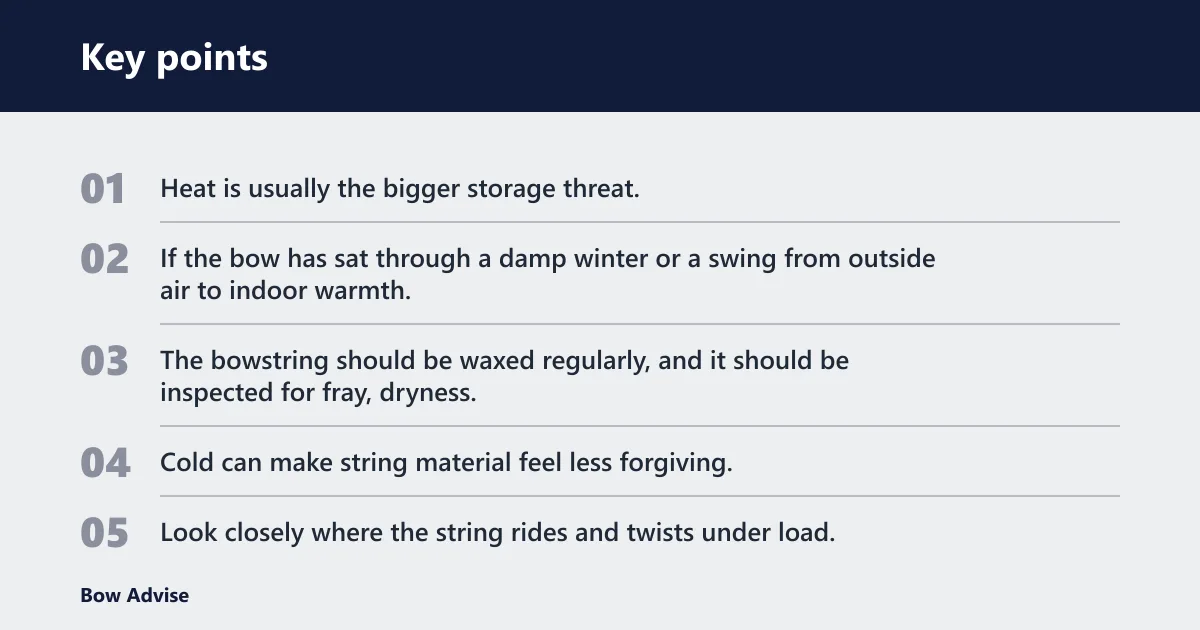
Heat is usually the bigger storage threat, but cold can stiffen materials and affect performance. Moisture is the stronger reason to inspect. If the bow has sat through a damp winter or a swing from outside air to indoor warmth, it deserves a careful check before shooting.
Bowstring and cable checks
The bowstring should be waxed regularly, and it should be inspected for fray, dryness, and serving wear before shooting. Cold can make string material feel less forgiving, while dampness can shorten the life of serving and fibers over time. Look closely where the string rides and twists under load.
Cables need the same attention. Check for fuzzing, separation, flat spots, and any signs that moisture sat on them. If the bow came out of a wet garage or a soft case that trapped damp air, the cables deserve extra attention.
Limbs and delamination checks
Limbs should be checked for cracks, chips, bubbling, or delamination before use. Heat and moisture are the classic long-term concerns, but a bow stored under stacked gear or pressed against a wall can also suffer damage from pressure and impact.
Do not stack boxes, cases, or boots on top of the bow. Limbs are built to flex in use, not to carry load in storage. If the bow sat in a case on a garage floor, inspect the limb surfaces and limb tips carefully before the first shot.
Cams, axles, and hardware after storage
Cams should turn freely and look even. Check for chips, wobble, unusual wear, or anything that seems blocked by ice, snow, or grit. Axles and contact points can also show issues after storage if condensation displaced lubrication or left moisture behind.
Hardware matters too. Screws, rest mounts, sight screws, and accessory bolts can loosen over time. A bow that spent winter in a garage should not go straight to full use without a close visual check.
Should you store it in a hard case?
Yes, a hard case is the better choice for garage storage if the bow will sit there for more than a short time or if the space is shared with tools, pets, children, or floor traffic. It protects a compound bow from bumps, dust, and pressure, and it helps keep the bow safer during storage or transport.
A soft case is better than leaving the bow exposed, but it offers less protection against impact and floor moisture. If the garage is clean, dry, and rarely disturbed, a soft case can be acceptable. If the garage is busy or damp, a hard case is the stronger choice.
What a hard case protects against
A hard case helps shield limbs, cams, string, cables, and accessories from accidental hits and from being crushed by other gear. It also keeps the bow off the floor, where moisture and debris collect first. That matters in winter, when tracked-in water can pool near the garage door.
It is also a practical barrier against pets and children. A compound bow stored out in the open can be nudged, knocked over, or buried under other items. A hard case lowers that exposure.
When open storage is a poor choice
Open storage is a poor choice when the garage has dust, slush, pests, or clutter. It is also a poor choice when the bow sits near a heater, near direct sun, or next to stacked items that can press on the limbs or cams.
If the bow is uncased, it should still be on a safe rack or shelf, away from the floor and away from anything that can deform or strike it. A clean, dry, stable spot is the goal.
What happens when a cold bow warms up?
When a cold bow moves into warm indoor air, condensation can form on metal parts, cams, screws, axles, and other hardware. That is the failure path that matters most after garage storage. The bow itself may be fine, but the moisture formed during the transition can create new problems.
The fix is simple: let the bow acclimate before inspecting or shooting it. Do not rush it from a freezing garage straight to the range bag and then straight to the shot line.
How long to let it acclimate
There is no universal timer that fits every garage, but the bow should be allowed to warm gradually until the surface no longer feels cold enough to sweat. That matters most when the garage is near freezing and the house is warm and humid.
A common first-timer mistake is bringing the bow in from a cold garage, wiping nothing down, and checking screws immediately. That invites false confidence because the condensation may not be visible yet. Give the bow time to settle first.
What to inspect before shooting
After acclimation, check the string, cables, limbs, cams, and hardware before the bow goes back into use. Look for moisture on the surface, fray, serving wear, wobble, chips, loose screws, or anything that seems off in alignment. If the bow was in a case, inspect the case itself for dampness.
Suppose a bow comes out of a 35°F garage and into a 70°F house. If you see beads of moisture on the cams or hardware, that is a sign to dry the bow fully before shooting. Do not shoot while condensation is still present.
Pre-shoot inspection after cold storage
Before shooting a bow that sat in the cold, do a full visual check. The goal is to catch moisture damage, loose hardware, and wear before the first draw. A bow press is not needed for basic storage, but it is needed for string or cable work that removes tension.
If the inspection reveals structural damage, stop. Do not try to shoot through cracked limbs, damaged cams, or a string that looks unsafe. Repair work belongs on the bench, not on the range line.
- Check the bowstring for fray, fuzzing, dryness, and serving wear.
- Inspect the cables for fuzzing, twist issues, and dampness.
- Look over both limbs for cracks, chips, or delamination.
- Spin or observe the cams for wobble, chips, or unusual wear.
- Check axle areas and hardware for condensation or corrosion.
- Verify that rests, sights, quivers, and other accessories are still tight.
- Confirm the bow is still uncocked, unloaded, clean, and dry before use.
- Stop and use a bow press only if string or cable work is needed.
Frequently asked questions
Can you leave a compound bow in a cold garage overnight?
Yes, if the garage is dry and fairly stable. Keep the bow uncocked, unloaded, clean, and dry, and place it in a hard case if possible. Overnight cold is usually not the problem; damp air, floor moisture, and a fast move into warm indoor air are the bigger concerns.
How cold is too cold for a compound bow to sit in storage?
Cold alone is not the main cutoff. A forum poster mentioned extreme cold like -20 degrees, and that is the kind of condition that deserves caution, especially if the bow will see moisture or rapid warming afterward. Stable dry cold is less concerning than repeated swings.
Will cold weather damage bow strings or cables in storage?
Cold weather alone usually does not damage them, but it can make problems easier to spot and can make materials feel stiffer. Moisture is the bigger risk because it can affect fibers, serving, and hardware. Inspect the string and cables for fray, dryness, or dampness before shooting.
Should I keep my compound bow in a hard case in the garage?
Yes, that is the safer storage choice for most garage setups. A hard case protects against bumps, dust, pets, children, and floor impact, and it gives the bow better protection than leaving it exposed. A soft case is acceptable only when the garage is dry and low-risk.
What happens if a bow goes from a cold garage to a warm house?
Condensation can form on metal parts, cams, screws, and axles. That is why the bow should acclimate before inspection or shooting. Once the surface is no longer cold and damp, check the string, cables, limbs, cams, and hardware before returning the bow to use.
What parts should I inspect before shooting a bow stored in the cold?
Check the string, cables, limbs, cams, screws, rests, and sights. Look for fray, serving wear, cracks, delamination, wobble, chips, and loose hardware. If the bow shows moisture or visible damage, stop and let it dry or get repaired before drawing it again.