
Snow and Frozen Ground Change Arrow Retrieval
Snow and frozen ground change arrow retrieval by making penetration, target stability, and footing less predictable; if the ground is hard or icy, move the target, add a backstop, and use a safer retrieval path instead of forcing arrows out at an angle. Ignoring that can bend shafts, split foam, tip stands, and cause slips during pulling. This guide covers winter target placement, frozen-soil risks, snow-packed impact zones, and safer arrow-retrieval routines for cold-weather shooting.

Must-have
These three items do the most work in winter: a target that handles cold and repeated impacts, a stable stand or base that stays put on frozen ground, and a safe grip aid for straight-back removal. The right mix matters because winter problems come from the target, the footing, and the arrow itself, and each one changes how the others behave.
 Also greatSHOOTER · 48-inch buck · Weather-resistant · Replaceable core
- Lifelike buck design
- High-density self-healing foam
- Weather-resistant with stakes included
Drawback: Replacement core is sold separately.$112.99Price as of 24 Nov 2026View on Amazon →As an Amazon Associate we earn from qualifying purchases. Prices and availability are accurate as of the date shown and are subject to change.

- Lifelike buck design
- High-density self-healing foam
- Weather-resistant with stakes included
SHOOTER Buck 3D Archery Target
Based on the published details, this high-density self-healing foam target is better suited to field-point practice than a soft bag target that can pack up with snow. The replaceable insert helps when one area starts to open up, and the weather-resistant build is useful for outdoor storage. The drawback is simple: broadheads and expandables will wear any foam faster, and a large 48-inch deer shape can be awkward to move once the ground is frozen.
Upgrade pickDelta McKenzie · 41-inch deer · Self-healing · Scoring rings- Self-healing flex foam construction
- Lifelike deer dimensions with scoring rings
- Works with broadheads, expandables, and field points
Drawback: Replaceable vital section is sold separately.$159.99Price as of 24 Nov 2026View on Amazon →As an Amazon Associate we earn from qualifying purchases. Prices and availability are accurate as of the date shown and are subject to change.

- Self-healing flex foam construction
- Lifelike deer dimensions with scoring rings
- Works with broadheads, expandables, and field points
Delta McKenzie Challenger Deer 3D Archery Target
This self-healing foam target is a better fit when a winter practice setup needs broadhead and field-point compatibility. Self-healing foam is described as balancing stopping power with easier pulls, which is useful when cold makes extraction harder. The tradeoff is cost and weight; a taller 3D target can be harder to reset on slick ground, and repeated hits in the same spot will still thin the face over time.
Pair with itArcherest · 3-pack · Rubber · Arrow puller- Durable rubber construction
- Ergonomic finger groove grip
- Universal opening fits many shafts
Drawback: Three-pack may be more than you need.$8.48Price as of 24 Nov 2026View on Amazon →As an Amazon Associate we earn from qualifying purchases. Prices and availability are accurate as of the date shown and are subject to change.

- Durable rubber construction
- Ergonomic finger groove grip
- Universal opening fits many shafts
3 Pack Archery Arrow Puller Target Remover Gripper
A rubber arrow puller adds friction, which matters when gloves, cold fingers, and damp shafts reduce grip. The ergonomic groove and belt clip make it easier to keep nearby during winter shooting, and a straight-back pull is still the safe method. The drawback is that a puller helps with grip, not with a frozen target base, ice crust, or a shaft buried too deep.
A stable base for frozen ground and snow
Frozen ground changes more than pull resistance. It changes where the target sits, how the stand loads, and how safe it is to walk up to the impact zone. Bag targets and block targets need different treatment here, because bag targets can shift on slick ground while foam blocks can rock if the base is only partly seated.
Frozen-ground setup changes
- Clear the contact patch. Remove loose snow, crusted ice, and thawed slush from under the target feet before setting the stand down. A flat, dry contact patch keeps the base from skating when the first arrow hits.
- Seat the stand fully. Push the legs or base into the surface until all feet touch evenly. If one foot sits on packed snow and the others sit on hard ground, the target can tilt after a few shots.
- Keep the target lower. On frozen ground, a lower center of gravity is usually safer than a tall setup. A high target on a narrow base catches more side load from uneven footing and from a hard pull on a tight arrow.
- Check the approach path. Make a clear walking lane to the target before shooting. If the path is icy, arrows may be easy to shoot and hard to retrieve safely, which is when slips happen most often.
Bag targets usually need extra attention at the base because their shape can roll or shift if the footing is uneven. Block targets are steadier, but a frozen tilt can make the face angle upward or sideways, which changes penetration and can put more load on the shaft during removal.
Say your target is a 16-inch base stand on a crusted patch near the garage. One front foot sits on ice and the rear foot sits on bare concrete. The first close-range shot lands fine, but the next one pushes the target a few degrees off center. That small tilt makes later pulls harder because the shaft is no longer exiting straight.
How are arrows harder to pull in winter?
Cold weather is one of the key reasons arrows pull harder from targets. Foam stiffens in low temperatures, and frozen or snow-packed impact zones can clamp down on the shaft where the arrow entered. Easy arrow removal depends on target material, arrow point type, weather conditions, and technique, so winter changes all four at once.
Foam stiffness and density
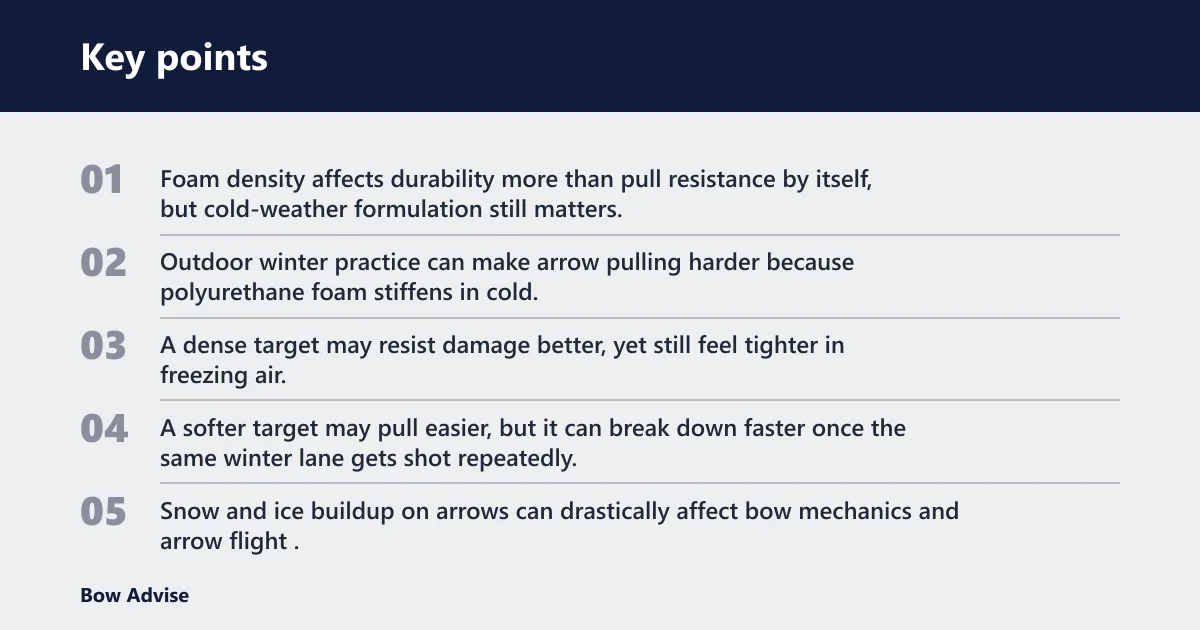
Foam density affects durability more than pull resistance by itself, but cold-weather formulation still matters. Outdoor winter practice can make arrow pulling harder because polyurethane foam stiffens in cold. Self-healing foam is described as balancing stopping power with easier pulls, while denser foam often lasts longer around repeated impacts and face wear.
That distinction matters. A dense target may resist damage better, yet still feel tighter in freezing air. A softer target may pull easier, but it can break down faster once the same winter lane gets shot repeatedly.
Snow-packed impact zones and shaft buildup
Snow and ice buildup on arrows can drastically affect bow mechanics and arrow flight. It also affects retrieval. When snow packs into a fresh hole, the target face can freeze around the shaft and increase pull resistance. Ice on the shaft itself adds drag, and wet grit can transfer into the foam or the target bag.
A common first-timer mistake is shooting a tight group into the same winter spot all afternoon. The face opens, the foam around the holes hardens, and the next arrow has to pass through a packed, icy channel instead of a clean one. That is when pull resistance jumps sharply.
Point type and pull resistance
Field points generally pull easier than fixed-blade broadheads in cold weather. Fixed-blade broadheads create more surface contact, and external collars or outserts can add more resistance at the front of the shaft. The arrow type also affects target compatibility, especially with broadhead-rated foam versus a bag target that is meant for lighter field-point use.
Do field points pull easier than broadheads in cold weather? Yes, usually. The point shape and the amount of blade surface inside the foam change how much force is needed to remove the shaft. Broadheads and some outsert setups can also catch on damaged foam more easily than a simple field point.
How do I keep arrows from sticking too deep in winter?
Keep arrows from burying too deep by shortening the use of one spot, watching target condition, and using a placement that matches the arrow tip. A colder target face, a snow-packed center, or a worn hole will all let arrows sink farther. Rotating aim points and keeping the target face sound helps limit that.
Target face wear and rotation
Hole growth, thinning foam patches, and worn spots matter more in winter because the face loses consistency faster. Rotate the shot location before the center opens up too far. If a cover or insert is available, replace it when the surface starts to look thin or stretched, especially on block and 3D targets that see repeated shots in one area.
Distance and aim point rotation
Back the shooting line up if the target face is already soft or cluttered with old holes. A shorter distance can create repeated hits in the same patch, which speeds up face wear. Rotating the aim point by a few inches after each round spreads impact load and lowers the chance of arrows burying deep into a single frozen channel.
- Move the point of aim. Shift to a fresh patch of foam or a new area on the bag after several shots. This keeps one winter lane from packing up with ice and worn foam.
- Limit repeated clusters. Avoid stacking tight groups in the same cold spot for long sessions. Tight clusters look good, but they drive more buildup into one hole and increase pull resistance.
- Reset worn faces early. Replace or rotate the face when holes open up or the foam begins to thin. Waiting too long usually means deeper penetration and more shaft stress later.
Suppose a practice lane uses a block target at 15 yards and the same center spot stays under a light snow crust. After a few ends, the arrows start sitting deeper than before, even though the draw weight did not change. Rotating the aim point to the upper third of the face usually reduces that buildup and gives a cleaner pull path.
Does frozen ground change how I should set up a target bag or block?
Yes. Frozen ground changes where the target should sit, how it should be anchored, and how high the base should ride above ice and snow. A bag target needs firmer support so it does not skate or lean, while a block target needs level contact so it does not rock or tilt during removal.
Bag vs block placement
Bag targets should not sit in meltwater, slush, or a depression that refreezes overnight. Block targets should not perch on one hard corner with the opposite side floating on snow. Both types need a flat base, but the bag target usually needs more side control because its shape can slide when the ground is slick.
Target height and base anchoring
Raise the target enough to keep the lower edge out of snow splash and crust, but not so high that the stand becomes top-heavy. The exact height depends on the stand and the lane, yet the rule stays the same: keep the lowest contact points dry, level, and easy to reach without stepping into a slick dip.
Before winter shooting, archers are told to avoid setting the bow down in snow and ice. The same caution applies to the target base. If the stand has spikes, pads, or feet, each one should be checked for grip before the first arrow goes downrange.
- Level the footing first. Pack loose snow down or clear it away so the target feet do not sink unevenly. A level base reduces tilt and makes arrow removal more predictable.
- Anchor for thaw cycles. If the ground will thaw and refreeze, secure the stand so it does not shift as the surface softens. That matters most for light bag targets that can drift after a warm afternoon.
- Keep feet off ice. If one foot must sit on ice, move the target or add a grip layer under the base. Bare ice under a leg can create a slow slide that only shows up after several impacts.
Can snow or ice on the arrow rest affect arrow removal and flight?
Yes. Snow or ice on the arrow rest and launcher can affect arrow flight, and a frozen launcher can also make the bow look like the target is the problem when the real issue starts before the shot. Snow build-up can obscure arrow rest issues and create a missed shot. That contamination should be checked before every winter round.
Launcher and rest contamination
Snow, sleet, and wet grit can collect on the launcher arm, rest blade, or containment parts. That contamination can alter launch angle, slow the arrow, or create a wipe that carries into the target face. A dirty rest can also leave the shaft with residue that makes removal feel tighter than it should.
Clothing interference at the shot
Warm winter clothing can interfere with the shot and bowstring clearance. A puffy sleeve can contact the bowstring and cause poor arrow flight or equipment damage. Buttons, scarves, large pockets, and sweatshirt strings can get stuck in the bowstring. Bulky gloves and a face mask can also change anchor feel enough to move the release point.
Inspect the bow setup before the first end, not after the first miss. If the rest has packed snow or the launcher is iced over, stop and clear it before another arrow goes downrange. That simple pause is safer than trying to diagnose bad flight from a contaminated rest.
What should you inspect after shooting in snow or sleet?
After shooting in snow or sleet, inspect the shaft, the front hardware, the nock, the rest area, and the target face. Snow and ice on gear can affect arrow flight, while the target can hide wear that is not obvious from a distance. Dry the bow after a snowy hunt to prevent rust or damage.
Arrow, nock, and point checks
Look for shaft buildup, cracked carbon, bent aluminum, and damaged nocks. Fixed-blade broadheads should be checked for bent blades or a loose collar, and field points should be checked for straightness at the tip. Any arrow that picked up ice or hard grit should be wiped clean before the next shot.
Target face and foam condition
Check for hole growth, thinning foam patches, and a face that is starting to pull apart around the impact zone. On bag targets, look for wet spots, torn seams, or clumped fill. On foam targets, look for compressed channels that no longer close well in the cold.
Inspect the rest and launcher area for snow or ice buildup before putting the bow away. If the bow was set down in slush, dry it fully and remove moisture from the string, limbs, and hardware. That reduces the chance of rust, frozen residue, and stiffness at the next session.
Winter target checklist
This checklist turns the winter setup into a quick pass before shooting. Use it for frozen ground, snow cover, ice crust, target tilt, stand anchoring, shooting distance, aim point rotation, and retrieval order. It also gives a clear stop point when the site stops being safe.
| Condition | Adjustment |
|---|---|
| Frozen ground | Clear the footing, level the base, and avoid a high, narrow setup. |
| Snow cover | Remove loose snow around the stand and keep the target face dry enough to inspect. |
| Ice crust | Break or remove the crust under the feet so the stand does not slide. |
| Target tilt | Reset the target until the face is square to the lane and the base sits even. |
| Stand anchoring | Use stakes, weighted support, or a firmer placement that matches the surface. |
| Shooting distance | Shorten the session if the face is packing up, then move farther only if the target stays stable. |
| Aim point rotation | Shift to a fresh patch after a few ends instead of using one frozen hole. |
| Retrieval order | Clear the path, check footing, approach straight on, then pull arrows straight back. |
Stop shooting if:
- The target base starts sliding or leaning after impact.
- Ice makes the retrieval path unsafe to walk.
- Arrows are burying deep enough to require forceful, awkward pulling.
- The rest or launcher has snow or ice that changes arrow launch.
- The target face is so worn that holes are merging into one soft patch.
Consumables and spares
Winter sessions go better when spare parts are ready. A replacement face, extra field points, and inspection items for nocks, inserts, outserts, and shafts matter more than usual because cold weather magnifies small defects. Broadheads also need a clean, dry place after use so the blades do not corrode or bend in storage.
Target face replacement
Rotating or replacing the face is the easiest way to control hole growth and thinning foam patches. A worn cover lets arrows sink farther and makes pull resistance less consistent. That is especially true on targets that already see field points and fixed-blade broadheads in the same winter lane.
Field points, broadheads, and shaft parts
Field points are useful for winter practice because they usually pull easier than broadheads. Keep a few spare field points on hand, along with broadheads for hunting-specific tune checks. Also keep spare nocks, inserts, outserts, and a shaft inspection method ready, since cold and impact stress can show up as small cracks or bent hardware.
Budget setups
These examples use the products listed above and keep the setup focused on what winter actually changes: stand stability, target material, and safe removal. Prices shown are the listed prices only.
| Setup | What it includes | Price | Best use |
|---|---|---|---|
| Starter | Archerest arrow puller | $8.48 | Cheap grip aid for cold fingers and stubborn arrows. |
| Mid | Aimax Outdoor target stand + Archerest arrow puller | $37.92 | Good for a backyard lane that needs adjustable support on winter ground. |
| Serious | Aimax Outdoor target stand + SHOOTER Buck 3D target + Archerest arrow puller | $150.91 | Better for winter practice that needs a stable base and a target face built for repeated shooting. |
Frequently asked questions
Why are arrows harder to pull out of targets in the cold?
Cold weather stiffens foam, and frozen or snow-packed impact zones can clamp the shaft more tightly. Pull resistance also changes with point type and target material. A dense target may hold up well, but if the face is cold and packed with ice, even field points can feel much tighter than usual.
Should I move my target setup when the ground is frozen?
Often, yes. If the ground is hard, icy, or uneven, move the target to a place with better footing and safer access. The goal is a flat, stable base and a clear retrieval path. If you cannot get that, the setup is better moved than forced into place.