Why Your Bow Feels Different in Freezing Air
Cold air can change a bow quickly, so the first cold shot and peep alignment should be checked before blaming the tune. String tension, grip, and clothing clearance shift together, so a cold check matters before any tuning change. If you skip that step, you can chase a false paper tear, miss low, or misread a peep issue that comes from temperature and layers.
What changes first in freezing air?

- Wraps hands in soft polar fleece on cold weather hunts
- Five storage pockets give room for calls and small essentials
- Stretch-fit wrist opening helps block out wind and weather
The first minutes outside usually bring three shifts at once: the bow cools, your hands and face feel different, and heavy layers change anchor and grip. That is why the bow can feel heavier or less clean before it has fully cold-soaked.
A bow may feel different in very cold air. That looks small on paper, but the first few shots can feel larger because numb fingers, stiffer sleeves, and tighter neck gaiters change how the draw cycle and anchor are felt.
Why the bow can feel heavier even when the setup is close
In cold air, synthetic bowstring fibers contract slightly, and composite limbs stiffen a bit. The change is usually modest, but the draw can feel more abrupt because you are also pulling through colder clothing and less responsive fingers.
For a compound, that can show up as a draw cycle that feels more abrupt at the wall. For a recurve, the limb feel can seem firmer through the last inches of draw, even when the tiller and brace height were fine indoors.
That first impression matters because the mind often reads “heavier” when the real issue is less tactile feedback. If the bow feels wrong only in the first five to ten minutes outside, separate that from a true tuning problem.
Warm house, cold air, and the shooter side
Thicker gloves change grip depth and can move the bow hand to a slightly different spot on the riser. A jacket cuff can also nudge the string path or elbow angle enough to change the release and make the shot feel off.
Suppose a 70-yard sight mark is fine indoors, but the first cold shot drops low and left. That does not automatically mean the bow is out of tune. It may be a colder release, a jacket sleeve catching, or a peep that is not yet aligned at full draw in the cold.
Cold bowstring and brace height
Bowstring behavior changes quickly when a warm string meets freezing air. Synthetic fibers contract slightly, waxed strings hold up better than dry ones, and a dry string can feel crunchy during the draw. Fraying or fluffing is a warning sign, not just a cosmetic issue.
Cold-weather archery can make a bow string feel crunchy if it is dry. That feeling deserves attention because a dry string can lose consistency faster than a properly waxed one, especially when moisture is part of the transition.
Wax, contraction, and the brace-height check
Wax condition matters because a dry string loses surface protection and can pick up more harshness in cold air. Waxing before every session below freezing is a sensible winter habit when the string looks dull, fuzzy, or dry to the touch.
A small string-length shift can also alter brace height. Even a slight change can affect how the bow starts the draw, where the arrow launches, and how the shot sounds. The change is usually subtle, but a winter check makes sense if the bow feels different after a warm-to-cold move.
Warning signs worth fixing now
- Frayed servings near the cam, nock point, or peep area.
- Fluffing that appears after a cold soak or a dry indoor-to-outdoor transition.
- A sharper, rougher feel at full draw than the same bow had indoors.
- Visible dryness after a session in freezing air.
Once a string starts showing those signs, the issue is no longer just temperature. It is maintenance plus temperature.
Do cold bows change draw weight?
Yes, but usually only a little, and the bigger change is often how the draw feels rather than a dramatic jump in actual weight. Limbs, cams, and string material all respond to cold, so the bow may feel stiffer before it is truly out of tune.
Field use and storage matter as much as the weather itself. A bow staged in a garage or mudroom will often come to temperature more gently than one pulled from a warm house and carried straight into freezing air.
How limbs and storage affect the feel
Composite limbs stiffen in low temperatures. That does not mean the bow is unsafe by default, but it can change the way the draw builds and how the bow settles at anchor. The effect is often more noticeable on the first shots after the move outdoors.
Storage matters because the bow can absorb the environment it was left in. A cold case acclimation is better than a sudden warm-room-to-freeze transition, since it reduces condensation and makes the first draw feel more like the rest of the session.
Compound and recurve differences
On a compound, the limbs, cams, and axles can feel different if cold changes friction at contact points or if old lubrication is already present. On a recurve, the limb response is simpler, but the shooter often feels the change more through finger pressure, grip shift, and anchor consistency.
The important point is this: a slight change in perceived draw weight after leaving a warm house does not automatically mean a bad tune. It may be a temporary mix of colder materials and a colder shooter.
Why peep and release feel off
Cold can move a peep enough that it matters after an overnight garage soak, and a release can feel slower or notchier in freezing air. Those two symptoms often show up together, but they do not come from the same cause and should not be treated as one problem.
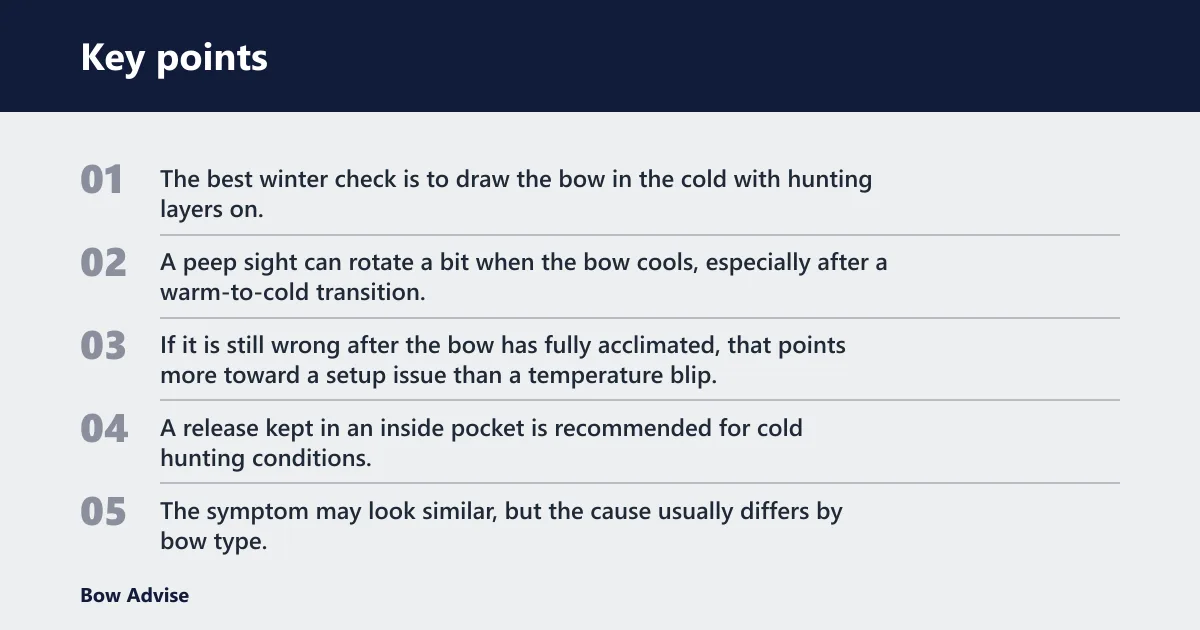
The best winter check is to draw the bow in the cold with hunting layers on. That shows the real anchor line, real peep alignment, and real clearance around sleeves and collars.
Peep sight rotation and alignment
A peep sight can rotate a bit when the bow cools, especially after a warm-to-cold transition. The first check should be at full draw, in the same layers you plan to hunt in, because the peep can look aligned at rest and be off under load.
If the peep is only wrong after a cold soak, the issue may be material movement, serving behavior, or the string settling as it contracts. If it is still wrong after the bow has fully acclimated, that points more toward a setup issue than a temperature blip.
Release aid feel in freezing air
Cold can change the movement of a release aid, especially some hydraulic models and other mechanical releases, which can feel thicker, slower, or more notchy when the internals are cold or lightly contaminated with moisture.
A release kept in an inside pocket is recommended for cold hunting conditions. Warming it against the body for a few minutes before use can reduce the first cold-shot slowdown and help the trigger or jaws move more cleanly.
Compound and recurve first checks
Compound and recurve bows have different cold-weather checks: for a compound, common early checks include the peep, the release, and sleeve clearance, while recurves often call for checking glove bulk, anchor position, and string contact. The symptom may look similar, but the cause usually differs by bow type.
If a cold shot feels off only because a glove changes the grip or anchor, retuning the bow will not solve it. That is a shooter-side issue, not a hardware one.
Cold arrow flight and sight marks
Carbon shafts can behave slightly stiffer in cold air, which can shift arrow impact and make bare-shaft readings drift. The change is often small, but it is enough to move a hunting point of impact at distance.
Cold weather can shift impact, but the amount varies with setup and shooter. Recheck sight marks if you are moving from indoor warmth to outdoor freezing air.
When to recheck sight tape
Yes, sight tape should be rechecked after going from indoor warmth to outdoor freezing air, especially before a hunt. Warm-weather marks may still be close, but cold-weather yardage should be confirmed in the conditions you expect to shoot in.
That matters because point of impact changes are most annoying when they are treated as random. A tape that was right indoors may be a touch off once the bow, string, and shooter all cool down together.
Condensation and small hardware shifts
Moisture can gather on the sight housing, screw threads, peep, and other exposed metal surfaces during temperature changes.
Those tiny wet spots can affect feel, visible alignment, and friction at threads or moving parts. They are also a reason to keep the bow from bouncing between warm rooms and freezing trucks without a staging period.
Warm-to-freezing air symptom matrix
| Symptom | Likely cause | Quick field check | Fix priority |
|---|---|---|---|
| Bow feels heavier right after stepping outside | Cold limbs, string contraction, thicker layers, numb fingers | Draw once in hunting layers and compare the feel after 5 minutes outside | Medium; check shooter setup before retuning |
| Peep looks off at full draw | Cold-soak rotation, string settling, condensation | Draw in the cold and verify alignment at anchor | High for compound bows |
| Release feels slow or notchy | Cold internals, hydraulic change, moisture | Cycle the release from a pocket-warmed state | High for compound bows |
| Anchor feels different with gloves | Bulkier clothing, less tactile feedback | Check anchor with the exact glove or mitten setup | High for recurve shooters; medium for compound shooters |
| Impact shifts low or slightly left | Cold shaft behavior, brace-height change, clothing interference | Shoot a short cold-group check before hunting | Medium to high depending on distance |
| Sight mark no longer matches | Temperature-compensated yardage change | Confirm the mark at your normal hunting distance | High before the first hunt |
How do you fix the first-minute problems?
The first-minute problems should be addressed by checking layers, grip, peep, release, and condensation before retuning or re-sighting the bow. Start with the fastest checks: layers, grip, peep, release, and condensation. Only after those are ruled out should the bow be retuned or re-sighted.
-
Check your clothing clearance.
Make one cold draw in the exact layers you will hunt in. Look for sleeve contact, collar interference, glove bulk, and any change to anchor depth or jaw position before changing the bow. -
Inspect the peep at full draw.
Draw in the cold and verify that the peep lines up naturally. If it is off only after the bow cools, wait for a full cold soak and recheck before turning the system into a tuning project. -
Warm the release first.
Keep the release in an inside pocket until you are ready to shoot. This is especially useful if the trigger or jaws feel thick, sticky, or slow in freezing air. -
Wipe off visible moisture.
Check the sight housing, screw heads, peep, and exposed threads for condensation. If the bow moved from a warm room to cold air, dry the exposed surfaces before the first cold shot. -
Verify the first cold group.
Shoot a short group at a known distance, then compare it to your indoor zero. A small shift may be normal; a large or repeating change points to a setup issue worth fixing before hunting. -
Separate compound and recurve checks.
On a compound, focus on cams, peep, release, and sight tape. On a recurve, focus on glove interference, anchor consistency, brace height, and whether the string still feels smooth and clean.
A common first-time mistake is to see one low arrow and immediately change the sight. That can hide the real issue, which may be a hooded jacket brushing the string or a peep that only rotates after the bow leaves the warm house.
Picture a compound shooter stepping from a 68-degree room into 18-degree air, then taking a shot 20 minutes later. If the peep is off, the release feels stiff, and the arrow lands a touch low, the best move is to sort those three symptoms separately instead of chasing one cold-weather cause.
Frequently asked questions
Why does my bow feel heavier after I step outside from a warm house?
The bow often feels heavier because cold limbs, a slightly contracted string, and thicker clothing all stack together at once. Your hands also lose feel fast, which makes the draw seem more abrupt than it really is. That is common during the first minutes outside.
Does cold weather make a bow draw weight increase?
It can increase slightly, but the bigger issue is often the feel of the draw, not a large change in actual weight.
Can temperature change my bow’s point of impact?
Yes. Temperature changes can shift point of impact, and the amount varies by setup and shooter. Recheck before hunting if conditions changed a lot.
Why does my peep sight rotate more in cold weather?
Cold can make a peep move enough that it matters after an overnight garage soak. String contraction, serving behavior, and condensation can all change how the peep settles. The best check is at full draw in the same layers you plan to hunt in.
Should I wax my bowstring before shooting in freezing temperatures?
Yes, if the string looks dry or feels rough. Wax does not solve every cold-weather issue, but it helps a dry synthetic string resist that crunchy feel and reduces surface wear signs like fluffing.
Can cold make my release aid feel different?
Yes. Cold can slow or thicken the movement of a release aid. A simple fix is to keep the release in an inside pocket until use, then check its feel before the first shot.