Funnels vs Pinch Points During the Rut: Buck Encounters
Funnels usually produce more buck encounters when deer movement is packed into a narrow route. On pressured ground, a subtle pinch point can beat an obvious crossing if deer still trust it. During the rut, bedding-fringe setups often do better than both when bucks are cruising or scent-checking. Pick the wrong stand and you sit empty through prime movement. This guide shows how to choose between funnels, pinch points, and bedding-edge setups by pressure, terrain, and rut phase.
| Decision factor | Funnels | Pinch Points During the Rut | Winner |
|---|---|---|---|
| Movement concentration | Best when a creek, river, ditch, fence crossing, saddle, or cover line compresses travel into a narrow path. | Best when the corridor is subtle and deer still use it without treating it like a danger line. | Funnels |
| Pressure tolerance | Strong on lightly pressured ground; weakens fast when the same access is obvious to other hunters. | Better when pressure is moderate and the pinch is small enough to keep deer moving through it without alarm. | Pinch Points During the Rut |
| Daylight buck encounter odds | High when movement is tied to terrain and access is clean. | High only when the pinch is low-profile and not repeatedly hunted. | Funnels |
| Best fit | Intercepting moving bucks on a defined travel line. | Picking off bucks slipping through a lesser-known bottleneck. | Funnels |
Movement concentration
Funnels win when terrain pushes deer onto one route. A creek bend, river crossing, ditch edge, fence gap, or narrow strip of cover can turn scattered rut travel into a clean ambush lane.
Pressure tolerance
Pinch points can hold value when they are subtle enough that deer do not treat them like danger zones. On shared ground, though, they are easier to burn out because other hunters expect deer to use them. Pressure can also cause whitetails to avoid funnels and other obvious locations, which shifts the edge toward quieter pinch points or away from both entirely.
Daylight encounter odds
Funnels usually create the better daylight shot because the deer path is clearer and the setup is easier to time with access, wind, and thermals. Pinch points can still pay, but they need light pressure and a route deer already trust. If the spot looks perfect on a map but forces deer to expose themselves in an overhunted area, mature bucks often slide around it instead of through it.
Best-fit use case
For a rut sit, funnels are the cleaner answer when the goal is to intercept moving bucks. Pinch points are the backup when the terrain gives you a smaller, less obvious bottleneck that still sees regular deer use. That difference matters because bucks may travel miles from their typical home range during the rut, but they still choose the easiest secure route once they enter local cover.
Are funnels or pinch points better during the rut?
Funnels are often a strong choice during the rut because they can intercept more deer movement with less uncertainty. Pinch points can still work, but only when they are subtle, low-pressure, and part of a route bucks already trust. In practical terms, funnels are the first choice; pinch points are the secondary choice when pressure is light.
What makes a funnel
A funnel is a terrain or cover feature that narrows deer travel. Creek crossings, river crossings, ditch crossings, fence lines, field edges squeezed between cover blocks, saddles, and narrow strips between bedding cover all qualify when they pull bucks into a tight lane. That makes a funnel a movement pattern, not just a single object on the map.
When a pinch point still works
A pinch point still works when it is narrow enough to concentrate travel but not so obvious that deer avoid it. On lightly hunted private ground, a subtle squeeze between cover types can outproduce a louder funnel because deer do not expect a hunter there. The same setup on public land can go stale quickly.
Why pressure changes the answer
Pressure decides whether the obvious spot still deserves a sit. Bucks may stay in a small rut area for 24 to 48 hours, but that does not mean they keep using the same exposed route if hunters keep pressure on it. When pressure rises, the better play is often the less obvious corridor or the bedding edge.
When should you hunt a funnel instead of a bedding area?
Hunt a funnel instead of a bedding area when movement is concentrated and the access is clean, especially if bucks are cruising across a larger area rather than locked to one doe pocket. Bedding areas become stronger when bucks are scent-checking edges or slipping in late, but a good funnel still beats them when travel is more predictable than bedding activity.
Doe bedding area edges
Doe bedding area fringes matter because bucks cruise for estrous does and often work the downwind side of those beds. When the first part of daylight is spent checking the outside edge of doe cover, that can beat a funnel sitting too far off the action.
Buck bedding area setups
Buck bedding areas still matter during the rut because mature bucks may use thick, nasty cover to rest, shift, or daylight late. The catch is access. A bedding sit only works if entry and exit are quiet, the wind keeps scent off the bed, and the timing matches the brief daylight window when the buck stands or moves inside cover.
Choosing by deer movement
Choose the setup by what the buck is doing. Cruising bucks favor bedding fringes and travel edges. Chasing bucks can blast through funnels and pinch points because urgency overrides caution. Scent-checking bucks often stay on the downwind side of bedding cover, where a straight funnel may be too far away to intercept them.
How do thermals change ridge and bench setups?
Thermals matter because scent does not move the same way all day on hills and ridges. Morning and evening airflow can change how a ridge or bench hunts, so the right stand is the one that matches the thermal direction and the wind, not just the prettiest line on the topo map.
Upper-third benches in the morning
Upper-third ridge benches can be stronger early in the day when rising thermals help keep scent moving away from lower travel lanes. They work best when bucks are returning from or skirting bedding on the leeward side of a ridge. A bench that sits too low in the morning often leaks scent into the route you are trying to hunt.
Lower-third benches in the evening
Lower-third ridge benches can gain value later in the day as thermals fall. That shift can pull scent down and out of the travel line if the wind is stable enough to hold it together. A common mistake is treating every bench the same; the upper and lower thirds do different jobs at different times of day.
Leeward ridges and saddles
Leeward ridge lines can be bedding and travel routes at the same time, which makes them useful during the rut when bucks want security and easy movement. Saddles matter because deer can cross a low spot between ridges without climbing the high ground, so they often become natural intercept points. If the wind is wrong or the thermal shift is unstable, both spots lose edge fast.
What does pressure do to obvious travel corridors?
High pressure makes obvious corridors less reliable, especially on public land and on shared private ground where multiple hunters target the same crossings. Light pressure keeps classic funnels and pinch points useful longer. When the ground is quiet, deer are more willing to use the most efficient route instead of detouring around it.
Public land pressure
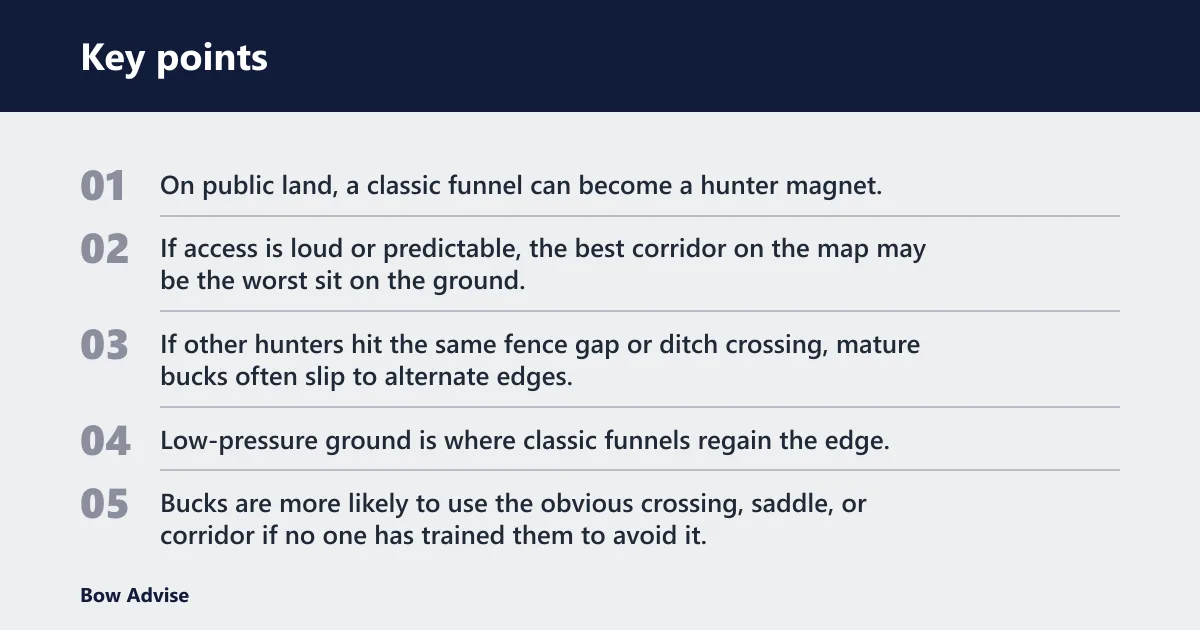
On public land, a classic funnel can become a hunter magnet. That is where subtle pinch points and bedding-fringe setups often gain ground, because they let a buck move without feeling pinned to a known crossing. If access is loud or predictable, the best corridor on the map may be the worst sit on the ground.
Shared private land pressure
Shared private land can be nearly as tricky because the deer learn hunting pressure from repeated access routes, not just from gunshots or arrows. If other hunters hit the same fence gap or ditch crossing, mature bucks often slip to alternate edges. That is why a smaller pinch point can sometimes beat a big funnel on paper.
Low-pressure ground
Low-pressure ground is where classic funnels regain the edge. Bucks are more likely to use the obvious crossing, saddle, or corridor if no one has trained them to avoid it. On quiet ground, a travel funnel tied to bedding and feeding movement usually remains the sharper play.
Where do cruising bucks leave the map line and enter cover?
Cruising bucks often leave open, map-friendly travel and slip into cover where the terrain softens, pinches, or bends. Subtle pinch points and leak points near bedding are good for that transition, especially when the approach stays hidden. The more a setup depends on a buck committing to a visible line, the more pressure can push him around it.
Subtle pinch points
Subtle pinch points are the small squeezes that do not look like much until deer keep using them. They are excellent when pressure is low and the wind lets a hunter sit without being detected. They fail when the same corridor gets overhunted and mature bucks start using the neighboring cover edge instead.
Leak points near cover
Leak points sit where bucks drift out of one cover block and into another. These spots are useful because they capture movement that is already committed to the bedding edge, not just general travel across the map. If a hunter cannot slip in quietly, the leak point often leaks the buck away first.
Access and exit routes
Access matters as much as the stand tree. If entry crosses the same corridor the deer use, the setup loses value before legal shooting light ends. The best rut stand is still the one where a buck is most likely to be during legal shooting light, but it also needs to be close enough to that movement without being too close to spook him.
-
Map the movement type.
Decide whether the target buck is more likely cruising, chasing, or scent-checking. A cruising buck favors bedding fringes and quiet pinch points, while a chasing buck can run through a stronger funnel.
-
Match pressure to the spot.
Use obvious funnels first on lightly hunted ground. Shift toward subtle pinch points or bedding edges when the same crossing gets hit often, especially on public land or shared private ground.
-
Check wind and thermals.
On ridge systems, morning and evening thermals can change how a stand hunts. If scent drifts into the deer route, even the best crossing or bench can fail.
-
Choose the cleanest access.
Pick the stand you can reach without crossing the route or blowing deer out of cover. A perfect location with a noisy entry is usually a poor rut sit.
When does a bedding-fringe setup beat both?
Bedding-fringe setups beat both funnels and pinch points when bucks are cruising does, checking beds, or moving during a short daylight window near cover. That is especially true when pressure has made obvious routes risky. In those cases, the edge of the bedding cover becomes the encounter zone, not the crossing out in front of it.
Cruising and scent-checking bucks
Cruising bucks often travel just outside doe bedding cover to catch scent without committing to the center of the beds. Scent-checking bucks do the same on the downwind side. That is why a bedding-fringe sit can outproduce a funnel that is clean on paper but too far from the real action.
Chasing windows
During hard chasing, a funnel can still be excellent because bucks move fast and straight. But when chasing slows into scent-checking, the bedding edge often wins back the advantage. The difference is small on a map and obvious in the field: one is a transit corridor, the other is a decision line.
Daylight timing by terrain
On flat ground, bedding edges often carry the day from first light through late morning. On ridges, upper-third benches and leeward travel lines are stronger early, while lower-third benches and exit routes improve later. If daylight timing is the real constraint, sit the terrain feature that lines up with that window rather than the feature that looks best all day.
Rut stand decision matrix
Use the considerations below with pressure, terrain, and the movement type, not as a standalone number. A funnel beats a pinch point when movement is concentrated, access is clean, and the corridor is repeatedly used by bucks moving between bedding and other rut cover.
| Stand type | Best terrain | Pressure sensitivity | Wind/thermal requirement | Best time of day | Likely buck behavior | Common failure mode | Huntability |
|---|---|---|---|---|---|---|---|
| Funnels | Creek, river, ditch, fence crossing, saddle, tight cover break | Medium | Clean wind; ridge sites need matching thermals | All day, strongest when movement is concentrated | Moving, traveling, crossing, chasing | Overhunted access or obvious approach routes | 5/5 |
| Pinch Points During the Rut | Subtle corridor between cover blocks or terrain edges | High | Steady wind with little swirl | Midmorning or afternoon on quiet ground | Drifting, scent-checking, cautious travel | Deer reroute after repeated pressure | 3/5 |
| Doe bedding fringe | Downwind edge of doe bedding cover | Medium to high | Wind must favor the edge; thermals matter on hills | First light to late morning | Cruising, scent-checking, pausing on edge | Too close, too loud, or inside the bed | 5/5 |
| Buck bedding area | Thick, nasty cover with controlled access | High | Very precise wind and entry control | Early daylight or late afternoon | Standing, shifting, stepping out briefly | Poor access or wrong timing blows the bed | 4/5 |
| Upper-third ridge bench | Higher ridge bench on a morning line | Medium | Morning rise helps scent lift away | Morning | Traveling below or along the bench | Thermals flip before setup time ends | 4/5 |
| Lower-third ridge bench | Lower ridge bench on an evening line | Medium | Evening fall helps scent drop away | Evening | Late travel, exit movement, edge cruising | Scent hangs if wind and fall conflict | 4/5 |
Choose Funnels if…
Choose Funnels if movement is concentrated, access is clean, and the route is naturally narrow enough to force deer through it. They are the better first pick on quiet ground, on saddles, at creek or river crossings, and on any corridor that keeps deer predictable during legal shooting light. If pressure climbs, the edge shifts toward bedding-fringe cover or a subtler pinch point.
Choose pinch Points during the rut if…
Choose Pinch Points if the corridor is subtle, deer still use it, and hunting pressure has not made the spot obvious. This is the stronger choice on lightly pressured private ground or on public ground only when access is uncommon and the pinch is not a known hotspot. If mature bucks are bypassing the line, the setup has already lost value.
Frequently asked questions
Do mature bucks avoid obvious pinch points on pressured ground?
Yes, often enough to matter. On pressured ground, mature bucks can reroute around the most obvious pinch point and use a quieter edge instead. That is why a small, hidden pinch can beat a bigger one that has already been burned by hunters.
What stand location gives the best odds of a daylight buck encounter?
The best odds usually come from the location where a buck is most likely to be during legal shooting light, with clean access and the right wind. During the rut, that is often a doe bedding fringe, a quiet funnel, or a ridge bench that matches the thermal pattern. The correct answer is the one tied to deer movement, not the one that looks best on the map.
How do thermals affect rut stand choice on ridges and benches?
Thermals can change how a ridge stand hunts, so the stand has to match the wind and the time of day. Upper-third benches can fit morning setups, while lower-third benches can fit later movement. If the scent stream crosses the travel line, the stand loses value even if the terrain is perfect.
What is the best rut stand on pressured private land?
The best rut stand on pressured private land is often a doe bedding fringe or a very subtle pinch point that deer still trust. If the pressure is moderate but not extreme, a quiet funnel can still win. The key is choosing the least obvious route that still matches the movement type you expect.