How Hunting Pressure Changes Rut Travel Routes
Hunting pressure usually pushes rut travel off open edges and straight lines into thicker cover, longer loops, and terrain funnels; if a buck has repeated human pressure, expect him to add distance and use cover before daylight. Ignore that shift and you waste sits on routes that stop producing. This guide explains how pressure changes rut movement, which reroutes matter most, and how to adjust setups to catch pressured bucks.
Pressure reroutes rut movement
Hunting pressure changes more than how often bucks move. It changes where they feel safe enough to travel, which routes they trust, and how much daylight they give up around bedding cover. Repeated human intrusion can turn a predictable rut line into a thicker, less direct path that still connects bedding, staging cover, and food.
In practical terms, pressure means hunter encounters, scent intrusion, repeated stand access, exit routes, vehicle noise, and midday bumping. Those inputs do not just reduce movement. They push deer toward security cover and away from easy-to-read edges, especially when the wind carries human scent into bedding cover.
What rerouting looks like in daylight
In daylight, pressured bucks often trade a visible corridor for a hidden one. They may slide inside a ditch line, use the back side of a ridge, or hold tighter to thick cover between bedding and a staging area. The route can look longer on a map, but it often feels safer to the deer.
A common first-timer mistake is treating every rut funnel as equal once the woods open. A funnel near a noisy parking area may go stale fast, while a more concealed terrain edge can keep producing because it handles pressure better.
What changes in bedding, staging, and funnels?
Pressure usually starts at the bed. Bucks shift into thicker bedding cover, often on the downwind side of cover that gives them scent control and a better view. From there, they may use short, indirect movement to staging cover before a longer daylight crossing. The route changes because the bed changes first.
Thicker bedding and downwind beds
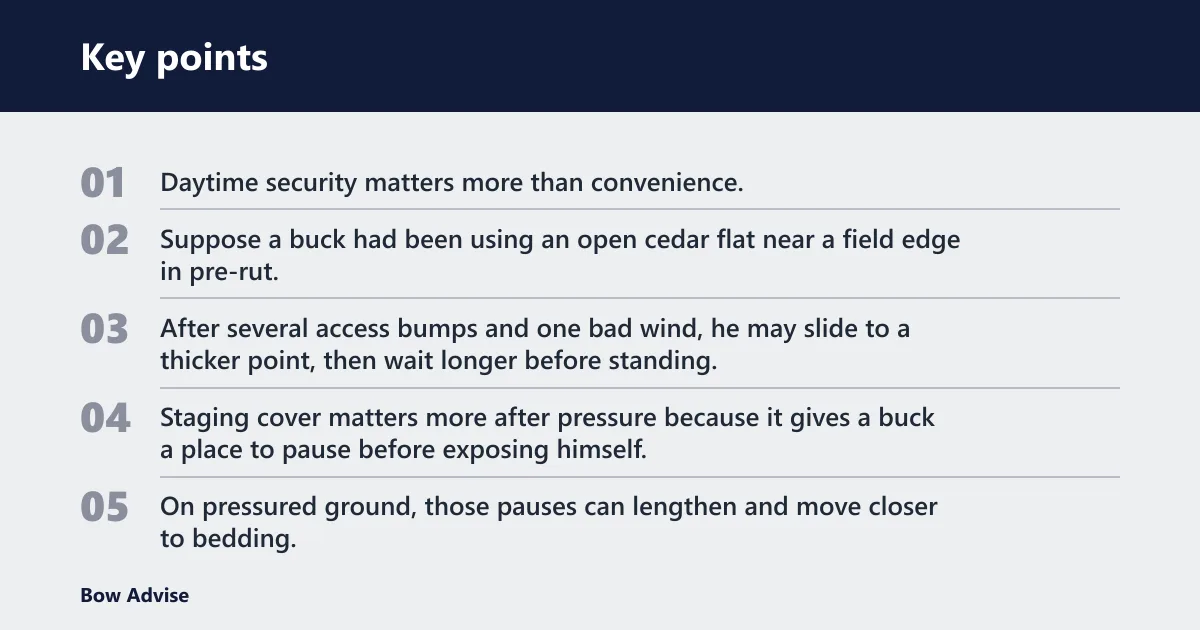
When pressure rises, bucks often use thicker buck bedding cover and move beds to places that offer both concealment and wind advantage. That can mean a steeper sidehill, a thicker bedding pocket, or a bed that faces a route where scent can be watched from downwind. Daytime security matters more than convenience.
Suppose a buck had been using an open cedar flat near a field edge in pre-rut. After several access bumps and one bad wind, he may slide to a thicker point, then wait longer before standing. The route is not gone. It is just compressed toward safer cover.
Why staging cover gets more important
Staging cover matters more after pressure because it gives a buck a place to pause before exposing himself. These are pre-dusk holding areas, often just inside cover, where deer can sample air, listen for danger, and wait for lower risk. On pressured ground, those pauses can lengthen and move closer to bedding.
Transition cover may be tucked back from the field edge. They keep aiming at the field edge while the buck is still in the transition cover. The route did not disappear; it shifted into a shorter, safer movement window.
When funnels still work and when they do not
Funnels still matter, but only if they remain the safest crossing option. A funnel that is open to human approach, bright with afternoon traffic, or contaminated by repeated scent may lose daylight use. A tighter funnel with better cover, a wind advantage, or limited access can keep drawing rut travel.
Do not assume all pinch points are equal after opening week. The best ones are usually tied to bedding cover, security cover, and a route that lets the buck keep the downwind side under control.
How pressure shifts routes by rut phase
The rut phase changes how pressure shows up. Pre-rut bucks often still follow familiar edges but begin checking more cover. Peak rut can pull them through longer daylight moves, yet pressure still pushes those moves tighter to cover. Lockdown and late rut usually reward patience near bedding and staging cover more than open travel corridors.
Pre-rut route changes
During pre-rut, hunting pressure often redirects bucks before they become reckless. They may keep using familiar terrain edges but switch to thicker strips, ditch lines, or shaded corridors that stay out of sight. If pressure is heavy, these changes can show up before the first strong cruising wave.
Peak rut route changes
Peak rut can justify all-day sits because bucks may still move widely, but pressure changes the shape of that movement. Instead of broad, open cruising, pressured bucks often use concealed routes that let them check more ground with less exposure. That can mean more indirect travel and more use of security cover between doe bedding pockets.
Lockdown and late-rut route changes
Lockdown often cuts visible travel because bucks stay closer to receptive does. Under pressure, the remaining movement may happen very near bedding cover or in the smallest safe connector routes. Late rut usually brings more searching again, but hunted deer still prefer routes that hide them from human access and exit pressure.
Does wind create or erase pressure routes?
Wind direction does both. It can create a usable route by letting a buck travel with scent control on the downwind side of bedding, or erase a route by contaminating the cover he wants to use. Wind also affects where a hunter should enter, how to exit, and which bedding areas are no longer safe to hunt that day.
Scent transport and bedding contamination
Wind carries scent into bedding cover, not just across a trail. If a route regularly takes human odor into a bed, bucks often shift to thicker or more awkward cover nearby. That is bedding contamination risk, and it can move a pattern faster than poor shooting pressure alone.
Entry planning around wind direction
- Match the entry to the wind. Choose a route that keeps scent away from the bed, the funnel, and the likely staging area. If the wind pushes scent toward bedding, the setup is usually compromised before the hunt starts.
- Keep access concealed. Use the quietest practical approach and avoid crossing open ground near known travel. Vehicle noise and visible entry routes teach deer where danger comes from, which changes how they move the next day.
- Adjust for current sign. Fresh tracks, rubs, and scrapes near thick cover matter more than a calendar date. If the sign is moving deeper with a safe wind, the route has likely shifted with it.
Exit planning after the sit
Exit pressure matters because a good sit can spoil the next one. If a buck watches or smells the exit route after legal shooting light, he may move his daylight crossing farther into cover. That is why the way out can alter tomorrow’s route as much as the sit itself.
When do pressured bucks move most?
No single best hour to hunt deer exists during bow season. The best time changes with hunting pressure and weather. Under pressure, morning, midday, and evening movement still happen, but each window shifts toward cover and away from exposed lines. Legal shooting light must be respected before taking a shot.
Morning movement after first light
Morning movement often happens after first light, especially when bucks are still returning from feeding or repositioning after a night move. Pressure can keep deer from settling into a pattern right away.
First light is not sunrise. That difference matters when a buck drifts back toward bedding after a short feed. If access pressure is low and the wind is right, that post-dawn move can still cut through a concealed route.
Midday movement after hunter pressure drops
Midday becomes more valuable near bedding cover during the rut, especially after other hunters leave the area. Pressure-triggered movement can happen when woods quiet down, and cruising bucks may use short, protected connectors to check does without showing themselves in open ground.
Peak rut can justify all-day sits, but that does not mean sitting anywhere works. Midday movement is most useful where bedding, staging cover, and a hidden route intersect.
Evening movement before legal shooting light ends
Afternoon movement often targets deer leaving bedding cover for food, and pressured bucks may delay that move until the very edge of legal shooting light. The exact cutoff always depends on state-regulated shooting time. A buck that feels hunted hard may stage longer and move later.
Pressure-shift route checklist
Use this checklist to decide whether a rut route still works after hunting pressure starts. The key is not just seeing deer. It is seeing whether the route still fits the buck’s security needs under current access, wind, and exit conditions.
| Pressure source | Likely deer response | Route change | Best setup adjustment | Abandon threshold |
|---|---|---|---|---|
| Vehicle noise near access | Delay movement or shift to thicker cover | Longer loop away from the loud edge | Move deeper and use a quieter entry route | If deer disappear for 3 straight sits |
| Repeated stand access | Tighten travel to safer cover | Switch from open edge to inner cover | Set farther from the old approach line | After two clear human-pattern betrayals |
| Midday bumping | Hold in bedding longer | Shorten midday travel and reduce daylight crossings | Shift closer to bedding cover | If movement stays nocturnal for a week |
| Busted wind into bedding | Move beds or avoid the area | Change to a different bedding-to-food connector | Hunt only with a clean wind | Any repeated wind contamination |
| Evening exit pressure | Hold longer before feeding | Use a later, more concealed crossing | Plan a silent exit path | If the exit route is visible twice |
| Hunter traffic near bedding | Shift bed location deeper or downwind | Move route to thicker interior cover | Set up on the next secure edge | If fresh tracks move away from the area |
| Shot missed from a known funnel | Become more cautious at that crossing | Use a parallel route with more cover | Adjust to a quieter approach angle | If bucks stop using the crossing in daylight |
| Repeated pressure near food | Feed later and stage longer | Delay field entry and favor cover edges | Hunt the staging area, not the field | If only night sign remains at the food source |
| Noise from neighboring hunters | Move through darker, thicker routes | Rotate to the quiet side of the bedding block | Use terrain that blocks sight and sound | If daylight sign shifts off the side |
Can you still hunt a pressured buck?
Yes. Pressured deer do not vanish; they reroute. The key is recognizing when a route still carries daylight movement and when it has shifted into deeper, safer cover. If the sign, wind, and access all still fit the buck’s security needs, the route can remain huntable.
Signs a route is still huntable
A route is still worth hunting when fresh sign remains tied to bedding cover, when daylight crossings remain, and when the wind can be controlled without contaminating the bed. If a staging area is still receiving late-afternoon use, the route may simply have moved tighter to cover rather than gone dead.
Signs the route has gone stale
Look for the loss of fresh tracks, a sudden shift in rub direction, fewer daylight crossings, and new sign deeper inside cover. If access pressure or wind contamination repeats, the old route often dries up fast. The deer may still be there, but they are moving somewhere else.
A target trail along a creek edge may have been active before gun season, but after two loud exits the only fresh sign is about 70 yards inside a brushy draw. That is a route shift, not a dead area. The old crossing has likely been replaced by a safer one.
When to pivot or abandon
- Check the newest sign first. If fresh tracks, droppings, or rubs have moved deeper, follow the shift instead of forcing the old stand. Pressure usually leaves a trace in the next safest cover.
- Compare wind and access. If the route cannot be hunted without scent reaching bedding cover, pivot. A bad wind does more than lower odds; it can teach the buck to avoid the area.
- Leave after repeated failure. If a route shows no daylight use after repeated clean sits, abandon it until conditions change. That keeps you from burning the rest of the rut on a stale line.
Frequently asked questions
How does hunting pressure change where bucks travel during the rut?
Hunting pressure pushes bucks away from open, straight-line travel and into thicker, more hidden routes. They often stay closer to bedding cover, use terrain edges with more concealment, and extend their loops to avoid human scent and access routes. The result is rerouted movement, not absent movement.
Do bucks switch to thicker cover when pressure increases?
Yes. Bucks commonly move into thicker bedding cover, downwind bedding, and heavier interior cover when pressure rises. Those areas give them better security and better control of what they smell and see. The more repeated the intrusion, the more likely the buck is to choose cover over convenience.
Will pressured deer still use the same rut funnels?
Sometimes, but only if the funnel still feels safe. A pressured buck may keep the same general connection while changing the exact line through it, or he may abandon the exposed side and use a tighter, darker route nearby. Funnels work best when they stay hidden and tied to bedding security.
What time of day do pressured bucks move most during the rut?
They can move in all three windows, but pressure often shifts movement toward quieter times: after first light in the morning, after hunters leave around midday, and late in the evening near legal shooting light. Midday becomes especially useful near bedding cover during the rut because pressured bucks may move after the woods calm down.
How do access routes change rut travel patterns after hunting starts?
Access routes teach deer where danger comes from. Loud parking areas, visible trails, and repeated entry paths can push bucks deeper, delay daylight movement, or reroute them around the hunted edge. Clean access and exit routes matter because they protect the route you want to hunt the next day.
Can you still kill a buck after an area gets hit hard?
Yes, if you identify the new pattern quickly. A pressured buck usually shifts rather than disappears, so the best play is to find the new bedding-to-staging line, match the wind, and avoid the contaminated access route. The hunt may move deeper or later, but it can still be productive.