When to Move Your Stand During the Rut and When to Stay Put
Stay put when fresh sign, a huntable wind, and low pressure still line up; shift the stand about 20 to 80 yards when the setup is right but the deer seem to be using a different edge; relocate only when sign is stale, the wind is wrong, or pressure seems to have pushed deer elsewhere. Move too often and you burn clean ground and bump deer. This guide gives a rut-phase decision tree for staying put, sliding slightly, or making a full move.
How to tell if your stand is dead
Move based on what the deer are doing now, not on the calendar alone. The strongest signal is a match between rut phase, fresh sign, and a wind that still keeps your entry, exit, and stand tree clean. A weak sit can be a bad day. A dead setup is usually a pattern.
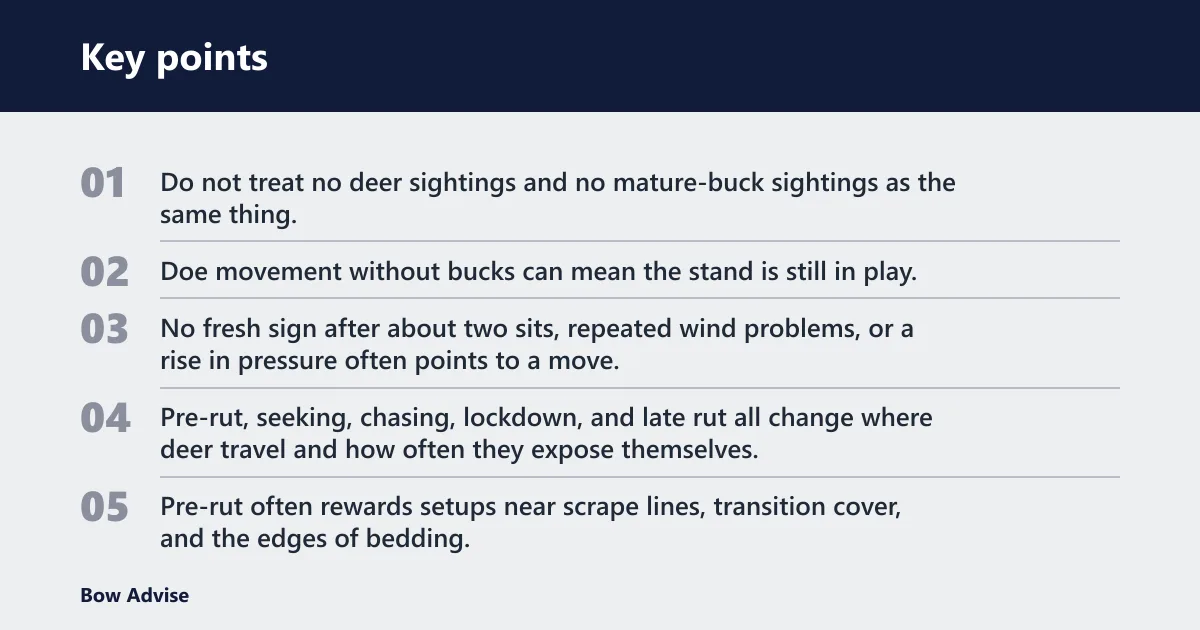
Do not treat no deer sightings and no mature-buck sightings as the same thing. Doe movement without bucks can mean the stand is still in play. No fresh sign after about two sits, repeated wind problems, or a rise in pressure often points to a move.
Rut phase matters more than the calendar
Pre-rut, seeking, chasing, lockdown, and late rut all change where deer travel and how often they expose themselves. A stand on a travel corridor can stay productive in one phase and go quiet in another because the route deer use shifts by phase, not by date on the calendar.
Pre-rut often rewards setups near scrape lines, transition cover, and the edges of bedding. Seeking and chasing can pull deer through funnels and downwind setups faster, with less predictability. Lockdown and late rut often shorten movement windows, so the stand that catches a narrow daylight lane can be better than a big move.
Signs your stand is still worth hunting
Fresh tracks, new rubs, active scrapes, and daylight movement on the same edge are the best signs a stand still has value. The sign should be close enough to matter, not just somewhere in the section. New rubs within 100 yards, fresh tracks in soft ground, and scrapes that were opened recently all point to a usable setup.
Morning sign and evening sign can tell different stories. Morning sign near bedding or a downwind setup can stay useful if deer are slipping back after first light. Evening sign often matters more on a food-to-cover route, especially on a travel corridor or funnel that still connects bedding and food.
Move or stay matrix
This matrix turns the decision into a simple rule. If the sign is hot, the wind is steady, and pressure is low, stay. If one part is weak but the route still makes sense, make a small shift. If sign is stale, wind is unstable, or pressure has changed how deer use the area, relocate.
| Rut phase | Sign level | Pressure level | Recommended action |
|---|---|---|---|
| Pre-rut | Fresh tracks, new rubs, active scrapes within 100 yards | Low | Stay put on the travel corridor or scrape line |
| Pre-rut | No fresh sign after 2 sits | Low to moderate | Shift 20 to 80 yards to a better edge or funnel |
| Seeking phase | Does moving without bucks, light fresh sign | Moderate | Stay if wind is stable; otherwise make a small shift |
| Seeking phase | New rubs within 100 yards, current wind steady | Low | Stay put and hunt the route again |
| Chasing phase | Repeated mature-buck sightings within 48 hours | Low | Stay put if access is clean and the wind still works |
| Chasing phase | Wind instability, swirling wind, or busted entry | Moderate to high | Relocate to a safer downwind setup |
| Lockdown | Limited daylight sign, but a known line still exists | Low | Stay put and wait for the narrow movement window |
| Lockdown | No fresh sign after 2 sits plus pressure buildup | High | Move to a quieter transition cover or different funnel |
| Late rut | Morning and evening sign both weak | Moderate to high | Relocate entirely to a fresh travel corridor |
| Late rut | Fresh sign window after front, current wind steady | Low | Stay or make only a small shift |
How far should you move a rut stand?
Start with the smallest move that solves the problem. A 20 to 80 yard shift can place the tree on the next edge of the same corridor, funnel, or scrape line without abandoning the area. That keeps the same deer pattern in play while correcting for the wrong tree, slight wind issue, or a better shot angle.
-
Confirm the pattern.
Check whether the deer are using a nearby edge, ditch, pinch, or trail crossing rather than the exact tree. If fresh tracks, rubs, or scrapes are still present within 100 yards, a small shift is usually enough. -
Match the wind first.
Move to the downwind setup that protects your scent cone and keeps the current wind from leaking into the approach. If the wind is swirling, skip the small adjustment and pick a safer location. -
Use terrain, not guesswork.
Slide to the next funnel, transition cover, or edge that tightens movement. A slight move works best when the route is still the same but the deer are pinched tighter than before. -
Go farther only when needed.
If the sign appears to have shifted to a different travel corridor or the old one has gone quiet after about two sits, move to a new setup about 150 to 300 yards away or more. That is a relocation, not a tweak.
Picture a stand on the edge of a cedar flat that still shows fresh tracks and one new rub 60 yards away. If deer are slipping through the same opening but avoiding the original tree, a 40-yard move to the next trunk in the corridor is a better answer than abandoning the area.
When should you stay put instead of moving?
Stay put when the stand still covers a known line, the wind is steady, and the pressure level has not changed the deer’s route. Lockdown can be the best time to sit still because movement windows are narrow and a good stand can go from quiet to active in a short span.
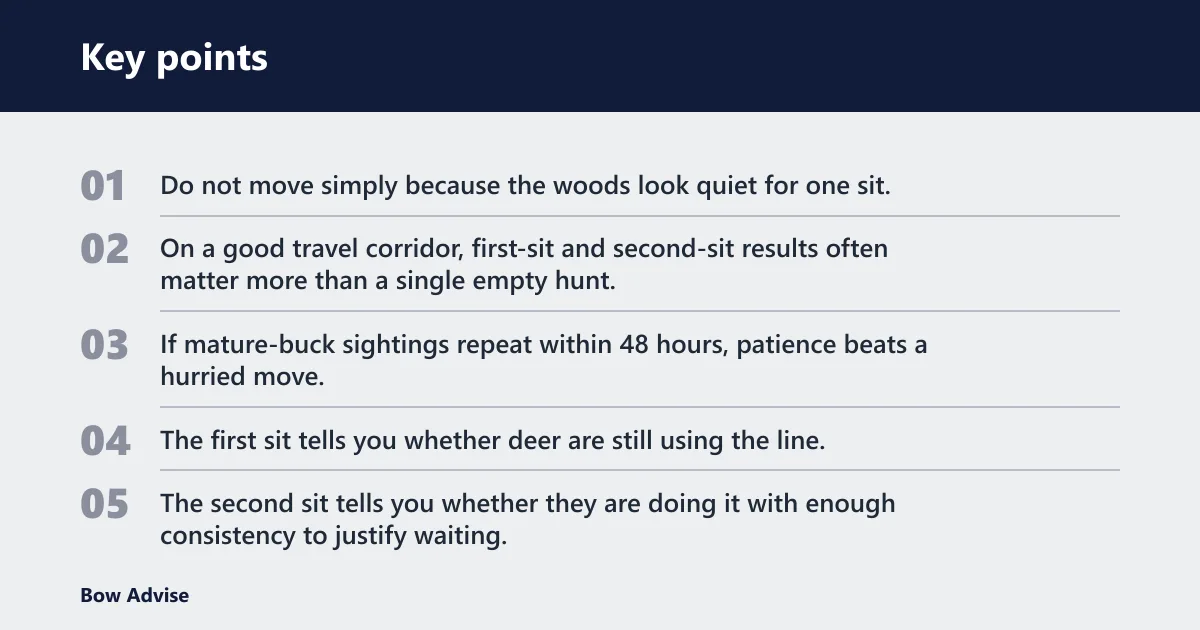
Do not move simply because the woods look quiet for one sit. On a good travel corridor, first-sit and second-sit results often matter more than a single empty hunt. If mature-buck sightings repeat within 48 hours, patience beats a hurried move.
First-sit and second-sit situations
The first sit tells you whether deer are still using the line. The second sit tells you whether they are doing it with enough consistency to justify waiting. If fresh sign is present and the wind is right, the second sit is often the better time to hold, not bail.
After about two sits with no fresh sign, the decision may change. If the setup is on a known route but the sign has gone stale, shift slightly or relocate depending on pressure and wind stability. That rule is more useful than waiting for an arbitrary number of days.
When repeated mature-buck sightings justify patience
Repeated mature-buck sightings within about 48 hours are commonly cited as a strong reason to stay. That means the stand is still intercepting daylight movement, even if every deer is not showing. Keep hunting it if the access is quiet and the current wind still protects the setup.
Suppose a mature buck is seen at 7:10 a.m. on Tuesday and again at last light on Wednesday from the same funnel. That pattern argues for another sit from the same tree or a tiny shift, not a full relocation, unless pressure or wind has broken the setup.
What pressure says it is time to relocate?
Pressure says it is time to move when deer stop moving in daylight, start using the area after dark, or begin reacting to your entry and exit. A stand can be good on paper and still be dead in practice once human scent, noise, or repeated access starts changing deer behavior.
The key warning signs are bumped deer, a sudden nocturnal shift, and stand burn-out from too many sits. One bad entrance can matter as much as several good hunts because deer learn the route, not just the tree.
Bumped deer and nocturnal shift
If deer are bumped on the approach, assume the setup is compromised. If the same area then shifts to night-only activity, the stand has likely lost daylight value. That usually means relocation, not a small adjustment, unless there is a separate route with cleaner access.
Repeated pressure buildup works the same way. More scent, more noise, and more visible entry routes make mature deer leave the lane earlier or avoid it during daylight.
Wind swings, swirling wind, and bad access
Wind instability is a stand killer. A crosswind can work if it is steady and the setup is built for it, but swirling wind near bedding, creek bends, saddles, or steep drainage often ruins the advantage. A safe wind tolerance should be narrow on pressured deer.
If the approach forces noise through the deer’s entry route, the stand is burning out. A quiet entry route matters as much as the tree because pressure often starts before the hunter is seated. When the wind starts swinging or the approach starts educating deer, move.
Mobility tools that make moving practical
A saddle setup, lightweight climbing stick system, mobile platform, and quiet entry route make short moves realistic. They matter most when the best answer is a 20 to 80 yard adjustment rather than a full tear-down and reset.
- Saddle setup: helps move between trees in the same corridor without hauling a bulky stand.
- Lightweight climbing stick system: keeps the move quiet and fast, especially on a fresh sign window.
- Mobile platform: useful when the next tree is unknown and the route may need a higher or lower angle.
- Quiet entry route: reduces pressure so the new setup does not die before the first sit.
How often should you move a stand during rut hunting?
Move as often as the sign and pressure demand, not on a fixed schedule. If the stand still shows fresh sign, a safe wind, and honest daylight use, keep hunting it for another sit. If those three weaken together, move sooner rather than later.
A practical rule is simple: after two sits with no fresh sign, reassess; after one bad entrance, reassess immediately; after repeated mature-buck sightings, hold steady if the wind still works. The point is to protect the few honest setups that remain.
Should I move after seeing no deer for a few sits?
Not always. No deer for a few sits is a sign to check the pattern, not automatically to bail. If no fresh sign shows up after two sits and the wind is stable, the stand may need a small shift or a full move. If the area still has tracks, rubs, or scrapes, it may simply be a narrow movement window.
Should I stay put on a known travel corridor during the rut?
Yes, if the corridor still holds fresh sign and the wind remains workable. Travel corridors are often worth patience because deer reuse them as long as the pressure is low and the approach stays clean. The best time to sit still is when the line is known, the sign is current, and the wind is not drifting into bedding.
Frequently asked questions
When should I move my stand during the rut?
Move when fresh sign disappears after two sits, the wind becomes unstable, or pressure starts changing deer movement. If the setup still shows tracks, rubs, or scrapes and the wind is safe, stay. The best decisions come from phase, sign, and pressure together.
What rut phase is best for sitting the same stand?
Lockdown is often the best phase for staying on the same stand if it still covers a known line. Movement can be narrow, and a good tree may only need one more sit. Pre-rut and seeking phase often allow more movement, but they can also reward consistency.
What sign tells me a rut stand is dead?
A rut stand is close to dead when fresh tracks, new rubs, active scrapes, and daylight use all fade at once. If deer have gone nocturnal, the wind has been unstable, and no fresh sign appears after two sits, the setup has likely lost its value.
How far should I move a stand when shifting for rut activity?
Start with 20 to 80 yards if the deer are still using the same corridor but a different edge. Move farther, often 150 to 300 yards or more, when the route changes to a new funnel or the old setup has been pressured out. Match the move to the pattern.
Is it better to hunt one good stand or keep mobile during the rut?
It is better to be selective than to swing between extremes. Hunt one good stand as long as the sign, wind, and pressure still support it. Move when the pattern breaks. A good rut hunter stays put on the honest setups and moves fast when the evidence changes.